Alpine countries – the influence of the natural environment on the economy
that in the natural environment of mountainous regions there are direct relationships between its elements;
that the interdependence of natural elements in regions with high mountains created a specific type of landscape, called an alpine landscape;
that the natural environment influences the way the economy is managed in a given region.
to determine the geographical and political position of Alpine states;
to give examples of the relationships between elements of the natural environment in regions with high mountains;
to describe the features of an alpine climate;
to talk about the features of the alpine landscape;
to identify the influence of the alpine region's natural environment on the development of selected economic fields in alpine states.
The Alps are the highest mountain range in Europe. They are located in the southern part of the continent, within the borders of 7 countries. Austria, Switzerland, France and Italy are the countries most commonly associated with the Alps. The mountains are also located in Germany, Slovenia and Liechtenstein. Did you know that the natural environment of high mountains had a huge influence on the type of economic activities which developed in the Alpine countries?
The geographical location of the Alps and their geological structure
The Alps extend in an arc from the Ligurian Sea to the South‑West, to the Great Hungarian Plain to the North‑East.
The length of the Alps' arc, which curves towards the North, is 1200 km, and its width ranges from 150 km to 250 km. Folding of the rock layers and uplift occurred at the end of the Cretaceous period in the Mesozoic era, and during the Paleogene period in the Cenozoic era. The core of the Alps is made up of uplifted massifs made of crystalline rocks which are resistant to weathering: granite, gneiss and slate. The edge of the alpine massif is made of sedimentary rocks – limestone and dolomite – which are more susceptible to weathering processes. The geological structure and lengthy formation processes contributed to the creation of the characteristic mountain landscape – known as an alpine landscape.
The Alpine states – their geographical and political location
The Alpine mountain range is located within the borders of seven countries – Italy, France, Switzerland, Liechtenstein, Austria, Germany and Slovenia. The name Alpine states refers to three of them, since the Alps occupy a large part of those countries, and economic activity has been adapted to a great extent to the conditions specific to mountain areas. These countries are: Austria, Switzerland and Liechtenstein.
The combined area of these three states is 125.3 thousand kmIndeks górny 22, and almost 17 million people reside there.
The Alpine states do not have access to the sea. The territories of Austria and Switzerland extend over the Alps and the regions that border this mountain range, meaning that the Alps occupy over 60% of the area in both countries.
Switzerland mainly owns the Western Alps, and besides that a small part of the Eastern Alps. To the North‑West of the Alps, is the Swiss Plateau, and the Jura mountains extend along the border with France. Switzerland is a mountain‑upland country.
Austria owns the Eastern Alps, which occupy the central and western parts of the country. To the North – between the Danube valley and the border with the Czech Republic – extends the Bohemian Massif. The small, lowland Vienna Basin is located to the East of Austria. Austria is a country in which mountain landscapes dominate.
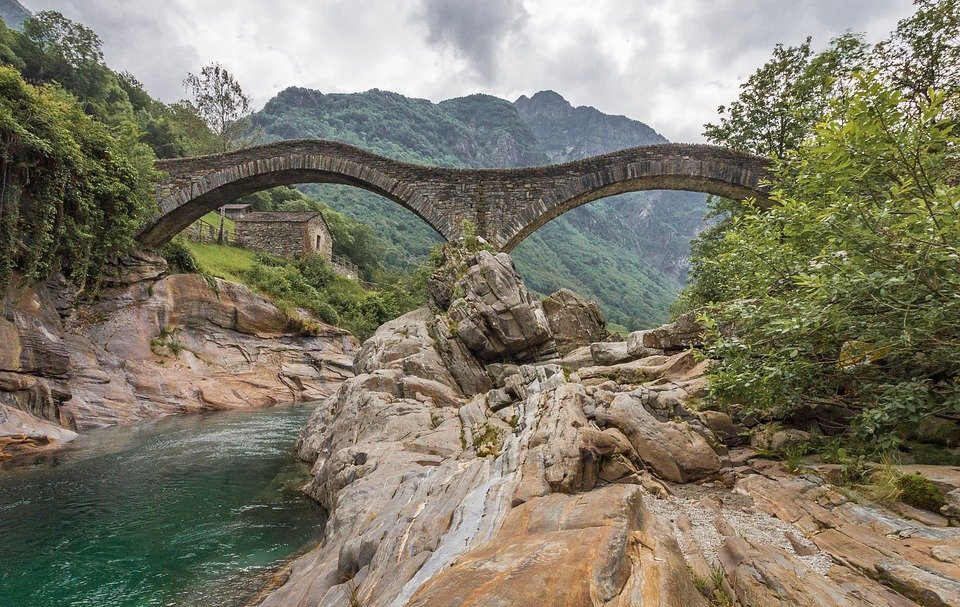
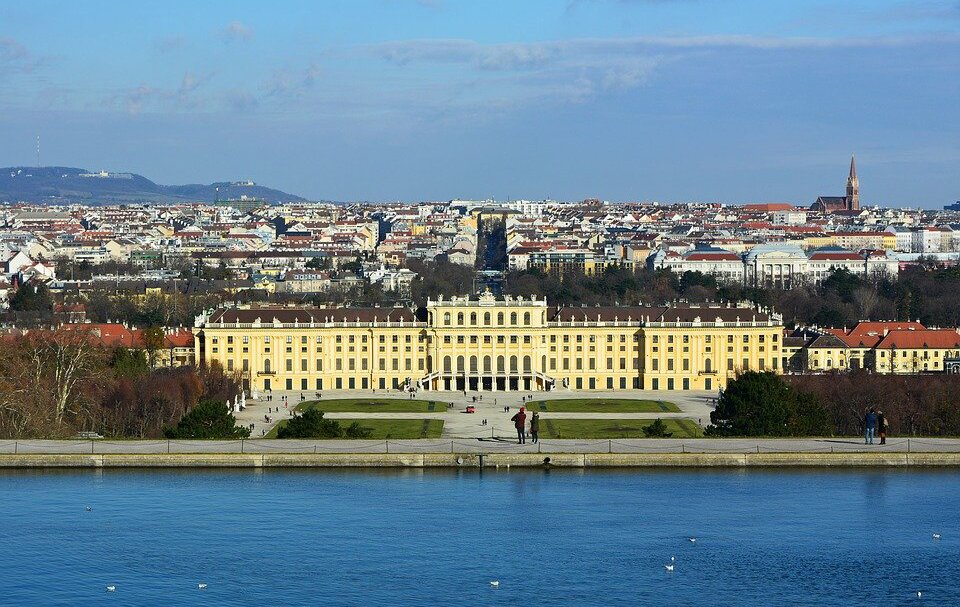
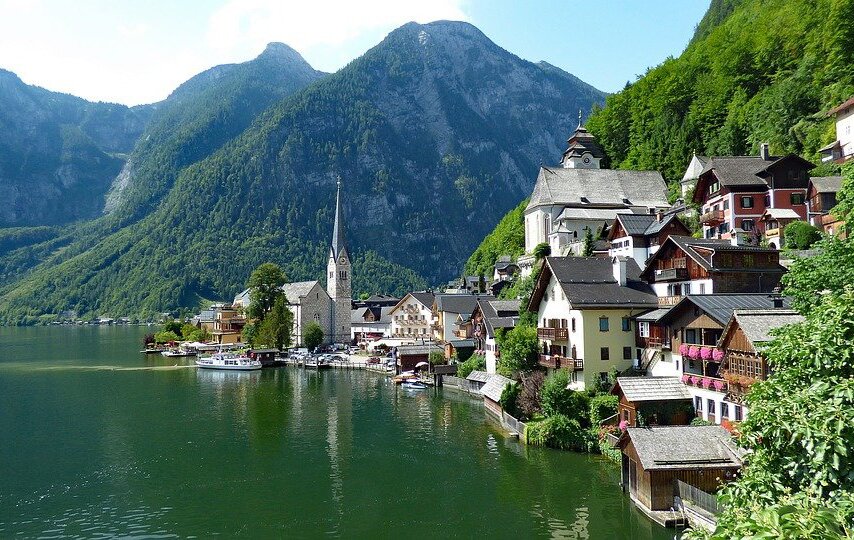
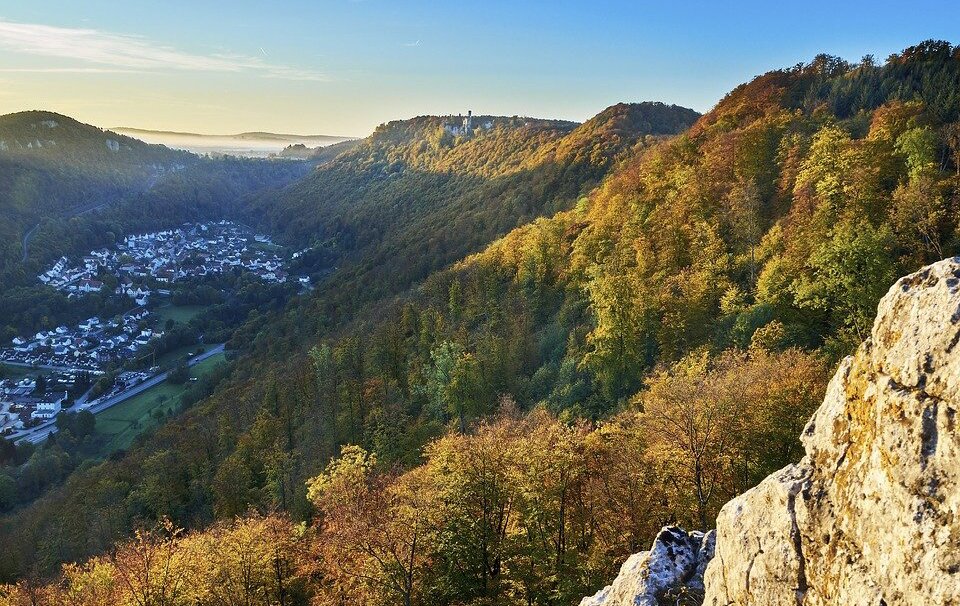


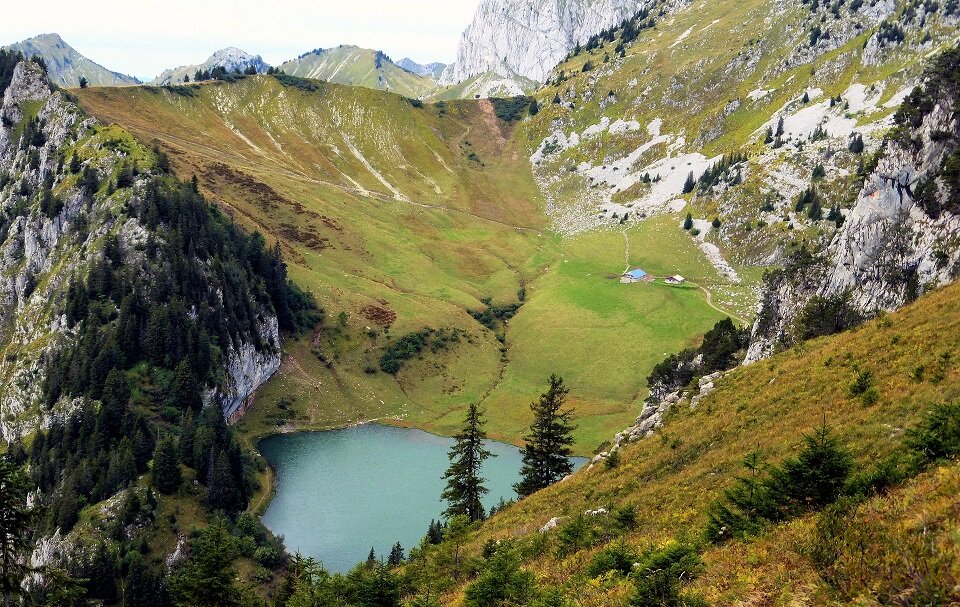
Due to their surface areas, Austria and Switzerland are classed as small states, and Liechtenstein is one of the smallest states in the world. Switzerland has been a neutral state since 1815. Austria declared perpetual neutrality in 1955. These states' neutrality means that they do not engage in millitary alliances. Austria has been a member of the European Union since 1995.
The Alpine landscape
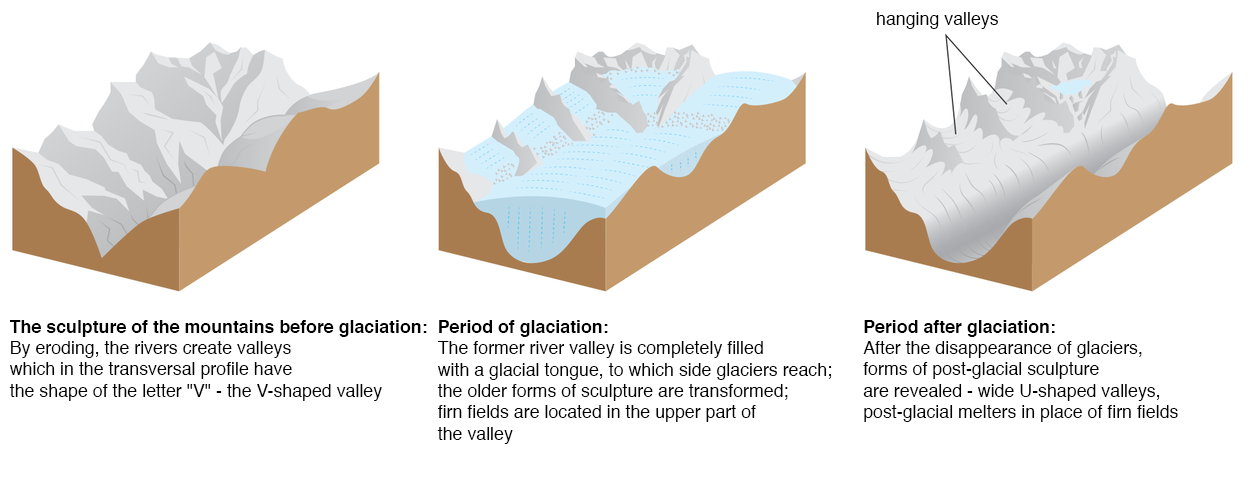
The Alps are a young mountain range, composed of many ranges divided by long and deep valleys carved by mountain rivers. The diversity of rocks and corroding and building factors has created the characteristic type of mountain landscape, known as an Alpine landscape. The Alps' final sculptural features were caused by repeated glaciation in the Pleistocene period.
The diagram below shows the mountain valley's transformation from the Miocene period until the period after the Pleistocene glaciation.
The picture above shows the Alpine landscape, as it appears in the highest parts of the Alps. Among the main characteristics of this landscape are: vertical and very steep rock faces, deeply cut, wide valleys, rivers and streams with a large drop, carrying a large amount of rock material and numerous waterfalls. A present‑day element of the formation of the Alps which is present in the highest parts of the mountains are mountain glaciers flowing from cirques, which continuously reshape the mountains.
The highest alpine peaks are located in the higher western section of the mountains. They are: Mont Blanc (4810 metres above sea level.), Monte Rosa (4634 metres above sea level), and Matterhorn (4478 metres above sea level).
The Eastern Alps are lower. High peaks include: Piz Bernina (4049 metres above sea level) and Grossglockner (3797 metres above sea level) – Austria's highest peak. Glacial lakes are an important element of the alpine landscape. The largest among them formed at the mouths of valleys during the time when mountain glaciation was at its maximum range. On the northern side there are the large Lakes Geneva and Constance, and on the southern side the somewhat smaller lakes – Garda, Lago Maggiore and Como.
The whole of the Alpine region has an alpine climate, which is, however, modified by the land's formation, height above sea level and the direction of the long alpine ridges and valleys. An unusually important factor which affects the system of altitudinal zonation is the latitudinal course of the main part of the Alps' arch. It makes a significant difference to the exposure of the southern and northern slopes.

Local winds with mountain‑valley circulation are characteristic of the Alpine region, arising as a result of temperature differences between the lower and upper parts of the valley. A common phenomenon is warm wind, known as foehn, forming in a similar way to the halny wind in the Tatras.
Mark the countries located on the terrain of Europe's highest mountain range blue, and those outside of it, red.
{niebieski}Germany{/niebieski} {czerwony}Slovakia{/czerwony} {niebieski}Slovenia{/niebieski}
{czerwony}Croatia{/czerwony} {niebieski}France{/niebieski} {czerwony}Serbia{/czerwony}
{niebieski}Italy{/niebieski} {czerwony}Spain{/czerwony} {czerwony}Luxembourg{/czerwony}
{niebieski}Austria{/niebieski} {niebieski}Switzerland{/niebieski} {czerwony}Bulgaria{/czerwony}
{niebieski}Liechtenstein{/niebieski} {czerwony}The Czech Republic{/czerwony} {czerwony}Hungary{/czerwony}
The natural environment – its influence on the economy in Alpine states
In both Austria and Switzerland, agriculture is an important sector of the economy. In both countries, farmland constitutes around 38% of the country's area. The fact that that most of the state area is located in mountain terrain means that meadows and pastures make up the largest part of this farmland – in Austria 20.3%, and in Switzerland 26.6%. As a result, animal husbandry is well developed in Alpine states, and traditional products of the food industry are highly processed products: cheeses, food concentrates and chocolate.
The Alpine states belong to the countries with the highest share of arable land cultivated in accordance with the principles of organic farming in the world. In Austria this is as much as 18.5% (1st place in the world), and in Switzerland 10.8% (3rd place in the world), of farmland.
In both of these states, forest terrain also plays a significant role. In Austria, forests occupy 47%, and in Switzerland 31% of the country's area. Austria is a large European manufacturer of timber, paper and cellulose. Forests also fulfill soil‑protecting and recreational functions.
The Alpine states' central location provides a large income for the economy. Despite difficult natural conditions – steep slopes, great heights and changeable weather – relatively dense rail and road transport networks have been developed in Austria and Switzerland. In alpine areas roads have been built, bridges spanned and tunnels excavated, which makes transport possible throughout the whole year. Among the longest tunnels in Switzerland are: Simplon (19.8 km), which leads to Italy, and the tunnel below St Gotthard Pass, which is 16.9 km in length. An example in Austria is the tunnel below Arlberg pass, which is 14 km in length. Pipelines transporting crude oil and gas from the ports in Genoa and Trieste to Germany are of great importance in Austria.
The energy industry in both states uses, above all, hydroelectric energy. Mountain terrains allow the building of great hydroelectric power plants, and moreover, in Austria the flow of large rivers such as the Danube are also used – as many as 8 hydroelectric power plants are build on it. Switzerland produces 40% of its electric energy in modern nuclear power plants.
The country is one of the largest exporters of electrical energy – it has a share of 5,4% of world‑wide exports, ranking it 5th in the world.
Both Alpine states have a highly developed processing industry, requiring heavy workloads and technical thought. It is the electromechanical, precision and chemical industries and the products of these branches which are mainly intended for export.
A very important economic sector, which brings huge profits is services, especially those related to tourism. The alpine terrains are a huge, year‑round, natural tourist attraction. In addition to this, in Austria and Switzerland, there are numerous cultural objects which attract tourists. In both states, the tourist infrastructure has been expanded to suit many groups of tourists with a variety of preferences and needs. Apart from the Alps, important tourist centres include Vienna, Salzburg and Graz in Austria, and Geneva, Lausanne and Basel in Switzerland.
In 2014, 25.2 million tourists visited Austria, and 9.2 million, Switzerland. This difference is due to that fact that Switzerland is a more expensive country which targets wealthier tourists. In turn, Austria is closer to Central and Eastern Europe, where more and more guests, including Poles, visit from.
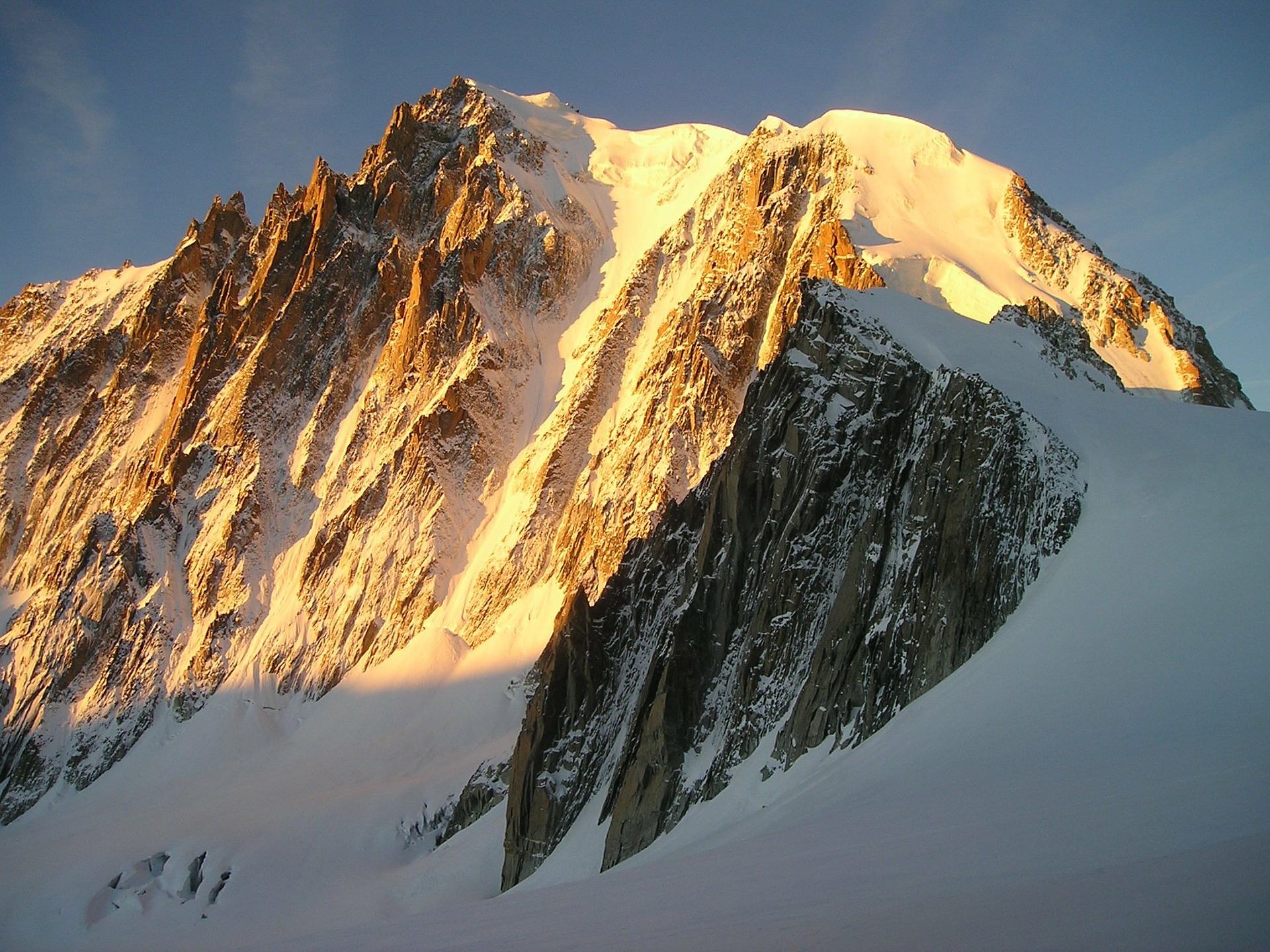
The highest peak in the Alps is shown in the picture – Mont Blanc. Identify its correct height.
- 4810 m
- 3005 m
- 4999 m
- 2499 m
Income from tourism is an important item in the budget of Alpine states, but financial services, insurance and providing services to many international organisations with European and worldwide scope are also of importance. Most of them are established in Geneva, which is the headquarters for, among others, the European office of the United Nations, the World Health Organisation, the International Labour Organisation and the International Red Cross. The European Organisation for Nuclear Research (CERN) is also located in Geneva. Zurich and Basel are the headquarters of numerous firms which have subsidiaries in Europe. Both of these cities are important metropolises with at least regional scope. In Austria, Vienna fulfills a similar role. It is an important European metropolis, which has had a significant political, cultural and commercial importance since the 17th century.
The Alps span from the Ligurian Sea to the Great Hungarian Plain, in the shape of an arc. Identify the length of the mountain range.
- 820 km
- 1200 km
- 2500 km
- 900 km
Austria and Switzerland are among countries with a very high level of economic development. In both of these states, around 70% of employed people work in service. Local economies must adapt to the conditions present in the natural environment, but important factors which influence prosperity in these countries are: an educated and hardworking society, an appropriate immigration policy and neutrality in the international arena. In the case of Switzerland, this neutrality has protected the state from the destructive consequences of the two world wars.
Summary
The Republic of Austria, The Swiss Confederation and The Principality of Leichtenstein are Alpine states without access to the sea. The Alps occupy the greater part of the area of these states. The natural conditions there affect economic development – it is especially marked in agriculture, forestry, the development of hydroelectric energy, transport and the development of alpine tourism.
The Alpine states' central location has been put to use – rail and road transport systems have been expanded despite the difficult terrain.
Austria and Switzerland are states with a very high level of economic development. Among the economic sectors, which form the basis of the current development of these states, are: in Austria – various industries and tourist services; in Switzerland – specialised industry and financial and tourist services.
In both countries, agriculture, especially animal husbandry, is also well developed.
Non‑natural factors which influence economic development in the Alpine states include: history, the social situation, political neutrality, affiliation, and also Austria's membership of the European Union.
With the help of the test question generator, develop questions about the natural environment and economy of the Alpine states. Then, ask them to your friends.
Question: ...
- ...
- ...
- ...
- ...
Keywords
Alpine states, tourist infrastructure, alpine landscape, altitudinal zonation
Glossary
fen – silny, ciepły wiatr górski wiejący w Alpach z południa; tworzy się podobnie do naszego halnego, tj. przed południową barierą gór gromadzi się powietrze, które po osiągnięciu odpowiednio wysokiego ciśnienia przedostaje się na drugą stronę grzbietu i spływa po stokach z dużą prędkością
OECD - Organisation for Economic Co‑operation and Development – Organizacja Współpracy Gospodarczej i Rozwoju.