Birds
birds are vertebrates;
birds lay eggs like reptiles, but are warm‑blooded like mammals;
birds mastered the air thanks to the adaptation to flying.
to indicate and describe the birds’ adaptation to flying (visible in the skeleton and external structure);
to explain what homeothermy consists in and what significance it has;
to describe the structure of lungs and explain the mechanism of gas exchange in birds.
Birds are warm‑bloodedwarm‑blooded vertebrates. They maintain a relatively constant body temperature, largely independent of the temperature of the surrounding environment. The high body temperature of the birds (41‑42°C) is the result of:
a high rate of cell metabolism; to maintain this rate, birds eat large amounts of food and use large amounts of oxygen as well as convert a large part of the energy contained in food into heat;
the presence of adipose tissue and feathers, which protect against heat loss;
the ability of cooling down the body by evaporating water (panting) and behaving in a way which prevents overheating and chilling of the organism.
Thanks to the development of homeothermy, the birds were able to live in all types of ecosystems on all continents. Some of them, like penguins and petrels, inhabit even the Antarctic coastline.
Birds’ adaptations for flight
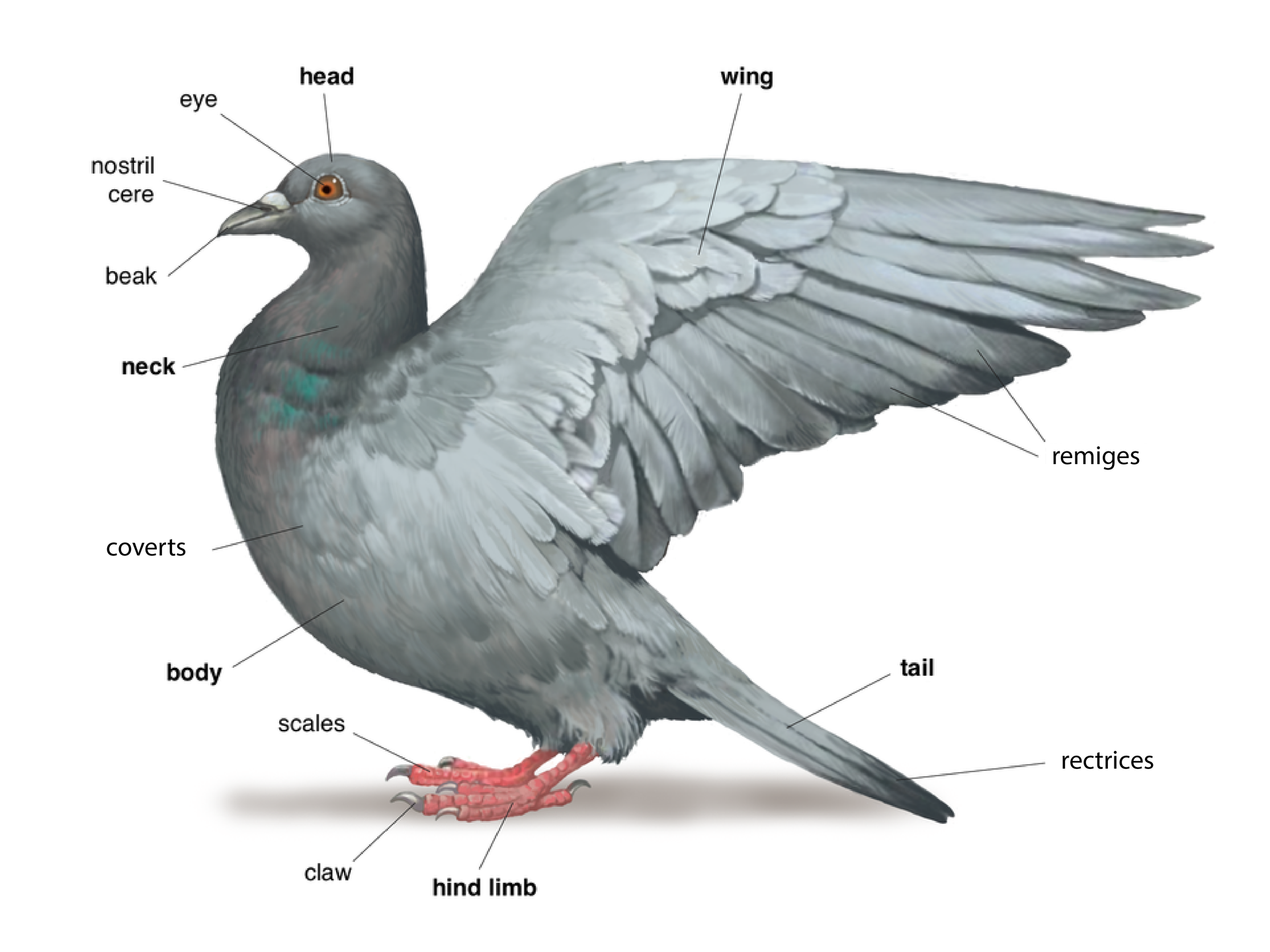
The most characteristic feature of birds are wings. The wings are covered with feathersfeathers, which give them a streamlined (aerodynamic) shape and increase their surface during flight.
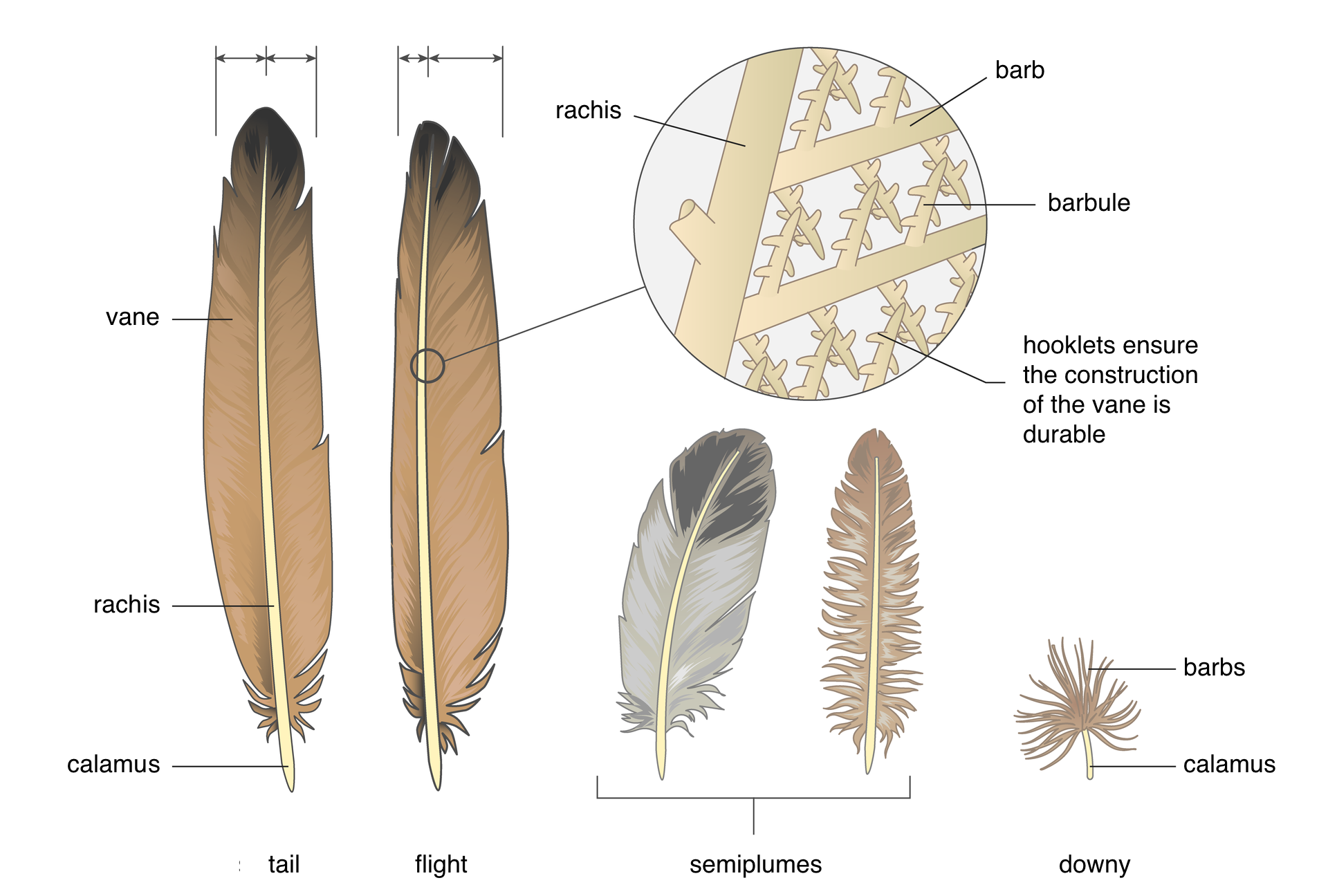
The birds’ feathers are divided into down feathers and pennaceous feathers (vanned feathers) – coverts, remiges and rectrices. Down feathers together with the air between them form a layer that protects the bird from cold. Coverts cover the down and hinder the exchange of heat with the environment. Remiges overgrow the feathers and form their load‑bearing surface. Similarly to remiges, rectrices are arranged on the tail in a fan‑like fashion on the tail and are used to control the flight, maintain the balance and slow down the speed during landing.
Pennaceous feathers are composed of a shaft and a vane. The part of the shaft in the skin is the calamuscalamus; the remaining part, covered with a vane is the rachisrachis. The vanevane is made up of barbs from which barbules equipped with hooklets go sideways. Hooklets overlap to form a light, compact and flexible surface of the vane.
Film dostępny na portalu epodreczniki.pl
Nagranie filmowe dotyczące przystosowania ptaków do latania. Podpisano: Birds are homeothermic. They maintain stable body temperature of 39,5 degrees Celsius. Their feathers and the air between them keeps the body temperature from escaping. Birds learnt how to fly. (wskazano poszczególne części ciała ptaka) Their body is covered with feathers which create bearing surface. The keel in their chest and powerful chest muscles allow them to move their wings. How birds adapted to flying: A limb with 5 fingers transformed into a wing. Toothless jaws equipped with horny beak. Keel - the place where muscles responsible for wing movements are attached. It is the extension of the sternum. Their pelvis is not knit together in the front - it's adapted for laying eggs. Hind limb with elongated part of the foot works like a spring, throwing the bird into the air. Pneumatized bone filled with air (wskazano puste otwory w strukturze kości) podpisano: spaces filled with air. Oviparity. Birds embryo develops outside of mother's body and does not burden her during the flight. Keel is the place of support for the muscles that move the wings. Flight requires lots of energy. Lungs provide oxygen to the blood during inhales and exhales, thanks to air sacks. Wskazano i podpisano poszczególne części struktury ciała ptaka: humeral Diverticulum of the Clavicular Air Sac; Paranasal Sinus; Paratynpanic Sinus; Trachea; Cervical Air Sacs; Clavicular Air Sac; Anterior Thoracic Air Sacs; Posterior Toracic Air Sacs. Lung; Abdominal Air Sacs.
Comparison of feather structures.
different types of feathers,
magnifying glass.
Look at the structure of particular feathers.
Look at the structure of the flexible part of the vane.
Recognise down feathers and pennaceous feathers. Divide the pennaceous feather into remiges, rectrices and coverts. Draw the remige and describe its structure.
The structure, shape and size of the feather depend on its location on the bird's body and its function.
In order to the ability to fly, the birds must be light. Therefore their bones are pneumatisedpneumatised – have spaces filled with air inside. The forelimbs of birds are in the form of feather‑covered wings. In order to the ability to fly, the birds need strong muscles to move their wings. They are attached to a wide keel on the sternum. The skull of the bird has no teeth which would burden the head during the flight.
Feeding during the winter can save many birds' lives. When days are short, temperatures are low and access to food is hindered, old or weak individuals are unlikely to survive. Explain how to feed the birds so as not to inadvertently harm them.
Respiration
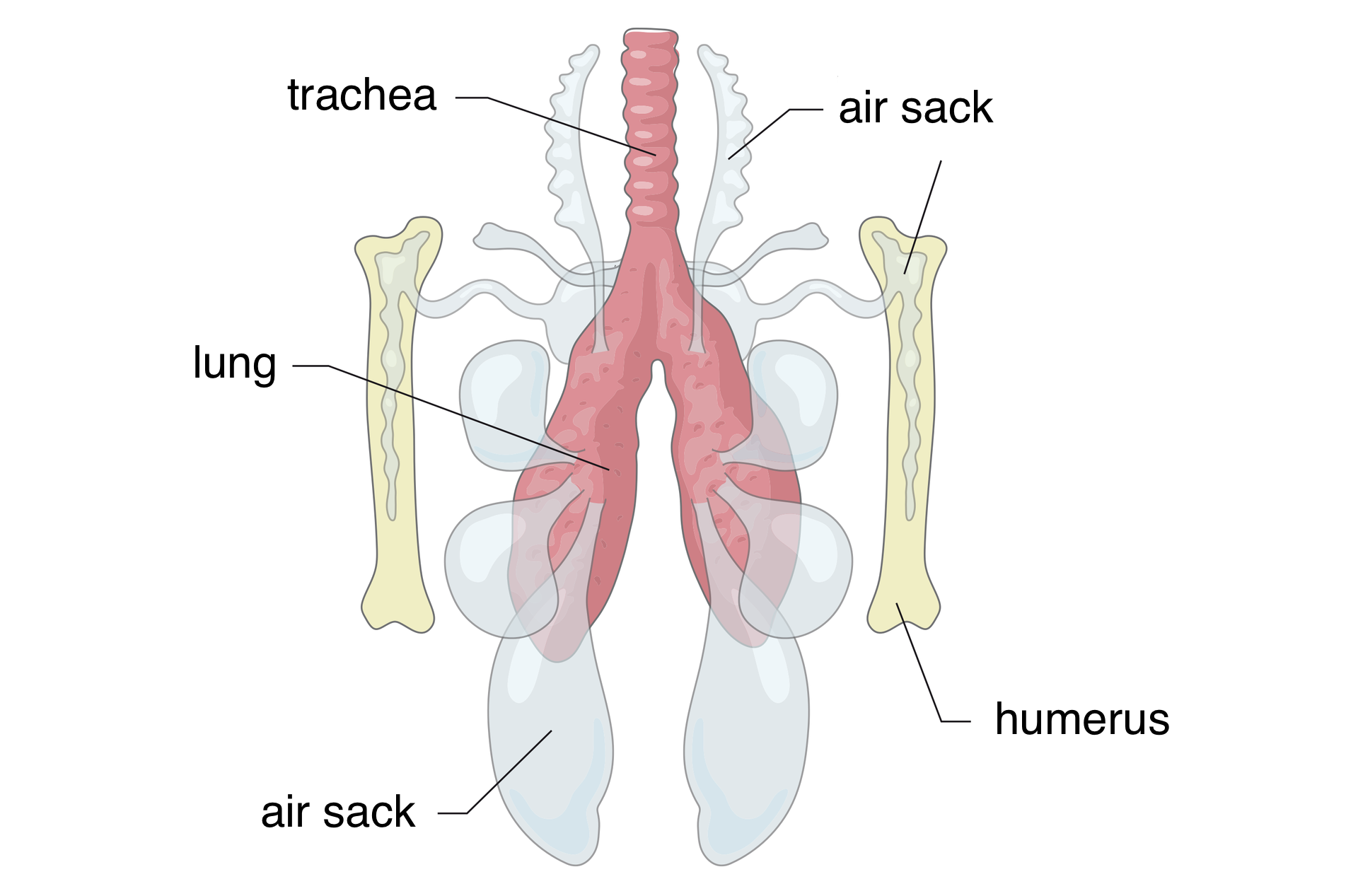
In birds, gas exchange takes place in lungs made up of a large number of thin tubes intertwined with each other. As a result, they have a large gas exchange surface. This is important because flying requires a great deal of energy, which is released in the presence of oxygen. Air is stored in air sacsair sacs. These are thick‑walled tanks filled with air and connected to the bronchi. They reduce the specific weight of the bird.
Lung ventilation can occur in two ways. During walking or resting, the air is pumped into the lungs thanks to the rhythmic movement of the chest, caused by the contraction of the intercostal muscles. During the flight, the chest is stiffened, as it provides support for the muscles moving the wings. When the bird raises its wings, the inhale takes place and the air enters the lungs and the air sacs through the airways. When the wings are lowered, the exhale takes place. Then the used air escapes from the lungs and the air stored in the air sacs is sucked into the lungs, oxygenating the blood. This mechanism is called double respirationdouble respiration, because oxygen‑rich air flows through the lungs of the bird twice, both when it is inhaled and when it is exhaled.
Almost all birds can glide. Some of them can travel long distances in this way. Explain why birds choose this mode of flight under favourable conditions.
Birds’ reproduction
Birds, like reptiles, are amniotes. The embryo of the bird develops from an embryonic disc which forms on the surface of the yolk constituting the source of food for the embryo. The egg yolk is kept in place by the protein structures known as strands. The highly hydrated protein protects the germ from drying out and absorbs shocks. The pores in the egg shell and the air chamberair chamber allow for gas exchange. The parchment membranes and the calcareous shell protect the egg from mechanical damages. As the embryo develops, the shell becomes thinner, as the calcium it contains is gradually built into the bone.
Bird nestlings are usually altricial species that hatch out unfledged, blind and dependent on their parents for a long time. If the nestling after hatching is covered with down feathers and has open eyes, can immediately leave the nest and follow its mother, it is called precocial species. This is the case in hens, ducks, ostriches.
Chaffinch occurs in agricultural and urbanized areas. It inhabits all types of forests, parks, cemeteries and even house gardens and parcels. It feeds on seeds of herbaceous plants, trees and shrubs, as well as fruits and grains and sometimes tree buds. It can also eat insects and arachnids from tree branches.
Eurasian eagle‑owl is the largest Polish owl. It hunts at night, guided by its hearing and eyesight. Feathers around the eyes and the beak create a facial disc, an antenna that concentrates sounds and guides them to the ear. Eurasian eagle‑owl has a massive silhouette, a large round head, orange eyes and characteristic clusters of feathers resembling ears. It inhabits vast primary forest areas. It hunts for medium sized birds and mammals, sometimes also insects.
The fastest bird is the peregrine falcon, which can reach speeds of up to 300 km/h when nose‑diving down. It is characterized by a large, bulky and strong silhouette with long, sharp‑ended wings and a massive head. It hunts for small vertebrates during the day, mainly birds and mammals. It inhabits all continents, most often river valleys, mountain areas and forests close to water reservoirs. It can also be found in urban areas.
Explain why many birds of prey have camouflaged colouring.
Eurasian hoopoe is a territorial bird and in case of danger it aggressively defends the territory. Explain the reason for this behaviour.
Match the features of the bird’s body structure to the adaptations for flight, adaptations to the habitat and mode of life.
Decrease of the specific weight of the body, Flight and gliding capability, Grabbing and tearing the prey, Masking their presence, Decrease of head weight
| Long claws and curved beak of white-tailed eagle | |
| White feathers in winter, brown feathers in summer in polar birds | |
| Bones filled with air sacs | |
| Large wing area | |
| Lack of teeth |
Conclusion
Birds are warm‑blooded vertebrates that can fly (or, as in the case of ostriches, their ancestors could) and inhabit all the world's ecosystems.
The birds' adaptations to flight include, among others, covering with feathers, a forelimb transformed into a wing, the presence of a keel on sternum, a light skeleton, and the presence of air sacs.
The shape of the bird's beak depends on the type of food it feeds and how it is obtained.
The structure of the bird's hindlimbs depends on the bird's lifestyle and the inhabited environment.
Double respiration in birds is due to the presence of air sacs.
Birds are oviparous, characterised by internal fertilisation.
Birds are amniotes, their young develop in eggs and are surrounded by foetal membranes which provide optimal conditions for their development.
Keywords
birds, pneumatised bones, double respiration
Glossary
część pióra zbudowana z 2 rzędów promieni wytwarzających promyki połączone ze sobą za pomocą haczyków; występuje na stosinie
część osi pióra tkwiąca w skórze ptaka
przestrzeń w jaju ptaka wypełniona powietrzem i ograniczona błonami pergaminowymi, która umożliwia młodemu osobnikowi wymianę gazową tuż przed wykluciem
kości długie posiadające liczne przestrzenie wypełnione powietrzem, które sprawiają, że masa ciała ptaka w stosunku do jego objętości jest mniejsza niż gdyby tych przestrzeni nie było; takie kości są przystosowaniem do lotu
wytwory naskórka pokrywające ciało ptaka, nadające mu opływowy kształt i umożliwiające latanie
mechanizm oddychania występujący u ptaków; umożliwia przepływ bogatego w tlen powietrza przez płuca, a co za tym idzie, wymianę gazową zarówno podczas wdechu i wydechu
zdolność do utrzymania względnie stałej temperatury ciała w znacznym stopniu niezależnej od temperatury środowiska
część osi pióra wystająca ponad skórę ptaka; na niej znajduje się chorągiewka
grubościenne pęcherze połączone z płucami ptaka poprzez oskrzela, występujące w tułowiu i we wnętrzu niektórych kości długich; ich funkcją jest umożliwienie wymiany gazowej podczas wydechu oraz zmniejszenie masy ciała ptaka w stosunku do jego objętości