Birth of Christianity
what the religious (Judaic origin) and historical (connected with the conquest of Palestine by the Roman Empire) context of the birth of Christianity is;
that the first Christians were persecuted, but less than four centuries later Christianity became the Roman state religion;
identify common elements and differences between Judaism and Christianity;
distinguish historical knowledge about Jesus from religious beliefs about him;
recognize the universal (timeless) problem of the birth of new, revolutionary ideas that face social resistance and sometimes great hostility of the contemporary people.
While the peoples of ancient Mesopotamia, Egypt, Greece and Rome worshipped many gods, the Israelites living in PalestinePalestine (called JewsJews) worshipped a single God called YahwehYahweh. Their sacred book was the BibleBible. The Israelites believed that God will send his Son to redeem all human sins. Jesus was born in PalestinePalestine under the reign of Augustus. This event was later recognised as the beginning of a new era. Jesus preached that all people are equal. In his teachings, he said one should love his or her neighbour. He promised that those who observe God’s commandments recorded in the BibleBible will enjoy eternal life. Some JewsJews recognised Jesus as the Son of God and the MessiahMessiah (in Greek: Christ). Jesus ran afoul of the Jewish priests, was sentenced to death and crucified by the Romans. The GospelsGospels describe the life and death of Jesus Christ. His followers – Christians – spread across the entire Roman Empire. Initially, they were persecutedpersecuted by the Roman authorities, but in 313 Emperor Constantine the GreatConstantine the Great permitted the free practice of this religion, and then converted to ChristianityChristianity himself. This paved the way for ChristianityChristianity’s development. In the late 4th century, Emperor Theodosius the GreatTheodosius the Great proclaimed ChristianityChristianity the national religion and banned the traditional one.
Read the text and answer the questions:
What was unseen in the beliefs of the JewsJews?
What are the common features between Jewish religion (JudaismJudaism) and ChristianityChristianity?
Followers of YahwehYahweh
PalestinePalestine is the cradle of ChristianityChristianity. It was conquered by the Romans and at the beginning of the 1st century AD it became one of the provinces of the empire. The JewsJews living there, who called themselves Israelites, professed JudaismJudaism. Unlike other ancient peoples who worshipped many gods, the Jews believed in one God, YahwehYahweh. According to their religion, YahwehYahweh created heaven and earth, liberated them from Egyptian slavery and made a covenant with them, the chosen people, through Moses. They believed that if they obeyed the commandments entrusted to Moses, God would send MessiahMessiah, who would free them from foreign domination and save the world from evil. The BibleBible was the holy book of the followers of JudaismJudaism. We learn from the BibleBible that Moses was one of the Israelite leaders and a prophet. God gave him stone tablets with rules (commandments) engraved on them, which became the most important principles of the Jewish religion. The text of the Ten Commandments, the Decalogue, is written in the Holy Book.
Complete the sentences.
Christians, Jesus of Nazareth, Messiah, Palestine, Rome, apostles
Christianity was born in .................................. and derives from the Jewish religion. .................................., like the Jews, believe in one God. The Jews are still waiting for the coming of the .................................., and the Christians have recognized it as .................................. and have proclaimed him the Son of God. After Jesus' martyrdom, his teachings were continued by the ...................................
Match the beliefs or traditions proper to the followers of a given religion: Judaism or Christianity. Put the common facts and beliefs in the right place.
They believe in saints., They were persecuted by the Romans., It is a monotheistic religion., His followers regard Jesus as the Messiah., They believe in the words of the Gospel., Their holy book is Torah., They are headed by the Pope., They called themselves Israelites., They do not eat pork., They consider Moses one of the prophets., They consider themselves to be chosen people.
| Judaism | |
|---|---|
| Christianity | |
| Shared facts or beliefs |
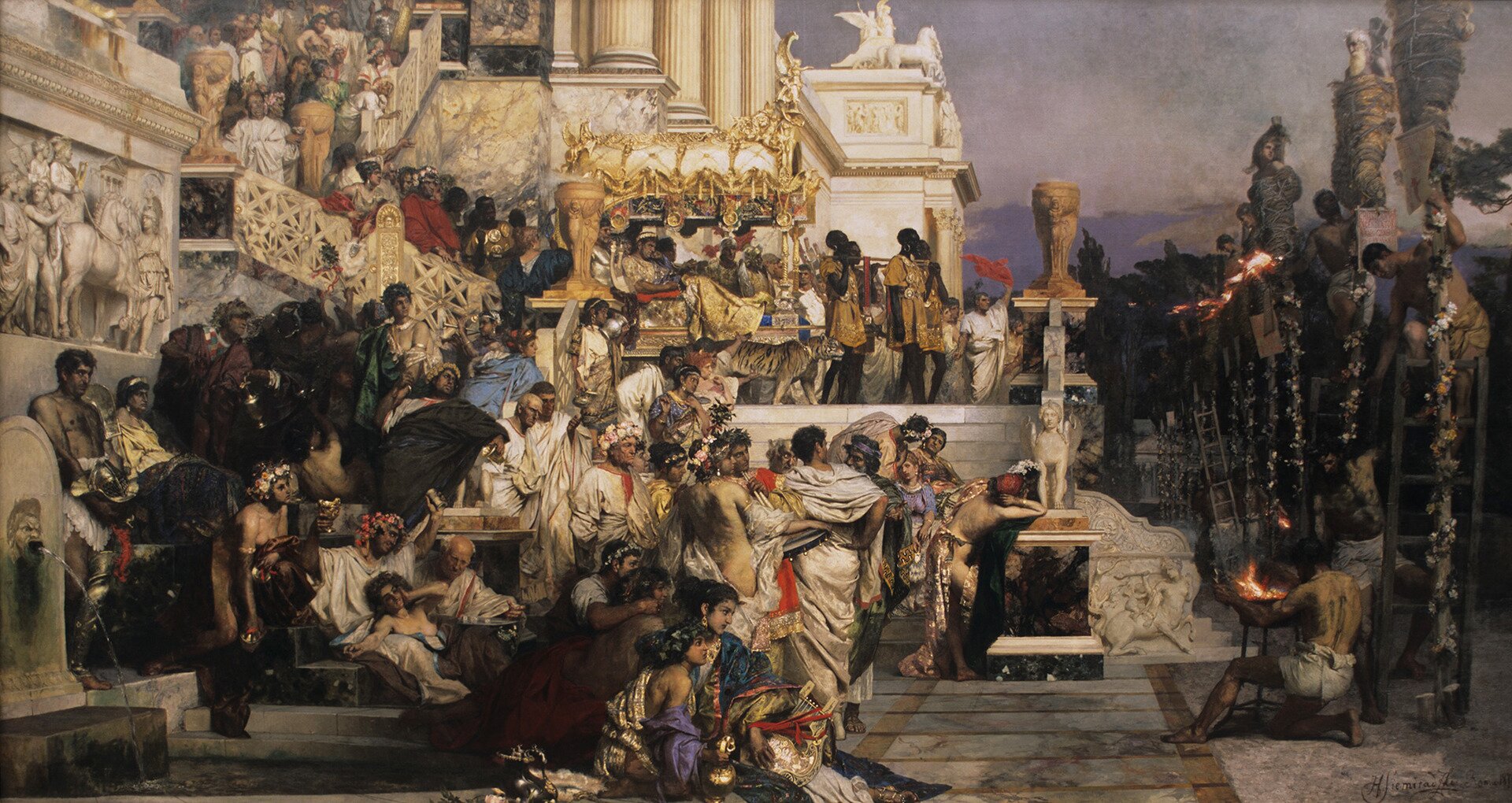
What is the relation of Norwid's poem with the above image?
Coś ty Atenom zrobił, SokratesieI
Coś ty Atenom zrobił, Sokratesie,
Że ci ze złota statuę lud niesie,
Otruwszy pierwej?Coś ty Italji zrobił, Alighieri,
Że ci dwa groby stawi lud nieszczery,
Wygnawszy pierwej?Coś ty, Kolumbie, zrobił Europie,
Że ci trzy groby we trzech miejscach kopie,
Otruwszy pierwej?Coś ty uczynił swoim, Camoensie,
Że po raz drugi grób twój grabarz trzęsie,
Zgłodziwszy pierwej?Coś ty, Kościuszko, zawinił na świecie,
Że dwa cię głazy we dwu stronach gniecie
Bez miejsca pierwej?Coś ty uczynił światu, Napoljonie,
Że cię w dwa groby zamknięto po zgonie,
Zamknąwszy pierwej?Coś ty uczynił ludziom Mickiewiczu?
II
Więc mniejsza o to, w jakiej spoczniesz urnie,
Gdzie, kiedy, w jakim sensie i obliczu,
Bo grób twój jeszcze odemkną powtórnie,
Inaczej będą głosić twe zasługi
I łez, wylanych dziś, będą się wstydzić,
A lać ci będą łzy potęgi drugiej
Ci, co człowiekiem nie mogli cię widziéć.III
Każdego z takich, jak ty, świat nie może
Odrazu przyjąć na spokojne łoże,
I nie przyjmował nigdy, jak wiek wiekiem.
Bo glina w glinę wtapia się bez przerwy,
Gdy sprzeczne ciała zbija się aż ćwiekiem
Później... lub pierwéj...Pisałem w Paryżu 1856 w styczniu.
Source: Cyprian Kamil Norwid, Coś ty Atenom zrobił, Sokratesie.
In spite of persecutionpersecution, more and more inhabitants of the Roman Empire adopted a new religion. However, it was not until the 4th century that the situation of Christians changed. In the year 313 Constantine the GreatConstantine the Great issued the Edict of Milan allowing Christians to profess their religion freely. He later became the first emperor to convert to ChristianityChristianity.
In the year 392 emperor Theodosius the GreatTheodosius the Great prohibited the worship of pagan gods. ChristianityChristianity became the state religion in the Roman Empire.
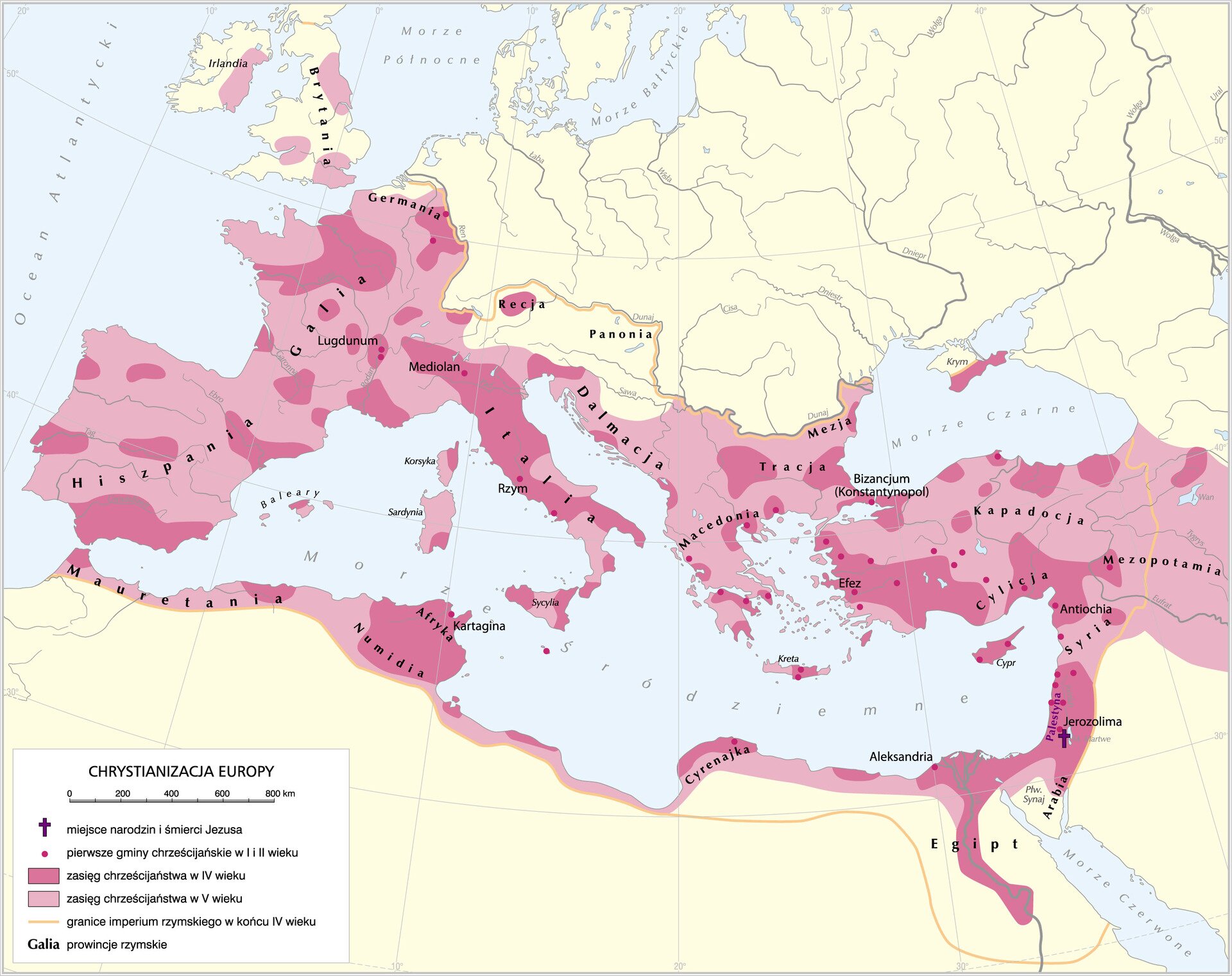
Show on the map the land where Christianity was born.
Look carefully at the map and describe the way that Christianity has spread.
Language practice. Match pairs: English and Polish.
Żydzi, chrześcijaństwo, Mesjasz, Ewangelie, Tora, prześladowania, menora
| Jews | |
| Torah | |
| menorah | |
| persecution | |
| Messiah | |
| christianity | |
| Gospels |
Keywords
Christianity, Judaism, Palestine, Jews, Messiah, persecution
Glossary
Palestyna – kraina geograficzna w zachodniej Azji, kolebka judaizmu i chrześcijaństwa.
Żydzi – lud zamieszkujący w starożytności Palestynę, wyznawcy judaizmu.
judaizm – religia monoteistyczna (wiara w jednego Boga - Jahwe) wyznawana przez Żydów.
Jahwe – nazwa Boga czczonego w judaizmie i chrześcijaństwie.
Biblia – Pismo Święte, zbiór ksiąg uważanych przez chrześcijan i Żydów za natchnione przez Boga. Biblia chrześcijańska składa się ze Starego i Nowego Testamentu.
Tora – pięć pierwszych ksiąg Starego Testamentu, najważniejszy tekst judaizmu.
menora – siedmioramienny ozdobny świecznik obecny przy każdym święcie żydowskim.
prześladowania
Konstantyn Wielki, cesarz rzymski,który jako pierwszy przeszedł na chrześcijaństwo, w 313 r. ogłosił swobodę wyznawania nauk Jezusa (edykt mediolański).
Teodozjusz Wielki, cesarz rzymski żyjący w IV w.n.e., za jego panowania chrześcijaństwo stało się religią państwową.
Mesjasz, zbawiciel, odkupiciel win.
Jezus z Nazaretu, w chrześcijaństwie Syn Boży, odkupiciel i zbawiciel. Najważniejsza postać religii chrześcijańskich.
chrześcijaństwo – monoteistyczna religia oparta na naukach Jezusa Chrystusa. Najważniejszą księgą chrześcijaństwa jest Biblia.
ewangelie – część Biblii zawierająca opis życia i nauki Jezusa Chrystusa. Zostały spisane przez czterech uczniów Jezusa – apostołów.
kipa – jarmułka, nakrycie głowy noszone przez ortodoksyjnych Żydów. Po hebrajsku znaczy kopuła.
mezuza – małe pudełeczko zawieszone na drzwiach domu żydowskiego zawierające fragment z Tory.