Boleslav I the Brave – Poland’s first king
talk about the history and significance of the Congress of GnieznoCongress of Gniezno;
characterize the figure of Saint Wojciech;
explain that in different historical periods the hierarchy of values has changed and what once was right, today may have a completely different meaning;
talk about the complex nature of the social division of labor and the roles of some social groups in Piast Poland.
Boleslav, nicknamed the Brave, was the son of Mieszko I and Doubravka. He consolidated Christianity in Poland. He also helped organise a Christianising MissionChristianising Mission to lands inhabited by Prussian tribes (today’s Warmia and Masuria). The mission was led by the Bohemian bishop Adalbert. The Prussians killed Adalbert, and Boleslav bought out his remnants and buried them in Gniezno. Soon thereafter, Adalbert was canonised as saint by the Church. In 1000, Emperor Otto III made an official pilgrimagepilgrimage to the saint’s grave. The Polish Duke received the Emperor in Gniezno and hosted him with great honours. Otto III honoured Boleslav by placing his imperial diademimperial diadem on the Polish Duke’s head. This gesture was is interpreted as the Emperor’s consent to Boleslav’s coronationcoronation as king. At the Congress of GnieznoCongress of Gniezno, Gniezno was raised to the rank of archbishopric. Three subordinate bishoprics were established in Wrocław, Cracow, and Kołobrzeg. Otto III died soon afterwards, however, and Polish‑German relations deteriorated. Throughout his rule, Boleslav I the Brave waged wars against his neighbours and conquered new lands. In 1025, he ultimately affected the coronationcoronation and became the first Polish king. Soon thereafter, he died.
The Gniezno Doors is a kind of medieval comic book of bronze, telling the story of St. Adalbert. Look at the illustration and check what information has been placed in its carved parts.
Listen to the recording and mark the correct answer.
Nagranie dostępne na portalu epodreczniki.pl
Nagranie lektorskie
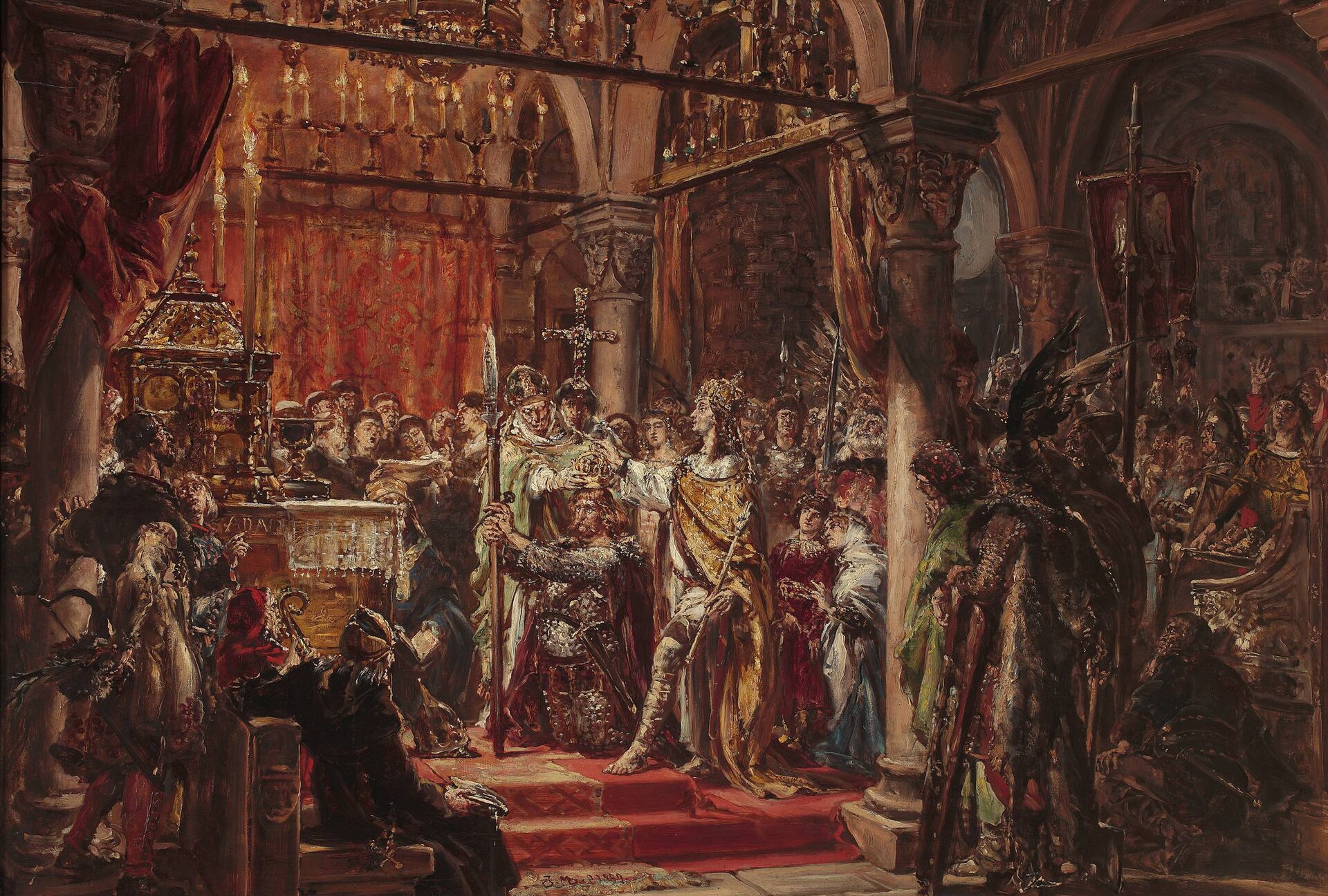
Otto III had an important reason to visit Prince Boleslav I the Brave. He wanted to unite Europe on the model of the former Roman Empire. The new European empire was to include four provinces: Italy, France, Germany and the Slavic lands, that is countries inhabited by Slavs. During a convention in Gniezno, the emperor discussed this idea with Boleslav I the Brave. The ambitious Polish prince was to become the ruler of all Slavdom. Therefore, during the convention in the year 1000, the emperor symbolically placed his own diadem on Boleslav's head. Unfortunately, nothing came of the plans to unite Europe, because soon afterwards the emperor died. But the idea of the royal crown for the Piast prince survived. Finally, in a favourable political situation, a quarter of a century later, in the spring of 1025, Boleslav I the Brave was anointed as King of Poland. This first coronationcoronation in the history of Poland was an important political act. It stressed the independence of the young Polish state. Poland began to be defined and described as a kingdom. Let's remember about it when we look at the Polish state emblem. The crown on the head of the White Eagle reminds us of this important event from a thousand years ago.
After the coronation of Boleslav I the Brave:
- He became the ruler of the entire Slavic region.
- Poland began to be treated as an independent state.
- Europe has united.
Language practice. Match pairs: English and Polish.
misja chrystianizacyjna, dworzanie, wojownicy, pielgrzymka, koronacja, zjazd gnieźnieński, diadem cesarski
| christianization mission | |
| pilgrimage | |
| Congress of Gniezno | |
| imperial diadem | |
| coronation | |
| courtiers | |
| warriors |
Keywords
Boleslav I the Brave, Chrobry, Saint Adalbert, coronation, king, christianization
Glossary
misja chrystianizacyjna – misja polegająca na upowszechnianiu chrześcijaństwa wśród pogan
diadem cesarski - opaska na głowę wykonana ze złota lub srebra, będąca oznaką władzy
koronacja – uroczystość, w czasie której na głowę władcy nakładano koronę, a jego samego namaszczano świętymi olejami
Zjazd gnieźnieński
pielgrzymka