Nuclear fissionfissionfission is a type of nuclearnuclearnuclear reaction in which the nucleus splits into smaller fragments with smaller mass. In the fission process free neutrons and gamma rays are produced. The process is associated with a large amount of released energy.
Nuclear fission is carried out in a nuclear reactor or occurs spontaneously.
Two isotopes in common use as nuclear fuels are: uranium and plutonium .
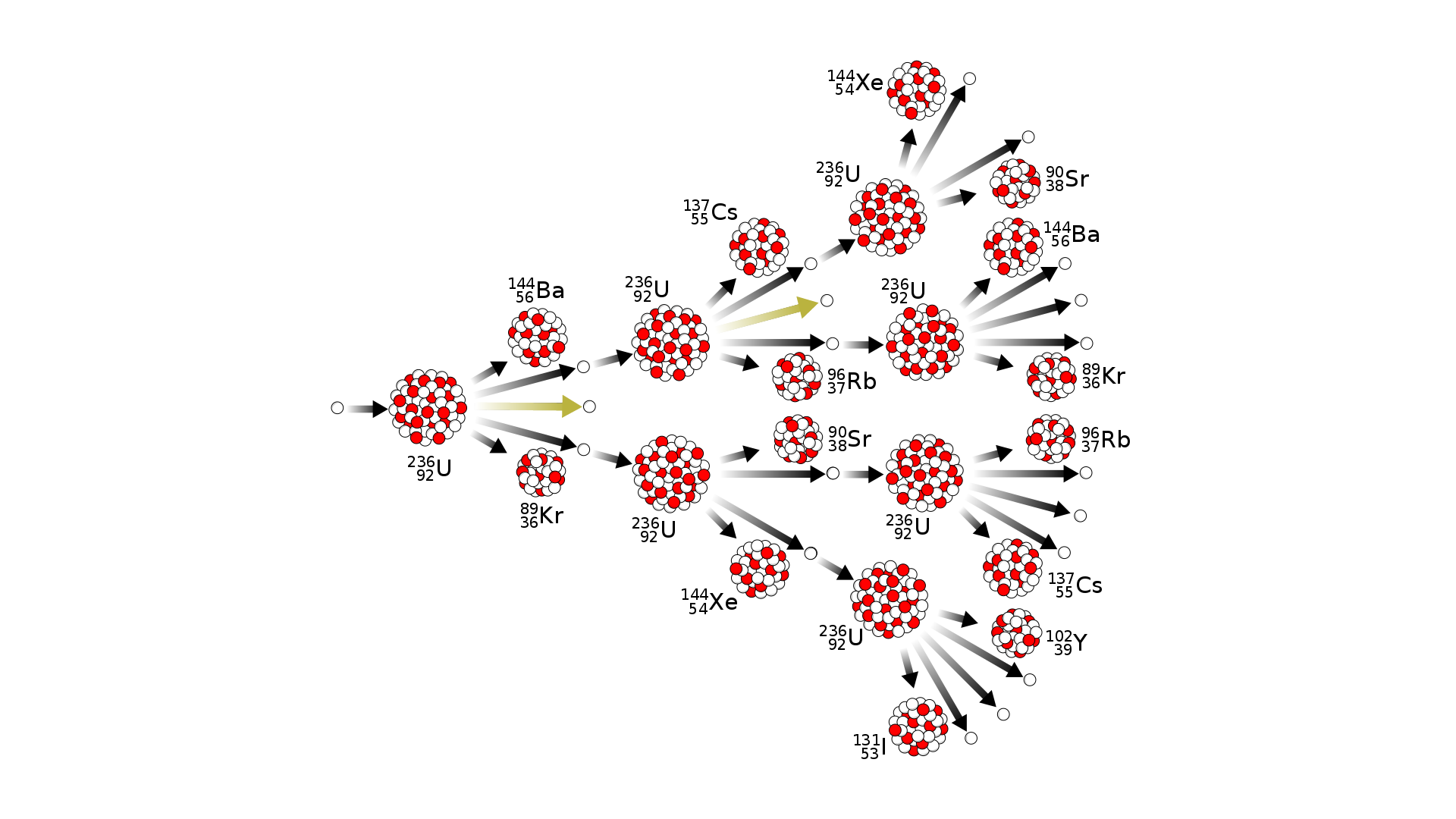
The nuclear fissionfissionfission in chain reaction proceeds in several steps
the nucleus splits into two parts and releases two or three neutrons and energy,
the newly formed fission products lose their kinetic energy and emit gamma rays,
the fission products in the excited state lose their excess energy by radioactive decay and emit gamma rays and beta particle.
R1OVExMayomxr
Na ilustracji interaktywnej pokazany jest przebieg procesu rozszczepienie jądrowego w pięciu etapach: neutron uderza w jądro, jądro pochłania neutron, jądro ulega odkształceniu, jądro dzieli się na dwie części i uwalnia dwa lub trzy neutrony oraz wydziela się energia, nowo utworzone produkty rozszczepienia tracą swoją energię kinetyczną i emitują promieniowanie gamma, produkty rozszczepienia znajdujące się w stanie wzbudzenia tracą nadwyżkę energii przez rozpad radioaktywny i emitują promienie gamma i cząstki beta. Każdy etap narysowany jest symbolicznie, gdzie jądro atomowe macierzyste i jądra potomne zaznaczone są jako niebieskie duże kule, a cząstki emitowane jako małe kuleczki (niebieska – neutron powodujący reakcję i neutrony emitowane, zielona – emitowana cząstka beta). Promieniowanie gamma zaznaczone jest w postaci małych czerwonych sprężynek. Mała niebieska kulka oznaczona numerem 1, czerwona sprężynka oznaczona numerem 2, mała zielona kulka oznaczona numerem 3. Na ilustracji widoczne są numery, a na nich podpisy. 1. neutron {audio}, 2. gamma ray {audio}, 3. beta particle {audio}.
Na ilustracji interaktywnej pokazany jest przebieg procesu rozszczepienie jądrowego w pięciu etapach: neutron uderza w jądro, jądro pochłania neutron, jądro ulega odkształceniu, jądro dzieli się na dwie części i uwalnia dwa lub trzy neutrony oraz wydziela się energia, nowo utworzone produkty rozszczepienia tracą swoją energię kinetyczną i emitują promieniowanie gamma, produkty rozszczepienia znajdujące się w stanie wzbudzenia tracą nadwyżkę energii przez rozpad radioaktywny i emitują promienie gamma i cząstki beta. Każdy etap narysowany jest symbolicznie, gdzie jądro atomowe macierzyste i jądra potomne zaznaczone są jako niebieskie duże kule, a cząstki emitowane jako małe kuleczki (niebieska – neutron powodujący reakcję i neutrony emitowane, zielona – emitowana cząstka beta). Promieniowanie gamma zaznaczone jest w postaci małych czerwonych sprężynek. Mała niebieska kulka oznaczona numerem 1, czerwona sprężynka oznaczona numerem 2, mała zielona kulka oznaczona numerem 3. Na ilustracji widoczne są numery, a na nich podpisy. 1. neutron {audio}, 2. gamma ray {audio}, 3. beta particle {audio}.
The released neutrons may hit other nuclei and cause them to split. Even more neutrons are then released, which in turn can split more nuclei. This is called a chain reactionchain reactionchain reaction. The chain reaction in nuclearnuclearnuclear reactors is controlled to stop it going too fast. The chain reaction is ongoing so long as the nuclei, that can undergo fission, are present in the sample.
For the chain reaction to take place some condition must be fulfilled.
Forced fissionfissionfission to occur requires the supply of a minimum energy.
The excitation energy of a nucleus determines how much the energy of the excited nucleus is greater than the energy of the nucleus in its ground state. The minimum excitation energy required for fission to occur must be above a certain level and is called the critical energy (EIndeks dolny cc) or threshold energy. The critical energy depends on the nuclearnuclearnuclear structure.
Critical masscritical massCritical mass is the minimum amount of fissile material necessary to achieve a self‑sustaining fission chain reactionchain reactionchain reaction, characteristic of a given izotop.
Uranium is the most widely used fuel for nuclear fissionfissionfission. NuclearnuclearNuclear power plants use uranium enrichedenrichedenriched in the isotope as the fuel. This isotope, in contrast to the more common uranium , can fission.
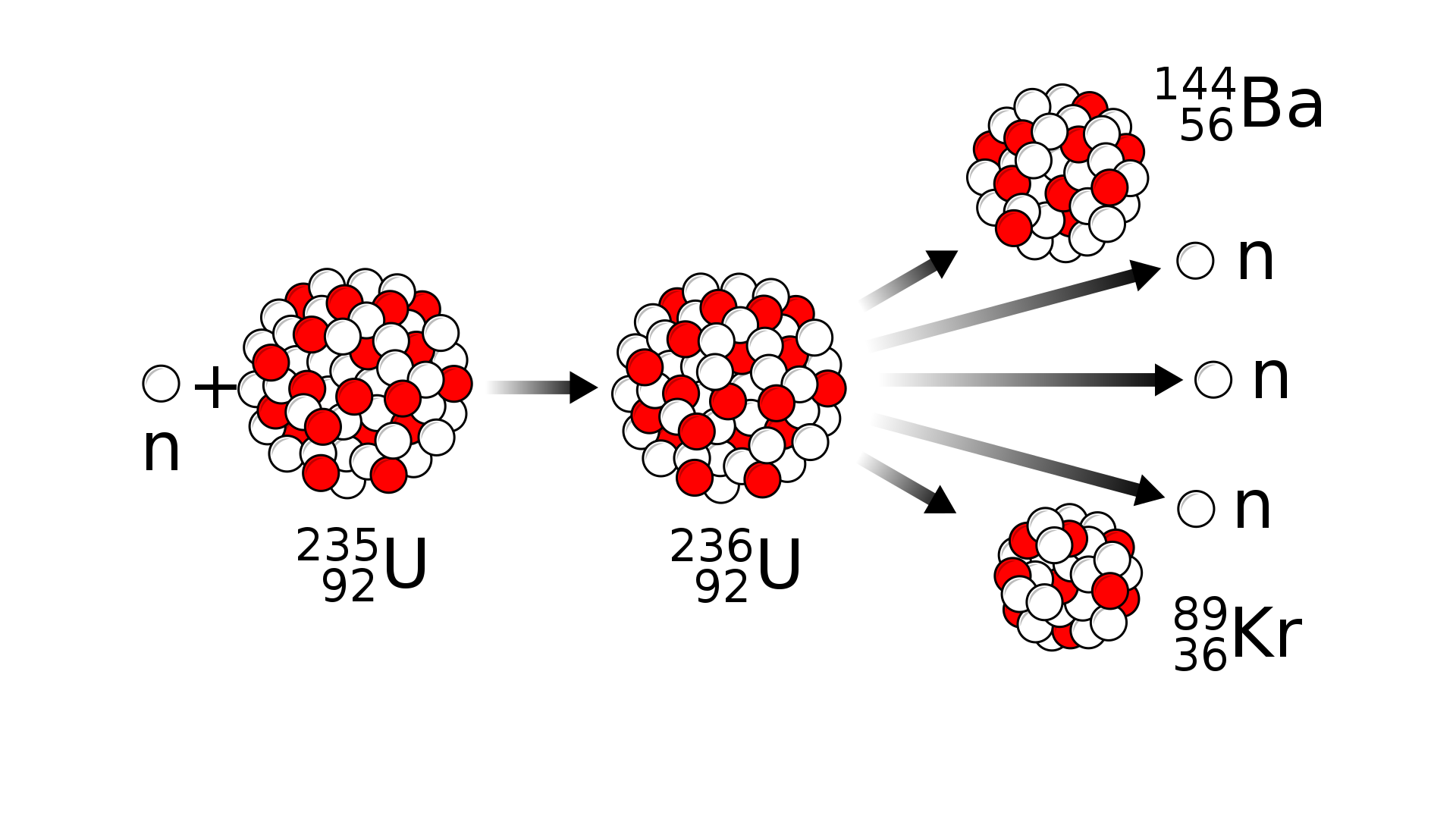
The fission of uranium is triggered by the absorption of a moving neutron with low energy (below 10 eV) called slow neutron and unstable is formed. High energy neutrons (0,5 – 15 MeV), called fast neutrons, are not captured. Hence, these particles must be slow down in the process of moderation in the reactor. The average number of neutrons released per fission is 2,4.
Example 1
The example reaction of fission:
is schematically presented in the figure below:
RRYApUTLJ6ssE1
Na rysunku przedstawiona jest przykładowa reakcja rozszczepienia uranu-235. Rozszczepienie uranu-235 jest wyzwalane przez absorpcję poruszającego się neutronu o niskiej energii, zwanego neutronem powolnym (termicznym), po czym powstaje niestabilny izotop uran-236. W wyniku rozpadu uranu-236 powstają nowe jądra izotopów ciężkich pierwiastków baru-144 i kryptonu-89 oraz trzy neutrony. Bombardujący neutron oraz neutrony powstałe w reakcji oznaczone są małym białym kółkiem. Jądra biorące udział w reakcji zaznaczone są jako zbiory ściśle do siebie przylegających kółek białych i czerwonych. Poszczególne stadia reakcji oddzielone są od siebie strzałkami, wskazującymi kierunek przebiegu reakcji. Białe kółko podpisane n, obok znak plus, obok zbiór kółek podpisany w indeksie górnym 235, w indeksie dolnym 92, U. Od niego strzałka pozioma skierowana w prawo do zbioru kółek podpisanego w indeksie górnym 236, w indeksie dolnym 92, U. Od niego pięć strzałek w prawo do (od góry): zbioru kółek podpisanego w indeksie górnym 144, w indeksie dolnym 56, Ba; kółka białego podpisanego n, kółka białego podpisanego n, kółka białego podpisanego n, zbioru kółek podpisanego w indeksie górnym 89, w indeksie dolnym 36, Kr.
In the uranium the nucleons are bound with an average binding energy per nucleon of about 7,6 MeV. In the fission product nuclei, the binding energy per nucleon is higher and amounts to approx. 8,5 MeV. The difference in binding energy is of 0,9 MeV per nucleon and has 235 nucleons. Hence, the energy of about 210 MeV is released in the single nuclearnuclearnuclear fission process. The released energy is the sum of the following components:
- kinetic energy of fission products is 175 MeV, - kinetic energy of fission neutrons is 5 MeV, - energy of the gamma radiation emitted during the fission is 7 MeV, - energy of beta and gamma radiation during the decay of the radioactive fission products is 13 MeV, - energy of the neutrinos is 10 MeV.
Plutonium atom is bombarded with a neutron and produces an atom of strontium and four neutrons. In this reaction the other nuclide is formed. Identify it and write the corresponding equation.
Barium,
Remember
Nuclear fissionfissionfission is a type of nuclearnuclearnuclear reaction in which the nucleus splits into smaller fragments with smaller mass. The process is associated with a large amount of released energy.
For the chain reactionchain reactionchain reaction to take place the critical energycritical energycritical energy must be supplied and the minimum mass of the sample, characteristic of a given izotop, known as critical mass, is necessary.
Exercises
RpTjsMOlQIo82
Exercise 3
Wersja alternatywna ćwiczenia: Determine which sentences are true. Możliwe odpowiedzi: 1. When one large nucleus is split into two smaller nuclei, the process is nuclear fission., 2. When nuclei decay, massive amounts of energy is released., 3. Uranium and plutonium are two fissionable substance often used in nuclear plants as a fuel., 4. Chain reaction never stops.
Wersja alternatywna ćwiczenia: Determine which sentences are true. Możliwe odpowiedzi: 1. When one large nucleus is split into two smaller nuclei, the process is nuclear fission., 2. When nuclei decay, massive amounts of energy is released., 3. Uranium and plutonium are two fissionable substance often used in nuclear plants as a fuel., 4. Chain reaction never stops.
Determine which sentences are true.
When one large nucleus is split into two smaller nuclei, the process is nuclear fission.
When nuclei decay, massive amounts of energy is released.
Uranium and plutonium are two fissionable substance often used in nuclear plants as a fuel.
Chain reaction never stops.
zadanie
Source: GroMar, licencja: CC BY 3.0.
Exercise 4
A plutonium atom is bombarded with a neutron and produces an atom of technetium and three neutrons. In this reaction the other nuclide is formed. Identify it and write the corresponding equation.
Exercise 5
Explain in English what the nuclear fission is.
R1WlDDmi6UwnY
Exercise 6
Wersja alternatywna ćwiczenia: Indicate which pairs of expressions or words are translated correctly. Możliwe odpowiedzi: 1. rozszczepienie - fission, 2. jądrowy - nuclear, 3. energia krytyczna - critical energy, 4. masa krytyczna - critical mass, 5. reaktor jądrowy - chain reaction, 6. neutrony powolne - power reactor
Wersja alternatywna ćwiczenia: Indicate which pairs of expressions or words are translated correctly. Możliwe odpowiedzi: 1. rozszczepienie - fission, 2. jądrowy - nuclear, 3. energia krytyczna - critical energy, 4. masa krytyczna - critical mass, 5. reaktor jądrowy - chain reaction, 6. neutrony powolne - power reactor
Indicate which pairs of expressions or words are translated correctly.
rozszczepienie - fission
jądrowy - nuclear
energia krytyczna - critical energy
masa krytyczna - critical mass
reaktor jądrowy - chain reaction
neutrony powolne - power reactor
zadanie
Source: GroMar, licencja: CC BY 3.0.
RX4WYJSKlRLDX1
Interaktywna gra, polegająca na łączeniu wyrazów w pary w ciągu jednej minuty. Czas zaczyna upływać wraz z rozpoczęciem gry. Jeden ruch to odkrywanie najpierw jednej potem drugiej karty z wyrazem. Każdy wyraz jest odczytywany. Kolejny ruch to odkrywanie trzeciej i czwartej karty. W ten sposób odsłuchasz wszystkie wyrazy. Nawigacja z poziomu klawiatury za pomocą strzałek, odsłuchiwanie wyrazów enterem lub spacją. Znajdź wszystkie pary wyrazów.
Interaktywna gra, polegająca na łączeniu wyrazów w pary w ciągu jednej minuty. Czas zaczyna upływać wraz z rozpoczęciem gry. Jeden ruch to odkrywanie najpierw jednej potem drugiej karty z wyrazem. Każdy wyraz jest odczytywany. Kolejny ruch to odkrywanie trzeciej i czwartej karty. W ten sposób odsłuchasz wszystkie wyrazy. Nawigacja z poziomu klawiatury za pomocą strzałek, odsłuchiwanie wyrazów enterem lub spacją. Znajdź wszystkie pary wyrazów.
Match Polish terms with their English equivalents.
jądrowy
critical mass
energia krytyczna
rozszczepienie
chain reaction
reakcja łańcuchowa
masa krytyczna
critical energy
fission
nuclear
Source: Zespół autorski Politechniki Łódzkiej, licencja: CC BY 3.0.