Each body is made up of many atoms in which the number of protons and electrons is the same. Additional electrons can be led to such a body, and then such a body is endowed with a negative electric charge. If we take electrons from the valence shells from the atom, we say that the body is endowed with a positive electric charge. It must be remembered that protons can not be detached or delivered to the atom. Only a change in the number of electrons can lead to electrified body.
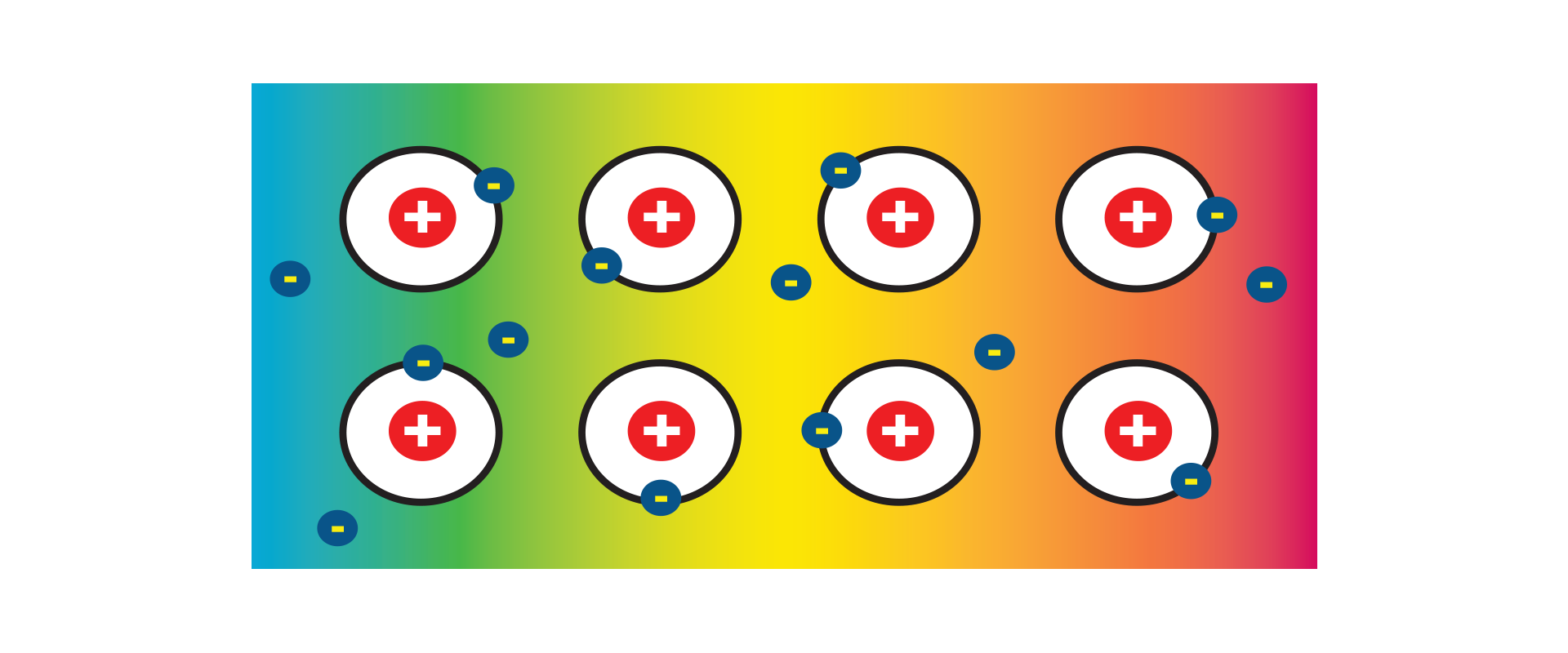
The conductor is a body in which electrons orbiting the atomic nucleus are weakly bound to the atomic nucleus. The electrons in the outermost orbits can practically move in the entire body volume.
RrV0KMVm8Rfy2
Na rysunku przedstawione jest schematycznie osiem atomów: kółko ze znakiem plus, wokół niego okrąg, na którym jest kółko ze znakiem minus. Kółka ze znakiem minus znajdują się także w wolnej przestrzeni między atomami.
In conductors, electrons can move practically in the entire volume of the conductor
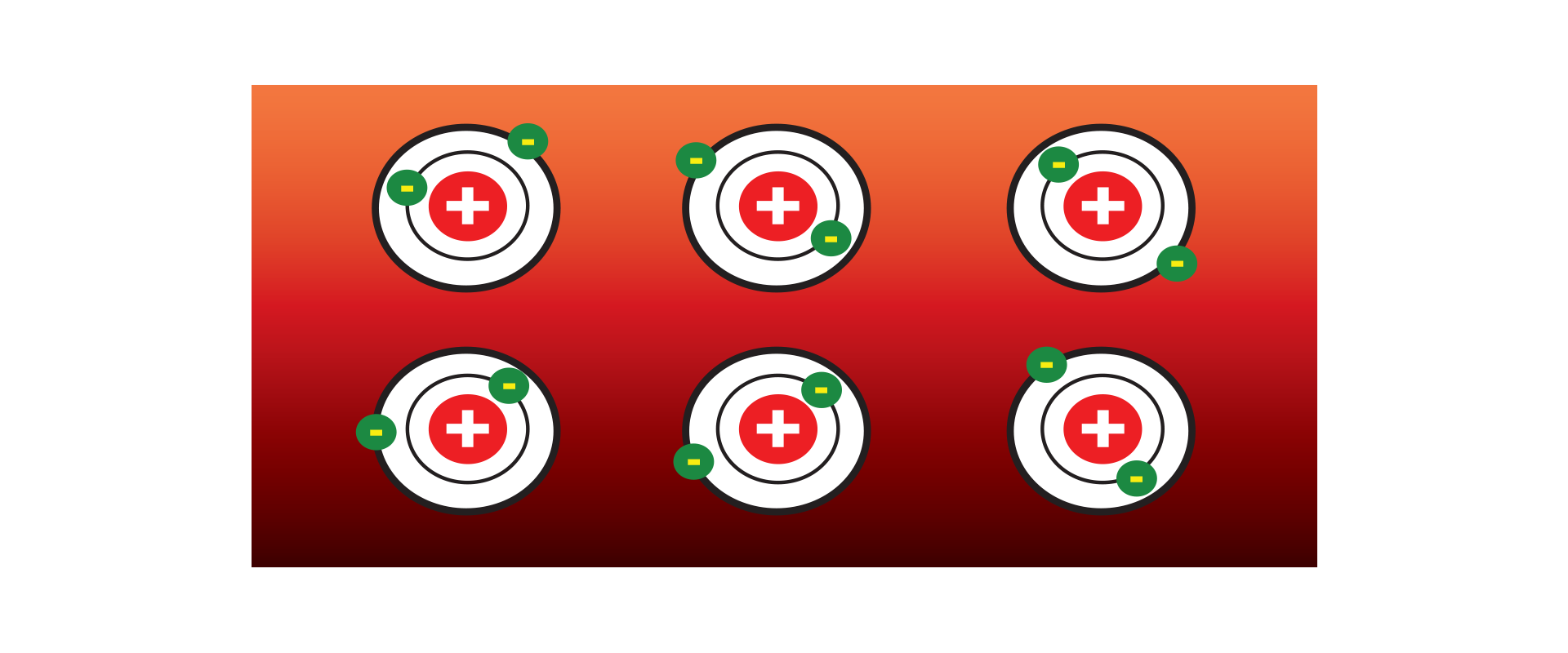
An insulator is called every body in which electrons orbiting the atomic nucleus are very strongly related to this nucleus and therefore can not move inside the body. In certain situations they can move slightly inside the atom.
R1d3eqnhQgiMX
Na rysunku przedstawione jest schematycznie sześć atomów: kółko ze znakiem plus, wokół niego dwa okręgi, na każdym z nich jest kółko ze znakiem minus.
In insulators, electrons are permanently bound to the atom's parent nucleus
Source: GroMar, licencja: CC BY 3.0.
RdqRW4X1t6Lk6
W górnej części ilustracji interaktywnej przedstawione jest schematycznie sześć atomów: kółko ze znakiem plus, wokół niego dwa okręgi, na każdym z nich jest kółko ze znakiem minus. Atomy wzięte są w klamrę oznaczoną numerem 1, jedno kółko ze znakiem minus oznaczone jest numerem 2. W dolnej części ilustracji interaktywnej przedstawione jest jest schematycznie osiem atomów: kółko ze znakiem plus, wokół niego okrąg, na którym jest kółko ze znakiem minus. Kółka ze znakiem minus znajdują się także w wolnej przestrzeni między atomami. Atomy wzięte są w klamrę oznaczoną numerem 3, jedno kółko ze znakiem minus oznaczone jest numerem 4. Na ilustracji widoczne są numery, a na nich podpisy. 1. insulators {audio}, 2. electrons move only around atom's parent nucleus {audio}, 3. conductors {audio}, 4. electrons move in the entire volume {audio}.
W górnej części ilustracji interaktywnej przedstawione jest schematycznie sześć atomów: kółko ze znakiem plus, wokół niego dwa okręgi, na każdym z nich jest kółko ze znakiem minus. Atomy wzięte są w klamrę oznaczoną numerem 1, jedno kółko ze znakiem minus oznaczone jest numerem 2. W dolnej części ilustracji interaktywnej przedstawione jest jest schematycznie osiem atomów: kółko ze znakiem plus, wokół niego okrąg, na którym jest kółko ze znakiem minus. Kółka ze znakiem minus znajdują się także w wolnej przestrzeni między atomami. Atomy wzięte są w klamrę oznaczoną numerem 3, jedno kółko ze znakiem minus oznaczone jest numerem 4. Na ilustracji widoczne są numery, a na nich podpisy. 1. insulators {audio}, 2. electrons move only around atom's parent nucleus {audio}, 3. conductors {audio}, 4. electrons move in the entire volume {audio}.
Chargingcharging Charging is the process of accumulation of an excess of charge of the same sign in a given body.
Chargingcharging Charging by contactcontactcontact occurs when we touch at least two bodies with each other, of which at least one is charged. When the bodies come into contact, electrons flow from one body to another.
R1MRBTwcRNDLt
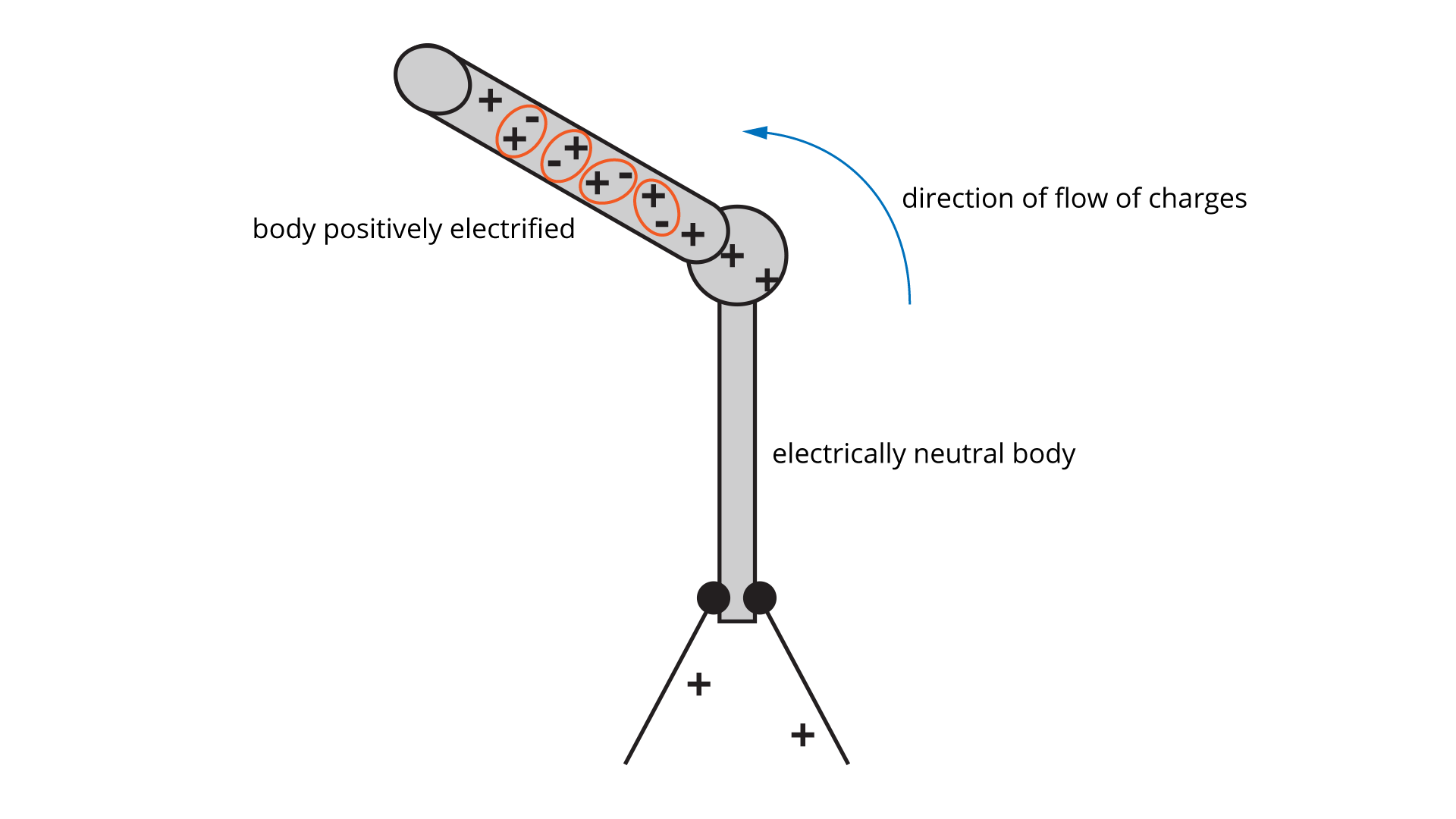
Na rysunku przedstawiony jest schematycznie elektroskop. Pionowy prostokąt opisany electrically neutral body, na dole dwa kółka z liniami przy których jest znak plus, na górze koło wewnątrz którego są dwa znaki plus. Obok koła ukośny prostokąt ze znakami plus (5) i minus (3) opisany body positively electrified. Trzy pary znaków plus i minus otoczone elipsą. Po prawej stronie obrazka strzałka ukośna skierowana w lewo opisana direction of flow of charges.
Positively electrified glass rod (shortage of electrons) approaches the neutral metal ball, located on the top of the electroscope (a sphere in which there is no excess or underflow of electrons).
After contact between two bodies, some of the electrons from the sphere will flow to the glass rod. The glass rod will still be positively charged, but this charge will be smaller. In contrast, the metal part of the electroscope will obtain a positive charge. (Due to the construction of insulators, the change of charge on the glass rod is local.) To change the electrification state of a larger part of the glass rod, it should be moved over the sphere of the electroscope.
Leaves of the electroscope will rise (repulsion of like charges).
Electrifying the bodies by touch occurs when we touch bodies with each other, at least one of which is endowed with an electric charge.
As a result of contact, some of the electrons pass from the body on which there are more of them to the second, where there are fewer of them.
The distribution of charge between the body is such that the sum of charges after contact of the bodies is equal to the charge of the charged body before contact with the electrically inert body.
On both bodies, after contact, it will be the same load if they are identical (e.g. two identical conductor balls).
It is static electricity.
Only conductors can be charged by contactcontactcontact.
RKMnpGOapxqo6
Po lewej stronie ilustracji interaktywnej narysowany jest poziomy prostokąt z zaokrąglonymi rogami i ośmioma znakami minus wewnątrz po prawej stronie, opisany numerem 1. Po jego prawej stronie koło z czterema znakami plus po lewej stronie i czterema znakami minus po prawej stronie, opisane numerem 2. Od koła ukośnie do góry narysowana jest linia do linii poziomej. Zaznaczona strzałka od prostokąta do koła. Po prawej stronie ilustracji interaktywnej narysowany jest poziomy prostokąt z zaokrąglonymi rogami i czterema znakami minus wewnątrz po prawej stronie. Jego prawy bok styka się z kołem z czterema znakami minus po prawej stronie. Miejsce styku oznaczone numerem 3. Od koła ukośnie do góry narysowana jest linia do linii poziomej. Na ilustracji widoczne są numery, a na nich podpisy. 1. body with negative charge {audio}, 2. movement of charges in a neutral body {audio}, 3. distribution of charges after charging {audio}.
Po lewej stronie ilustracji interaktywnej narysowany jest poziomy prostokąt z zaokrąglonymi rogami i ośmioma znakami minus wewnątrz po prawej stronie, opisany numerem 1. Po jego prawej stronie koło z czterema znakami plus po lewej stronie i czterema znakami minus po prawej stronie, opisane numerem 2. Od koła ukośnie do góry narysowana jest linia do linii poziomej. Zaznaczona strzałka od prostokąta do koła. Po prawej stronie ilustracji interaktywnej narysowany jest poziomy prostokąt z zaokrąglonymi rogami i czterema znakami minus wewnątrz po prawej stronie. Jego prawy bok styka się z kołem z czterema znakami minus po prawej stronie. Miejsce styku oznaczone numerem 3. Od koła ukośnie do góry narysowana jest linia do linii poziomej. Na ilustracji widoczne są numery, a na nich podpisy. 1. body with negative charge {audio}, 2. movement of charges in a neutral body {audio}, 3. distribution of charges after charging {audio}.
During charging, the total chargetotal chargetotal charge is always conserved. Below are examples of charge values of two identical bodies before and after chargingcharging charging by contactcontactcontact.
Chargingcharging Charging by contactcontactcontact occurs when we touch at least two bodies with each other, of which at least one is charged. When the bodies come into contact, electrons flow from one body to another.
Electrons move from one body to the other, thus causing chargingcharging charging the second body and the reduction of charge in the first body. According to the law of electric chargeelectric chargeelectric charge conservation, the total chargetotal chargetotal charge before contact must be equal to the total charge after contact.
Exercises
RHVs7akcLw188
Exercise 1
Wersja alternatywna ćwiczenia: Determine which sentences are true. Możliwe odpowiedzi: 1. During charging by contact, only the negative charge can flow., 2. In the process of charging by contact, a charge of the same sign as the existing one is generated., 3. In the process of charging by contact, the total charge decreases due to the flow of this charge to another body., 4. Only insulators can be charged by contact because only for them the flow of charge from one body to another is possible.
Wersja alternatywna ćwiczenia: Determine which sentences are true. Możliwe odpowiedzi: 1. During charging by contact, only the negative charge can flow., 2. In the process of charging by contact, a charge of the same sign as the existing one is generated., 3. In the process of charging by contact, the total charge decreases due to the flow of this charge to another body., 4. Only insulators can be charged by contact because only for them the flow of charge from one body to another is possible.
Determine which sentences are true.
During charging by contact, only the negative charge can flow.
In the process of charging by contact, a charge of the same sign as the existing one is generated.
In the process of charging by contact, the total charge decreases due to the flow of this charge to another body.
Only insulators can be charged by contact because only for them the flow of charge from one body to another is possible.
zadanie
Source: GroMar, licencja: CC BY 3.0.
Exercise 2
If two spheres with different radii are in contact with each other, the charge will not evenly split into both spheres in the process of charging. It turns out that the bigger the radius of the sphere the bigger the charge will be on it. Mathematically, you can write that charge Q is proportional to the radius R (Q ~ R). A metal sphere with a radius of 4 cm having a charge of 18 μC was brought in contact with an electrically neutral sphere with a radius of 2 cm. Determine how much charge a sphere with a smaller radius will receive in the process of charging by contact.
Exercise 3
The sphere made of an insulator is charged on the surface with a certain charge. Write in English how you can neutralize this charge.
R10HeQPP82HCP
Exercise 4
Wersja alternatywna ćwiczenia: Indicate which pairs of expressions or words are translated correctly. Możliwe odpowiedzi: 1. ładunek elektryczny - electric charge, 2. elektryzowanie - charging, 3. dotyk - contact, 4. ładunek sumaryczny - charge flow, 5. przepływ ładunku - total charge
Wersja alternatywna ćwiczenia: Indicate which pairs of expressions or words are translated correctly. Możliwe odpowiedzi: 1. ładunek elektryczny - electric charge, 2. elektryzowanie - charging, 3. dotyk - contact, 4. ładunek sumaryczny - charge flow, 5. przepływ ładunku - total charge
Indicate which pairs of expressions or words are translated correctly.
ładunek elektryczny - electric charge
elektryzowanie - charging
dotyk - contact
ładunek sumaryczny - charge flow
przepływ ładunku - total charge
zadanie
Source: GroMar, licencja: CC BY 3.0.
Rf2VJg3PCwmAB1
Interaktywna gra, polegająca na łączeniu wyrazów w pary w ciągu jednej minuty. Czas zaczyna upływać wraz z rozpoczęciem gry. Jeden ruch to odkrywanie najpierw jednej potem drugiej karty z wyrazem. Każdy wyraz jest odczytywany. Kolejny ruch to odkrywanie trzeciej i czwartej karty. W ten sposób odsłuchasz wszystkie wyrazy. Nawigacja z poziomu klawiatury za pomocą strzałek, odsłuchiwanie wyrazów enterem lub spacją. Znajdź wszystkie pary wyrazów.
Interaktywna gra, polegająca na łączeniu wyrazów w pary w ciągu jednej minuty. Czas zaczyna upływać wraz z rozpoczęciem gry. Jeden ruch to odkrywanie najpierw jednej potem drugiej karty z wyrazem. Każdy wyraz jest odczytywany. Kolejny ruch to odkrywanie trzeciej i czwartej karty. W ten sposób odsłuchasz wszystkie wyrazy. Nawigacja z poziomu klawiatury za pomocą strzałek, odsłuchiwanie wyrazów enterem lub spacją. Znajdź wszystkie pary wyrazów.
Match Polish terms with their English equivalents.
electric charge
elektryzowanie
contact
charging
ładunek elektryczny
dotyk
Source: Zespół autorski Politechniki Łódzkiej, licencja: CC BY 3.0.