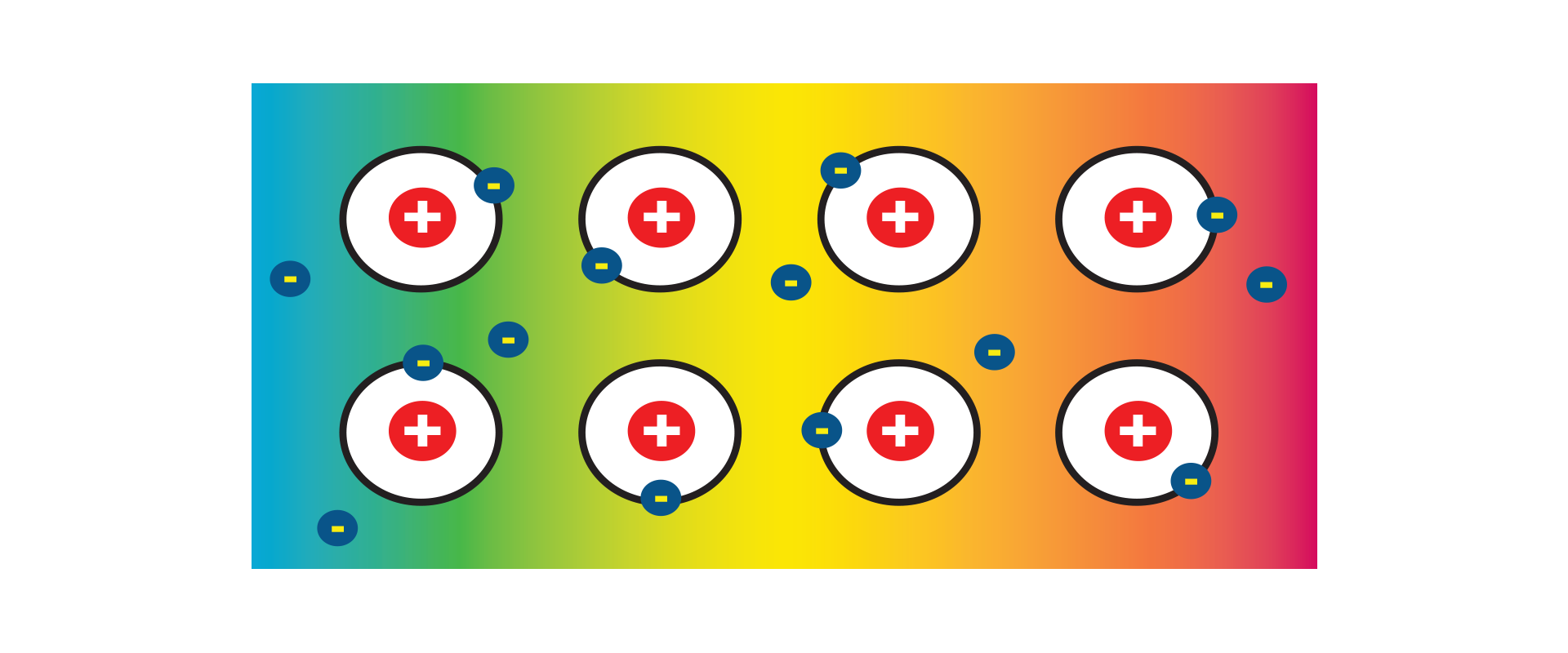
The conductor is a body in which electrons orbiting the atomic nucleus are weakly bound to the atomic nucleus. The electrons in the outermost orbits can practically move freely throughout the whole volume of a body.
RNKkBUNhojZJ61
Na rysunku przedstawione jest schematycznie osiem atomów: kółko ze znakiem plus, wokół niego okrąg, na którym jest kółko ze znakiem minus. Kółka ze znakiem minus znajdują się także w wolnej przestrzeni między atomami.
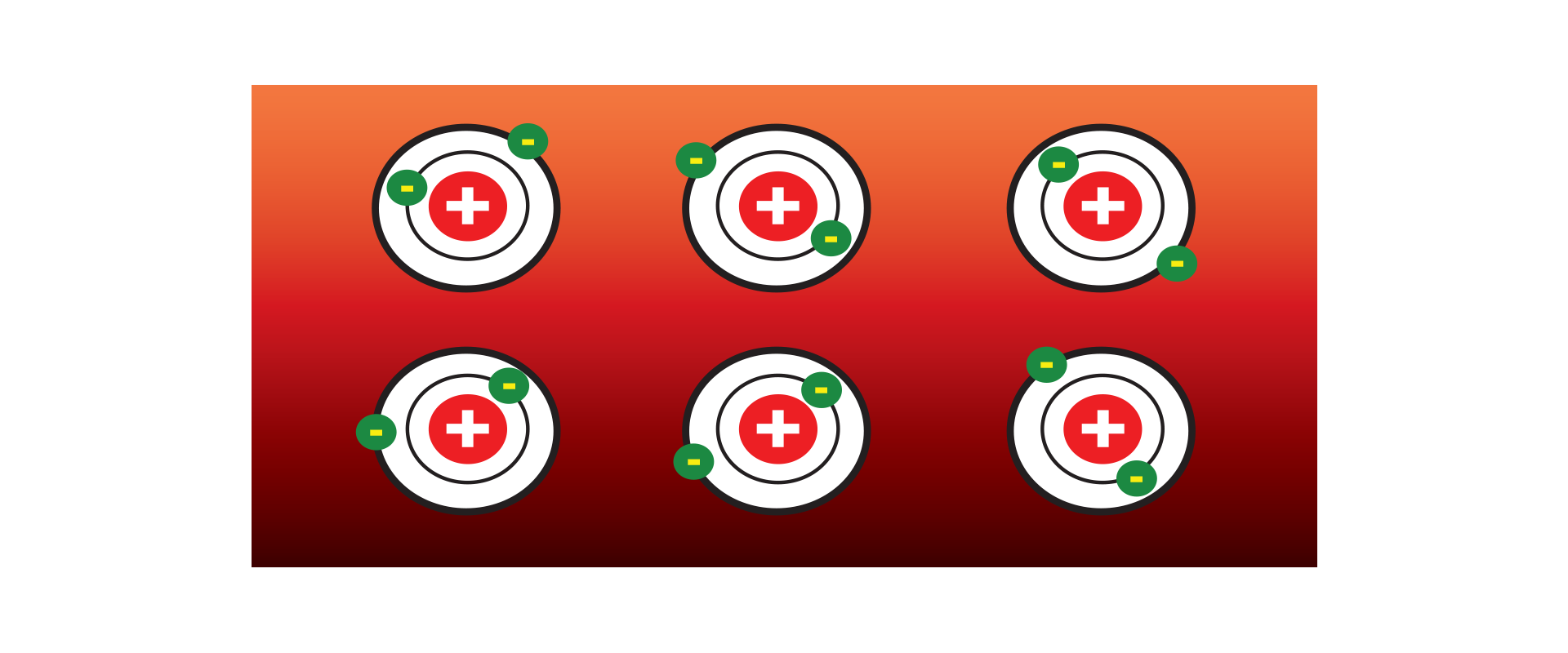
The insulator is a body in which electrons orbiting the nucleus are strongly bound to the nucleus and absolutely cannot move throughout the whole volume of the body. In certain situations, they can move slightly inside an atom.
R134Be0MtwHSD1
Na rysunku przedstawione jest schematycznie sześć atomów: kółko ze znakiem plus, wokół niego dwa okręgi, na każdym z nich jest kółko ze znakiem minus.
Source: GroMar, licencja: CC BY 3.0.
RKwJogODcwv1o
W górnej części ilustracji interaktywnej przedstawione jest schematycznie sześć atomów: kółko ze znakiem plus, wokół niego dwa okręgi, na każdym z nich jest kółko ze znakiem minus. Jeden z atomów oznaczony numerem 1, jedno kółko ze znakiem minus oznaczone jest numerem 2. W dolnej części ilustracji interaktywnej przedstawione jest jest schematycznie osiem atomów: kółko ze znakiem plus, wokół niego okrąg, na którym jest kółko ze znakiem minus. Kółka ze znakiem minus znajdują się także w wolnej przestrzeni między atomami. Jeden z atomów oznaczony numerem 3, jedno kółko ze znakiem minus oznaczone jest numerem 4. Na ilustracji widoczne są numery, a na nich podpisy. 1. insulators {audio}, 2. electrons move only around atom's parent nucleus {audio}, 3. conductors {audio}, 4. electrons move in the entire volume {audio}.
W górnej części ilustracji interaktywnej przedstawione jest schematycznie sześć atomów: kółko ze znakiem plus, wokół niego dwa okręgi, na każdym z nich jest kółko ze znakiem minus. Jeden z atomów oznaczony numerem 1, jedno kółko ze znakiem minus oznaczone jest numerem 2. W dolnej części ilustracji interaktywnej przedstawione jest jest schematycznie osiem atomów: kółko ze znakiem plus, wokół niego okrąg, na którym jest kółko ze znakiem minus. Kółka ze znakiem minus znajdują się także w wolnej przestrzeni między atomami. Jeden z atomów oznaczony numerem 3, jedno kółko ze znakiem minus oznaczone jest numerem 4. Na ilustracji widoczne są numery, a na nich podpisy. 1. insulators {audio}, 2. electrons move only around atom's parent nucleus {audio}, 3. conductors {audio}, 4. electrons move in the entire volume {audio}.
Chargingcharging Charging is the process of accumulation of an excess of chargecharge charge of the same sign in a given body.
Charging by inductioninductioninduction of a conductor is based on the displacement of free electrons inside it.
Charging by induction of an insulator causes its polarizationpolarizationpolarization (displacement of charges inside atoms - dipoles).
Consider the situation.
We bring a charged ebonite rod (-) close to a not charged electroscope (without touching), and then the same with a glass rod (+).
R1LtmERNEUVQ0
Ilustracja interaktywna przedstawia schemat elektroskopu opisany electroscope. Na jego górze znajduje się kółko oznaczone numerem 2, wokół którego narysowane są znaki plus. Poniżej pionowy prostokąt. Przy jego dolnym końcu koło oznaczone numerem 3. Wewnątrz tego koła dwa odcinki ukośne opisane znakami minus. Po lewej stronie elektroskopu znajduje się prostokąt ze znakami minus opisany ebonite rod, oznaczony numerem 1. Na ilustracji widoczne są numery, a na nich podpisy. 1. negatively charged ebonite rod {audio}, 2. positively charged electroscope sphere {audio}, 3. electrons that flew away under the influence of repulsion by the ebonite rod {audio}.
Ilustracja interaktywna przedstawia schemat elektroskopu opisany electroscope. Na jego górze znajduje się kółko oznaczone numerem 2, wokół którego narysowane są znaki plus. Poniżej pionowy prostokąt. Przy jego dolnym końcu koło oznaczone numerem 3. Wewnątrz tego koła dwa odcinki ukośne opisane znakami minus. Po lewej stronie elektroskopu znajduje się prostokąt ze znakami minus opisany ebonite rod, oznaczony numerem 1. Na ilustracji widoczne są numery, a na nich podpisy. 1. negatively charged ebonite rod {audio}, 2. positively charged electroscope sphere {audio}, 3. electrons that flew away under the influence of repulsion by the ebonite rod {audio}.
Bringing a charged body (regardless of its sign) to a not charged electroscope causes the moving of electrons in the electroscope, as a consequence the positive/negative charge accumulating on the electroscope ball and opposite charge on the electroscope leaves, and as the cosequence it causes the leaves to rise. After moving the charged body away, the leaves close.
Under the influence of a charged body free electrons in the conductor move.
During the interaction with a positively charged body, electrons „come close” to it.
When brought near to a negatively charged body, free electrons in the conductor move to be as far as possible.
In the first case, the separation of chargecharge charge occurs - deficiency of electrons on the leaves (+).
In the second case, excess of electrons on the leaves (-).
As a result of the presence of like charges, the leaves rise.
The leaves of the electroscope can be charged temporarily.
Using charged ebonite rod and charged glass rod, perform the experiment described above and then answer the questions.
1. Is chargingcharging charging of the electroscope leaves permanent?
2. What are the differences when charging the leaves of the electroscope by inductioninductioninduction (influence) with ebonite rods and glass rods?
3. Suggest how the leaves of the electroscope can be charged permanently.
R1OulYVPo7Buq
Rysunek przedstawia schemat elektroskopu - A. Na górze elektroskopu znajduje się kółko, wokół którego narysowane są znaki plus; poniżej pionowy prostokąt, przy jego dolnym końcu koło, wewnątrz którego dwa odcinki ukośne opisane znakami minus. Po lewej stronie elektroskopu znajduje się prostokąt ze znakami minus.
RBYcjB5rEuPIQ
Rysunek przedstawia schemat elektroskopu - B. Na górze elektroskopu znajduje się kółko, wokół którego narysowane są znaki plus; poniżej pionowy prostokąt, przy jego dolnym końcu koło, wewnątrz którego dwa odcinki pionowe. Po lewej stronie elektroskopu znajduje się prostokąt ze znakami minus. Po prawej stronie prostokąta narysowana pozioma linia opisana - e ze strzałką w prawo, od niej pionowa linia do trzech poziomych linii leżących pod sobą, od najdłuższej do najkrótszej.
RTj3krG00CN4S
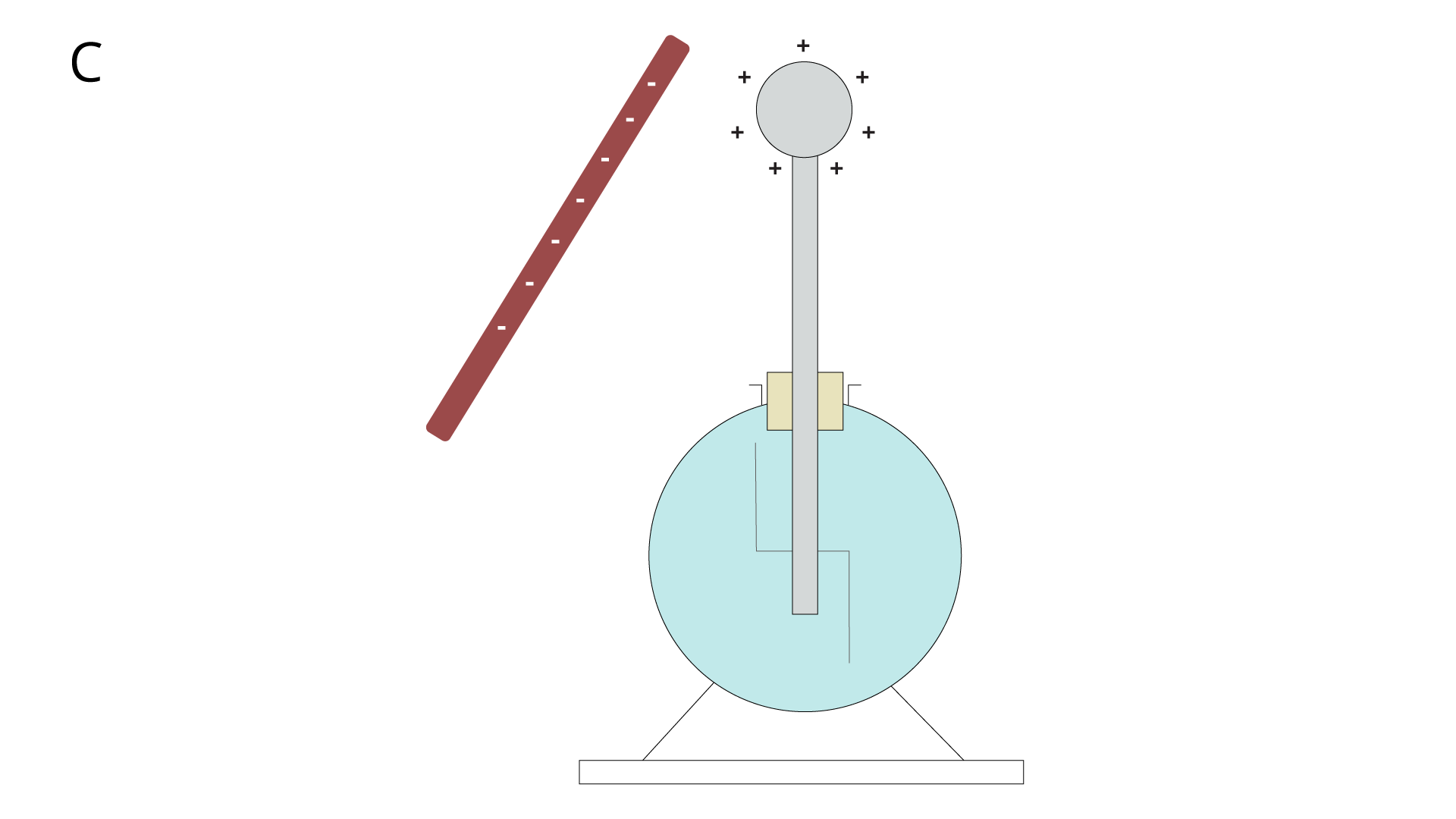
Rysunek przedstawia schemat elektroskopu - C. Na górze elektroskopu znajduje się kółko, wokół którego narysowane są znaki plus; poniżej pionowy prostokąt, przy jego dolnym końcu koło, wewnątrz którego dwa odcinki pionowe. Po lewej stronie elektroskopu znajduje się prostokąt ze znakami minus.
RBip6XpvIjnUZ
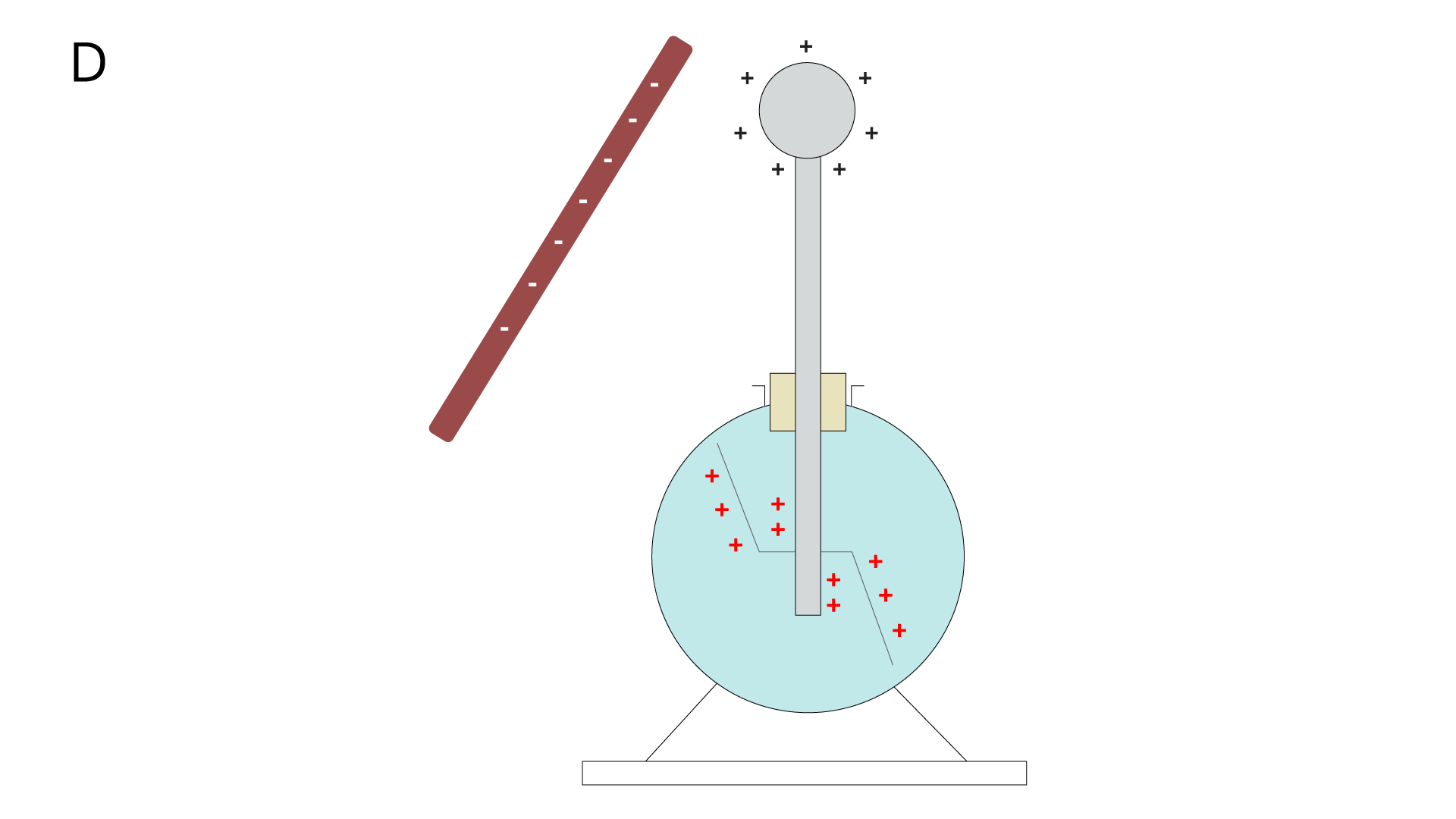
Rysunek przedstawia schemat elektroskopu - D. Na górze elektroskopu znajduje się kółko, wokół którego narysowane są znaki plus; poniżej pionowy prostokąt, przy jego dolnym końcu koło, wewnątrz którego dwa odcinki ukośne, wokół których narysowane są znaki plus.
1. Bring the charged rod nearer to the electroscope, so that its leaves will rise.
2. Touch the electroscope with your finger (not the rod). Our finger acts like grounding. Electrons pushed to the leaves are „looking for” a further way to get away from the negative rod as far as possible and are leaving the electroscope through our finger. The leaves will close.
3. We remove the finger from the electroscope - the situation does not change.
4. When we take the charged rod away, which we kept all the time close to the electroscope, then the leaves will rise again. This is because the electrons „escaped” through our finger when they were repelled by the rod.
Chargingcharging Charging by inductioninductioninduction, i.e. the influence of another charged body nearby, relies on the displacement of free electrons within the metal or the polarizationpolarizationpolarization of atoms in the insulator (electric dipoles are created). As a result, the body as a whole is still electrically neutral, but one side has „+” chargecharge charge and the other „-” charge.
Exercises
R9UNQyGF27JK7
Exercise 1
Wersja alternatywna ćwiczenia: Determine which sentences are true. Możliwe odpowiedzi: 1. During charging by induction, the charge flows from one body to the other., 2. During charging by induction in conductors the positive charge is displaced., 3. During charging by induction in conductors the negative charge is displaced., 4. It is not possible to permanently charge an insulator by induction.
Wersja alternatywna ćwiczenia: Determine which sentences are true. Możliwe odpowiedzi: 1. During charging by induction, the charge flows from one body to the other., 2. During charging by induction in conductors the positive charge is displaced., 3. During charging by induction in conductors the negative charge is displaced., 4. It is not possible to permanently charge an insulator by induction.
Determine which sentences are true.
During charging by induction, the charge flows from one body to the other.
During charging by induction in conductors the positive charge is displaced.
During charging by induction in conductors the negative charge is displaced.
It is not possible to permanently charge an insulator by induction.
zadanie
Source: GroMar, licencja: CC BY 3.0.
Exercise 2
You have two bars made of a conductor, e.g. copper, and a highly negatively charged ebonite rod. You can also use wooden pliers, which are used in chemical laboratories. Describe how you should proceed to:
1. charge the two bars with different charges,
2. charge positively one of the bars,
3. charge negatively one of the bars.
We bring the ebonite rod close to the two copper bars which are connected together. And then:
1. using wooden pliers (insulator), we separate the copper bars,
2. using a hand, we move away the bar which lies further away from the ebonite rod,
3. using a hand, we bring nearer the bar which lies closer to the ebonite rod.
Exercise 3
Storm clouds are approaching the area. In the short time, the charge flows between the cloud and the Earth. We are watching the lightning. Write in English what caused the flow of charge.
R1LUqQ0Yt9eRP
Exercise 4
Wersja alternatywna ćwiczenia: Indicate which pairs of expressions or words are translated correctly. Możliwe odpowiedzi: 1. elektryzowanie - charging, 2. indukcja - induction, 3. ładunek - charge, 4. przesunięcie ładunków - charge, 5. polaryzacja - induction
Wersja alternatywna ćwiczenia: Indicate which pairs of expressions or words are translated correctly. Możliwe odpowiedzi: 1. elektryzowanie - charging, 2. indukcja - induction, 3. ładunek - charge, 4. przesunięcie ładunków - charge, 5. polaryzacja - induction
Indicate which pairs of expressions or words are translated correctly.
elektryzowanie - charging
indukcja - induction
ładunek - charge
przesunięcie ładunków - charge
polaryzacja - induction
zadanie
Source: GroMar, licencja: CC BY 3.0.
RG1dzx40pFLTH1
Interaktywna gra, polegająca na łączeniu wyrazów w pary w ciągu jednej minuty. Czas zaczyna upływać wraz z rozpoczęciem gry. Jeden ruch to odkrywanie najpierw jednej potem drugiej karty z wyrazem. Każdy wyraz jest odczytywany. Kolejny ruch to odkrywanie trzeciej i czwartej karty. W ten sposób odsłuchasz wszystkie wyrazy. Nawigacja z poziomu klawiatury za pomocą strzałek, odsłuchiwanie wyrazów enterem lub spacją. Znajdź wszystkie pary wyrazów.
Interaktywna gra, polegająca na łączeniu wyrazów w pary w ciągu jednej minuty. Czas zaczyna upływać wraz z rozpoczęciem gry. Jeden ruch to odkrywanie najpierw jednej potem drugiej karty z wyrazem. Każdy wyraz jest odczytywany. Kolejny ruch to odkrywanie trzeciej i czwartej karty. W ten sposób odsłuchasz wszystkie wyrazy. Nawigacja z poziomu klawiatury za pomocą strzałek, odsłuchiwanie wyrazów enterem lub spacją. Znajdź wszystkie pary wyrazów.
Match Polish terms with their English equivalents.
ładunek
elektryzowanie
charging
indukcja
induction
charge
Source: Zespół autorski Politechniki Łódzkiej, licencja: CC BY 3.0.