Common language connects people
how to recognise environmental language variationslanguage variations
what are the reasons for which people create different variations of language
what are online slangslang dictionaries
how to create a youth slang dictionary
Before the lesson
You are a student and therefore a member of the student community. Prepare a list of environmental groups that you have contact with or you belong to.
Find websites with vocabulary typical for different environments on the internet. They can be dictionaries of words used by the representatives of various professional groups (e.g. doctors, stockbrokers), but also by computer players, sportsmen, fans of a specific musical genre (e.g. rap, hip‑hop) etc. On this basis, create a list of the most original words (terms) or the most interesting definitions.
The language that people use every day has many functions. Thanks to the language, you can create an infinite number of texts, extract, name and describe reality, communicate, transfer your knowledge, share your experiences and emotions. The language can finally unite members of a given professional community, environmental or peer group.
Think who creates the names of subculturessubcultures – members of subcultures or people from outside? can any of the terms from task 1 be offensive? Discuss this in the classroom.
Individual environmental groups have developed their own means of communication. They can be called environmental language variations or a group language. Environmental language variations differ mainly in vocabulary. Examples of such environmental language variations may be: the language of students, sportsmen, soldiers, doctors or IT specialists.... Environmental variations also include slangs and jargons, ie languages of informal groups, subcultures (e.g. hip‑hop).
Many words functioning in group languages have equivalentsequivalents in general Polish. Some of them, however, have a stronger emotional meaning. It is enough to compare pairs of the following words: „rodzice” – „staruszkowie” („parents” – „old people” ) or „dyrektorka” – „dyrka” (lack of corresponding word in English). A lot of dictionaries containing words characteristic of a specific environmental language variation have been created so far. Such dictionaries published on the internet have been particularly popular recently (see eg. Słownik slangu or Urban Dictionary).
A very important role in contemporary Polish is played by sociolectssociolects, ie variations of language functioning in a specific social group. Nobody knows what number of sociolects currently exists in Poland. The reason is that actually every group that work together can have their own way of communicating. Some social classes create it unintentionally. Then the sociolectsociolect is created only because people work together and talk about it. Other groups create sociolect on purpose. We can say that they do it deliberately, making sure that the way of mutual communication is in accordance with the rules.
Remember that sociolect is not a separate language (such as sign language or Kashub language). Actually, it is above all a collection of words that are not used outside the group. For example, in the sociolect of make‑up artists, words related to make‑up appear, such as nouns: „kocie oko” (cat's eye), „fluid” (liquid foundation), „korektor” (concealer), „kreska” (eyeline), but also verbs (action names): „rozświetlić” (light up), „przypudrować” (put face powder), „wklepywać” (pat in). The sociolect of bodybuilders includes words that call different types of muscles: „grucha”, „klata”, „tricek”, „kaptury”, „motyle” but also commonly known words got here, used to name other activities: „pakować” (pack), „pchać”, „cisnąć” (push) etc.
Use the materials prepared at home to create an interactive map. Put the names of social groups and examples of jargon words on it.
The character of sociolect is influenced by various elements, the words typical for a specific social group (specialized vocabulary), as well as the words belonging to the national language. There are three types of sociolects:
Slangs – these are playful and very expressive languages. They are created by informal environments, usually young and creative people. They play with the language and use it to differentiate themselves from the rest of society. Their language is the hallmark of their group. It contains many variants of words that refer to the same phenomena (e.g. „sleep” is: „kimać”, „ciąć komara”, „walić w kimono”, „zawinąć się w naleśnik”).
Professional languages – professionals create them. Most often they are people who do a profession that requires professional communication. The words they use are very precise, deprived of emotions, and the phenomena they call do not have too many synonyms. People outside of their group often may not understand their statements.
Secret languages – they are made up by people who want to hide information from others. In a sense, this language works like a cipher. Some words do not quite resemble Polish words. That is why the content is well masked. People who do something illegal (e.g. criminals, drug dealers) usually speak this way, Sometimes, they also use them – just for fun – children.
Referring to the vocabulary gathered before the lesson – determine to which of the three types of sociolects the words mentioned by you belong.
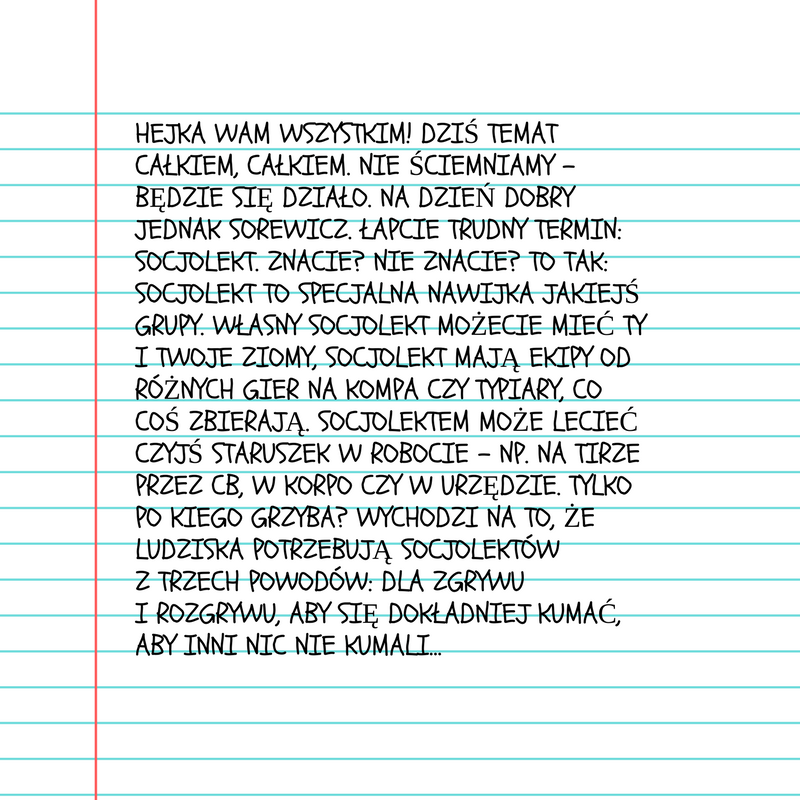
Read the below statement of your peer.
After reading the text, follow the instructions.
The quoted text is written in the youth language. In fact, the author tried to imitate this language accurately. Give the name of the device based on the intentional imitation of someone's speech style.
Describe the impressions made on you while you were reading this text.
List all words that are characteristic of youth slang from the text. Then think and write if you know any more recent equivalents of these words (for example, those used by your peers).
Project
Working in groups, prepare student's language dictionary.
Q for questionnaire: To create a student's language dictionary, you will need a questionnaire. Students should carry it out with each other and among other students of the school. Thanks to it, young researchers will gather a lot of words and will create a real dictionary out of them. Remember: the commands in this questionnaire shouldn’t be complicated. bearing in mind that it may be difficult to come up with topics concerning school life, below there are some examples of topics that may appear in the questionnaire:
What do you call school grades?
What do you call school subjects?
What do you call teachers?
What school sayings do you remember?
What other words related to the school do you use (e.g. „learn”, „have no task”, etc.)?
R for research: When the questionnaires are ready (you can write them in hand for a few minutes), students should go to research. They can do it during breaks, during part of the lesson or after lessons (as homework).
W for „what next?”: Now is the time to organize the collected material. Students working in larger groups should create a dictionary net. The best way to do this is to use a spreadsheet (e.g. Excel, LibreOffice).
A dictionary net is just a type of table with an alphabetical list of words. Typical dictionary categories should appear in the columns of the table (their list is open and depends on the teacher). The completed table is a ready „input” of the content for the dictionary. At the end, you can publish it in paper form (print it out) or put it in the electronic version on the website.
Match the pairs: English words with Polish definition.
grupa środowiskowa, odpowiednik, slang, odmiana języka potocznego, właściwa danej grupie środowiskowej, środowiskowa odmiana języka, subkultura, socjolekt, odmiana języka właściwa danej grupie społecznej
| environmental group | |
| subculture | |
| language variants used by community | |
| slang | |
| equivalent | |
| sociolect |
Keywords
general language, slang, jargon, environmental variation
Glossary
subkultura
środowiskowa odmiana języka
slang, odmiana języka potocznego, właściwa danej grupie środowiskowej
odpowiednik
socjolekt, odmiana języka właściwa danej grupie społecznej