Deserts
what is the relationship between the altitude of the Sun above the horizon and the climate;
that cyclic changes in temperature can occur both on a scale of a day and on a scale of a year.
discuss climatic conditions prevailing in the hot desert;
show the existence of a relationship between extremely low rainfall and a small amount of plants and animals in the desert;
exchange threats to human health and life in the desert.
Climatic conditions in the hot desert
In both hemispheres, there are special climaticclimatic conditions around the tropics. Apart from a short period of time, when the sun approaches the zenith at noon and rain can occur, there is almost constant drought here. During the day the sky is cloudless and the air temperature is as much as 50°C. No clouds and very dry air do not allow rainfall. During the night, heat is quickly released into the atmosphere, which is why just before sunrise the air temperature is often negative. A small amount of rainfall and very high air temperature cause rapid evaporation and desiccation of the ground to significant depths. The wind that is constantly blowing can create large sand dunes. From time to time, strongly heated air masses rise quickly, causing a pressure difference and a violent wind. This is how a sandstorm is created. In such conditions large areas are created almost devoid of vegetation called desertsdeserts. Slightly more plants are found in semi‑desertssemi‑deserts.
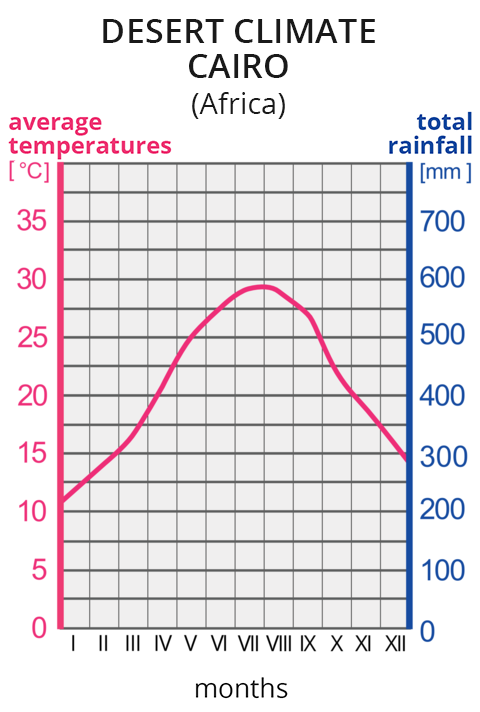
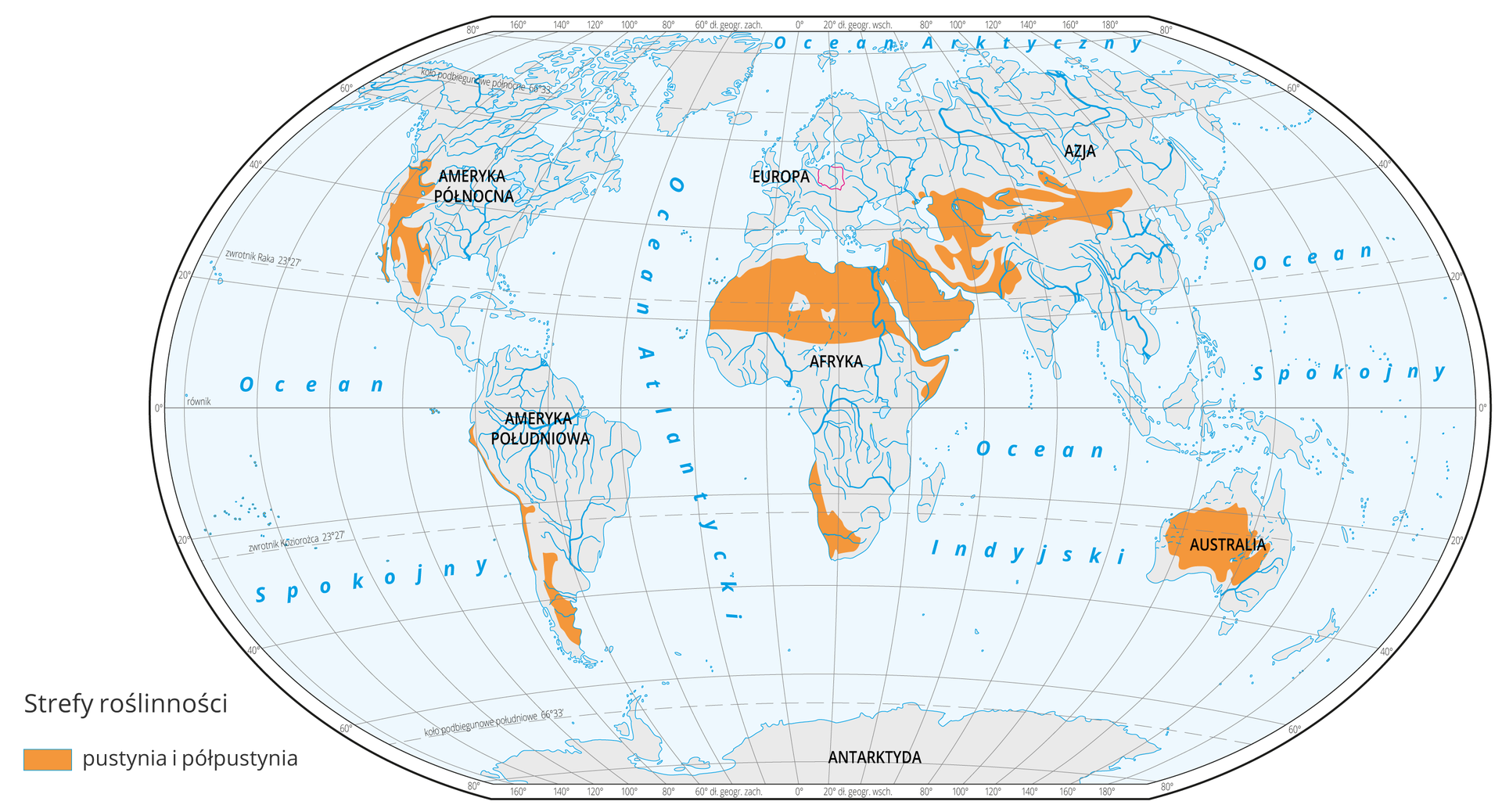
In hot deserts from time to time (usually once a year, but sometimes once in a few years), heavy rain falls. Desert valleys are quickly filled with rapid water. The wide and winding rivers are created for a short time, and the water flowing in them changes the terrain. In places where water accumulates for longer, oasesoases are formed. There are characterized by springs, wells and lush vegetation.
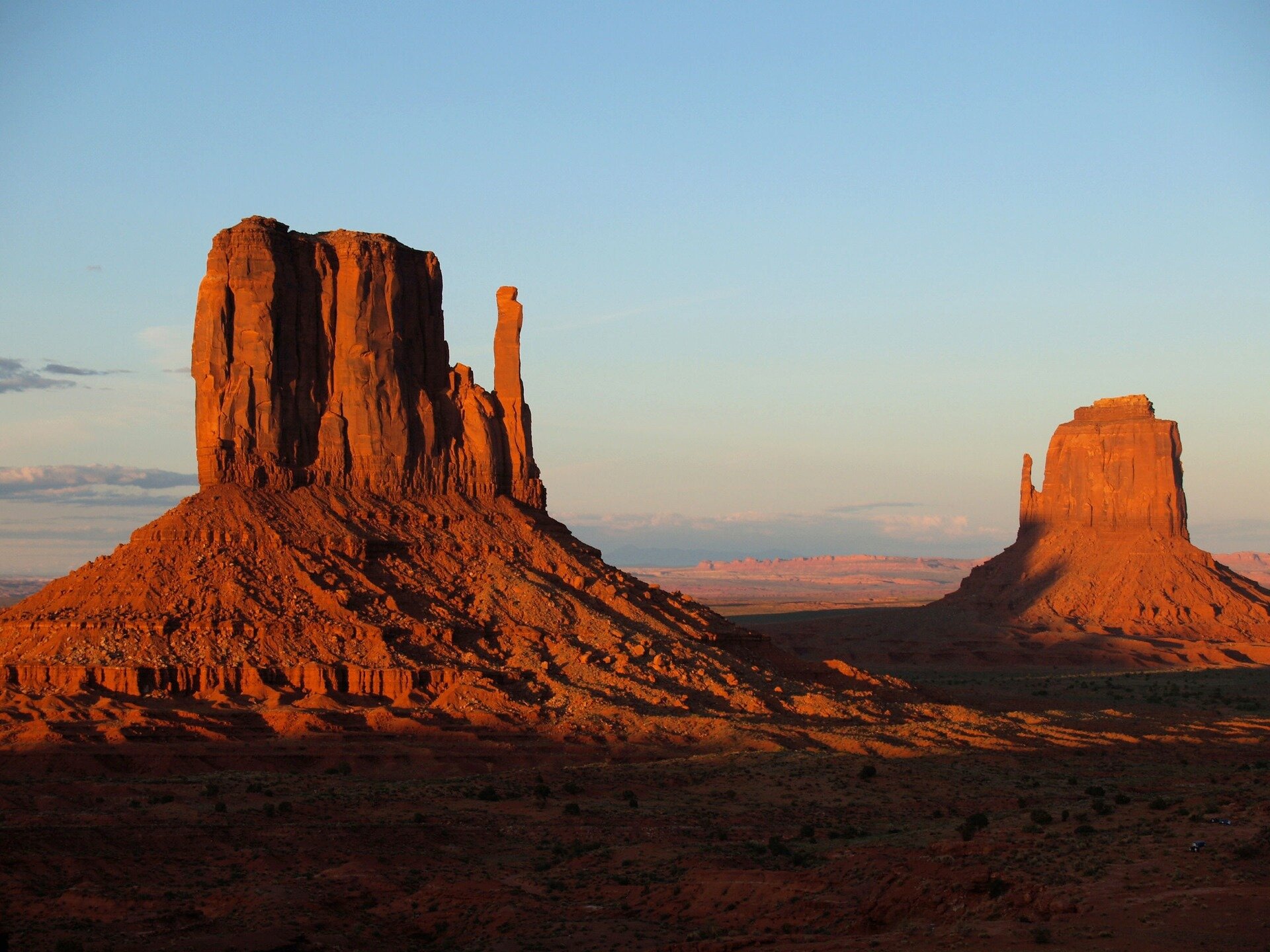
In addition to sand, deserts can be made of gravel and rocks. There are even salty deserts, mostly covered with salt. They arise in places where salt lakes once existed.
Life in the desert
Conditions prevailing in a desert are extremely unfavorable, and even dangerous for human life and most organisms. However, you can survive in the desert. Some plants and animals have adapted to the conditions of hot deserts.To survive in the desert, people who often go through it have also adapted. First of all, you have to try to provide the body with enough water. You have to drink 6, and with a lot of physical effort, up to 10 liters of water a day.You should also take care to limit the loss of water through the skin. For this purpose, it is necessary to cover the head and loose, light, preferably cotton clothing covering the whole body (cotton permeates the air, and thus allows heat to pass away from the skin). Desert people like the Berbers are transporting goods across the desert. They use pack animals for this purpose: horses or drought‑resistant camels. They wander the desert in caravans created for safety. A lone journey through the desert is in fact very dangerous.
Indicate the climate features of the hot tropic desert.
- even temperature above 25°C
- high humidity
- large fluctuations in air temperature
- high rainfall in the winter half-year
- equalized temperature above 50°C
- very low rainfall
- low atmospheric pressure
Summary
Hot deserts are located near tropics.
The desert are without vegetation with a stony, gravel or sandy foundation.
In the hot deserts there are large daily temperature fluctuations and very low humidity.
Keywords
desert, oasis, sandstorm, climate
Glossary
oaza – teren o bujnej roślinności, czerpiącej wodę z płytko zalegających wód podziemnych, otoczony przez pustynię lub półpustynię
półpustynia – teren o ubogiej roślinności i warunkach klimatycznych zbliżonych do pustyni. Nieco większe opady umożliwiają tam jednak życie trochę większej ilości roślin
pustynia – teren gdzie na skutek okresowo wysokiej temperatury powietrza i skrajnie niskich opadów nie ma zwartej pokrywy roślinnej
klimat – ogół zjawisk pogodowych na danym obszarze, ustalanym na podstawie obserwacji prowadzonych w okresie nie krótszym niż 30 lat.