Digestive system
food provides body with building materials and energy;
in the digestive system the digestion and food absorption take place.
to enumerate the organs that are part of the digestive system and to show where they are located (on a schematic drawing and on your own body);
to analyze the connection between the structure of selected organs of the digestive system and their functions;
How the digestive system is built
The digestive system is responsible for the intake and the digestion of food, as well as the absorption of the nutrients in that food. It is composed of the digestive tract, through which food passes (and in its final part the undigested food elements), and the glands that are connected with the tract: salivary glands, liver and pancreas.

Oral cavity, throat, oesophagus
Food processed by the teeth is mixed by the tongue with saliva – the product of the salivary glands. The amount of saliva depends on the pH and the consistency of the food. Acidic and dry food increases the amount of saliva produced. The mucus in saliva softens the processed food, glues it together, facilitates the forming of chunks of food and swallowing them. In the saliva there are also bactericidal substances that kill germs which reach the oral cavity with the food; substances that neutralize acidic ingredients (to protect the enamel) and digestive enzymes.
Oral cavity is connected with the throat. It is a joint section of both the digestive and the respiratory tract. Behind the throat there is the larynx, an organ that belongs to the respiratory system. Usually, the entrance to the larynx remains open (when we talk or breathe). When we swallow, the entrance to the larynx becomes closed by a cartilage called epiglottis. It prevents the food from accessing the respiratory system and causes it to pass straight to the oesophagus.
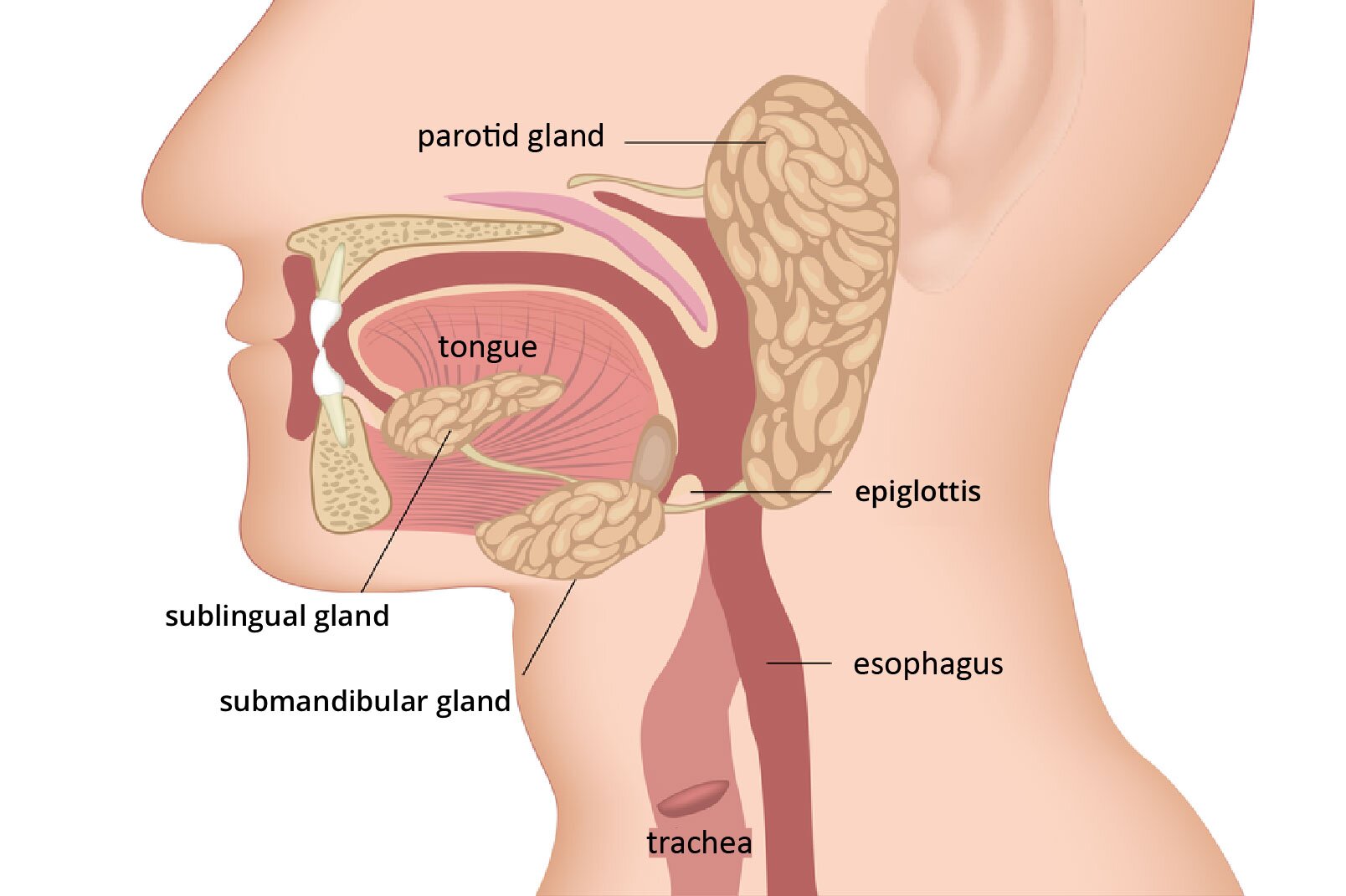
Oesophagus is a muscled tube that leads to the stomach. The smooth muscles that are present in the oesophagus and throat contract regularly, causing peristalsis that moves food into the stomach.
When you quickly swallow several portions of dry food, e.g. a bread roll, your oesophagus can get blocked for a short while. Explain why it happens and why it helps to drink some water in this situation.
Stomach and small intestine
Stomach is situated in the abdominal cavity, below the sternum, towards left. It is a type of a tank with the capacity of 1,5 litre in which food is stored (for up to 8 hours) and chemically processed. The stomach wall has glands that secrete gastric juicegastric juice, which consists mainly of digestive enzymes and hydrochloric acid. The latter destroys swallowed microbes and causes the muscles of the stomach wall to contract, which facilitates the mixing of food with the digestive enzymes and the movement of food towards the intestine. The mucus produced in the stomach protects its walls from damage caused by the acidic gastric acid and the digestive glands (self‑digestion).
The middle part of the digestive tract, and also its longest part, is the small intestine that is over 6 m long, and which initial part is called duodenum. It is situated in the abdominal cavity, right below the stomach. Here, the next stage of digestion takes place. The walls of the small intestine have glans that secrete, among other things, digestive enzymes.
Liver and pancreas are equipped with pipes which open into the duodenum.
Liver is the biggest gland of the body, and it is situated in the upper part of the abdominal cavity, to the right. It produces and secretes bilebile, which flows to the gallbladder, where it is temporary stored and thickened. Intense metabolic processes take place in the liver, which is why the blood that flows through it is heated up and then distributed throughout the entire body. This is how the liver participates in keeping stable body temperature. The liver is a type of filter through which the food that was absorbed from the intestine to the blood passes through. Before it reaches the cells, it has to be clean from poisons, e.g. alcohol and ingredients of medicines.
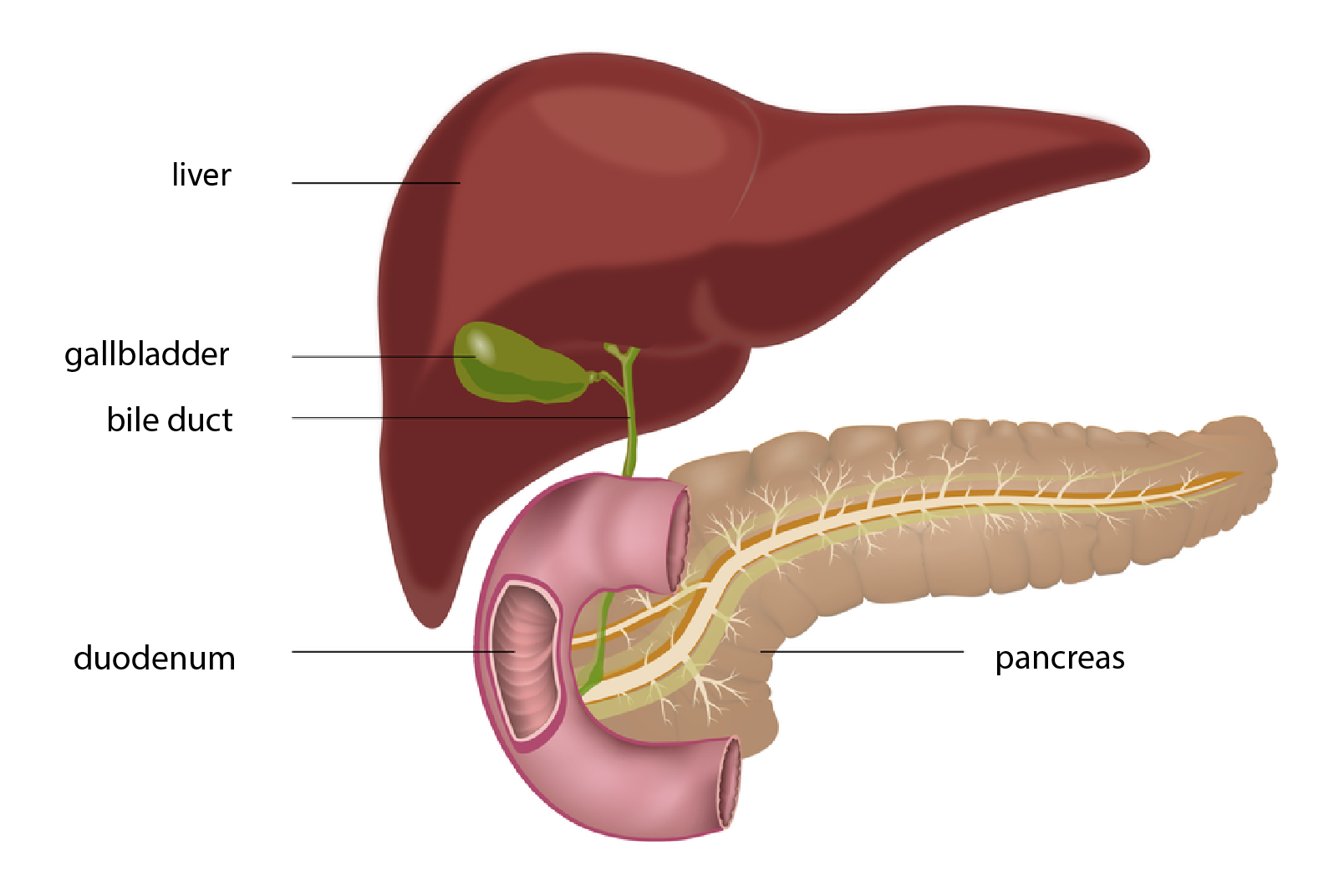
Pancreas is a gland that is situated below the stomach and has two important functions: endocrine - it produces hormones, and exocrine - it produces digestive enzymes.
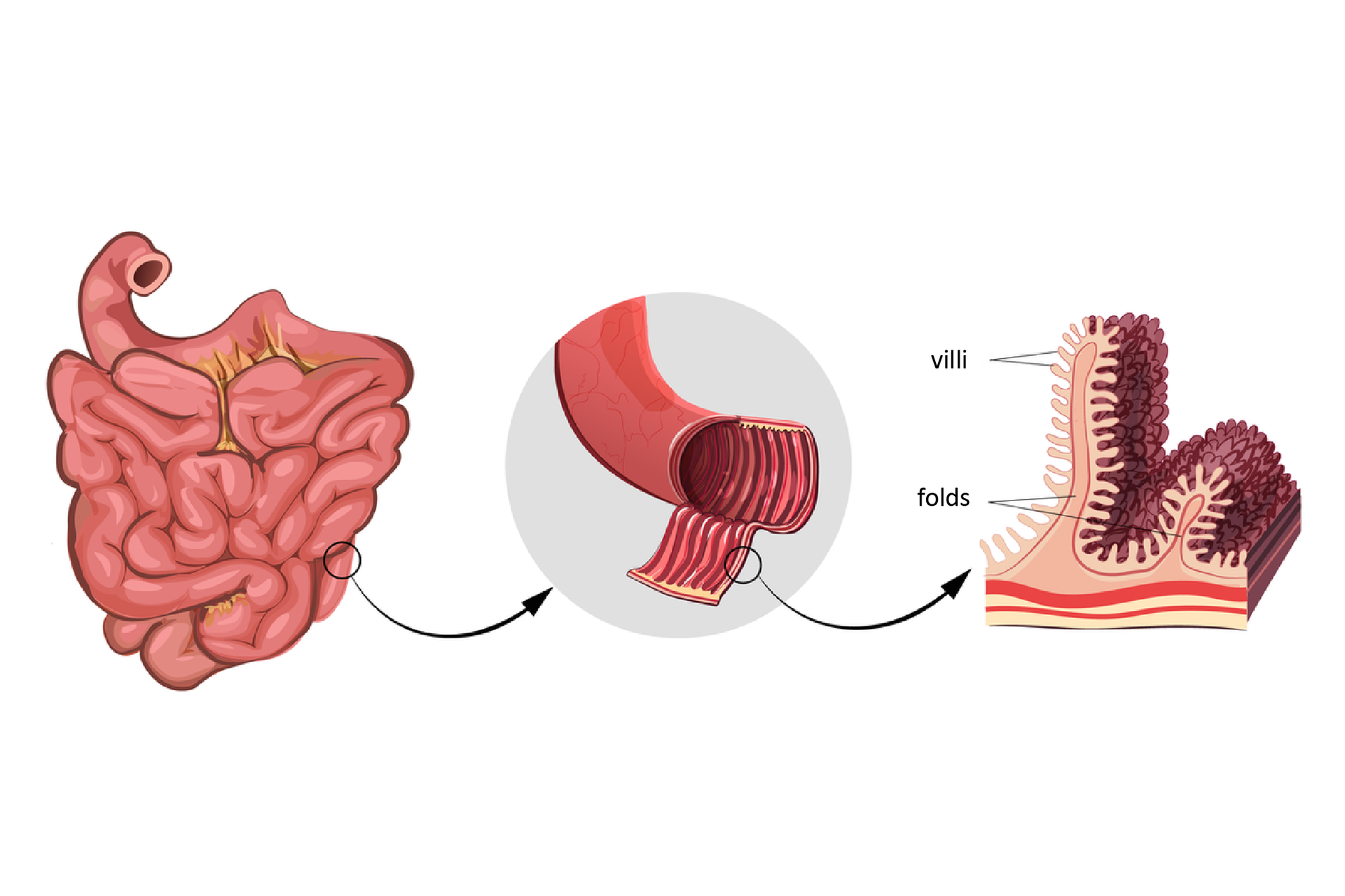
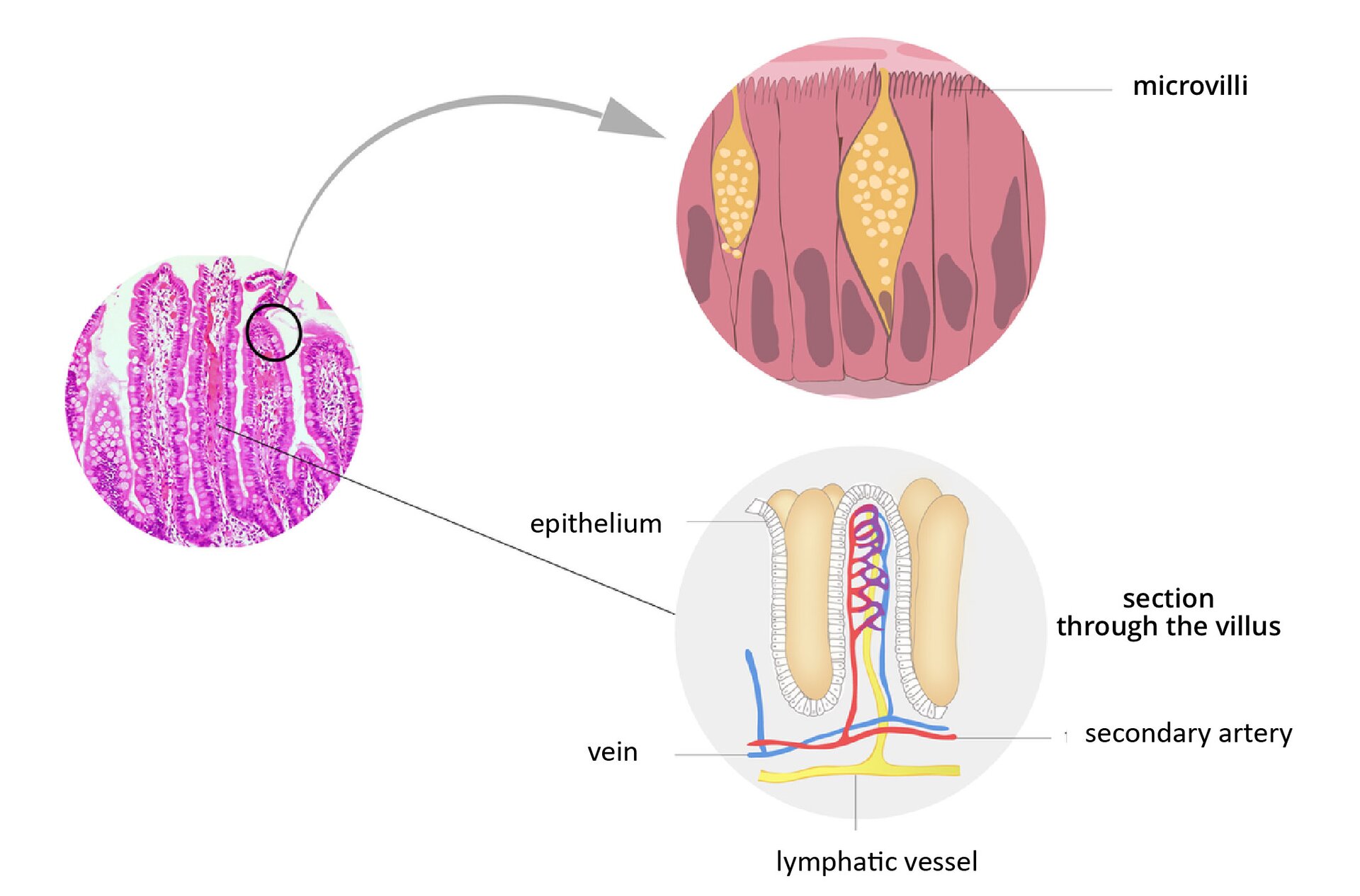
Nutrients are absorbed in the intestine. The interior surface of the intestine is wrinkled. There are numerous finger‑like projections present in the intestine - the intestinal villi, which are covered by even smaller projections - microvilli. The folds of the villi create a huge surface for absorption - it is close in size to the surface of a tennis court (around 300 square metres). Inside the villi, there are villus capillaries and villus lacteals (lymph capillary), which absorb nutrients. The final place the digested food reaches are the cells of the body. Food is transported there via blood.
Large intestine
The border between the small intestine and the last part of the digestive tract - large intestine - is where caecum is, which is joined to the appendix. In herbivore mammals, the caecum is well‑developed, as it is where cellulose is digested. In case of humans (as an example of an omnivore), this organ is reduced and it is a dead‑end pouch (vestigial organvestigial organ). Sometimes, when the appendix receives nutrients and they are stored there for some time, they start fermenting and an inflammation begins. Treatment in such cases involves surgical extraction of the infected organ.
In the large intestine there around 500 types of bacteria, which create a specific intestinal microflora. They digest the ingredients that are not absorbed by humans. This process creates a liquid mass from which water is taken out and faecal mass is formed. Thanks to peristaltic movements of the large intestine these masses are moved towards the last part of the large intestine - rectum and through anus, they are expelled from our body.
During an antibiotic treatment it is advised to use probiotics and prebiotics. Using various sources, explain the meaning of these two words.
Order the organs of the digestive tract, starting with the top.
- anus
- throat
- small intestine
- stomach
- oral cavity
- oesophagus
- duodenum
- large intestine
Summary
Digestive system is responsible for the intake, digestion and absorption of nutrients and the expulsion of undigested food.
Digestive system consists of digestive tract and digestive glands connected with it.
The movement of food along the digestive tract takes place thanks to peristaltic movements.
The stomach's food is mixed and crushed and partially digested
The first part of the small intestine is called duodenum, and it is where bile and enzymes of the pancreas are transferred.
In the small intestine the nutrients are digested and absorbed.
The large intestine is where the water and mineral salts are flushed out and where faecal mass is formed.
Keywords
digestive tract, intestine, digestive glands
Glossary
narząd szczątkowy – narząd, który u przodków danego gatunku był dobrze rozwinięty i pełnił ważne funkcje; w toku ewolucji zanika i przestaje pełnić swoją rolę; u człowieka narządem szczątkowym są na przykład zęby mądrości, wyrostek robaczkowy, kość ogonowa
sok żołądkowy – wydzielina żołądka zawierająca m.in. enzymy rozpoczynające trawienie białek, kwas solny i śluz
żółć – wydzielina wątroby zawierająca substancje ułatwiające trawienie tłuszczów; składniki żółci rozbijają tłuszcze na drobniutkie kuleczki, dzięki czemu enzymy trawienne obecne w dwunastnicy mają do nich łatwy dostęp