Earth's atmospheric layers
what the place of the atmosphere is in relation to the lithosphere, hydrosphere, biosphere and pedosphere;
that the Earth's atmosphere is the part of the Earth and moves with it.
explain the term „atmosphere”;
name gases that form the air and their percentage share;
name permanent and variable components of atmospheric air;
name the layers of the atmosphere;
discuss the role of the ozone layer;
characterize the effects of the ozone holeozone hole and the greenhouse effect.
What layers is the atmosphere built of?
In the Earth's atmosphere we distinguish 5 main layers characterized by specific features and 4 intermediate layers called pauses. The boundaries between them are conventional and change depending on the geographical latitude, terrain and season of the year.
The closest one to the surface of the earth is the troposphere. Its thickness ranges from 7 km (in winter) to 10 km (in summer) above the poles, and 15‑18 km above the equator. The main feature that allows determining the boundary of the troposphere is the drop in the air temperature with an increase of about 0,6°C per 100 m. In the upper layer of the troposphere, the temperature reaches -55°C (above arctic regions) to -70°C (above equatorial regions).
Above this layer there is a thin tropopause with the constant temperature, and above it there is the stratosphere extending up to a height of about 50 km, in which the air temperature rises to reach 0°C. In the stratosphere there is the ozonosphere – a layer with an increased content of ozone (oxygen in the form of triatomic particles), which reaches the highest concentration at a height of 25‑30 km. It plays a very important role – it protects the Earth against the lethal ultraviolet radiation emitted by the Sun. At the upper boundary of the stratosphere, a few‑kilometre thick stratopause, the temperature is constant.
The next layer is the mesosphere reaching up to around 80 km, in which the temperature constantly decreases down to -70°C and even -100°C. Above the mesopause there is a layer called the thermosphere with a rising temperature of up to 1000°C, and at a height of 500‑600 km, even up to 1500°C. Above its upper boundary – thermopause – there is the exosphere in which the very low‑density air temperature begins to drop down to -273°C in cosmic space. The upper boundary of the exosphere is difficult to be determined.
As the height increases, the atmospheric pressure drops. From approximately 1000 hPa hectopascals at the sea level through 200 hPa at the boundary with the tropopause, 1 hPa at the boundary of the stratopause, up to 0.000 001 hPa in the exosphere.
Where is the ozone layer located? Describe the appearances in each of the layers.
Think for a while and explain the reason why the layer thickness of the atmosphere above the poles is smaller than above the equator.
Match the information to the appropriate atmospheric layer.
It has the ozonosphere that plays a very important role in protecting the Earth against the ultraviolet radiation emitted by the Sun., It is located up to a height of 80 km., It is the closest layer to the Earth's surface., The temperature therein constantly decreases and reaches even -270 degrees Celsius., The outer layer of the atmosphere. The temperature increases with increasing height. In this sphere, the aurora phenomenon occurs.
| Troposphere | |
| Exosphere | |
| Mesosphere | |
| Thermosphere | |
| Stratosphere |
Check the composition of atmosphere layers in available sources. The fixed components of atmospheric air are:
- nitrogen, oxygen, water vapour, hydrogen, argon, ozone, helium, methane
- argon, neon, nitrogen, hydrogen, methane, helium, krypton, oxygen
- carbon dioxide, ozone, sulphur dioxide, hydrogen, methane, helium, krypton, oxygen
Practising the ability to measure atmospheric air pressure.
Finding the magnitude of atmospheric pressure at the Earth's surface.
Understanding pressure variability in the lower tropospheric layers.
barometer.
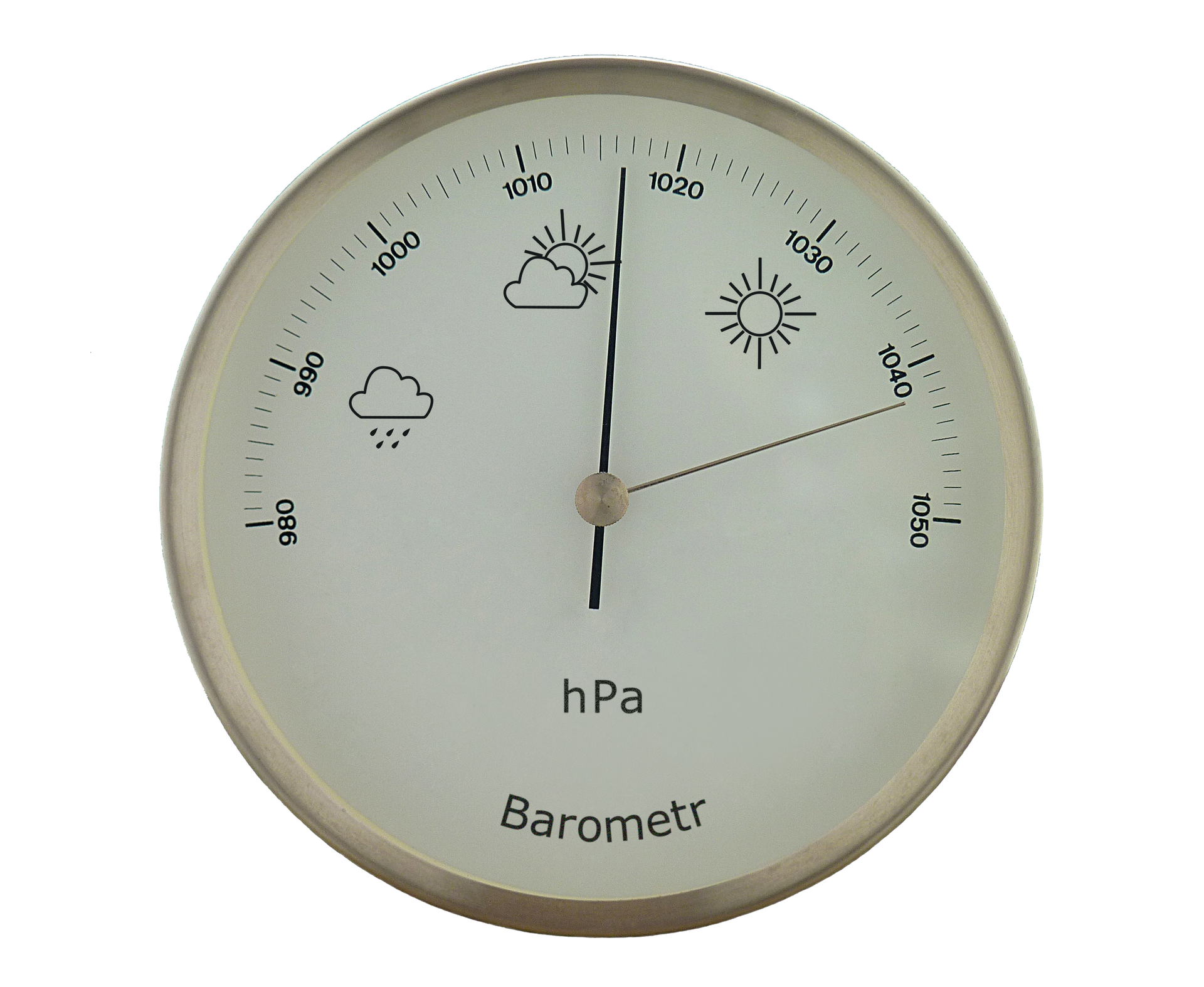
Read the barometer reading, giving the correct pressure unit.
Read the extreme possible barometer readings, which probably exceed the range of atmospheric pressure in Poland near the Earth's surface.
How the barometer works?
Film dostępny na portalu epodreczniki.pl
Film prezentujący jak w domowych warunkach zrobić barometr, barometer. Na otwór pustego słoika założona zostaje guma wycięta z balonu i umocowana gumką recepturką. Do gumy przyklejona zostaje wykałaczka. Tak skonstruowany barometr zostaje postawiony przy kartonie, na którym flamastrem oznaczone zostaje wskazanie. W zależności od wzrostu lub spadku ciśnienia wskazówka uniesie się lub opuści.
Atmospheric pressure can be measured both indoors and outdoors, because only few rooms (e.g. balloons covering tennis courts) are so tight that they can create a pressure different from the natural atmospheric pressure that is above a given area at the same time.
Review out the effects of the ozone hole and the greenhouse effect.
Summary
Atmospheric air consists of approximately 78% nitrogen, 21% oxygen, less than 1% argon and dozens of other components.
Most air constituents are present in fixed proportions, only the content of water vapour and carbon dioxide, and some impurities changes quite clearly in time and space.
The atmosphere is composed of 5 main layers: troposphere, stratosphere, mesosphere, thermosphere and exospheres, and 4 transition layers: tropopause, stratopause, mesopause, and thermopause.
The air temperature changes depending on the atmosphere layer: it decreases in the troposphere, increases in the stratosphere, decreases in the mesosphere, increases significantly in the thermosphere, and decreases significantly in the exosphere.
The air temperature near the Earth's surface depends on many different natural factors and on human activity.
Keywords
atmosphere, air, spheres
Glossary
dziura ozonowa - zjawisko spadku stężenia ozonu w stratosferze atmosfery ziemskiej. Do powierzchni Ziemi dociera większa ilość promieniowania nadfiloetowgo (UV), czego następstwem jest: większa zachorowalność na raka skóry, uszkodzenia wzroku, osłabienia odporności, niszczenie planktonu.