Ecosystem of the forest, ecosystem of the lake
that the environment has an impact on organisms;
that organisms are adapted to the environment;
that the living conditions underwater are different from those on land;
that the interactions between species inhabiting one environment are either antagonistic or non‑antagonistic.
to name living and non‑living parts of an ecosystem;
to describe the relationship between living and non‑living elements of an ecosystem;
to provide examples how organisms can impact the non‑living part of an ecosystem;
to describe the structure of forest and lake ecosystems.
Forest ecosystem
Primeval forest is an example of a naturally formed and stable terrestrial ecosystem. Such ecosystems can be found in almost every part of the Earth. Depending on the latitude, we distinguish rainforests, taigas, or mixed forests in temperate regions. Factors that affect the organisms constituting an ecosystem include average annual temperature, seasons, and soil moisture. Trees growing in different climate zones have adjusted accordingly to make the best use of the sunlight available.
Name as many species living in the temperate zone forest as you can, including microorganisms, fungi, plants and animals.
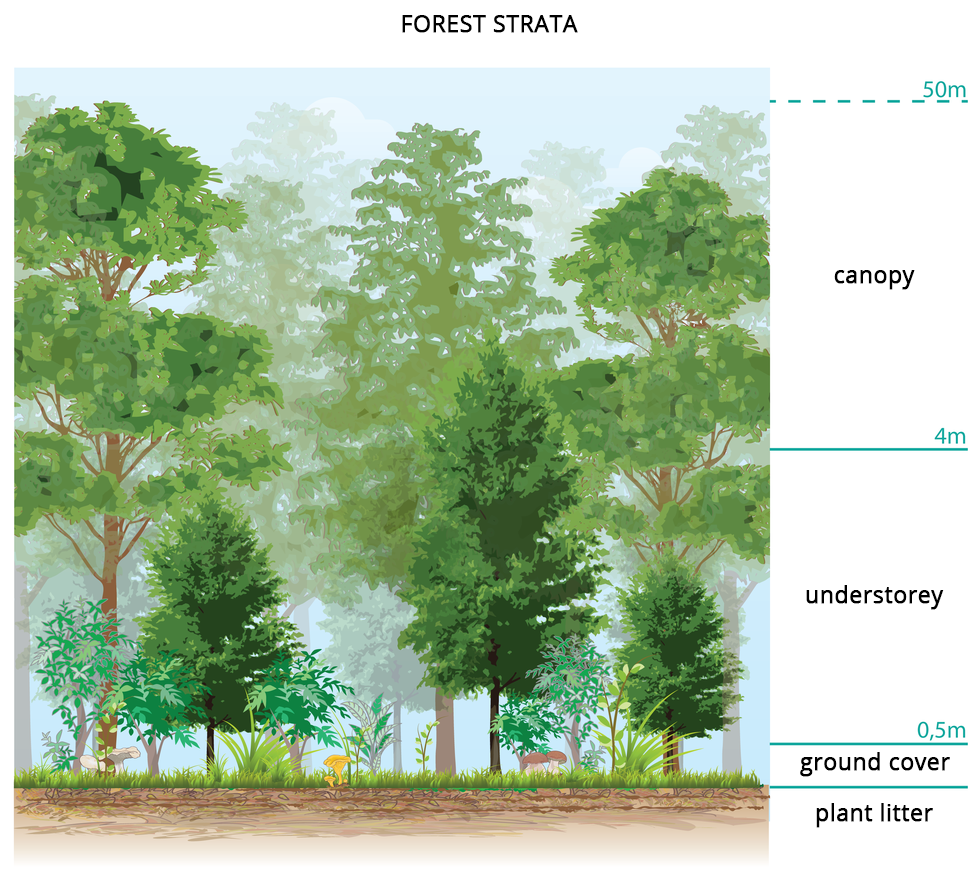
The forest ecosystem is characterised by stratification, which is the result of plants competing for sunlight access. There are four strata in a temperate zone hardwood forest: plant litter, ground cover, understorey, and canopy. A rainforest has more strata.
The lowest stratum is called the plant litter. It consists of dead organic matterorganic matter, mainly plant remains. Due to the presence of saprobiontssaprobionts such as bacteria or fungi, decomposition processes are constantly taking place, as a result of which organic matter is transformed into forest soil. Large amounts of heat are released in the process, fostering the development of invertebrates living in this strata. The amount of plant litter depends on the activity of decomposers. Therefore, there is very little to no plant litter in warm climate, where decomposition happens very fast, while in taiga it forms a thick layer. For this reason, taiga soil, unlike rainforest soil, is of fertility.
Every year, the thicket produces huge amounts of organic matter, which serves as food for many heterotroph species. Every species has its own place in the forest system and is connected to the environment and other species in many different ways.
Lake ecosystem
Similarly to forests, lakes also have different layers depending on the depth, with varying levels of sunlight access. There are three groups of organisms inhabiting a lake: those that live at the bottom, active swimmers, and those that float freely in midwater.
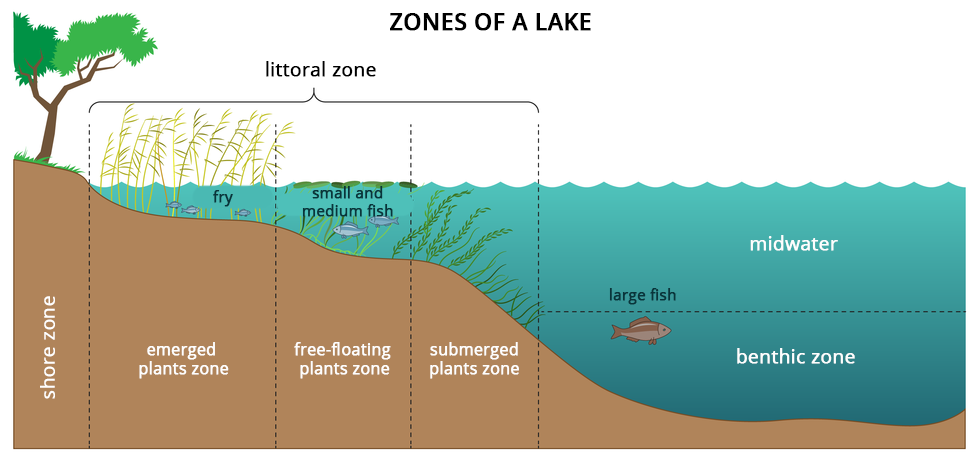
The littoral zonelittoral zone is located close to the shoreline. Water here is shallow and receives a lot of sunlight during daytime. In consequence, it is warm on a sunny day, and cools down quickly during the night. In winter, water in the littoral zone freezes. Due to the shallowness and waves caused by the wind, the water is well‑oxygenated, which together with sunlight fosters the development of various organisms. Plants that grow by the shore—ditch reed, sweet flag—are rooted in the lake bottom immediately below the water surface. Those that grow further from the shore—nymphanea, nuphar—do not grow high above the surface, just enough to develop their leaves above it, with roots in the lake bottom. Even further from the shore, underwater plants can be found—pondweed, Canadian waterweed. Many animals live in the littoral zone: aquatic insects and their larvae, fry, tadpoles, fish such as pike, perch, roach, amphibians—frogs and newts—and many species of birds.
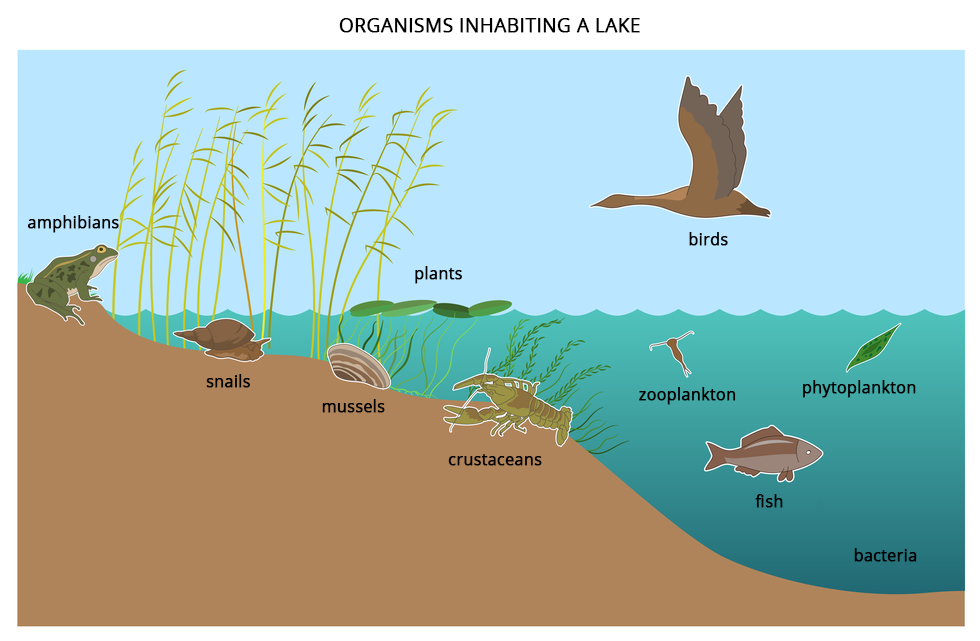
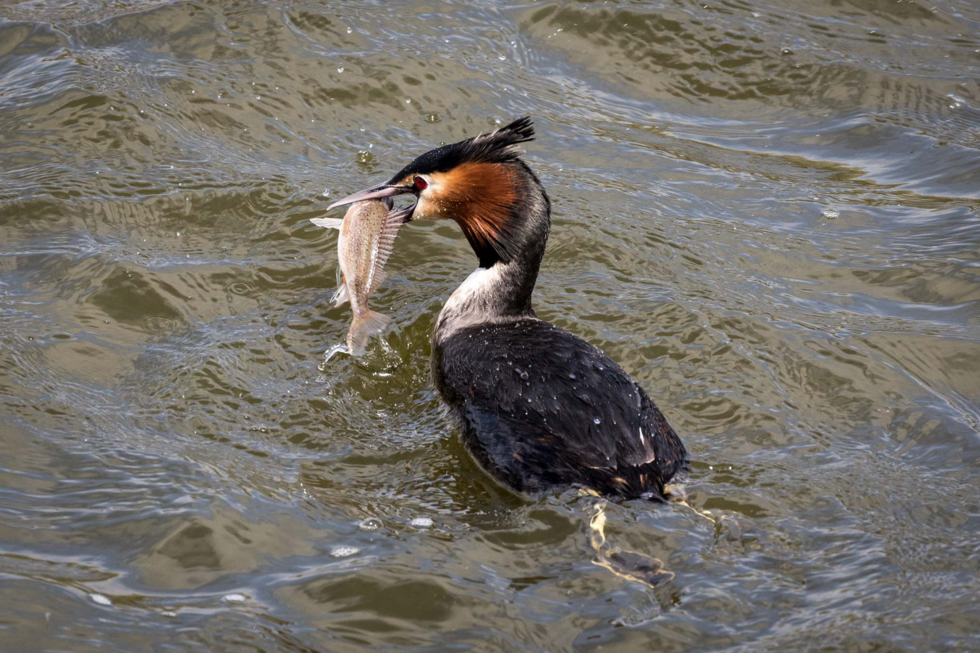
The midwatermidwater receives varying amounts of sunlight, depending on the depth and transparency of water. Relatively high fluctuations of the temperature and oxygenation appear close to the surface, but the conditions stabilise with depth. Fewer animals live here than in the littoral zone, and no plants are rooted in the bottom. The inhabitants of this zone include grayling and zander, as well as great crested grebe and great cormorant. Under the surface, many small organisms float, known as planktonplankton.
Not much sunlight or oxygen reaches the benthic zonebenthic zone. The range of temperatures is narrow here. In winter, when the surface water is frozen, the temperature near the bottom remains at a stable 4°C, approximately. There are no plants in this zone; only bacteria, protists, and animals. Most of them feed on dead organic matter that falls onto the bottom. Many, like mussels, filter out food particles from the water. At the lake bottom, demersal fish can be found, mainly eels. Some animals, such as frogs, spend the winter hidden in the mud at the bottom.

Arrange the forest strata from lowest to highest.
- canopy
- plant litter
- understorey
- ground cover
Match the description of the forest stratum with its name.
the highest stratum, reaching 50 m, plants and fungi that grow directly above the plant litter, dead organic matter in which decomposition processes take place, shrubs and small trees not taller than 4 m
| plant litter | |
| ground cover | |
| understorey | |
| canopy |
Which of the following zones belong to the littoral zone?
- shore zone
- emerged flora zone
- free-floating plants zone
- submerged flora zone
- benthic zone
- midwater
Summary
An ecosystem is the combination of abiotic environment with all the populations of different species inhabiting it, as well as the processes and interactions between themselves and between them and the inanimate environment.
In an ecosystem, the environment affects individual species of animals, and those change the environment in turn.
Ecosystems can be divided into artificial and natural, or terrestrial and aquatic.
The structure of a forest ecosystem is based on strata.
The structure of a lake ecosystem is dependent on water depth and transparency.
A lake consists of three main zones: littoral zone, midwater, and benthic zone.
Keywords
strata, midwater, littoral zone
Glossary
ekologia – dział biologii zajmujący się funkcjonowaniem ekosystemów; bada środowiska i zamieszkujące je zespoły organizmów
ekosystem – wydzielony fragment przyrody składający się z elementów ożywionych i nieożywionych powiązanych ze sobą zależnościami, utrzymujący się w dynamicznej równowadze
plankton – drobne organizmy swobodnie unoszące się w toni wodnej
materia organiczna – masa złożona z ciał organizmów
saprobionty – organizmy odżywiające się martwą materią organiczną; saprofagi – organizmy zwierzęce odżywiające się szczątkami zarówno roślin jak i zwierząt; saprofity to organizmy niezwierzęce rozkladające martwą materię organiczną
strefa denna – strefa obejmująca dno zbiornika i wodę, do której dociera niewielka ilość światła; panuje tam niska temperatura
strefa toni wodnej – strefa obejmująca odległe od brzegu wody położone pod powierzchnią zbiornika; jest dobrze oświetlona, zamieszkiwana przez plankton i aktywnie pływające zwierzęta
strefa przybrzeżna – strefa, w której występują rośliny zakorzenione w dnie oraz glony i inne organizmy; charakteryzuje się dużą zmiennością warunków