The force of the interaction between the charges is directly proportional to the product of their magnitude and inversely proportional to the square of the separation between them.
where: - the force of interactioninteractioninteraction between charges, - the magnitude of charges interacting with each other, - separation between charges, – electrostatic constant depends on the type of the matter in which the charges are located.
1. There are two types of charge - positive and negative.
2. Two like charges repel each other and unlike charges attract.
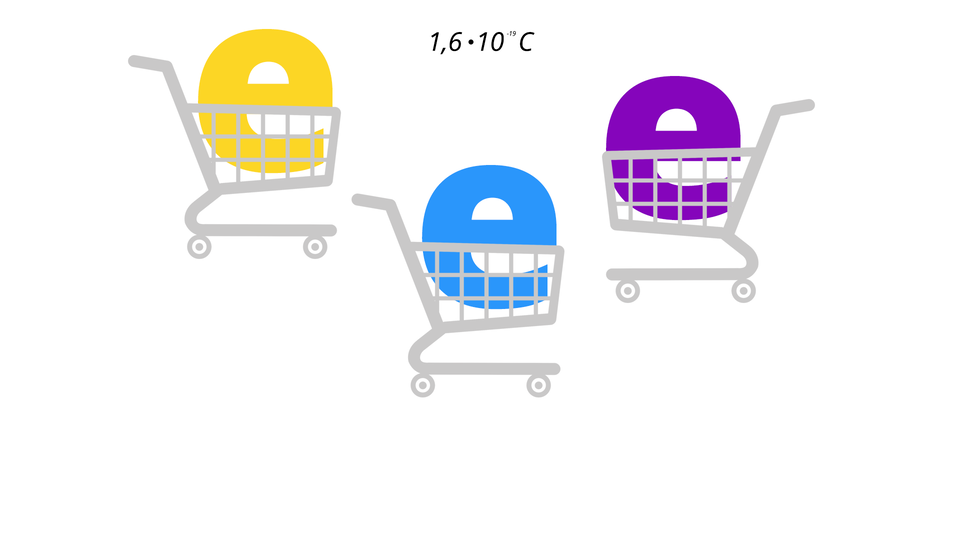
3. Every charge is always total multiple of one the least possible portion of charge called the elementary charge.
Watch the slidehow.
RdbYtHHrpjWzb
Pokaz slajdów - własności ładunków. Instrukcja obsługi z poziomu klawiatury: 1. Uruchomienie aplikacji - ENTER, 2. Na każdym ze slajdów czytany jest automatycznie tekst alternatywny po polsku, 3. Przy pierwszym uruchomieniu na pierwszym slajdzie, czytanie tekstu po angielsku - TAB, 4. Przejście między slajdami: do następnego slajdu - TAB, do poprzedniego slajdu - TAB + SHIFT, 5. Przejście do czytania napisu po angielsku - strzałka w górę + strzałka w dół (czyta tekst po angielsku widoczny na slajdzie).
Pokaz slajdów - własności ładunków. Instrukcja obsługi z poziomu klawiatury: 1. Uruchomienie aplikacji - ENTER, 2. Na każdym ze slajdów czytany jest automatycznie tekst alternatywny po polsku, 3. Przy pierwszym uruchomieniu na pierwszym slajdzie, czytanie tekstu po angielsku - TAB, 4. Przejście między slajdami: do następnego slajdu - TAB, do poprzedniego slajdu - TAB + SHIFT, 5. Przejście do czytania napisu po angielsku - strzałka w górę + strzałka w dół (czyta tekst po angielsku widoczny na slajdzie).
In nature there are two types of electric charges: positive and negative.
Charges with the same signs, called like charges, repel each other whereas charges with different signs, called unlike charges, attract.
A scientific instrument that is used to examine the magnitude of electric charge on a body is called an electroscope.
An electrically charged body has excess or deficiency of electrons.
Exercises
Rvt9Je2omuOMO
Exercise 1
Wersja alternatywna ćwiczenia: The unit of electrical charge in the SI system is Możliwe odpowiedzi: 1. wat., 2. coulomb., 3. joules., 4. newton.
Wersja alternatywna ćwiczenia: The unit of electrical charge in the SI system is Możliwe odpowiedzi: 1. wat., 2. coulomb., 3. joules., 4. newton.
The unit of electrical charge in the SI system is
wat.
coulomb.
joules.
newton.
zadanie
Source: GroMar, licencja: CC BY 3.0.
Exercise 2
Two identical balls with charges -4Q and 2Q are located at a distance r from each other and are attracted by the force of 8 N.
a) What will be the magnitude of the interaction between loads if we spread them twice the distance?
b) Will it be repulsion or attraction?
a) 2 N
b) repulsion
Exercise 3
You have at your disposal a few identical balloons inflated and tied with a thin thread. By rubbing balloons, for example with a thin sweater or fabric, you can collect a certain charge on them. Suggest how you can explain in this case a qualitatively the Coulomb's law. Write a brief instruction for such an experiment in English.
R19whVfOZZw3p
Exercise 4
Wersja alternatywna ćwiczenia: Indicate which pairs of expressions or words are translated correctly. Możliwe odpowiedzi: 1. ładunek elektryczny - electric charge, 2. cechy ładunku - charge properties, 3. prawo Coulomba - Coulomb's law, 4. elektroskop - interaction, 5. oddziaływanie - electroscope
Wersja alternatywna ćwiczenia: Indicate which pairs of expressions or words are translated correctly. Możliwe odpowiedzi: 1. ładunek elektryczny - electric charge, 2. cechy ładunku - charge properties, 3. prawo Coulomba - Coulomb's law, 4. elektroskop - interaction, 5. oddziaływanie - electroscope
Indicate which pairs of expressions or words are translated correctly.
ładunek elektryczny - electric charge
cechy ładunku - charge properties
prawo Coulomba - Coulomb's law
elektroskop - interaction
oddziaływanie - electroscope
zadanie
Source: GroMar, licencja: CC BY 3.0.
R1ZeFtNDrnibL1
Interaktywna gra, polegająca na łączeniu wyrazów w pary w ciągu jednej minuty. Czas zaczyna upływać wraz z rozpoczęciem gry. Jeden ruch to odkrywanie najpierw jednej potem drugiej karty z wyrazem. Każdy wyraz jest odczytywany. Kolejny ruch to odkrywanie trzeciej i czwartej karty. W ten sposób odsłuchasz wszystkie wyrazy. Nawigacja z poziomu klawiatury za pomocą strzałek, odsłuchiwanie wyrazów enterem lub spacją. Znajdź wszystkie pary wyrazów.
Interaktywna gra, polegająca na łączeniu wyrazów w pary w ciągu jednej minuty. Czas zaczyna upływać wraz z rozpoczęciem gry. Jeden ruch to odkrywanie najpierw jednej potem drugiej karty z wyrazem. Każdy wyraz jest odczytywany. Kolejny ruch to odkrywanie trzeciej i czwartej karty. W ten sposób odsłuchasz wszystkie wyrazy. Nawigacja z poziomu klawiatury za pomocą strzałek, odsłuchiwanie wyrazów enterem lub spacją. Znajdź wszystkie pary wyrazów.
Match Polish terms with their English equivalents.
electric charge
ładunek elektryczny
charge properties
cechy ładunku
interaction
oddziaływanie
Source: Zespół autorski Politechniki Łódzkiej, licencja: CC BY 3.0.