Electric current and current intensity
Prąd elektryczny i jego natężenie
to explain the phenomenon of electric current flow and define the intensity of electric current in English.
Prepare answers to the introductory questions for the lesson.
What is an insulator?
What is a conductor?
Indicate the basic differences in the structure of the insulator and conductor.
Why can electricity flow only through conductors?
1. What is electric currentelectric current?
The bodies, which as a whole are electrically neutral, hide charges of both signs inside. We also know that there are bodies called conductors, where some of these charges (electrons or ions) are free to move. The movement of these charge carriers is chaotic. However, if an external factor arranges the movement of charges, we deal with electric currentelectric current.
2. What is an orderly movement?
Examples of an orderly movement.
- In the lake, the water somehow moves, but in different places it does in a different direction. In the river, water moves in one direction. This is the orderly movement. It is sometimes called river current.
- Or one more comparison. Imagine you are in a Spanish city on the street. The festival is underway. People walk chaotically from place to place, jostling each other. Finally, the main attraction of the day follows: the bulls were released. The crowd begins to move one way, away from the bulls running down the street. Before the bulls were released, the street resembled a conductor where no electric currentelectric current flows. People are free charge carriers. Bulls enforce the orderly movement of the crowd. During the current flow through a conductor we deal with such an orderly movement of charges.
- It should be emphasized that during the current flow, charges do not move quite as neatly as soldiers on a parade, but rather like a rushed running crowd. This is in addition an obstacle race, because on the way of electrons there are positive metal ions standing still.
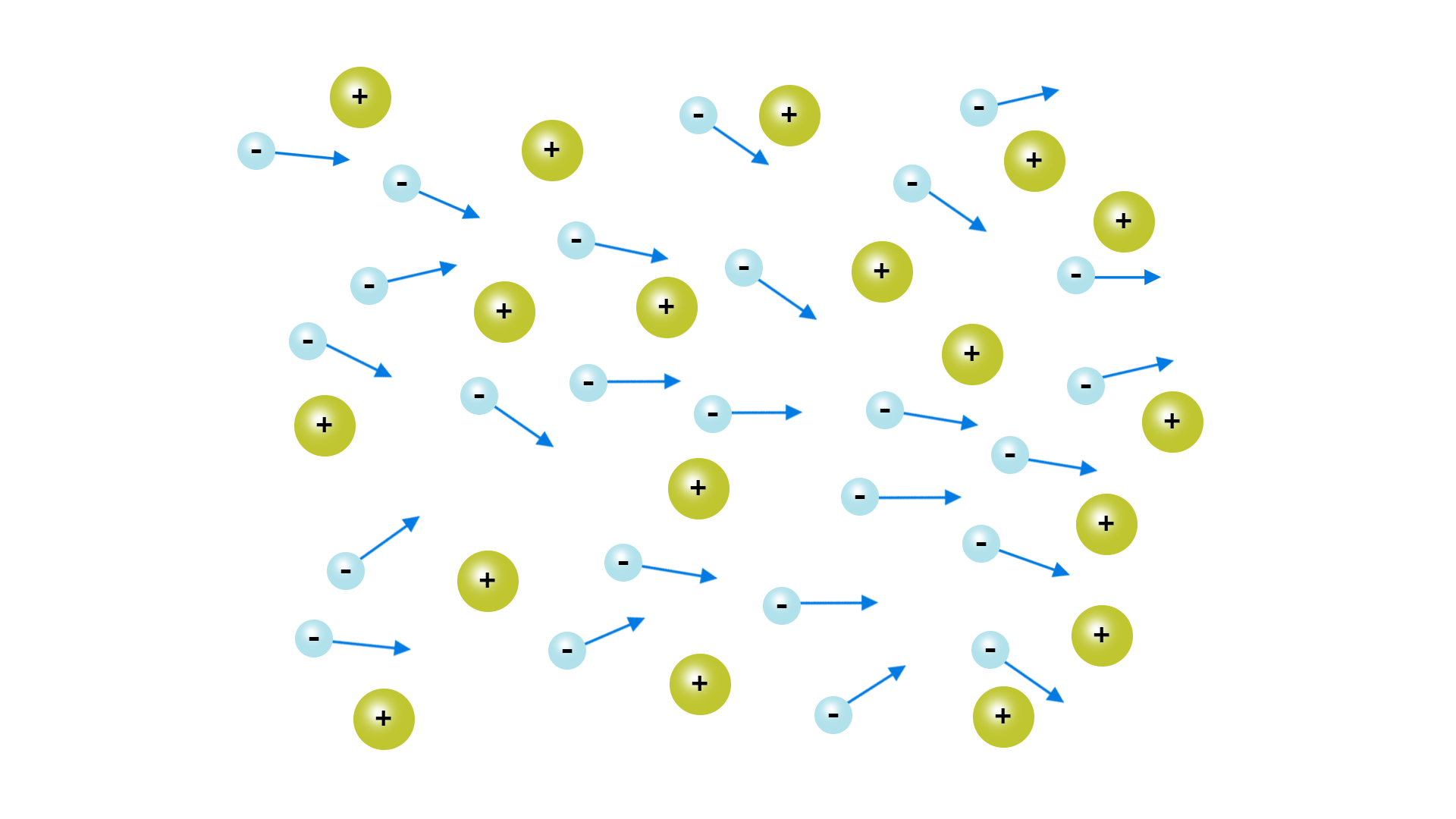
3. What is the direction of electric currentelectric current?
The direction of the current is determined conventionally as the direction of movement of positive charges. If the current carriers are negative charges, the current direction is opposite to the direction of charge movement. People agreed to determine the direction of the current flow in this way.
4. What physical quantity describes quantitatively the flow of electric currentelectric current?
This quantity is the current intensitycurrent intensity, often referred to simply as the current. Often when we are considering the strength of a phenomenon, we are talking about the intensity, e.g. about the intensity of traffic. The more cars drive on the street in a unit of time the larger the intensity of traffic. The same is with the current intensitycurrent intensity. If a large charge flows through the conductor within a second, we say that there is a high current in the conductor. If during a unit of time a small charge flows, then the current is small.
So we can say that the current is an electric chargeelectric charge that flows through the conductor in a unit of time.
5. How to calculate the current?
If, for example, during the time t = 7 s, a charge of 14 coulombs flows, then there are 2 coulombs in one second. To find out how many coulombs flow per unit of time, the charge that flows has to be divided by the flow time.
Thus, the current is the ratio of the charge to the time it flows. The same definition expressed as a formula:
The unit of current is the ampereampere. The current has an intensity of one ampereampere, when the charge of one coulomb flows through the conductor in one second.
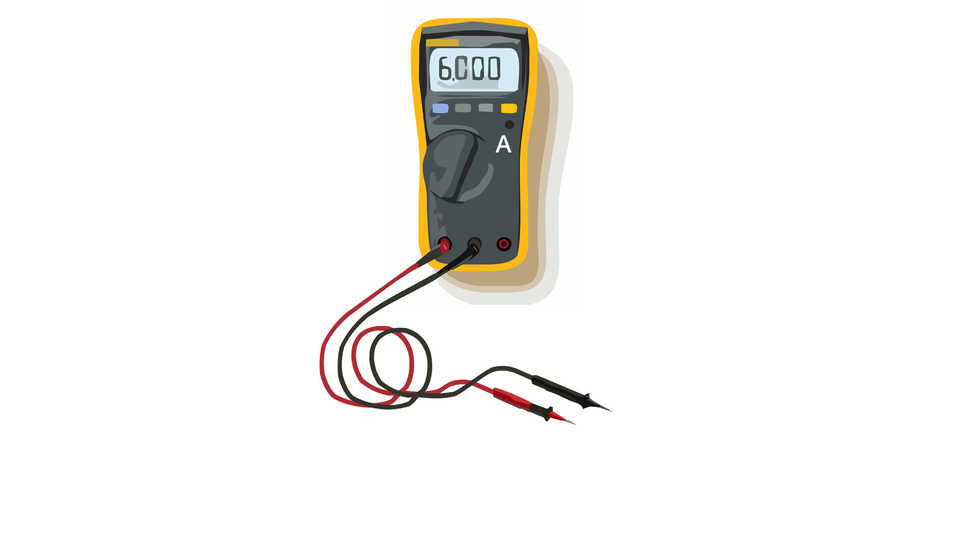
Current is measured using a device called an ammeter.
Zasób interaktywny dostępny pod adresem https://zpe.gov.pl/a/DiQAbLZew
Summary
Electric currentElectric current is the orderly movement of free electric charges.
Free charges - carriers of electric current - can be both negative and positive. In metals, these are electrons, in gases and liquids these are ions. According to convention, the direction of the current is consistent with the movement of positive charges, i.e. from „plus” to „minus”.
The intensity of the current is the ratio of the charge flowing through the cross‑section of the conductor to the time when this charge has flown:
The unit of current is 1 A (ampereampere). The current intensitycurrent intensity is equal to 1 A, when the 1 C charge flows through the cross‑section of the conductor within 1 s.
The intensity of the electric current is measured using an ammeter.
Exercises
Determine which sentence is true.
- In order for the electric current to flow, it is enough to have any load carriers.
- The intensity of the current is called the free movement of electrons.
- The unit of electric current is 1 C.
- Positively charged particles moving may form the current.
During the operation of the bulb, the current of 200 mA flows through it for 4 hours.
1. Calculate what electric chargeelectric charge has flown through the bulb within 4 hours.
2. How long does it take for the charge of 720 C to flow through the bulb?
Use the source of information available to you and indicate the differences related to the current flow through the metallic conductor and the conductive liquid.
Write a short note in English on this topic.
Indicate which pairs of expressions or words are translated correctly.
- prąd elektryczny - electric current
- ładunek elektryczny - electric charge
- dryft elektronów - current intensity
- natężenie prądu - electron drift
- natężenie prądu
- electric current
- electric charge
- dryft elektronów
- amper
- ampere
- current intensity
- electron drift
- prąd elektryczny
- ładunek elektryczny
Glossary
prąd elektryczny
Nagranie dostępne na portalu epodreczniki.pl
wymowa w języku angielskim: electric current
ładunek elektryczny
Nagranie dostępne na portalu epodreczniki.pl
wymowa w języku angielskim: electric charge
dryft elektronów
Nagranie dostępne na portalu epodreczniki.pl
wymowa w języku angielskim: electron drift
natężenie prądu
Nagranie dostępne na portalu epodreczniki.pl
wymowa w języku angielskim: current intensity
amper
Nagranie dostępne na portalu epodreczniki.pl
wymowa w języku angielskim: ampere
Keywords
electric currentelectric current
electric chargeelectric charge
electron driftelectron drift