Element and chemical compound - chemical compound
what is a substance;
how to follow the safety rules in the school chemical laboratory in practice;
what physical and chemical properties are and name examples of these;
how the physical and chemical properties of the substance can be tested.
why we should use chemical symbols;
discuss rules of creating symbols of chemical elements;
define the term: chemical compound;
explain the difference between an element and a chemical compound;
name examples of chemical elements and compounds.
Which substances are called chemical compounds?
Arrange the picture. What substances, chemical elements do you see on it? Of which elements these consist in your opinion? Write their names and symbols here or in a notebook.
After you watch the movie „Obtaining a chemical compound from chemical elements”, formulate a research question and a hypothesis. Write down the observations and conclusions. Pay attention whether the mixture of chemical elements has the same properties as the elements.
Film dostępny na portalu epodreczniki.pl
Nagranie filmowe przedstawiające eksperyment otrzymywania związku chemicznego, obtaining chemical compound. Do eksperymentu potrzebne będą sproszkowana siarka, opiłki żelaza, łyżka, magnes, parownica kwarcowa lub porcelanowa, palnik laboratoryjny. Do parownicy dodajemy szczyptę siarki oraz opiłek żelaza. Po wymieszaniu obu proszków przykładamy magnes. Magnes przyciąga opiłki żelaza oddzielając je od proszku siarki. Opiłki żelaza zostają na powierzchni magnesu natomiast siarka w parownicy. W drugim eksperymencie, parownicę zawierającą mieszaninę proszku siarki i opiłków żelaza podgrzewamy w płomieniu palnika. W efekcie działania wysokiej temperatury powstaje siarczek żelaza dwa, czarny osad, który traci właściwości magnetyczne. Zbliżenie magnesu do otrzymanej substancji nie powoduje jej przyciągania.
Are rock salt and water simple or complex substances?
We meet many chemical compoundschemical compounds every day. For example, water, rock salt (sodium chloride), sugar (sucrose), citric acid, vinegar (acetic acid and water) or alcohol (ethanol and water). Let's look at rock salt. It is a compound – product of the reaction of sodium with chlorine. Sodium () is a solid substance reacting violently with water, and chlorine () (chlorine gas occurs in the form of molecules) is a poisonous gas. Chemical compound is the most popular spice and preservative, giving the dishes a salty taste. Chemical compounds have different properties than the elements they contain. For example, water is a compound - product of the reaction of hydrogen with oxygen.
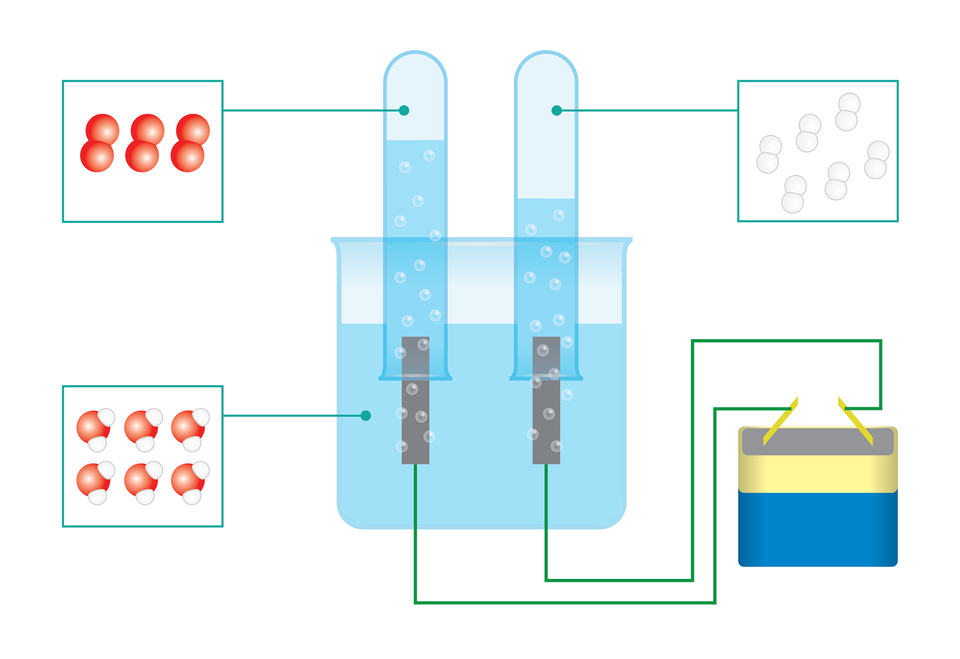
1. Oxygen O2(g) 1 volume of gas
2. Hydrogen gas H2(g) 2 volumes of gas
3. Acidified water (dilute sulfuric acid) Overall: 2H2O → 2H2 + O2
4. Anode (graphite) At the anode:
6H2O → O2 + 4H3O+ + 4e-
5. Cathode (graphite) At the cathode:
4H3O+ + 4e- → 2H2 + 4H2O
6. Battery
Knowing the symbols of chemical elements, you can write formulas of chemical compoundsformulas of chemical compounds down, for example: is magnesium oxide,
– calcium oxide,
– carbon monoxide.
Be carefull with capital letters in symbols of elements and chemical compounds:
is symbol of carbon,
is symbol of oxygen,
– is symbol of cobalt,
but is formula of carbon monoxide – chemical compound.
Select true sentences.
- Chemical elements can combine with others to form chemical compounds.
- The chemical properties of a chemical compound are the same as the elements that make up it.
- In the symbols of chemical elements and compounds, the capitalization of letters does not matter.
- Chemical element is a permanent combination of at least two elements.
Summary
The substance is every element and every chemical compound.
A chemical element is a simple substance that cannot be divided into simpler substances.
A chemical compound is composed of atoms or ions of at least two different chemical elements connected to each other.
Chemical compounds have different properties than the elements it is composed of.
Keywords
element, symbol, chemical compound, substance
Glossary
pierwiastek chemiczny – substancja, której nie można rozłożyć na substancje prostsze
symbol pierwiastka – umowny, międzynarodowy skrót łacińskiej, greckiej lub angielskiej nazwy pierwiastka złożony najczęściej z jednej lub dwóch liter, przy czym pierwsza jest wielka
wzór chemiczny – oznaczenie związku chemicznego złożone z symboli pierwiastków chemicznych
związek chemiczny – substancja o stałym składzie złożona z atomów lub jonów co najmniej dwóch pierwiastków chemicznych połączonych ze sobą