Fertilizers and soil fertility
what a soil is and what elements it is composed of;
that soil pH affects the development of plants;
how to carry out the testing of selected soil properties.
to define the notion of soil fertility;
to name the elements that condition soil fertility;
to classify fertilizers into natural and artificial ones;
to name the types of natural fertilizers, giving examples;
to discuss the role of natural fertilizers in soil fertilization;
to classify mineral fertilizers, giving examples;
to discuss the role of artificial fertilizers in soil fertilization;
to list plants that require organic fertilization;
to justify the need for using natural fertilizers or artificial fertilizers;
to explain why it is important to use the right amount of fertilizer.
Fertile and fruitful soils
Soil fertility means its natural ability to satisfy the nutritional needs of plants. It consists of a set of physical, chemical and biological properties of soils – providing plants with adequate conditions for growth (i.e. appropriate nutrients, water and soil air). The fertility of the soil depends on its composition, including content of mineral compounds, humus and microorganisms.
The soil abundance of components needed for the development of plants is indicated by the presence of such elements as:
chemical compounds of nitrogen,
chemical compounds of phosphorus,
ions / compounds of potassium,
calcium ions,
magnesium ions.
For the development of plants, it is important what the content of these elements in an easily digestible form is, i.e. one that can be taken up from the soil and then subjected to metabolism in the cells of the plants. An important factor is also the pH of the soil, which affects the occurrence of bioavailable forms of nutrients and the activity of soil microorganisms.
In addition to the listed components, ions / compounds of elements such as: carbon, oxygen and hydrogen, sulfur and boron, copper, manganese, molybdenum and others are also important. Lack of any ingredient in the soil may cause plant diseases or reduce yields; For example, the shortage of easily absorbable copper in soils prevents the development of grains in crop plants.
Soil fertility may be increased by cultivating it, i.e. appropriate treatments, e.g. plowing and other agrotechnical activities, fertilization, irrigation, crop rotation. All this determines the agricultural productivity of the soil, i.e. its fruitfulness. The basic measure of fruitfulness is yield – on fruitful soils under favorable weather conditions high yields can be achieved.
The use of fertilizers is the main way to get a quick improvement in soil quality. All fertilizers – natural and mineral ones, appropriately used, improve the fruitfulness of the soil by providing plants with the ingredients necessary for their growth.
Natural organic fertilizers
Natural organic fertilizers provide the soil with the minerals it lacks and enrich it with humus. Organic fertilizers are produced from an organic substance or from a mixture of various organic substances. Organic fertilizers include:
fertilizers of animal origin: solid manure, liquid manure, slurry, chicken manure, guano (excrement of seabirds);
fertilizers of plant origin: peat, straw;
compost (fertilizer of plant and animal origin).
Solid manure is a mixture of liquid and solid fermented feces of farm animals mixed with litter. It contains ingredients necessary for the proper development of plants, is a valuable source of humus, improves the physical and chemical properties of the fertilized soil and affects the microbiological changes taking place in soil.
Slurry and liquid manure are fermented animal feces. They are collected in tightly closed containers and diluted before fertilizing the fields. The slurry composition is dominated by urine fermentation products.
Compost is a fertilizer from waste organic matter (mown grass, falling petals of flowers or branches, food leftovers) stored in a composter, where they are processed by microorganisms.
Compost is a universal fertilizer that can be used to improve the quality of any soil and fertilize each plant.
Mineral fertilizers
Mineral fertilizers, commonly known as artificial fertilizers, are chemical compounds or mixtures thereof, containing nutrients used for fertilizing plants, being a product of the fertilizer industry. These fertilizers are more effective than natural ones because plants absorb them more easily.
Fertilizers support the development of plants by improving the soil physical and chemical properties. They are characterized by high efficiency, and their effects are visible in a much shorter time than when using natural fertilizers. Unfortunately, there is also a risk of overfertilization, which is why fertilizers should be used as stipulated in recommendations. Excessive amount of fertilizer negatively affects the soil and plants that grow in it.
Their basic components include:
Nitrogen – ingredient necessary for plant growth. It is responsible for the growth of green plant mass, roots, higher grain yield. Nitrogen compounds of deficiency in soil causes inhibition of plant growth and shortening of the ripening period. Fertilisers contain nitrogen in compounds as nitric, ammoniacal or urea nitrogen.
Phosphorus – responsible for the development of generative plant parts (seeds, fruits). Phosphorus compounds deficiency is the cause of dwarfing in plants, poor development of the root system, problems with flowering and fruiting. Phosphorus compounds in fertilizers is in the form of phosphates, including calcium phosphate and ammonium phosphate.
Potassium – improves the resistance of plants to low temperatures and diseases, extends the storage period of vegetables. Potassium ions deficiency results in inhibition of plant growth and characteristic necrotic changes in leaves. Potassium ions are present in fertilizers in the form of chloride or sulphate.
Fertilizers are mainly used to supply these basic nutrients, which is why most of them are called NPK fertilizers (because they provide compounds of: nitrogen, phosphorus and potassium).
Calcium fertilizers and magnesium fertilizers are also used for soil fertilization. In addition to providing nutrients to plants, they improve the pH and properties of soil. Magnesium ions deficiency in the soil causes a decrease in plant resistance to diseases, negatively affects plant growth and quality. Magnesium ions are present in fertilizers in the form of oxide, carbonate and in the form of magnesium sulphate. Calcium ions in fertilizers may be in the form of oxide, hydroxide, carbonate and silicate.
Ions and compounds of: calcium, magnesium, sodium and sulfur are referred to as secondary nutrients.
Other ions / compounds of elements are also necessary for the growth of plants, but in small amounts compared to the basic ingredients. Such micronutrients are ions / compounds of : boron, cobalt, copper, iron, manganese, molybdenum and zinc.
Fertilizers available on the market can be divided into:
single‑nutrient (or straight) fertilizers (containing one basic nutrient in a large amount), used to supplement a specific component missing from the soil, to acidify or deacidify the soil; their use requires specialist knowledge about the fertilizer needs of specific plant groups;
multi‑nutrient fertilizers, which are a suitably balanced mixture of mineral components needed for plants to grow properly; they are easier to use; the note on the packaging informs about the crops they are suitable for.
Single‑nutrient fertilizers are rich in only one element and are used when the soil quality indicates a shortage of this particular component. Nitrogen fertilizers supplement nitrogen compounds in case of its deficiency, phosphorus fertilizers – phosphorus compounds, and potassium fertilizers – potassium ions. Using an excessive amount of fertilizer can lead to the salinity of the substrate and the destruction of plants, as well as the accumulation of harmful compounds in the soil.
Formulate a research question and hypothesis before doing the experiment „Effect of fertilization on plant growth – hydroponic culture” Write your observations and conclusions.
pot,
sawdust,
4 jars with lids made of cardboard or polystyrene,
black paper,
weight,
4 straws
4 beakers (or 1‑liter bottles),
beans or maize grains,
distilled water,
calcium nitrate Ca(NOIndeks dolny 33)Indeks dolny 22,
potassium nitrate KNOIndeks dolny 33
potassium dihydrogen phosphate KHIndeks dolny 22POIndeks dolny 44
calcium sulfate CaSOIndeks dolny 44.
1.Preparation of cuttings:
the bean grains (or corn) in damp sawdust until they start to germinate.
Preparation of nutrients:
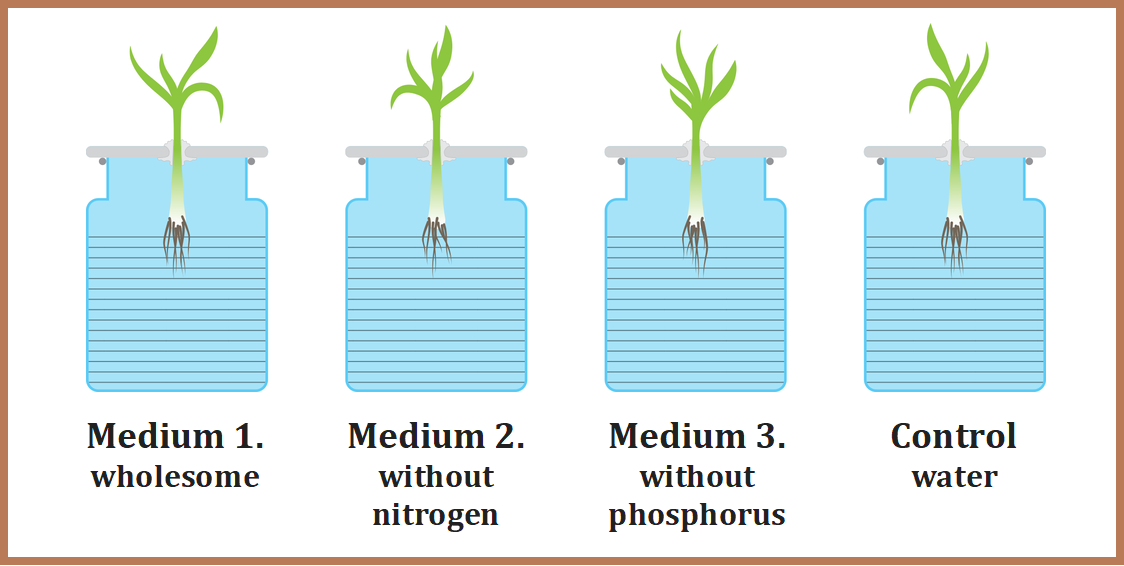
Medium nutrient 1 (wholesome): In 1 liter of distilled water, dissolve 1 g of calcium nitrate, 0.25 g of potassium nitrate and 0.25 g of potassium dihydrogen phosphate.
Medium 2. (without nitrogen): Dissolve 1 g of calcium sulfate and potassium dihydrogen phosphate in 1 liter of distilled water.
Medium 3. (without phosphorus): In 1 dmIndeks górny 33 of distilled water, dissolve 0.5 of calcium nitrate and 0.5 of potassium nitrate.
Prepare 4 jars with cardboard or polystyrene lid, in which there are openings allowing for fixing seedlings for hydroponic cultivation (as in the picture).
Number the jars and fill them to about 4/5 volume of medium (1, 2, 3) and water (up to the 4th jar).
Choose 4 seedlings of similar size, rinse and place each of them separately in the jar, so that the roots of the seedlings are immersed in the liquid.
Wrap the jars with black paper to protect the roots from the sun.
Every two days, the solutions in the jars should be blown through the straw.
Observe the development of plants for 2‑4 weeks.
Zaznacz wypowiedzi mówiące prawdę.
- Podstawową miara urodzajności jest plon
- Obornik trzody chlewnej zawiera najwięcej potasu
- Obornik, gnojówka, gnojowica, pomiot ptasi, to nawozy pochodzenia roślinnego
- Nawóz powstały z odpadowej materii organicznej to kompost
Summary
Soil fertility is the result of soil forming processes and depends on the content of, among others, minerals, humus and microbes. The elements the soil fertility depends on are mainly ions/compounds of: nitrogen, phosphorus and potassium. Others are, for example, ions/compounds of: calcium, magnesium, oxygen, iron, copper, manganese.
Incorrect or too homogeneous cultivation of plants means that the nutrient resources are depleted too quickly in the soil.
Natural or artificial fertilizers are used to supplement the shortage of nutrients in the soil and to regulate the soil pH.
Mineral (artificial) fertilizers provide the soil with minerals that are the source of elements essential for plant development – primarily nitrogen, phosphorus and potassium. These minerals may be present separately – in single‑nutrient fertilizers – or in more versatile mixtures thereof – multi‑nutrient fertilizers.
Design a home experiment to examine the effect of saltpetre concentration on cress development. Prepare the worksheet for this experiment.
Keywords
mineral fertilizers, natural organic fertilizers, soil fertility
Glossary
nawozy mineralne – sole lub inne związki dodawane do gleby w celu uzupełnienia niedoboru pierwiastków pobieranych przez uprawniane na niej rośliny; mogą być jednoskładnikowe (dostarczają jednego podstawowego składnika pokarmowego) lub wieloskładnikowe (uzupełniają niedobór kilku składników w glebie); wyróżnić można nawozy mineralne pochodzenia naturalnego oraz nawozy sztuczne uzyskiwane na drodze chemicznych procesów przemysłowych
nawozy naturalne organiczne – produkuje się z substancji organicznej; należą do nich nawozy pochodzenia zwierzęcego (obornik, gnojówka) lub pochodzenia roślinnego (torf)
urodzajność gleby – zdolność gleby do zaspokajania potrzeb roślin i wydawania plonu; urodzajność jest cechą określającą wartość produkcyjną gleby
żyzność gleby – naturalna zdolność gleby do zaspokajania potrzeb pokarmowych roślin, zespół właściwości gleb fizycznych, chemicznych i biologicznych zapewniający roślinom odpowiednie warunki do wzrostu (składniki pokarmowe, wodę i powietrze glebowe)