to characterize the major events of 1918 and 1919 in eastern Poland;
to describe the progress and the aftermath of the conflict with the Ukrainians in 1918–1919, initial fights with the Bolscheviks and the Kiev Offensive led by Józef Piłsudski;
to recognize the elements of the Bolschevik tactics (establishment of the Provisional Polish Revolutionary Committee in Białystok).
The re‑emerging Poland saw two concepts of the future Polish statehood: incorporation championed by Roman Dmowski and federation advocated by Józef Piłsudski. Attempts to draw the eastern border were initiated still during World War I. A conflict with the Ukrainians broke out in Galicia; the Ukrainians took Lviv and proclaimed the West Ukrainian People's Republic (ZUNR) (on the 1st of November 1918).
The Poles managed to regain control of the city and force the Ukrainians off east of the Zbruch River. A cease‑fire between the conflicted sides was signed in September 1919. After the German forces' retreat early in 1919 from the eastern territories, the Bolshevik Army entered determined to achieve the vision of a world proletarian revolution. In April 1920, Józef Piłsudski entered into an alliance with the Ukrainian atamanatamanataman, Symon Petlyura, and launched a joint offensive against the Red Army, ended with the capture of Kiev. A counteroffensive mounted by the Bolsheviks led to their win over the Poles, bringing them as far as to the outskirts of Warsaw.
Task 1
Listen to the broadcast. How Józef Piłsudski thanked the residents of Lwów for their heroic defence of the city?
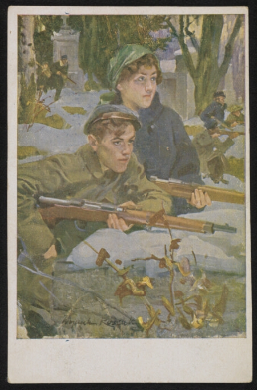
Ilustracja przedstawiająca postaci obrońców Lwowa. Modzi ludzie na pierwszym planie dziewczyna i chłopiec ubrani w wojskowe stroje w karabinami w dłoniach patrzą przed siebie. Na drugim planie biegną z pistoletami inni ludzie. Akcja rozgrywa się na cmentarzu wypełnionym śniegiem.
"Eeglets"; defenders of Lwów
Source: Wojciech Kossak, Biblioteka Narodowa, licencja: CC 0.
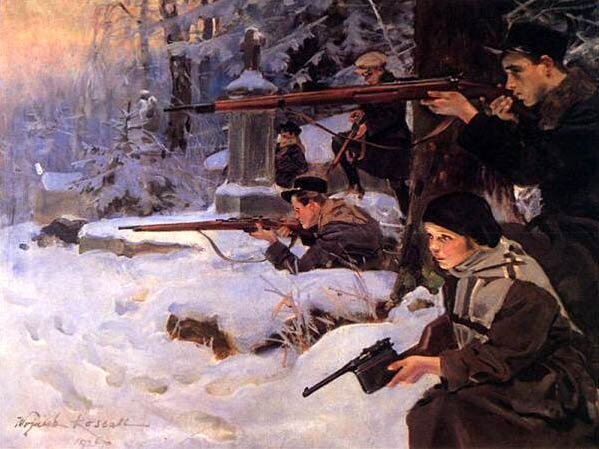
The Polish‑Ukrainian fights over Lwów broke out on 1 November 1918. The Ukrainian people, a negligible minority of the city inhabitants at the time, made claims to the territory of Galicia between the Zbruch and the San Rivers. They considered Lwów a Ukrainian city and felt that the Poles should retreat west of the San River. The action came as a surprise to the Polish people, the great majority of Lwów inhabitants. Regular fighting ensued after public buildings in the city were occupied by Ukrainian soldiers of the Austro‑Hungarian Army and the rise of the West Ukrainian People's RepublicWest Ukrainian People's RepublicWest Ukrainian People's Republic was proclaimed. Members of Polish conspiracy organisations responded by forming into units which were spontaneously joined by university students, young boy scouts, secondary school students and younger schoolchildren, or the famous „Lwów Eaglets”„Lwów Eaglets”„Lwów Eaglets”. Outnumbered, they fought heroically and sacrificially against the Ukrainian forces in November 1918, demonstrating exceptional patriotism and heroism. The Polish Army came to their aid, including the troops from Kraków under the command of the then Colonel Michał Karaszewicz‑Tokarzewski.
RCY9nvJbRyXl3
Ilustracja przedstawiająca postaci obrońców cmentarza. Po lewej stronie ilustracji znajduje się zaspa śnieżna po prawej znajduje się grupa młodych ludzi w lesie strzelających z użyciem karabinów oraz pistoletów. Spod śniegu przebijają nagrobki.
Eaglets; defenders of the cemetery
Source: Wojciech Kossak, domena publiczna.
The defenders of Lwów only learnt from newspapers that Poland regained independence on 11 November 2018. The final battle for the city was fought on 21 November. Following heavy combat, on 22 November, the entire Lwów was already in the Polish hands. The troops of the Ukrainian Halych Army retreated from Lwów, starting the siege of the city. Hostilities continued, but faced with the offensive of the Polish Army, the Ukrainian forces gave up the siege and retreated on 22 May 1919. Those were the heroic days, but very tragic too, the local residents having suffered great losses. – „My men from Lwów, but Cracovians among them too, went into combat like for a dance, but the fight was tough”, said General Karaszewicz‑Tokarzewski many years later talking to Radio Free Europe Polish SectionRadio Free Europe Polish SectionRadio Free Europe Polish Section. The graves of the Lwów Eaglets are situated in the Lychakiv Cemetery, Lwów (now Lviv).
In November 1920, on the 2nd anniversary of the Polish administration taking over in Lwów, Marshal Józef Piłsudski made a visit to the city. He arrived to award it the highest Polish decoration and the oldest military order, the Virtuti Militari Cross. „Those several dozen days of struggle made Lwów a gallant soldier. Therefore, I, in my capacity as the Chief of State, whose role is to decorate the bravest of the brave and the boldest of the bold, have resolved that it is in my powers to confer the highest military distinction upon your city,” said Józef Piłsudski to the crowd of residents. The ceremony was staged in St. Mary's Square at the monument to Adam Mickiewicz. The Marshal decorated the escutcheon of the city's coat of arms. Until World War II, Lwów remained the only Polish city to be awarded the Virtuti Militari Order; Warsaw was the next.
lwów Source: The defense of Lviv, dostępny w internecie: https://www.polskieradio.pl/39/156/Artykul/980851,Obrona-Lwowa-poszli-do-walki-jak-w-taniec oraz https://www.polskieradio.pl/39/156/Artykul/729414,Orleta-Lwowskie-zawsze-wierne.
Task 2
Assess Piłsudski's proposals included in his manifesto. Could the Lithuanians be interested in them? Provide arguments to support your case.
Manifest Józefa Piłsudskiego do ludności byłego Wielkiego Księstwa Litewskiego
Kraj Wasz od stu kilkudziesięciu lat nie zna swobody, uciskany przez wrogą przemoc rosyjską, niemiecką, bolszewicką – przemoc, która nie pytając ludności, narzucała jej obce wzory postępowania, krępujące wolę, często łamiące życie. Ten stan ciągłej niewoli, dobrze mi znanej osobiście, jako urodzonemu na tej nieszczęśliwej ziemi, raz nareszcie musi być zniesiony i raz wreszcie na tej ziemi, jakby przez Boga zapomnianej, musi zapanować swoboda i prawo wolnego, niczym nie skrępowanego wypowiedzenia się o dążeniach i potrzebach. Wojsko Polskie, które z sobą przyprowadziłem, dla wyrzucenia panowania gwałtu i przemocy, dla zniesienia rządów krajem wbrew woli ludności - wojsko niesie Wam wszystkim wolność i swobodę. Chcę dać Wam możność rozwiązania spraw wewnętrznych, narodowościowych i wyznaniowych, tak jak sami tego sobie życzyć będziecie, bez jakiegokolwiek gwałtu lub ucisku ze strony Polski.
manifest Source: Manifest Józefa Piłsudskiego do ludności byłego Wielkiego Księstwa Litewskiego.
Rvd43c2szt3lE
Exercise 1
Which of the land cessions made to Poland by Petlyura were unacceptable to the Ukrainians, do you think? Możliwe odpowiedzi: 1. It was Lwów because the Ukrainians wanted to make it their capital., 2. It was Vohlynia because of its fertile soils., 3. It was Eastern Galicia because it had the largest Ukrainian population.
Which of the land cessions made to Poland by Petlyura were unacceptable to the Ukrainians, do you think? Możliwe odpowiedzi: 1. It was Lwów because the Ukrainians wanted to make it their capital., 2. It was Vohlynia because of its fertile soils., 3. It was Eastern Galicia because it had the largest Ukrainian population.
Which of the land cessions made to Poland by Petlyura were unacceptable to the Ukrainians, do you think?
It was Lwów because the Ukrainians wanted to make it their capital.
It was Vohlynia because of its fertile soils.
It was Eastern Galicia because it had the largest Ukrainian population.
Exercise 2
Jaką rolę odgrywały plakaty podczas wojny polsko‑sowieckiej?
Jaką rolę odgrywały plakaty podczas wojny polsko‑sowieckiej?
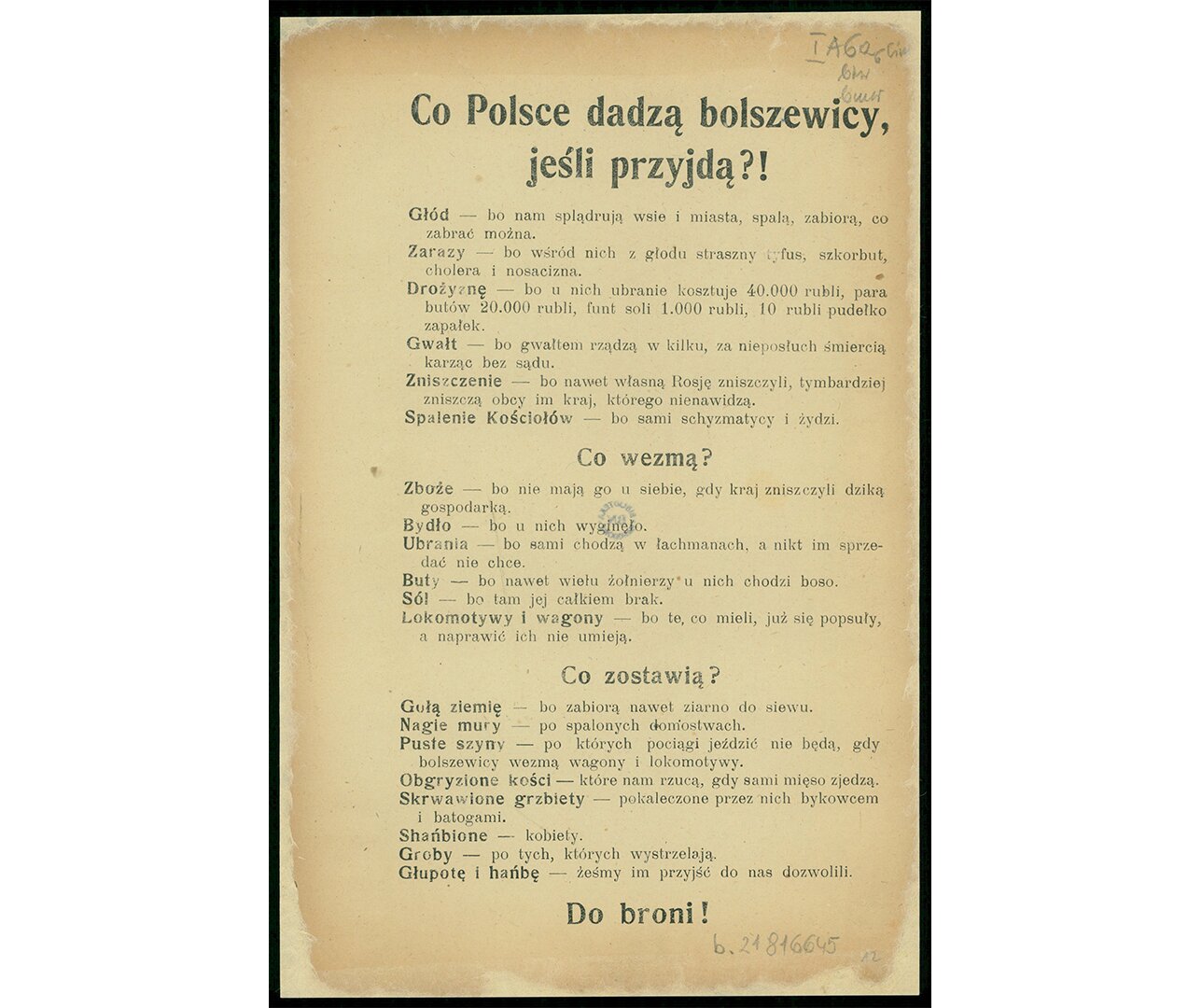
Look at the posters from the period of the Polish–Soviet War. Then decide which of them best corresponds to the joke of the day.
RKYTba3k1m5IH
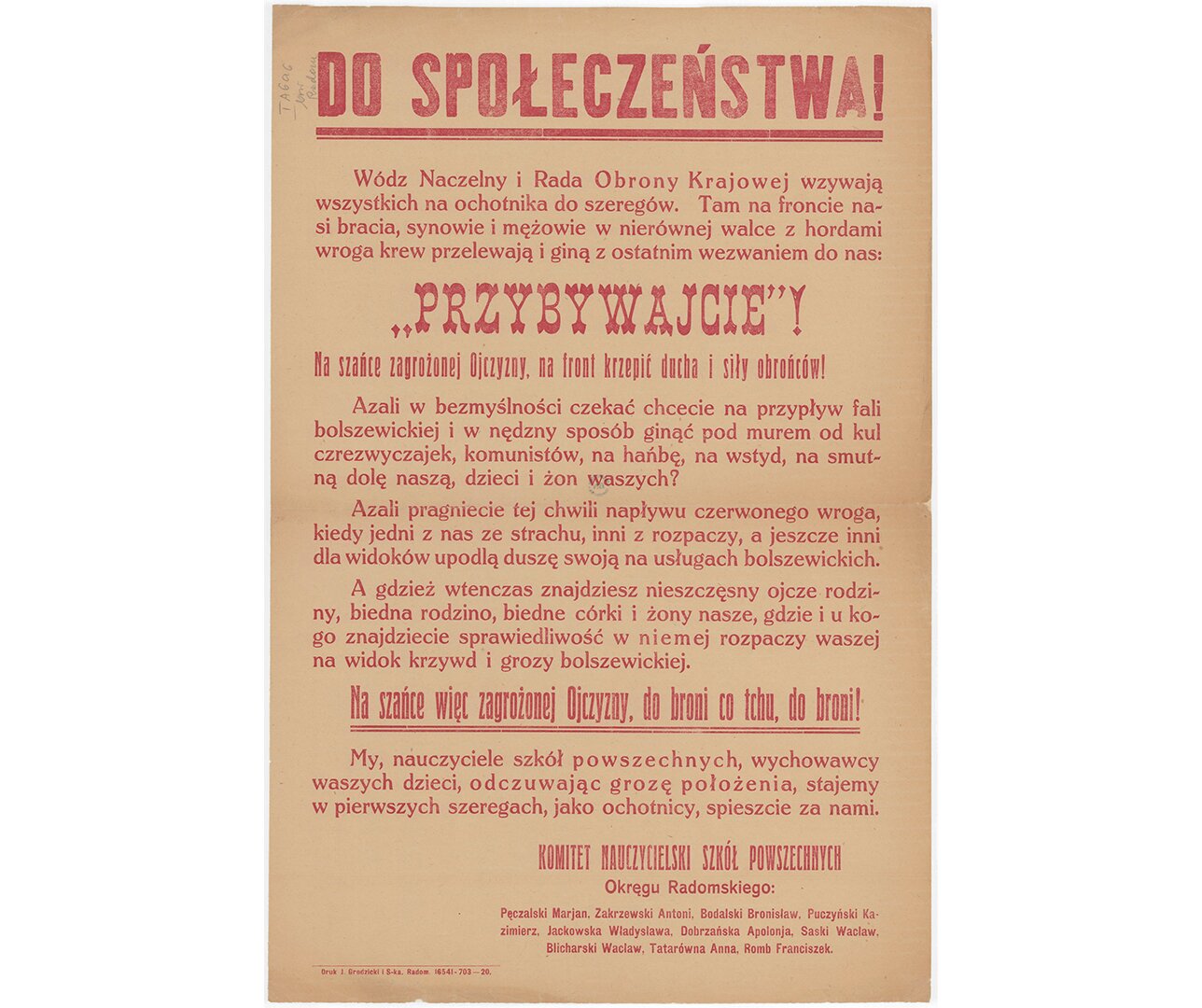
Grafika przedstawiająca plakat. Naczelny Wódz i Rada Obrony Narodowej wzywają wszystkich wolontariuszy do zaciągnięcia się.
Poster 1. The Commander-in-Chief and the Council of National Defence call for all volunteers to enlist
Source: licencja: CC 0.
R13CfErp0unVA
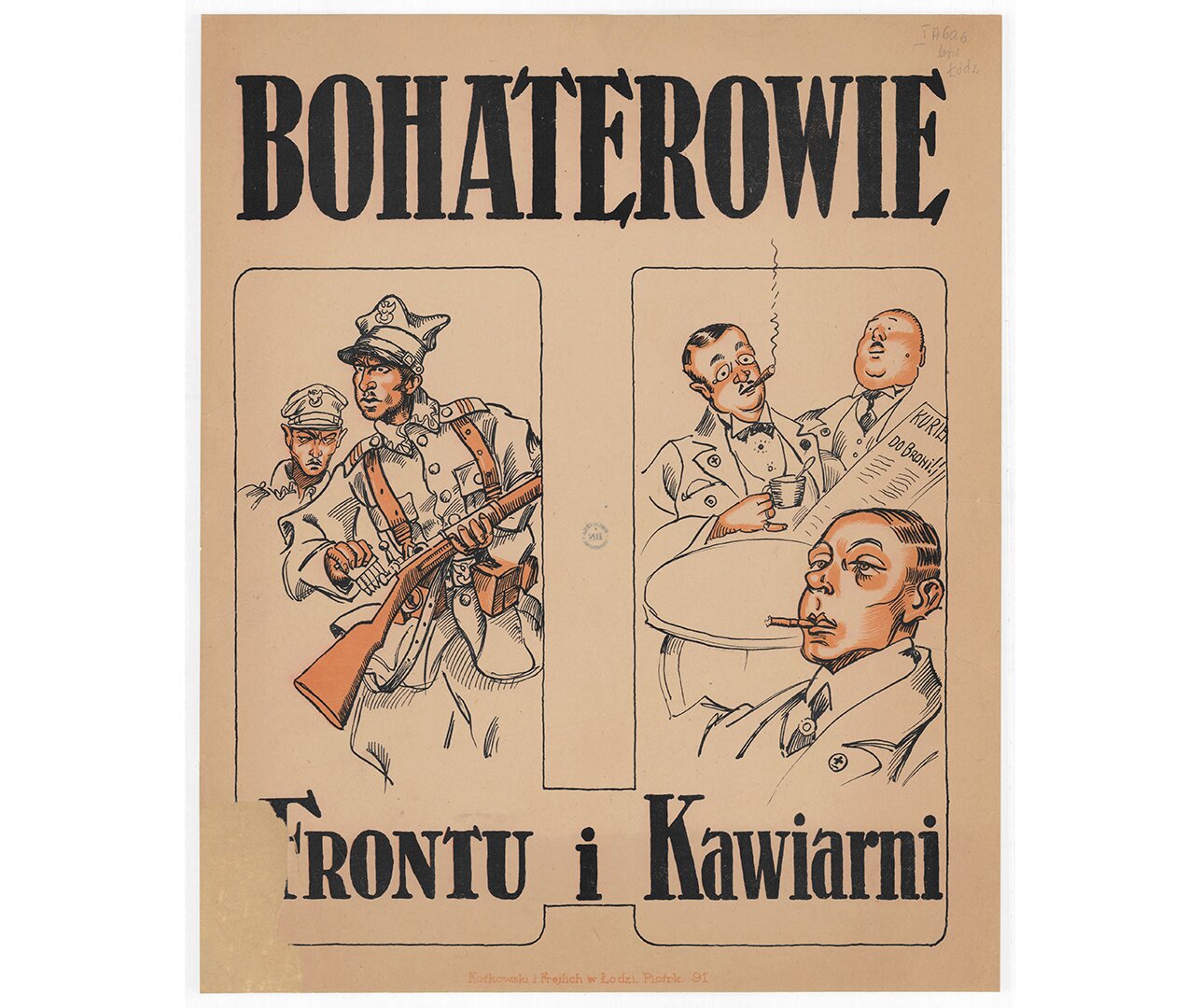
Grafika przedstawiająca plakat. Bohaterowie linii frontu i kawiarni.
Poster 2. Heroes of the front line and of cafés
Source: licencja: CC 0.
R1KW3vc8FvUDG
Grafika przedstawiająca plakat z napisem. "Głód: zdobędą nasze miasta i wsie".
Poster 3. Hunger: they will loot our towns and villages
Source: licencja: CC 0.
Absurdy Polski międzywojennej
„Dwóch domorosłych polityków siedzi w kawiarni i rozmawia, jeden z nich trochę głuchy:
– Słyszałem, że Polska od Wschodu podobna będzie do królestwa niebieskiego – bez granic.
– ...Nic?...
– Od Zachodu...
– ... O tak, wiele zachodu!
– Od Pólnocy zapewne morze.
– ... Może...
– Panie, a od Południa...
– Od południa jesteśmy zwykle w cukierni Lourse’a”.
fog Source: Absurdy Polski międzywojennej, oprac. Marek S. Fog, wybór Marek S. Fog.
RqEDOxHXlOxLa
Wybierz jedno nowe słowo poznane podczas dzisiejszej lekcji i ułóż z nim zdanie.
Wybierz jedno nowe słowo poznane podczas dzisiejszej lekcji i ułóż z nim zdanie.
Choose the poster which best illustrates the joke:
„Orlęta lwowskie” – młodzież zaangażowana w obronę Lwowa w 1918 roku. Spośród blisko 4 tyś. Polaków występujących z bronią w ręku w obronie Lwowa, ponad tysiąc nie przekroczyła 17. roku życia.
Obrona Lwowa – polsko‑ukraiński konflikt zbrojny o Lwów, trwający od 1 listopada 1918 do 22 maja 1919 roku, zakończony zniesieniem ukraińskiego okrążenia. Była jednym z frontów wojny polsko–ukraińskiej (1918–1919).
Rozgłośnia Polska Radia Wolna Europa – działająca od maja 1952 do 30 czerwca 1994 w strukturze Radia Wolna Europa jej polskojęzyczna sekcja; w okresie PRL była najczęściej słuchanym i systematycznie zagłuszanym przez władze radiem zagranicznym.
wyprawa kijowska – ofensywa Wojska Polskiego i armii Ukraińskiej Republiki Ludowej przeciwko Armii Czerwonej na Kijów w kwietniu 1920, podczas wojny polsko‑bolszewickiej.
Zachodnioukraińska Republika Ludowa – republika proklamowana we Lwowie (w Galicji wschodniej) przez Ukraińców w nocy z 31 października na 1 listopada 1918 roku, niezależna od URL.