For their freedom
to recognize the reasons and manifestations of the involvement of Europeans in the war for American independence were;
to explain who the Polish heroes of the War of Independence were;
to characterize how the Poles contributed to the fight for independence of the United States.
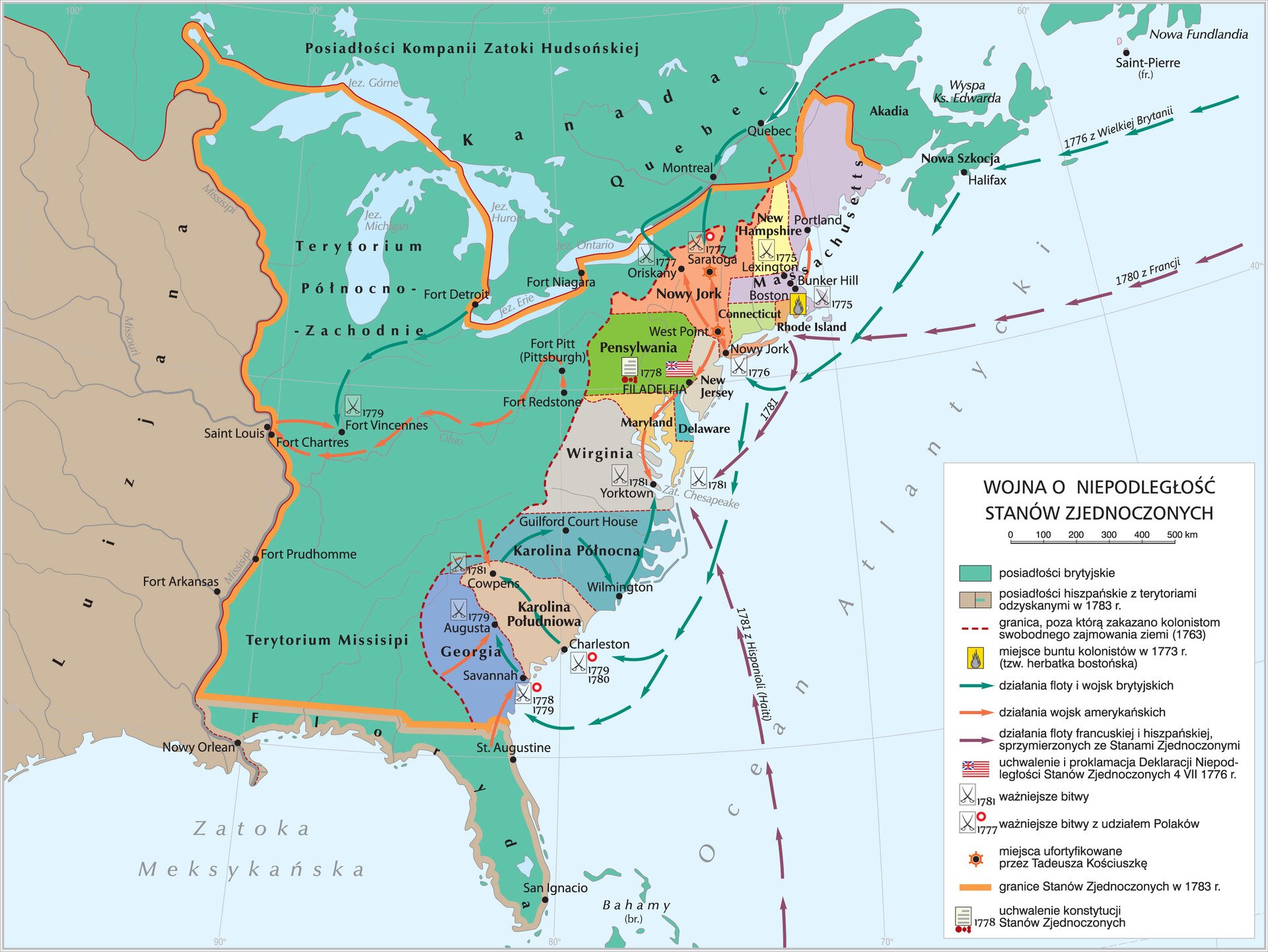
From the very beginning, European public opinion, and France in particular watched the conflict in the American colonies with great interest. The humiliation associated with the end of the Seven Years' War and the almost complete destruction of the French colonial empire had not been forgotten there. The desire for retaliation was very strong. However, direct support was limited to the actions and involvement of specific people, such as the Marquis de Lafayette, Pierre Beaumarchais. It was only the defeat of the English at Saratoga in 1777 and Franklin's skillful actions that led to the signing of two treaties by the government of Louis XVI: commercial and military‑defensive. Recognition of the new state and a mutual guarantee of the inviolability of the estate was complemented by the military alliance and the decision to wage the war until the recognition of independence of the United States. The next stages of internationalization of the conflict were the joining the coalition by Spain (1779) and the Netherlands (1780). Tadeusz Kościuszko also left for America. He became particularly famous during the siege of Saratoga and the construction of West PointWest Point fortifications. Another Pole, Kazimierz Pułaski, is considered to be the founder of American cavalry, which he owes to the commandership of a brigade of this military formation and the forming of a legion known as the „Pułaski Legion” in 1778.
Read the text and complete the exercise.
Virginia Declaration of Rights of 17761. That all men are by nature equally free and independent and have certain inherent rights (…)
2. That all power is vested in, and consequently derived from, the people (…)
5. That the legislative and executive powers of the state should be separate and distinct from the judiciary (…)
6. That elections of members to serve as representatives of the people, in assembly ought to be free (…).
12. That the freedom of the press is one of the great bulwarks of liberty, and can never be restrained but by despotic governments. (…)
16. (...) all men are equally entitled to the free exercise of religion, according to the dictates of conscience (...)
Source: Virginia Declaration of Rights of 1776.
People with what kind of views/origin/experience found the ideas proclaimed by American colonists close to their heart and thus came from Europe to help fight for them?
- Supporters of the monarch's strong rule.
- People brought up in republican traditions, such as nobility rights and freedoms.
- Supporters of the views of Voltaire, Rousseau and Montesquieu.
- Supporters of the principles proclaimed by the Church.
- Opponents of the absolute rule of the sovereign.
Familiarize yourself with the history of Polish involvement in the American War of Independence. What did it entail?
The illustration shows Tadeusz Kościuszko on a postcard., 4.7.1776 Declaration of Independence The adoption of the Declaration of Independence, which gave rise to the existence of a new state on the map of the world, the United States of North America.
The illustration depicts the first copy of the Declaration of Independence., 1777 Battle of Saratoga The Battle of Saratoga was the most important event of the American Revolution, and the first battle the Americans won, before France came to the rescue. Polish general Tadeusz Kościuszko, who was responsible for the construction of American field fortifications, became famous during the battles.
The illustration shows the Augustin Dupré medallion, minted in Paris in 1783. It was personally designed and commissioned by Benjamin Franklin to honour the victory of the Americans., 1777 Pułaski arrives in America Kazimierz Pułaski came to America with experience gained as a commander in the battles during the Bar Confederation. The following year, the Continental Congress authorized him to command an independent legion. To this day, he is considered to be the founder of the American cavalry., 1778 Kościuszko designs the West Point fortifications In recognition for the engineering and logistics skills of Tadeusz Kościuszko, he was entrusted with the designing of fortifications in West Point. The site for the construction of the fort was chosen by General George Washington, who later said that West Point was the most important defensive position on the entire North American continent. To this day, there is a monument of General Tadeusz Kościuszko on the site of the National Military Academy in West Point.
The illustration shows a view of the West Point hills (1825)., 1779 Pułaski trains soldiers Throughout the spring and summer of 1779, Kazimierz Pułaski recruited, organized and trained both cavalry and infantry soldiers. At the Battle of Savannah, he was hit by a canister shot. The wound turned out to be fatal.
The illustration shows the death of Kazimierz Pułaski., 1783 The Treaty of Paris Under the treaty, the British finally recognized the independence of the United States of America.
The illustration shows the first page of the Paris Treaty., 5.5.1798 Kościuszko's Testament In this year, the first American testament of Tadeusz Kościuszko came into existence. In it, he gave his fortune for the fight against slavery. Thomas Jefferson was to be the executor of this resolve. The words of the testament were as follows: "Mr. Jefferson, in case of my death, would you please allocate my money to freeing as many black people, as can be provided for with education and a dignified life. This means that each of them should know the rights and obligations of every free citizen, that he is obliged to defend his country against both an external invader and against internal enemies who would like to change the constitution in a way that is hostile and threatening to their freedom. That each of them has a good heart and sensitivity to the suffering of another human being. Each of them is to be married and have 100 acres of land, with tools and cattle for farming this land, and to know how to manage it. They should know that they should treat their neighbours with respect, kindness, and be ready to help in case of need. They are to provide their children with education from the heart and obligation to the country. Out of gratitude to me, they ought to try to be happy”.
The illustration shows the grave of Kościuszko on the Wawel Hill.
Organize the achievements of famous enlistees participating in the fight of American colonists for freedom
Transforming of the civil militia into a regular American army - establishing of a continental army, The issuing of a small army unit at his own expense, embarking it and coming to America in 1777, Decoration awarded by the Society of the Cincinnati (as one of the few foreigners), Organizing of the American cavalry legion in 1778, Congress awarded him the rank of major general., Construction of West Point fortifications, He fought, among others, at Yorktown, Outstanding merits during the siege of Saratoga
| Tadeusz Kościuszko | |
|---|---|
| Kazimierz Pułaski | |
| Marquis de Lafayette | |
| Fridrich Wilhelm von Steuben |
Keywords
FortificationsFortifications, Militia, Abolition movementAbolition movement, declaration of Independence.
Glossary
Fortyfikacje – umocnienia i obiekty obronne
West Point – oficerska szkoła wojskowa w Stanach Zjednoczonych, w pobliżu Nowego Jorku
Milicja – dawniej: oddziały zbrojne powoływane do służby czynnej tylko w czasie wojny
Ruch abolicyjny – walka o wolność amerykańskich niewolników.
deklaracja niepodleglości – Deklaracja głosiła prawo do ustanawiania wszelkich aktów państwowych, wypowiadania wojny i zawierania pokoju przez dawne kolonie angielskie w Ameryce Północnej.