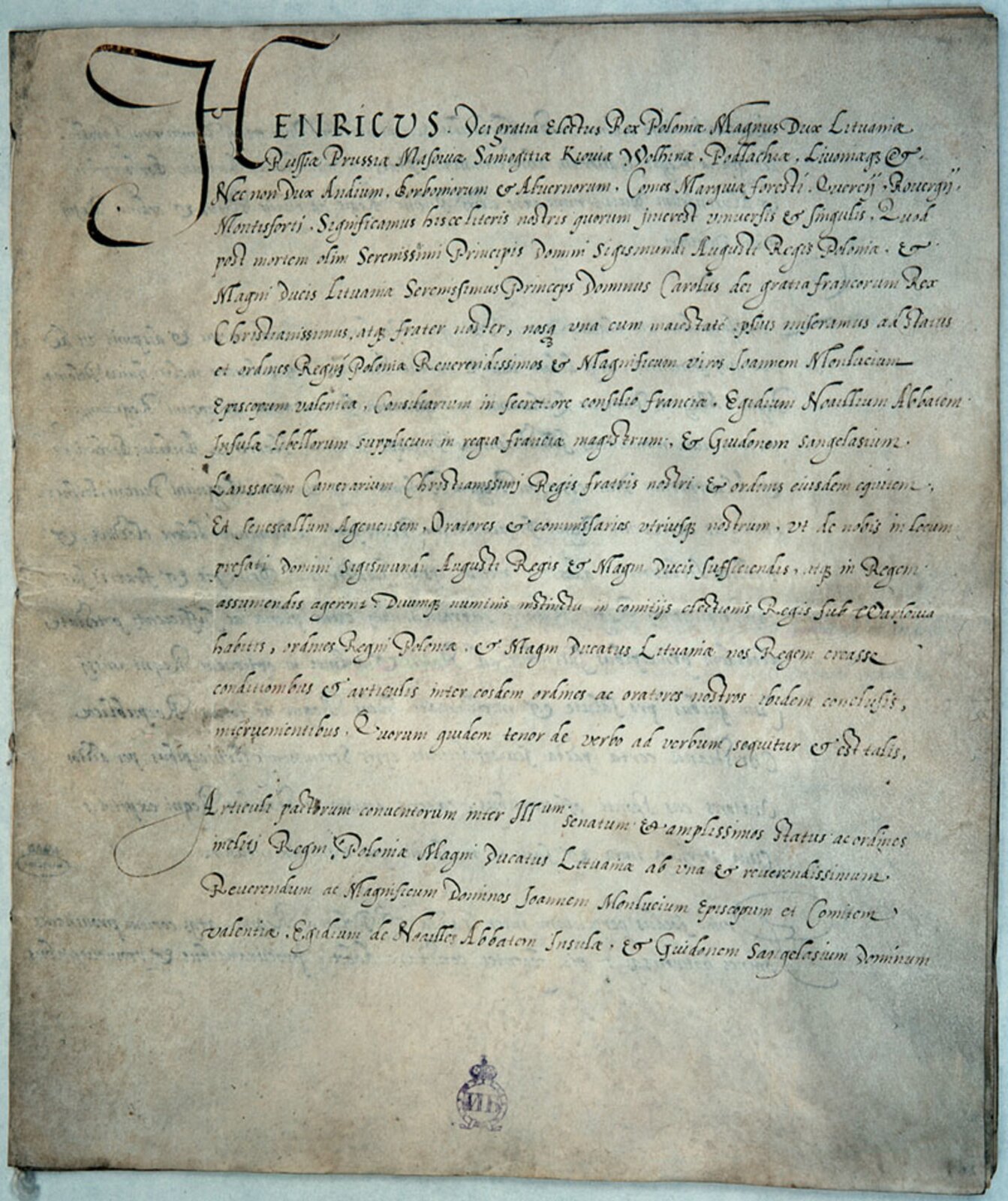
After the death of the last of the Jagiellons, a decision was made that new kings will be elected by the nobles during free election. The first free election took place in 1573, when Henri de Valois was elected the king. Prior to taking over the throne, he had to sign the so‑called Henrician Articles imposing on the ruler a set of conditions ensuring respecting by him of all the laws of the Commonwealth. Every newly elected king was required to commit to swearing fidelity to them during the coronation. Only after that, the king‑elect became the king. During the convocation sejm in Warsaw in January 1573, the nobles decided to obtain the guarantees of religious freedoms from the candidate for the king. This act was entitled Warsaw ConfederationConfederationConfederation. The provisions of the Confederation were incorporated into the Henrician Articles. The personal commitments of the rulers made during the election were called “contractual pacts” (Latin: “pacta conventa”).
Task 1
R18RFBAwAzF3G
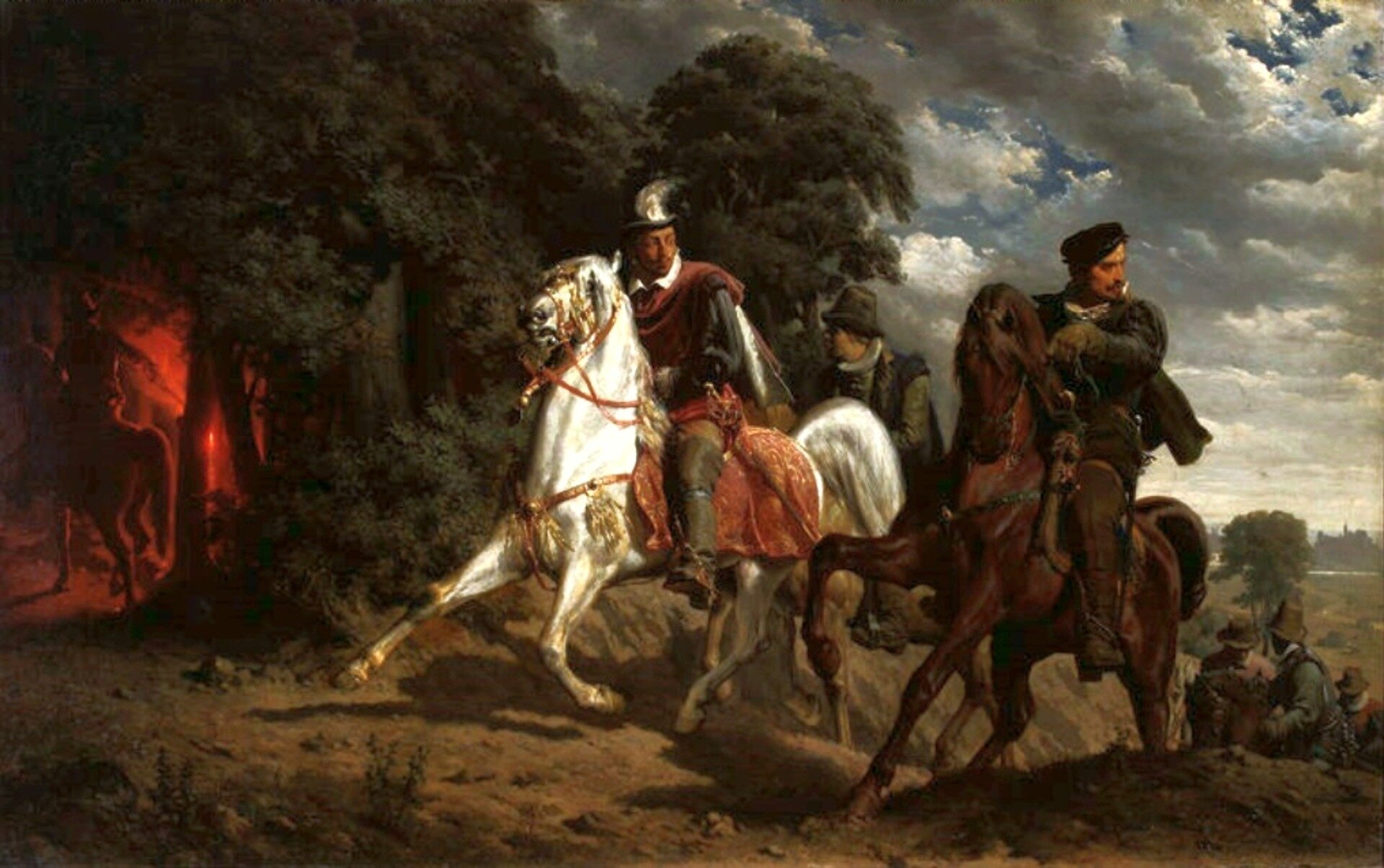
Look at the timeline presenting the most important events regarding the granting of privileges and concessions from the European rulers. Which of the events were the most important and why? 1356 The Golden Bull of Charles IV regulates the elections of the Emperor and constitutional structure of the Holy Roman Empire Illustration presenting the first page of the Golden Bull (a copy of 1400)., 1374 The Privilege of Koszyce , 1555 The Peace of Augsburg, constitutional structure of the Holy Roman Empire Illustration presenting the title page of the treaty signed in Augsburg., 7.7.1572 The death of Sigismund Augustus, the last of the Jagiellons , 1573 Warsaw Confederation The shows the Warsaw Confederation Act., 1573 The election of Henri de Valois for the King of Poland , 1574 The escape of Henri de Valois to France The Escape of Henry III from Poland painting by Artur Grottger., 1648 The Peace of Westphalia „The Ratification of the Treaty of Münster” (by Gerard ter Borch, 1648)., 1679 “Habeas Corpus Act” in England Illustration showing King Charles II., 1689 “Bill of Rights” in England , 1701 “Act of Settlment”
Look at the timeline presenting the most important events regarding the granting of privileges and concessions from the European rulers. Which of the events were the most important and why? 1356 The Golden Bull of Charles IV regulates the elections of the Emperor and constitutional structure of the Holy Roman Empire Illustration presenting the first page of the Golden Bull (a copy of 1400)., 1374 The Privilege of Koszyce , 1555 The Peace of Augsburg, constitutional structure of the Holy Roman Empire Illustration presenting the title page of the treaty signed in Augsburg., 7.7.1572 The death of Sigismund Augustus, the last of the Jagiellons , 1573 Warsaw Confederation The shows the Warsaw Confederation Act., 1573 The election of Henri de Valois for the King of Poland , 1574 The escape of Henri de Valois to France The Escape of Henry III from Poland painting by Artur Grottger., 1648 The Peace of Westphalia „The Ratification of the Treaty of Münster” (by Gerard ter Borch, 1648)., 1679 “Habeas Corpus Act” in England Illustration showing King Charles II., 1689 “Bill of Rights” in England , 1701 “Act of Settlment”
Source: Meister der Wenzel-Werkstatt, domena publiczna.
Task 2
What was the Košice privilege?
RCYwJxgAUnrmP
Ilustracja przedstawiająca dokument- Przywilej koszycki z 1374 r. - oryginał.
The privilege of Košice in 1374 - the original
Source: a. nn., domena publiczna.
Task 3
Why did Henri de Valois decide to escape from the Polish‑Lithuanian Commonwealth?
R1PPGKErLdJcB
Obraz przedstawiający scenę- Henryk Walezy ucieka z Polski.
Henri de Valois escapes from Poland
Source: Artur Grottger, domena publiczna.
Task 4
Provide the names of two documents that were created during the first interregnum in 1573 and constituted basic legal acts of the Polish‑Lithuanian Commonwealth.
RXk3GSjTVKNyy
Ilustracja przedstawia dokument Pacta conventa podpisany przez Henryka Walezego.
RiN9kcpR401q9
Exercise 1
Match terms to definitions. Henrician Articles Możliwe odpowiedzi: 1. law courts during the interregna operating since the 16th century. Their verdicts were pronounced by the delegates of the nobles, elected at the so-called “sejmiki kapturowe”. The name “sądy kapturowe” (literally: hooded courts) comes from the black hoods of the judges worn as a sign of mourning for the deceased king., 2. a document issued by the monarch in Poland in the past, granting specified rights to selected estates., 3. a contractual agreement with newly elected king, containing individually agreed commitments or each king-elect., 4. the act defining the basic principles of the Nobles' Commonwealth, sworn by all elects. It was of permanent and unchanging nature., 5. a temporary union of nobles, clergy, or towns in order to achieve particular goals; also: a union of states conducting common foreign policy. Confederation Możliwe odpowiedzi: 1. law courts during the interregna operating since the 16th century. Their verdicts were pronounced by the delegates of the nobles, elected at the so-called “sejmiki kapturowe”. The name “sądy kapturowe” (literally: hooded courts) comes from the black hoods of the judges worn as a sign of mourning for the deceased king., 2. a document issued by the monarch in Poland in the past, granting specified rights to selected estates., 3. a contractual agreement with newly elected king, containing individually agreed commitments or each king-elect., 4. the act defining the basic principles of the Nobles' Commonwealth, sworn by all elects. It was of permanent and unchanging nature., 5. a temporary union of nobles, clergy, or towns in order to achieve particular goals; also: a union of states conducting common foreign policy. Pacta conventa Możliwe odpowiedzi: 1. law courts during the interregna operating since the 16th century. Their verdicts were pronounced by the delegates of the nobles, elected at the so-called “sejmiki kapturowe”. The name “sądy kapturowe” (literally: hooded courts) comes from the black hoods of the judges worn as a sign of mourning for the deceased king., 2. a document issued by the monarch in Poland in the past, granting specified rights to selected estates., 3. a contractual agreement with newly elected king, containing individually agreed commitments or each king-elect., 4. the act defining the basic principles of the Nobles' Commonwealth, sworn by all elects. It was of permanent and unchanging nature., 5. a temporary union of nobles, clergy, or towns in order to achieve particular goals; also: a union of states conducting common foreign policy. Privilege Możliwe odpowiedzi: 1. law courts during the interregna operating since the 16th century. Their verdicts were pronounced by the delegates of the nobles, elected at the so-called “sejmiki kapturowe”. The name “sądy kapturowe” (literally: hooded courts) comes from the black hoods of the judges worn as a sign of mourning for the deceased king., 2. a document issued by the monarch in Poland in the past, granting specified rights to selected estates., 3. a contractual agreement with newly elected king, containing individually agreed commitments or each king-elect., 4. the act defining the basic principles of the Nobles' Commonwealth, sworn by all elects. It was of permanent and unchanging nature., 5. a temporary union of nobles, clergy, or towns in order to achieve particular goals; also: a union of states conducting common foreign policy. Sądy kapturowe (interim courts) Możliwe odpowiedzi: 1. law courts during the interregna operating since the 16th century. Their verdicts were pronounced by the delegates of the nobles, elected at the so-called “sejmiki kapturowe”. The name “sądy kapturowe” (literally: hooded courts) comes from the black hoods of the judges worn as a sign of mourning for the deceased king., 2. a document issued by the monarch in Poland in the past, granting specified rights to selected estates., 3. a contractual agreement with newly elected king, containing individually agreed commitments or each king-elect., 4. the act defining the basic principles of the Nobles' Commonwealth, sworn by all elects. It was of permanent and unchanging nature., 5. a temporary union of nobles, clergy, or towns in order to achieve particular goals; also: a union of states conducting common foreign policy.
Match terms to definitions. Henrician Articles Możliwe odpowiedzi: 1. law courts during the interregna operating since the 16th century. Their verdicts were pronounced by the delegates of the nobles, elected at the so-called “sejmiki kapturowe”. The name “sądy kapturowe” (literally: hooded courts) comes from the black hoods of the judges worn as a sign of mourning for the deceased king., 2. a document issued by the monarch in Poland in the past, granting specified rights to selected estates., 3. a contractual agreement with newly elected king, containing individually agreed commitments or each king-elect., 4. the act defining the basic principles of the Nobles' Commonwealth, sworn by all elects. It was of permanent and unchanging nature., 5. a temporary union of nobles, clergy, or towns in order to achieve particular goals; also: a union of states conducting common foreign policy. Confederation Możliwe odpowiedzi: 1. law courts during the interregna operating since the 16th century. Their verdicts were pronounced by the delegates of the nobles, elected at the so-called “sejmiki kapturowe”. The name “sądy kapturowe” (literally: hooded courts) comes from the black hoods of the judges worn as a sign of mourning for the deceased king., 2. a document issued by the monarch in Poland in the past, granting specified rights to selected estates., 3. a contractual agreement with newly elected king, containing individually agreed commitments or each king-elect., 4. the act defining the basic principles of the Nobles' Commonwealth, sworn by all elects. It was of permanent and unchanging nature., 5. a temporary union of nobles, clergy, or towns in order to achieve particular goals; also: a union of states conducting common foreign policy. Pacta conventa Możliwe odpowiedzi: 1. law courts during the interregna operating since the 16th century. Their verdicts were pronounced by the delegates of the nobles, elected at the so-called “sejmiki kapturowe”. The name “sądy kapturowe” (literally: hooded courts) comes from the black hoods of the judges worn as a sign of mourning for the deceased king., 2. a document issued by the monarch in Poland in the past, granting specified rights to selected estates., 3. a contractual agreement with newly elected king, containing individually agreed commitments or each king-elect., 4. the act defining the basic principles of the Nobles' Commonwealth, sworn by all elects. It was of permanent and unchanging nature., 5. a temporary union of nobles, clergy, or towns in order to achieve particular goals; also: a union of states conducting common foreign policy. Privilege Możliwe odpowiedzi: 1. law courts during the interregna operating since the 16th century. Their verdicts were pronounced by the delegates of the nobles, elected at the so-called “sejmiki kapturowe”. The name “sądy kapturowe” (literally: hooded courts) comes from the black hoods of the judges worn as a sign of mourning for the deceased king., 2. a document issued by the monarch in Poland in the past, granting specified rights to selected estates., 3. a contractual agreement with newly elected king, containing individually agreed commitments or each king-elect., 4. the act defining the basic principles of the Nobles' Commonwealth, sworn by all elects. It was of permanent and unchanging nature., 5. a temporary union of nobles, clergy, or towns in order to achieve particular goals; also: a union of states conducting common foreign policy. Sądy kapturowe (interim courts) Możliwe odpowiedzi: 1. law courts during the interregna operating since the 16th century. Their verdicts were pronounced by the delegates of the nobles, elected at the so-called “sejmiki kapturowe”. The name “sądy kapturowe” (literally: hooded courts) comes from the black hoods of the judges worn as a sign of mourning for the deceased king., 2. a document issued by the monarch in Poland in the past, granting specified rights to selected estates., 3. a contractual agreement with newly elected king, containing individually agreed commitments or each king-elect., 4. the act defining the basic principles of the Nobles' Commonwealth, sworn by all elects. It was of permanent and unchanging nature., 5. a temporary union of nobles, clergy, or towns in order to achieve particular goals; also: a union of states conducting common foreign policy.
Match terms to definitions.
a temporary union of nobles, clergy, or towns in order to achieve particular goals; also: a union of states conducting common foreign policy., the act defining the basic principles of the Nobles' Commonwealth, sworn by all elects. It was of permanent and unchanging nature., law courts during the interregna operating since the 16th century. Their verdicts were pronounced by the delegates of the nobles, elected at the so-called “sejmiki kapturowe”. The name “sądy kapturowe” (literally: hooded courts) comes from the black hoods of the judges worn as a sign of mourning for the deceased king., a document issued by the monarch in Poland in the past, granting specified rights to selected estates., a contractual agreement with newly elected king, containing individually agreed commitments or each king-elect.
Artykuły henrykowskie – ustawa określająca podstawowe zasady ustroju Rzeczpospolitej szlacheckiej, zaprzysięgana przez wszystkich elektów. Miała ona charakter stały i niezmienny.
Konfederacja – związek zawierany na pewien okres przez szlachtę, duchowieństwo lub miasta dla osiągnięcia określonych celów; także: związek państw, prowadzących wspólną politykę zagraniczną.
Sądy kapturowe – sądy działające w okresie bezkrólewia od XVI w. Orzekali w nich delegaci szlachty, wybierani na sejmikach kapturowych. Nazwa sądów kapturowych pochodzi od czarnych kapturów noszonych przez skład orzekający na znak żałoby po zmarłym królu.