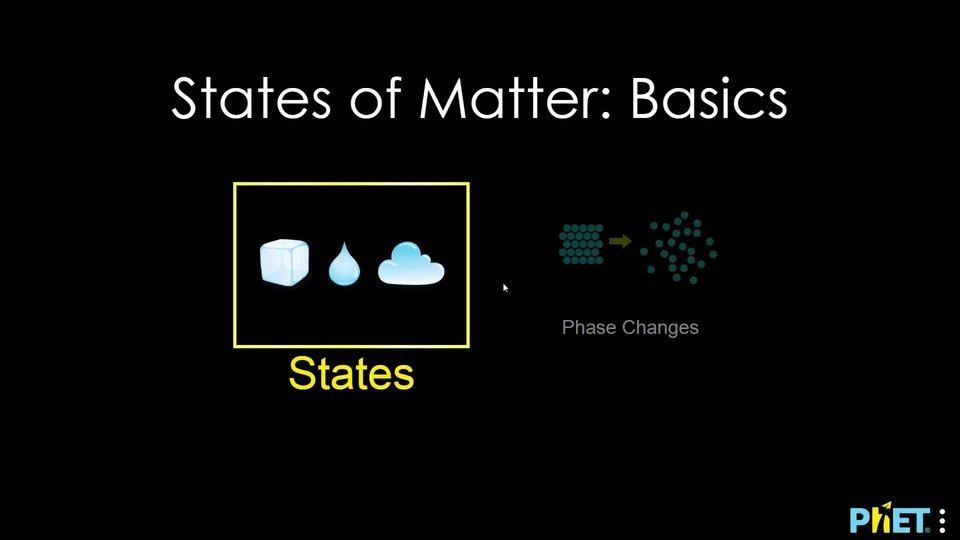
Scientists know that ice, water and steam are the same substance, but in different forms referred to as states of matter. Oxygen and nitrogen in the air are gases, while oil, water and gasoline are liquidsliquidliquids, and salt, sugar and coal are solidssolidsolids. When describing the properties of substances, we always pay attention to the form in which it occurs; solid, liquid or gasgasgas. In this way we define the physical statephysical statephysical state of the substance.
Each state of matter has its own characteristic features. In solid state, the substance retains its own shape. It is difficult to change its volume, which is why we say it is not very compressible. In liquid state the substance takes on the shape of the container in which it is located, but it is still difficult to change its volume. In gaseous state the substance always fills the entire container in which it is located and is compressible. This means that there is no specific shape or volume.
When does a substance change its state?
We already know that each substance is made of particles. They are in constant motion. Even in solid materials, the particles vibrate slightly. The physical state of the substance is related to the motion of it’s particles. The fastest particles are in gases, while in solids they almost never move.
Task 1
Before you watch the movie „Gases, liquids, solids”, write down the research question and the hypothesis. Make notes while watching the movie, and finally make conclusions.
R11egje8AO4wq
Polecenie sformułuj pytania I hipotezy pared filmem „Gases, liquids, solids”. Before you watch the movie „Gases, liquids, solids”, write down the research question and the hypothesis. Make notes while watching the movie, and finally make conclusions. Analyses of the experiment. Research question (Uzupełnij). Hypothesis (Uzupełnij). Observations (Uzupełnij). Conclusions (Uzupełnij).
Polecenie sformułuj pytania I hipotezy pared filmem „Gases, liquids, solids”. Before you watch the movie „Gases, liquids, solids”, write down the research question and the hypothesis. Make notes while watching the movie, and finally make conclusions. Analyses of the experiment. Research question (Uzupełnij). Hypothesis (Uzupełnij). Observations (Uzupełnij). Conclusions (Uzupełnij).
Analysis of the experiment
Rd2aB1h2QL8iX
Nagranie filmowe eksperymentu. Pokazana zmiana stanu skupienia wody w zależności od temperatury. Cząsteczki zbliżają się do siebie, kiedy obniżamy temperature. W miarę wzrostu temperatury zaczynają się od siebie oddalać i coraz szybciej poruszać.
Nagranie filmowe eksperymentu. Pokazana zmiana stanu skupienia wody w zależności od temperatury. Cząsteczki zbliżają się do siebie, kiedy obniżamy temperature. W miarę wzrostu temperatury zaczynają się od siebie oddalać i coraz szybciej poruszać.
Gases, liquids, solids
Source: GroMar Sp. z o.o., licencja: CC BY-SA 3.0.
Source: GroMar Sp. z o.o., licencja: CC BY-SA 3.0.
Nagranie filmowe eksperymentu. Pokazana zmiana stanu skupienia wody w zależności od temperatury. Cząsteczki zbliżają się do siebie, kiedy obniżamy temperature. W miarę wzrostu temperatury zaczynają się od siebie oddalać i coraz szybciej poruszać.
Changes in the state of matter
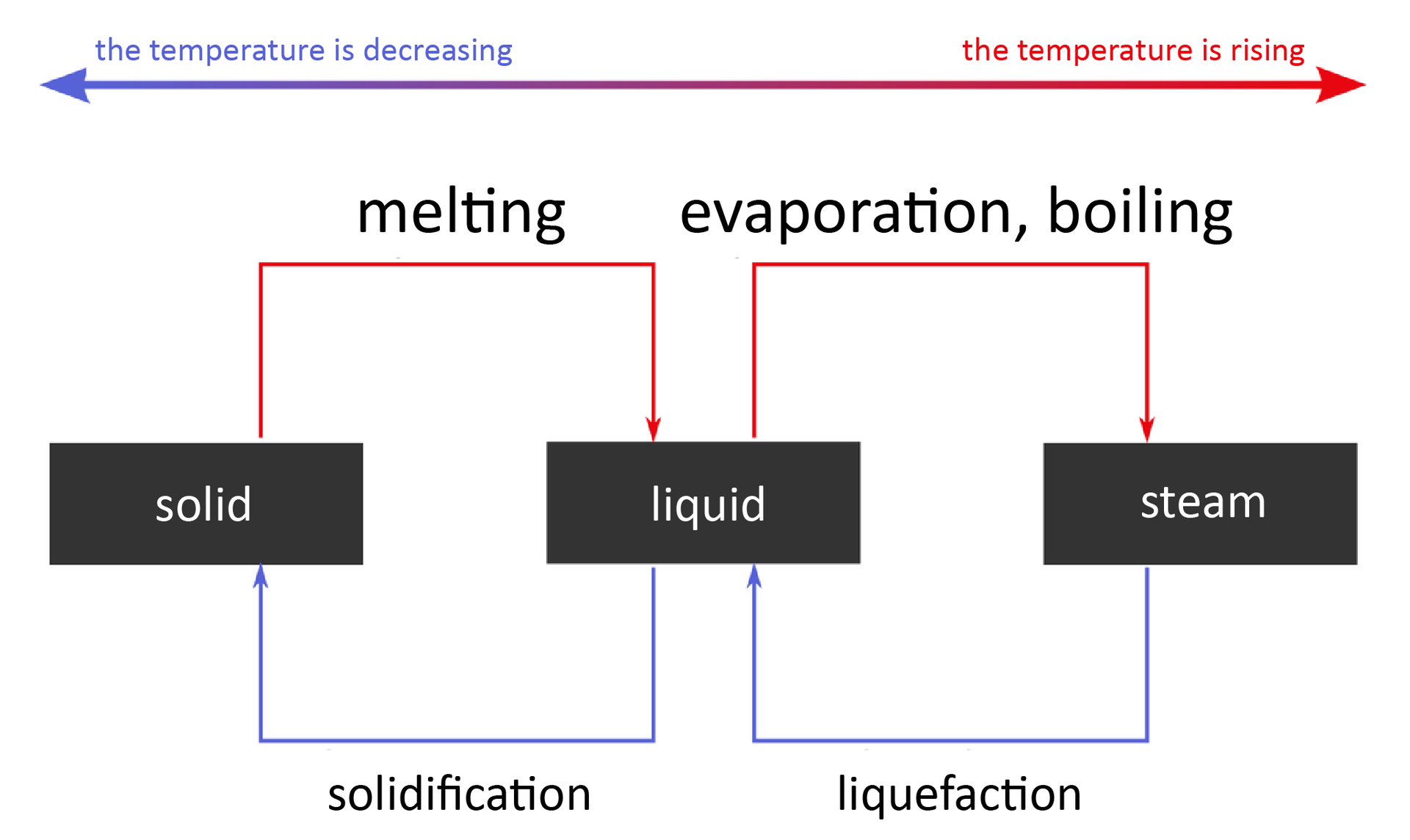
The speed of particles moving is determined by temperature, the higher the temperature, the faster the motion of particles and the easier they can detach from others. This means that a change in temperature affects the state of a substance. The process of changing a solid into a liquid is meltingmeltingmelting, a liquid to gas is called evaporationevaporationevaporation and boilingboilingboiling. The process of converting gas into liquid is called condensationcondensationcondensation, a liquid into a solid is called solidificationsolidificationsolidification.
Substance
Melting point
Boiling point
Physical state at room temperature
Aluminium
660,32°C
2519°C
solid at room temperature
Water
0°C
100°C
liquid at room temperature
Oxygen
−218,79°C
−182,97°C
gas at room temperature
RtyS6wUElNqiT
Na ilustracji zaprezentowano schemat obrazujący zmiany stanów skupienia. Są one związane ze zmianą temperatury substancji. Ciało stałe pod wpływem wzrostu temperatury topnieje i zamienia się w ciecz. Ciecz natomiast wraz ze wzrostem temperatury zaczyna wrzeć, a następnie parować, co powoduje zmianę jej stanu skupienia w stan gazowy. Kiedy temperatura spada, gaz ulega procesowi skraplania, zamieniając się w ciecz. Dalsze obniżanie temperatury doprowadzi do krzepnięcia i przemiany cieczy w ciało stałe. Na ilustracji są napisy: the temperature is decreasing,
the temperature is rising,
melting,
evaporation, boiling,
solidification,
liquefaction,
solid,
liquid,
steam
Changes in states of matter
Source: Krzysztof Jaworski, licencja: CC BY 3.0.
Changes in the state of matter do not occur at anytime, but at a certain temperatures. Boiling point is the temperature at which a liquid transforms into a gaseous state rapidly and in its entire volume. Melting point is the temperature at which a solid becomes a liquid (it melts).
Important!
The boiling and melting points are characteristic properties of each substance.
Warning!
Sometimes we may hear that something is evaporating. Evaporation it's – just like boiling – the process of converting liquids into gas. However, in contrast to boiling, evaporation occurs at any temperature higher than the melting point and does not change the state of the whole substance, only its surface. Boiling occurs in the whole volume of the liquid and only at a certain temperature.
R1S3KoNUicdo7
Exercise 1
Ćwiczenie scharakteryzuj trzy poznane podczas lekcji stany skupienia.
Ćwiczenie scharakteryzuj trzy poznane podczas lekcji stany skupienia.
Source: GroMar Sp. z o.o., licencja: CC BY-SA 3.0.
R1eDT2unWCu7t
Exercise 2
Ćwiczenie oceń prawdziwość zdań. Zdecyduj, czy przedstawione stwierdzenia opisujące cechy charakterystyczne ciał stałych, cieczy i gazów są prawdziwe, czy fałszywe. Ciało stałe łatwo jest ścisnąć i dopasować do dowolnego kształtu. whether the statements describing the characteristics of solids, liquids and gases are true or false.. A solid is easy to compress and adapt to any shape.. Możliwe odpowiedzi: True, False. A liquid always takes the shape of the container in which it is located.. Możliwe odpowiedzi: True, False. Matter in a gaseous state has a specific shape.. Możliwe odpowiedzi: True, False
Ćwiczenie oceń prawdziwość zdań. Zdecyduj, czy przedstawione stwierdzenia opisujące cechy charakterystyczne ciał stałych, cieczy i gazów są prawdziwe, czy fałszywe. Ciało stałe łatwo jest ścisnąć i dopasować do dowolnego kształtu. whether the statements describing the characteristics of solids, liquids and gases are true or false.. A solid is easy to compress and adapt to any shape.. Możliwe odpowiedzi: True, False. A liquid always takes the shape of the container in which it is located.. Możliwe odpowiedzi: True, False. Matter in a gaseous state has a specific shape.. Możliwe odpowiedzi: True, False
Decide whether the statements describing the characteristics of solids, liquids and gases are true or false.
True
False
A solid is easy to compress and adapt to any shape.
□
□
A liquid always takes the shape of the container in which it is located.
□
□
Matter in a gaseous state has a specific shape.
□
□
REVdh1OTdEcVh
Exercise 3
Ćwiczenie wyobraź sobie dwie sytuacje: 1) w miejscu, gdzie była kałuża, po nadejściu mrozu pojawia się lodowa tafla, 2) bałwanek w czasie odwilży robi się coraz mniejszy. Jakim procesom została poddana woda w opisanych sytuacjach? Imagine two situations: 1) in the place where there was a puddle, after the arrival of frost, an ice sheet appears, 2) a snowman during the thaw, which is getting smaller and smaller. What processes has the water been subjected to in these situations? Możliwe odpowiedzi: 1. situation 1 - solidification, situation 2 - boiling, 2. situation 1 - melting, situation 2 - solidification, 3. situation 1 - condensation, situation 2 - solidification, 4. situation 1 - solidifcation, situation 2 - melting
Ćwiczenie wyobraź sobie dwie sytuacje: 1) w miejscu, gdzie była kałuża, po nadejściu mrozu pojawia się lodowa tafla, 2) bałwanek w czasie odwilży robi się coraz mniejszy. Jakim procesom została poddana woda w opisanych sytuacjach? Imagine two situations: 1) in the place where there was a puddle, after the arrival of frost, an ice sheet appears, 2) a snowman during the thaw, which is getting smaller and smaller. What processes has the water been subjected to in these situations? Możliwe odpowiedzi: 1. situation 1 - solidification, situation 2 - boiling, 2. situation 1 - melting, situation 2 - solidification, 3. situation 1 - condensation, situation 2 - solidification, 4. situation 1 - solidifcation, situation 2 - melting
Imagine two situations: 1) in the place where there was a puddle, after the arrival of frost, an ice sheet appears, 2) a snowman during the thaw, which is getting smaller and smaller. What processes has the water been subjected to in these situations?
Ćwiczenie połącz pojęcie z definicją. Pair the names of the changes in the states of matter into pairs and their definitions. boiling Możliwe odpowiedzi: 1. gas conversion into a liquid, 2. conversion of a solid into a liquid, 3. transformation of liquid into a solid, 4. transformation of liquids into gas melting Możliwe odpowiedzi: 1. gas conversion into a liquid, 2. conversion of a solid into a liquid, 3. transformation of liquid into a solid, 4. transformation of liquids into gas condensation Możliwe odpowiedzi: 1. gas conversion into a liquid, 2. conversion of a solid into a liquid, 3. transformation of liquid into a solid, 4. transformation of liquids into gas solidification Możliwe odpowiedzi: 1. gas conversion into a liquid, 2. conversion of a solid into a liquid, 3. transformation of liquid into a solid, 4. transformation of liquids into gas
Ćwiczenie połącz pojęcie z definicją. Pair the names of the changes in the states of matter into pairs and their definitions. boiling Możliwe odpowiedzi: 1. gas conversion into a liquid, 2. conversion of a solid into a liquid, 3. transformation of liquid into a solid, 4. transformation of liquids into gas melting Możliwe odpowiedzi: 1. gas conversion into a liquid, 2. conversion of a solid into a liquid, 3. transformation of liquid into a solid, 4. transformation of liquids into gas condensation Możliwe odpowiedzi: 1. gas conversion into a liquid, 2. conversion of a solid into a liquid, 3. transformation of liquid into a solid, 4. transformation of liquids into gas solidification Możliwe odpowiedzi: 1. gas conversion into a liquid, 2. conversion of a solid into a liquid, 3. transformation of liquid into a solid, 4. transformation of liquids into gas
Pair the names of the changes in the states of matter into pairs and their definitions.
transformation of liquid into a solid, transformation of liquids into gas, conversion of a solid into a liquid, gas conversion into a liquid
boiling
melting
condensation
solidification
Summary
The substances that surround us can exist in three states – as solids, liquids and gases.
A solid has an unchanging shape and volume.
The liquid has a constant volume, but it has a variable shape.
The gas has no specific shape and easily changes in volume.
The physical state of the substance depends on the temperature. Changes in the physical state of a particular substance take place at strictly defined temperatures.
Keywords
state of matter, evaporation, condensation, solidification, melting point, boiling point