The gene is a fragment of a DNA molecule. It can be from several thousand to two million pairs of nucleotidesnucleotidenucleotides and is responsible for the production of a specific protein. The protein affects the organism's qualities, for example blood type or the shape of pea seeds. Usually, however, the body's features, such as the color of the eyes, require the presence of several proteins, which are determined by several genes.
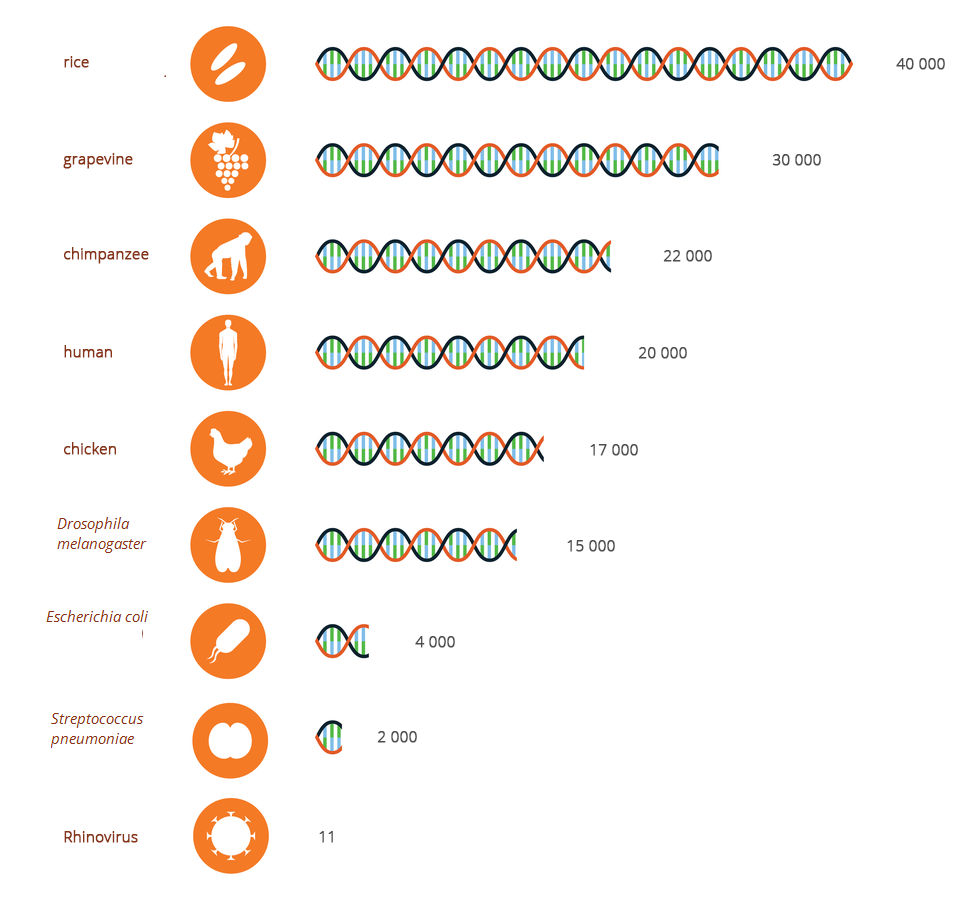
The number of genes in the DNA depends on the organism. The simplest bacteria have several hundred of them, and vertebrate animals and vascular plants tens of thousands. Some genes are active in all cells. Such genes include those that, for example, contain instructions for the production of enzymesenzymeenzymes which are involved in the intra‑cellular respiration process. This process occurs in every cell and constantly requires „reading” the instructions contained in the genes guiding this process. Other genes only work in selected sets of cells. Such genes are, for example, genes encoding hemoglobin, active only in immature erythrocytes, and a gene coding for growth hormone, capable of acting only in cells of the pituitary gland.
RA4cn6FYYxj34
Ilustracja przedstawia schematycznie liczbę genów w DNA różnychorganizmów. DNA ma postać zielono – pomarańczowej skręconej nici. Przy niej liczba, oznaczająca ilość genów. Z prawej pomarańczowe kółka z białą sylwetką organizmu. Od góry ryż, 40 000 genów. Dalej winorośl, 30 000. Niżej szympans, 22000 i człowiek 20 000 genów. Kura ma 17000, a muszka owocowa 15 000 genów. Pałeczka okrężnicy ma 4000, wirus grypy 2000 genów. Najmniej ma dwoinka zapalenia płuc, tylko 11 genów. Na ilustracji są napisy: rice, grapevine, chimpanzee, human, chicken, Drosophila melanogaster, Escherichia coli, Streptococcus pneumoniae, Rhinovirus.
The number of genes in the DNA of various organisms and viruses
Source: Anita Mowczan, licencja: CC BY 3.0.
Task 1
Explain the difference between the gene and the allele.
RfAd9LNozgrnG
Exercise 1
Ćwiczenie wskaż prawdziwe stwierdzenia. Indicate all true sentences. Możliwe odpowiedzi: 1. A gene is a fragment of a DNA molecule encoding a specific protein., 2. The length of individual genes can be different, depending on what proteins encode., 3. All organisms have exactly the same number of genes., 4. Genes encoding hemoglobin are active in all somatic cells.
Ćwiczenie wskaż prawdziwe stwierdzenia. Indicate all true sentences. Możliwe odpowiedzi: 1. A gene is a fragment of a DNA molecule encoding a specific protein., 2. The length of individual genes can be different, depending on what proteins encode., 3. All organisms have exactly the same number of genes., 4. Genes encoding hemoglobin are active in all somatic cells.
Show all true sentences.
A gene is a fragment of a DNA molecule encoding a specific protein.
The length of individual genes can be different, depending on what proteins encode.
All organisms have exactly the same number of genes.
Genes encoding hemoglobin are active in all somatic cells.
R10CtKQ9lqJ4M
Exercise 2
Ćwiczenie połącz w pary. Match the approximate number of genes to the appropriate group of organisms. viruses Możliwe odpowiedzi: 1. several hundred to several thousand genes, 2. several genes, 3. up to several tens of thousands of genes. bacteria Możliwe odpowiedzi: 1. several hundred to several thousand genes, 2. several genes, 3. up to several tens of thousands of genes. vertebrate animals Możliwe odpowiedzi: 1. several hundred to several thousand genes, 2. several genes, 3. up to several tens of thousands of genes
Ćwiczenie połącz w pary. Match the approximate number of genes to the appropriate group of organisms. viruses Możliwe odpowiedzi: 1. several hundred to several thousand genes, 2. several genes, 3. up to several tens of thousands of genes. bacteria Możliwe odpowiedzi: 1. several hundred to several thousand genes, 2. several genes, 3. up to several tens of thousands of genes. vertebrate animals Możliwe odpowiedzi: 1. several hundred to several thousand genes, 2. several genes, 3. up to several tens of thousands of genes
Match the approximate number of genes to the appropriate group of organisms.
several hundred to several thousand genes, several genes, up to several tens of thousands of genes
viruses
bacteria
vertebrate animals
R85suZkaxlGZl
Exercise 3
Ćwiczenie wskaż prawidłową odpowiedź. Indicate the appropriate words in the empty spaces. Information on the appearance and functioning of the body is stored in genes. The relationship between genetic information and the phenotype of the organism is as follows Możliwe odpowiedzi: 1. gene, 2. protein, 3. feature, 4. allele, and more specifically the particular Możliwe odpowiedzi: 1. gene, 2. protein, 3. feature, 4. allele, codes the information on the basis of which the appropriate Możliwe odpowiedzi: 1. gene, 2. protein, 3. feature, 4. allele is synthesized. The presence of a protein with a particular structure determines whether a given Możliwe odpowiedzi: 1. gene, 2. protein, 3. feature, 4. allele appears in the body's phenotype.
Ćwiczenie wskaż prawidłową odpowiedź. Indicate the appropriate words in the empty spaces. Information on the appearance and functioning of the body is stored in genes. The relationship between genetic information and the phenotype of the organism is as follows Możliwe odpowiedzi: 1. gene, 2. protein, 3. feature, 4. allele, and more specifically the particular Możliwe odpowiedzi: 1. gene, 2. protein, 3. feature, 4. allele, codes the information on the basis of which the appropriate Możliwe odpowiedzi: 1. gene, 2. protein, 3. feature, 4. allele is synthesized. The presence of a protein with a particular structure determines whether a given Możliwe odpowiedzi: 1. gene, 2. protein, 3. feature, 4. allele appears in the body's phenotype.
Drag the appropriate words to the empty spaces.
protein, gene, feature, allele
Information on the appearance and functioning of the body is stored in genes. The relationship between genetic information and the phenotype of the organism is as follows: .............., and more specifically the particular .............., codes the information on the basis of which the appropriate .............. is synthesized. The presence of a protein with a particular structure determines whether a given .............. appears in the body's phenotype.
Summary
A gene is a section of DNA that contains information about the structure of a particular protein.
R1LATAVSFbSHk
Dokończ zdania. How was this lesson? Did you like it? Finish selected sentences. Propozycje It was easy for me (uzupełnij), It was difficult for me (uzupełnij), Today I learned (uzupełnij), I understood that (uzupełnij), It surprised me (uzupełnij).
Dokończ zdania. How was this lesson? Did you like it? Finish selected sentences. Propozycje It was easy for me (uzupełnij), It was difficult for me (uzupełnij), Today I learned (uzupełnij), I understood that (uzupełnij), It surprised me (uzupełnij).
nukleotyd – podstawowy element strukturalny kwasu nukleinowego, zbudowany z cukru (rybozy lub deoksyrybozy), reszty kwasu fosforowego oraz zasady azotowej