Gene therapy
gene mutations often cause genetic diseases;
a mutation may prevent the creation of a specific gene product.
assess the usefulness of the gene therapy in medicine;
provide exemplary uses of the gene therapy;
identify risks of the gene therapy;
present advantages and disadvantages of the gene therapy in humans.
Origins of the gene therapy
The term „gene therapy” was introduced in 1962 by Wacław Szybalski. He was one of the first scientists who genetically modified eukaryotic cells. He managed to insert a piece of normal human DNA instead of mutant genes in bone marrow cells. The wrong DNA strand was repaired for the first time this way, laying foundations for other treatments and methods of the gene therapy.
The gene therapy is a method of treating genetic diseases by introducing a correct copy of a gene, whose defect causes a disease, into cells. The purpose of the therapy may also be to turn on or off the function of a specific gene or to introduce an additional therapeutic gene.
Gene therapy vectors
Vectors, i.e. gene carriers, are used to introduce genetic material into cells of a body undergoing the therapy. The most popular ones are viral vectors. Modified viral particles, which can introduce DNA encoding, for example, therapeutic proteins, are used for therapeutic purposes. These viruses cannot infect the body, because they have been deprived of genes dangerous to humans as a result of genetic transformations.
Non‑viral vectors may also be used in the gene therapy. A liposomeA liposome is a spherical vesicle that contains nucleic acid fragments or otherwise DNA. Viral proteins or other substances, which allow for cell penetration, are often added to them. When such a complex enters cytoplasm, DNA separates from a liposome. Introduced this way, nucleic acid enables the production of desired substances.
Study the diagram and discuss the course of the gene therapy. Specify a vector type.
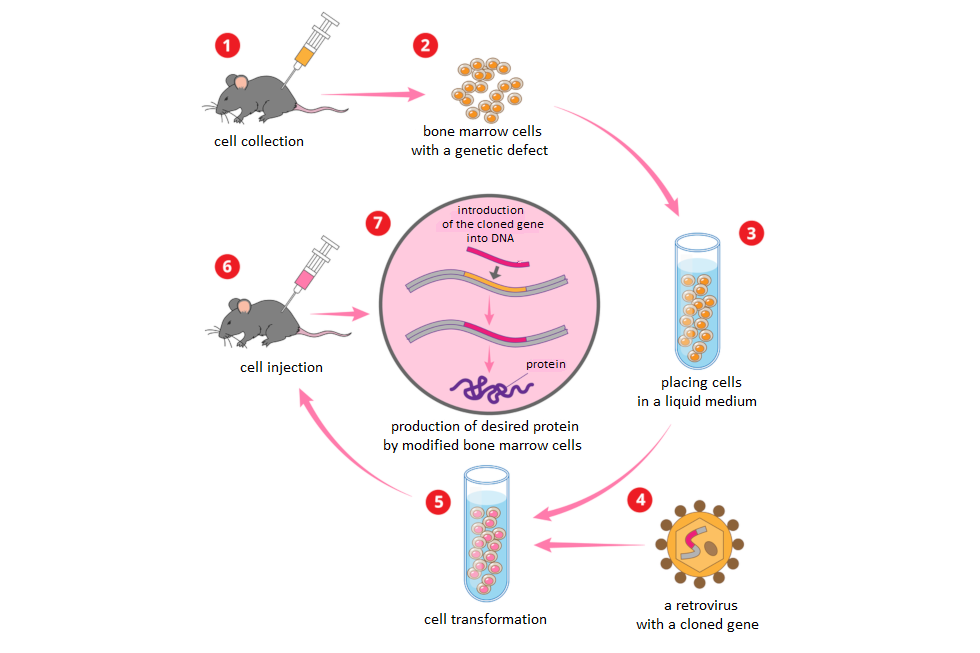
Present traits of viruses which enable them to be used as gene therapy vectors.
Types and strategies of the gene therapy
The gene therapy may involve reproductive cells, from which a new organism is to be formed, or embryo‑forming cells. If applied to the embryo, it enables an introduced change to be inherited. If applied to somatic cellssomatic cells, which build up the body, no changes are inherited. This treatment is conservative, as only symptoms, not the cause of the disease, are treated. At present, the somatic therapy in the only one used in patients. The reproductive cell therapy is prohibited due to ethical aspects.
So far, the gene therapy was attempted to be used to treat:
cancers;
diseases caused by monogenic dominant mutations, such as Huntington's chorea;
diseases caused by monogenic recessive mutations, such as sickle cell anemia, cystic fibrosis, haemophilia;
congenital blindness, i.e. an autosomal recessive disease, caused by a mutation in a gene encoding protein necessary for vision.
One disease, which can be treated with the gene therapy, is a severe immunodeficiency caused by a gene mutation (SCID syndrome). In this case, a patient's body lacks an enzyme necessary for the proper functioning of lymphocyteslymphocytes. The disease is manifested by low weight gain, low growth, frequent and recurrent infections, e.g. pneumonia, sepsis. If untreated, it leads to death which usually occurs before the age of 2.
There is also ongoing research on the treatment of diabetes.
Controversy around the gene therapy
The introduction of foreign DNA molecules to the human body raises many fears. Despite numerous attempts of treatment (cancers, phenylketonuria, dwarfism, insulin‑dependent diabetes) and very promising results, the use of gene therapy is in some cases risky and even dangerous due to its side effects. The gene therapy is an experimental therapyexperimental therapy at present, thus it cannot be used widely. So far, it has led to two deaths – a boy with immunity disorders and a teenager suffering from a rare liver disease. The latter died probably due to a violent immune response.
The use of viruses in the human gene therapy carries some risk, although genes dangerous to humans are removed. First of all, viral DNA is short, so it cannot contain many genes. It should be remembered that viral genetic material easily mutates, therefore any modified virus can become dangerous again. There is also no way of controlling where therapeutic genes are embedded which in turn makes the therapy less efficient. A badly embedded gene can also create an incorrect sequence – a new genetic defect.
Match the following terms with their correct definitions.
immune system cells, vesicles filled with water or an aqueous solution, surrounded by a lipid layer, a method of treating genetic diseases by introducing a correct copy of the gene, whose defect causes a disease, into cells, treatment involving new products and treatment techniques, used when routine and proven methods are ineffective
| gene therapy | |
| experimental therapy | |
| lymphocytes | |
| liposomes |
Which of the following diseases are attempted to be treated with the gene therapy? Select all the correct answers.
- cancers
- diseases caused by monogenic mutations
- diseases caused by multigenic mutations
- diseases caused by infectious agents
Is the gene therapy universally used at present? Select the correct answer.
- No, because it is still in the planning phase and no data on its effectiveness are available.
- No, because there are known cases of its serious side effects, including deaths.
- Yes, because the gene therapy proves more effective in every case than the traditional therapy.
- Yes, because it significantly reduces cancer treatment costs despite its dubious effectiveness.
Summary
The gene therapy is an experimental field of science.
The gene therapy can be used to treat genetic diseases, cancers and infectious diseases.
How was this lesson? Did you like it? Finish selected sentences.

Keywords
gene therapy, lymphocytes, liposomes
Glossary
komórki somatyczne – wszystkie komórki organizmu z wyjątkiem komórek płciowych
limfocyty – komórki układu odpornościowego
liposomy – pęcherzyki wypełnione wodą lub roztworem wodnym, otoczone warstwą lipidową; naturalnym liposomem jest na przykład cząsteczka cholesterolu; liposomy sztuczne służą do transportu zamkniętych w nich substancji, jak np. leki czy dermokosmetyki
terapia eksperymantalna – leczenie z wykorzystaniem nowych specyfików i technik leczenia, stosowane, gdy rutynowe i sprawdzone metody nie przynoszą efektu i gdy nie ma innej możliwości niesienia pomocy choremu oraz wtedy, gdy istnieje nawet niewielka szansa, że nowa terapia może przynieść korzyści dla pacjenta