How do we view others? The image of others in language and culture
you will explain what stereotypesstereotypes are and what their function is
you will get to know which stereotypes are linked with different nationsnations as well as social and professional groups
you will explain how idiomsidioms and proverbs reinforce a stereotypical view of the world
you will present the stereotypes hidden in adverts
you will tell what the consequensesconsequenses of using such simplificationssimplifications are
Before the lesson, prepare an anecdoteanecdote/jokejoke about Poles or other nationalities. Don't bring examples which are vular or offensive to the lesson.
Check out some newspapers, webpages or TV programs and think about the image the media portray of people from other countries. Is it neutral and objective?
Every language and every culture portrays a certain image of others, which is an attempt to learn about that which is unknown. We explain the world around us with the help of the language we have been learning since we were children, in addition to culture, which gives us the tools to interpret everything we come into contact with. We follow certain patterns subconsciously, which is why it is important to reflect on everything that we have inherited.
Check the meaning of the word stereotyp in a Polish monolingual dictionary.
An image of another is, in other words, a commonly accepted vision or idea of someone. When we think of members of a given group in a stereotypical way and unthinkingly repeat certain well‑worn phrases (such as, for example, „chefs are fat”, „Chinese people like rice”), we are using a simplified image of another. These „pictures in our heads” influence our perception of reality and our behaviour. Stereotypes can be about people from many different groups, including, among others, environmental (pupils, students), professional (teachers, IT specialists) and national (Americans, Germans). They can be neutral, positive or negative. The latter can give rise to intolerance and hostilityhostility, since they are emotionally coloured and are based on false generalisations.
The presence of stereotypes in language and culture is made evident not only by individual expressions, but also by common phrases, metaphors, proverbs and anecdotes.
Match the idioms and proverbs to their meanings. What traits can you see that are stereotypically assigned to particular nationalities or ethnic groups?
to persuade something to evil, to tempt, to incite, He realizes after the fact that the evil could be prevented., Even cordial friends should be counted among themselves., something cheap, of poor quality, listen to something, not understanding it, perfectly know something, but deliberately pretend to be incompetent, to cheat, person pampered, dubbed, fussy
| udawać Greka | |
| Kochajmy się jak bracia, liczmy się jak Żydzi. | |
| chińszczyzna | |
| siedzieć jak na tureckim kazaniu | |
| francuski piesek | |
| mądry Polak po szkodzie | |
| cyganić | |
| judzić |
Think about what image of ourselves and others is contained in them. Why do you think this is?
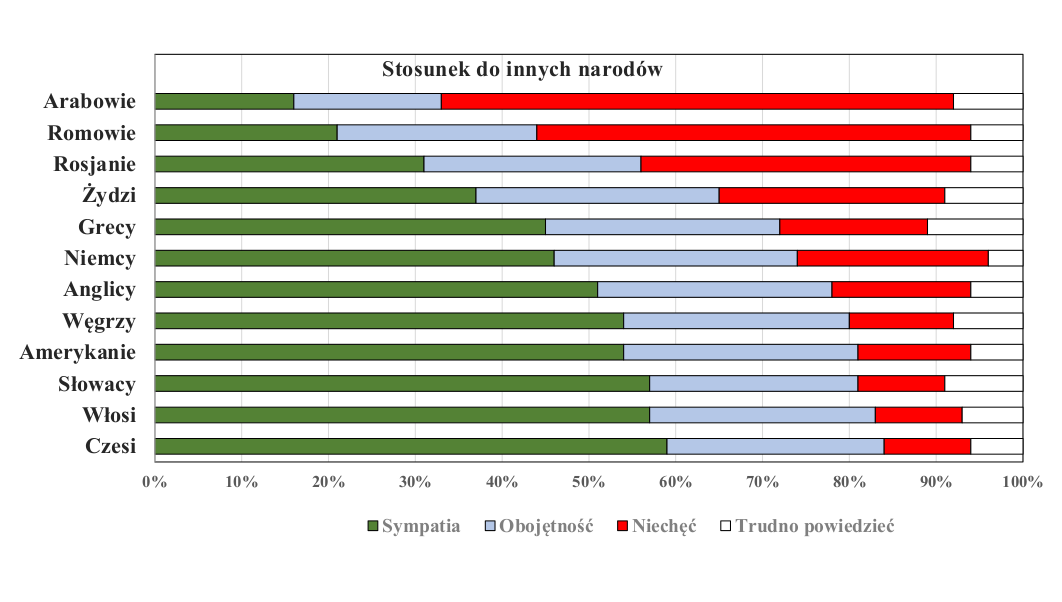
Work in groups using the sources available (for example, a dictionary of idioms) to find as many idiomatic phrases, in which representatives of nationalities, professional groups, etc. are mentioned. Evaluate whether they are positive (+), or negative (–) opinions.
Example: „Szewc bez butów chodzi” – ‘he is providing someone with something, that he himself doesn't have’. (–) „Tak krawiec kraje, jak (mu) materii staje” – ‘due to limited resources, one has to adjust one's demands according to what is possible’. (+)
Stereotypical views of others are passed down from generation to generation, as they are deeply rooted in language and culture. As an example, „Niemiec” in Polish, is literally ‘ktoś, kto jest niemy’, meaning someone who speaks an incomprehensible language. The literal meaning of the Polish word „Kozak” is ‘członek wspólnoty kozackiej’ (a member of the Cossak community), however „kozak” (written with a lowercase letter) means ‘śmiałek, chwat’ (a daredevil). What is interesting is that stereotyped images of not only people, but also animals, plants or objects around us play a part in language and culture. After all, we say „as faithful as a dog”, „as fit as a fiddle”, „as poor as a church mouse”, „a black sheep”, „as hungry as a horse”, „a sly fox”, „as strong as an oak”, „weeping willow”, „dumb as rocks”, etc.
Assign the idioms to the correct groups. If you don't know what a given phrase means, use a dictionary.
mieć końskie zdrowie, lwi pazur, kocia muzyka, niedźwiedzia przysługa, ranny ptaszek, znać się na czymś jak kura na pieprzu, gołębie serce, cielęce lata, biały kruk, żyć jak pies z kotem, czuć się jak ryba w wodzie, krecia robota, patrzeć wilkiem
| Positive characterisation | |
|---|---|
| Negative characterisation |
We encounter stereotypical descriptions of others both in literature, as well as in the press, on the radio, on television, and on the Internet. The mass media create simplified images of various groups for many reasons.
Complete the definition with the appropriate words.
positive, unjust, reality, negative, uncertain, emotional, imagination, complicating, rational, certain, simplification, complimentary
A stereotype is a simplified and often ............................ image of another or our own community. It is a result of limited opportunities to get to know a person and serves to order ............................. We can count the following among characteristics of stereotypes: ............................ of traits, over-generalisation, resistance to change, and most frequently, ............................ colouration. In other words, stereotypes are evidence of an imperfect, incomplete knowledge. This knowledge, however, helps people to adjust their behaviour in ............................ situations. Through stereotypes, we can judge a specific person and establish how we will treat them. We must remember, however, that in many cases our evaluation may be inaccurate and .............................
Find two adverts that use stereotypes related to gendergender, social roles or national traits. Identify which beliefs they appeal to, who they are aimed at, and what effect they are supposed to have.
Example: an advert for German cars uses the stereotype of Germans as people who like order, and value solid construction – effect: the impression is given that the advertised car will be reliable and dependable.
Keywords
idiom, stereotype, national minoritynational minority, self‑stereotypeself‑stereotype, image in language
Glossary
frazeologizm
stereotyp
mniejszosć narodowa
autostereotyp
przekonanie
nacechowanie
uprzedzenie
uproszczenie
obraz świata
grupa społeczna
płeć
zawód
naród
sondaż
akceptacja
niechęć
wrogość
sympatia
konsekwencje
anegdota
żart