How to care for your hearing and balance organ
nervous system is responsible for receiving, conducting and analyzing neural stimuli;
receptors receive light, mechanical and chemical stimuli;
information that travels from the receptor is transfered via sensory nerves to the encephalon or spinal cord, where it is analyzed.
to list factors which can damage the hearing and explain how to avoid them;
to describe how the organ of balance works.
How to care for your hearing?
Sensitivity to sounds and the ability to hear them is an individual feature. Human ear reacts to sounds between 16‑20 thousand Hz, and it is most sensitive to sounds between 500‑5 thousand Hz. The volume of sounds (intensity), which is measured in decibels (dB), affects how we perceive them. The amount of stimulated receptor cells in the cochlear duct and neural impulses caused depends on the volume of the sound. Human ear reacts to sounds with the volume up to 130 dB. Going over this limit initially causes pain, then it causes permanent mechanical damage of hearing caused by high air pressure (sound wave).
Annoying sounds, sounds that are too loud, sounds that irritate the nervous system, are described as noise. It accompanies us every day at school, at home, in the street. Too long listening to too loud noises may result in loss of sensitivity to quiet sounds and high frequencies. This happens because a noise of high intensity causes the loss of elasticity of the cilia found on sensory cells, and, in consequence, their death. This process is gradual, which is why a person with hearing loss is unaware of the problem initially. People that are at risk of hearing loss are e.g. bikers, workers who work with loud machines, musicians and people going to rock concerts. People who work in the environment with a lot of noise should have ear plugs or ear‑muffs. As a protection against noise in cities and along busy streets we build noise barriers or plant trees that limit the inconveniences caused by noise.
Young people usually listen to music that is too loud and they are convinced that they are not harmed by the noise. However, the research shows that 20‑30% of young people risk early hearing loss. One of the biggest threats is listening to music using headphones, especially the in‑ear ones. Air trapped between the headphone and the tympanic membranetympanic membrane acts as a piston and can lead to damage to the tympanic membrane. What is more, headphones introduce various germs and pollutants into the ear, which have perfect conditions for development there. This is why people using headphones are prone to ear infections which can lead to hearing loss.
Using the fishbone diagram and brainstorming method, solve the following problems:
Why do young people listen to very loud music?
Why do young people ignore the threats connected with the possibility of hearing loss?
Loud and unwanted noises cause strong mobilization to your body –-- stress reaction. As a result, you start feeling worse, you get tired more easily, you have headaches and dizziness, problems with cardiovascular systems appear, muscles are more tense and you have problems concentrating. The reason for hearing loss or hearing damage can be not only a long‑term noise but also ear wax deposition in ear canal, repeated ear infections of the middle earmiddle ear, stiffness of the ossiclesstiffness of the ossicles, thickening of the tympanic membrane and age.
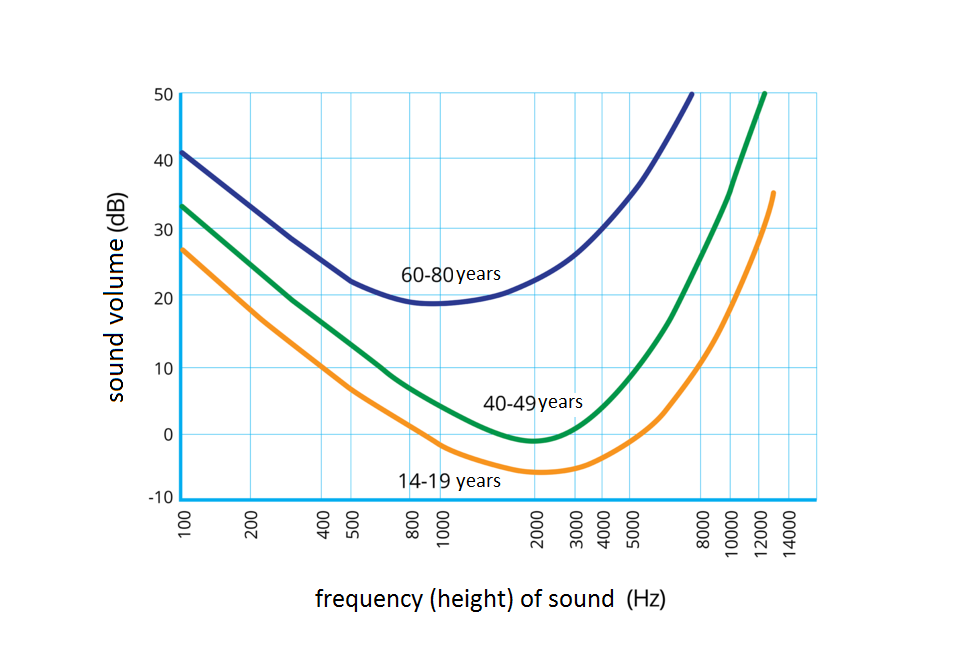
Based on the diagram, explain what it means that older people have weaker hearing than younger people.
People with hearing loss use hearing aids to help them with sounds. Those are electronic devices with a microphone, which receives sounds from the environment, a sound amplifier and a speaker. In case when most of the hearing receptors don’t work, we use hearing implants. Electronic devices that transfer sounds to electric signals which are transferred directly to the hearing nerve.
Balance organ
Ear, besides being the organ of hearing, has also the organ of balance. It is a part of the inner earinner ear. It registers the movements connected with head movements and changes of the body position. Its part are semi‑circular canals, arranged in 3 parallel planes. These canals are filled with fluid and the grains present in the fluid (otoliths), move as we move our head. Otoliths irritate certain areas of the semi‑circular canals, and the information about it travels to the brain. The fluid in the semi‑circular canals (and the otoliths) is in motion when you walk, which allows the brain to register the changes of position, control the body posture and the placement of your body in the space. Brain and cerebellum continuously assess the positioning of the body and can initiate the reaction to protect us from falling over.
While being in a big, empty room, check if you can walk straight ahead with your eyes closed. Stand at one side of the room, look ahead and set a point you want to reach. Close your eyes or put a blindfold on them. Try to reach the point. Did you manage to do it? Which sensory organ supports the organ of balance?
Choose the correct ending of the following phrase. Noise are not the sounds that can be heard:
- at school during breaks
- in a busy street of a big city
- at a rock concert
- in the forest when the wind is blowing
Select the correct sentence.
- Hearing becomes damaged because of high air pressure.
- Too strong sound waves cause temporary adaptation of auditory cells.
- Hearing loss connected with listening to too loud sounds is the result of hearing nerve loss.
- Listening to loud music often makes us immune to noise.
Mark your answers in the correct row
| I strongly agree | I agree | I disagree | I strongly disagree | |
| Sounds we hear every day do not damage our hearing. | □ | □ | □ | □ |
| Hearing can become damaged by the sound of an explosion or a jackhammer. | □ | □ | □ | □ |
| Audio devices guarantee the safety of your hearing. | □ | □ | □ | □ |
| Noise during breaks at school is safe for people who are used to it. | □ | □ | □ | □ |
| Time you spend listening to music does not have any influence over your hearing. | □ | □ | □ | □ |
| In-ear headphones cause hearing damage faster than over-the-ear or on-ear ones. | □ | □ | □ | □ |
Summary
Ear is the organ of hearing and balance.
The actual organ of balance are the receptor cells found inside the cochlear canal.
Receptor cells of the organ of hearing receive information in form of vibrations of the fluid that fills in the inside of the cochlear canal, whereas the cells of the organ of balance – the movement of the otoliths present in the fluid in semicircular canals.
Auditory sensations are created in the auditory centre in the cerebral cortex.
3 semicircular canals that are the part of inner ear are responsible for receiving the stimuli connected with head movement or change in body position.
Human ear reacts to sounds with the frequency of 16 Hz‑20 thousand Hz and the volume up to 130 dB.
Describe the elements of the inner, middle and outer earouter ear and the functions they have in the process of creating the auditory sensation.
Keywords
noise, decibel, hypoacusis
Glossary
błona bębenkowa -- cienka, elastyczna błona łącznotkankowa oddzielająca ucho zewnętrzne od ucha środkowego, odpowiedzialna za wzmacnianie drgań i przekazywanie ich na kosteczki słuchowe
kosteczki słuchowe – młoteczek, kowadełko, strzemiączko; najmniejsze elementy kostne organizmu połączone ze sobą stawowo; przekazują drgania z błony bębenkowej do ucha wewnętrznego
ucho środkowe – część ucha składająca się z błony bębenkowej, jamy bębenkowej i 3 kosteczek słuchowych: młoteczka, kowadełka i strzemiączka; częścią ucha środkowego jest też trąbka słuchowa, który łączy jamę bębenkową z gardłem; ucho środkowe odpowiada za wzmacnianie drgań i przekazywanie ich do ucha wewnętrznego
ucho wewnętrzne – część ucha, w której znajduje się właściwy narząd słuchu (przewód ślimakowy) oraz zmysł równowagi (kanały półkoliste)
ucho zewnętrzne – część ucha odpowiedzialna za wychwytywanie i przekazywanie dźwięków do ucha środkowego
trąbka słuchowa – przewód łączący jamę bębenkową z gardłem; odpowiada za wyrównywanie różnicy ciśnień między uchem zewnętrznym i środkowym