Nagranie dźwiękowe dotyczące determinacji płci u człowieka i dziedziczenie płci
Human sex determination
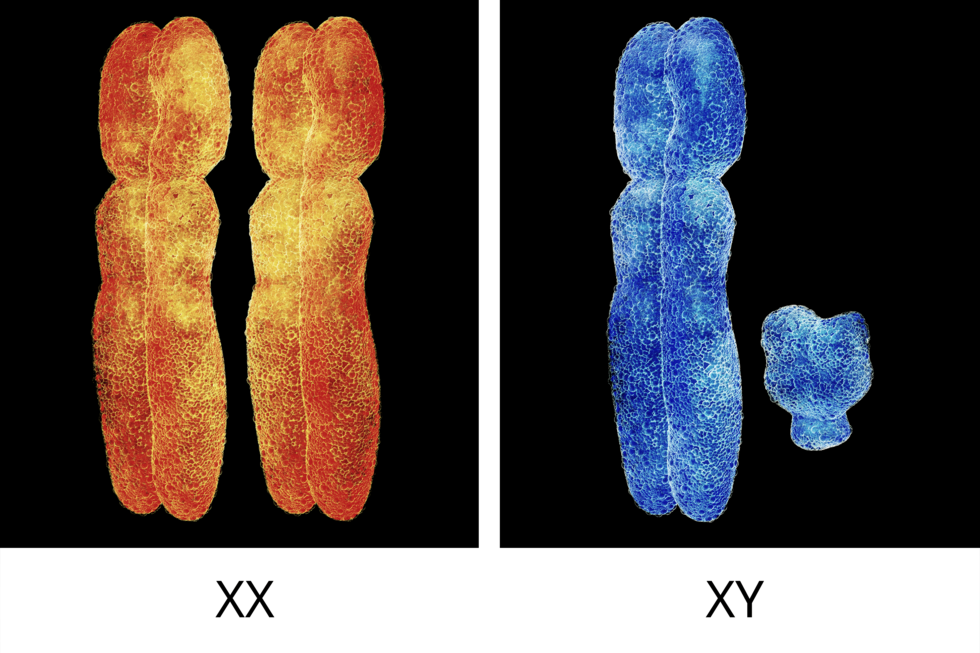
The set of chromosomes present in human somatic cells is called karyotypekaryotypekaryotype. The human karyotype consists of 22 pairs of autosomes and one pair of sex chromosomes. The sex chromosomes, called X and Y, differ in their structure and the presence of different genes.
In addition to autosomes A (44 chromosomes = 22 pairs), women have two X chromosomes in their somatic cells, therefore their karyotype is recorded as 44AXX, and men – in addition to autosomes, have one X chromosome and one Y, which means that their karyotype is 44AXY.
There are few genes in the Y chromosome, mainly conditioning the formation of male sex characteristics. In the X chromosome present in the karyotype of both sexes there are genes conditioning the development of female sexual features (until it is revealed which two X chromosomes are needed) and nearly 1200 other genes, significant for the health of both women and men. These include genes responsible for correct colour perception, blood coagulation, muscle function.
RW5JRGZsqbfe3
Ilustracja przestawia dwa zestawy chromosomów płci. Z lewej dwa grube, pomarańczowe chromosomy X (płeć żeńska). Z prawej jeden duży niebieski chromosom X, drugi mały niebieski chromosom Y.
Sex chromosomes
Source: Tomorrow Sp. z o.o., licencja: CC BY 3.0.
Task 1
Compare the structure of the X chromosome and the Y chromosome.
Sex inheritance
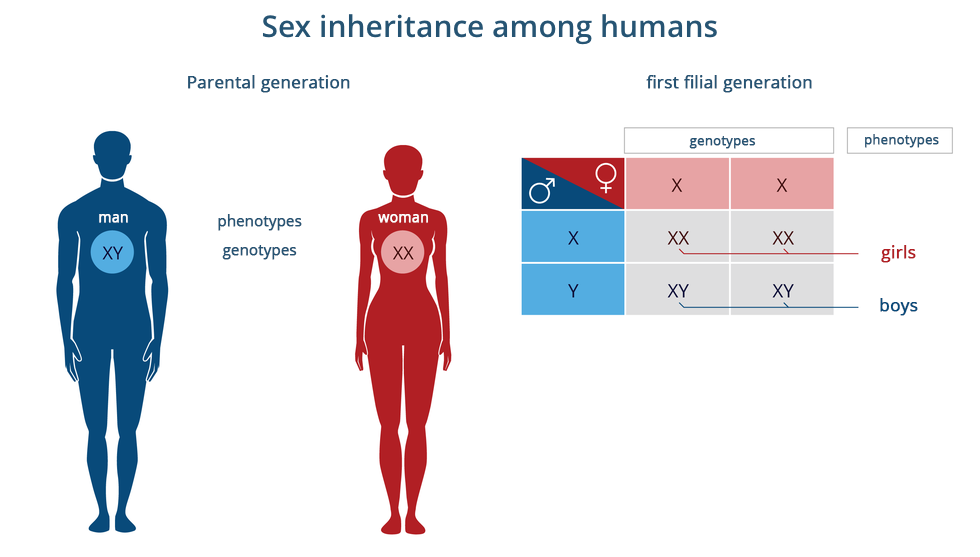
The genetic sex of a human is shaped at the time of fertilization. It depends on the sex chromosome that is contained in the sperm that fertilizes the egg cell. Sperms have either the X chromosome or the Y chromosome. In the egg cell there is an X chromosome. If the egg cell is fertilized with the sperm with the Y chromosome, the 44AXY karyotype will be created, i.e. a boy will be born. If the sperm containing the X chromosome penetrates the egg cell, a 44AXX karyotype will be created and a girl will be born. The theoretical probability of a given child's birth is 50%.
RrLOKxVcm4vEA
Ilustracja przestawia niebieską sylwetkę mężczyzny wpisanymi chromosomami płci XY. Obok różowa sylwetka kobiety z wpisanymi chromosomami XX. U góry podpis: Parental generation. Z prawej niebiesko - różowa krzyżówka genetyczna. U góry napis: first filial generation. W kolumnie pierwszej, w wierszu pierwszym oznaczenia płci – męska i żeńska. W kolumnach drugiej i trzeciej genorypy X. W wierszu drugim genotyp X, w wierszu trzecim genotyp Y. Komórka w kolumnie drugiej, w wierszu drugim – genotyp XX; komórka w kolumnie trzeciej, w wierszu drugim – genotyp XX; fenotyp w drugim wierszu – girls. Komórka w kolumnie drugiej, w wierszu trzecim – genotyp XY; komórka w kolumnie trzeciej, w wierszu trzecim – genotyp XY; fenotyp w trzecim wierszu – boys.
Sex inheritance among humans
Source: Anita Mowczan, licencja: CC BY 3.0.
Task 2
Until recently, in many countries around the world (and in China or India even now) sons have been more valued than daughters, whose mothers have been blamed for giving birth to too many girls. Explain whether the child's genetic sex depends on the woman.
RU5g0LOCN6DZa
Exercise 1
Ćwiczenie wskaż prawidłową odpowiedź. Indicate the correct statement. Możliwe odpowiedzi: 1. A woman and a man have the same karyotypes., 2. A woman and a man have different karyotypes., 3. A woman and a man differ in the number of autosomes., 4. A woman and a man differ in the number of sex chromosomes.
Ćwiczenie wskaż prawidłową odpowiedź. Indicate the correct statement. Możliwe odpowiedzi: 1. A woman and a man have the same karyotypes., 2. A woman and a man have different karyotypes., 3. A woman and a man differ in the number of autosomes., 4. A woman and a man differ in the number of sex chromosomes.
Indicate the correct statement.
A woman and a man have the same karyotypes.
A woman and a man have different karyotypes.
A woman and a man differ in the number of autosomes.
A woman and a man differ in the number of sex chromosomes.
R1SZsbFpbUpCu
Exercise 2
Ćwiczenie połącz w pary. Match each chromosome with a description of the genes it contains. X chromosome Możliwe odpowiedzi: 1. the majority of genes that condition external features and the functioning of the human body, 2. genes conditioning the development of male sex characteristics, 3. genes responsible for correct colour perception, blood coagulation and muscle function. Y chromosome Możliwe odpowiedzi: 1. the majority of genes that condition external features and the functioning of the human body, 2. genes conditioning the development of male sex characteristics, 3. genes responsible for correct colour perception, blood coagulation and muscle function. autosomes Możliwe odpowiedzi: 1. the majority of genes that condition external features and the functioning of the human body, 2. genes conditioning the development of male sex characteristics, 3. genes responsible for correct colour perception, blood coagulation and muscle function
Ćwiczenie połącz w pary. Match each chromosome with a description of the genes it contains. X chromosome Możliwe odpowiedzi: 1. the majority of genes that condition external features and the functioning of the human body, 2. genes conditioning the development of male sex characteristics, 3. genes responsible for correct colour perception, blood coagulation and muscle function. Y chromosome Możliwe odpowiedzi: 1. the majority of genes that condition external features and the functioning of the human body, 2. genes conditioning the development of male sex characteristics, 3. genes responsible for correct colour perception, blood coagulation and muscle function. autosomes Możliwe odpowiedzi: 1. the majority of genes that condition external features and the functioning of the human body, 2. genes conditioning the development of male sex characteristics, 3. genes responsible for correct colour perception, blood coagulation and muscle function
Match each chromosome with a description of the genes it contains.
genes conditioning the development of male sex characteristics, genes responsible for correct colour perception, blood coagulation and muscle function, the majority of genes that condition external features and the functioning of the human body
X chromosome
Y chromosome
autosomes
RaOw8jtSh8Ogm
Exercise 3
Ćwiczenie wybierz prawidłowe odpowiedzi. Indicate all correct statements. Możliwe odpowiedzi: 1. The sex of a human depends on the type of sex chromosome that is contained in an egg cell., 2. If there are two X chromosomes in the fertilized egg cell - a girl will be born., 3. If there are Y chromosomes and X chromosomes in the fertilized egg cell, a boy will be born., 4. The theoretical probability of giving birth to a given sex is 50%., 5. In practice, a little more boys are born than girls because the spermatozoon containing the Y chromosome is faster than the one containing the X chromosome.
Ćwiczenie wybierz prawidłowe odpowiedzi. Indicate all correct statements. Możliwe odpowiedzi: 1. The sex of a human depends on the type of sex chromosome that is contained in an egg cell., 2. If there are two X chromosomes in the fertilized egg cell - a girl will be born., 3. If there are Y chromosomes and X chromosomes in the fertilized egg cell, a boy will be born., 4. The theoretical probability of giving birth to a given sex is 50%., 5. In practice, a little more boys are born than girls because the spermatozoon containing the Y chromosome is faster than the one containing the X chromosome.
Indicate all correct statements.
The sex of a human depends on the type of sex chromosome that is contained in an egg cell.
If there are two X chromosomes in the fertilized egg cell - a girl will be born.
If there are Y chromosomes and X chromosomes in the fertilized egg cell, a boy will be born.
The theoretical probability of giving birth to a given sex is 50%.
In practice, a little more boys are born than girls because the spermatozoon containing the Y chromosome is faster than the one containing the X chromosome.
R1KNb7oN6qdKo
Exercise 4
Ćwiczenie uzupełnij luki w tekście. Complete the text below by dragging one of the suggestions below into each of the gaps. If the egg cell is fertilized by the spermatozoon containing the (uzupełnij) chromosome, a girl with a karyotype (uzupełnij) will be conceived. If a sperm containing a (uzupełnij) chromosome combines with the egg cell, a boy with a karyotype (uzupełnij) will be conceived. Możliwe odpowiedzi|: 1. 44AXY, 2. 46AXX, 3. Y, 4. 23AXY, 5. Z, 6. X, 7. 44AXX
Ćwiczenie uzupełnij luki w tekście. Complete the text below by dragging one of the suggestions below into each of the gaps. If the egg cell is fertilized by the spermatozoon containing the (uzupełnij) chromosome, a girl with a karyotype (uzupełnij) will be conceived. If a sperm containing a (uzupełnij) chromosome combines with the egg cell, a boy with a karyotype (uzupełnij) will be conceived. Możliwe odpowiedzi|: 1. 44AXY, 2. 46AXX, 3. Y, 4. 23AXY, 5. Z, 6. X, 7. 44AXX
Complete the text below by dragging one of the suggestions below into each of the gaps.
Y, 44AXX, 23AXY, Z, 46AXX, X, 44AXY
If the egg cell is fertilized by the spermatozoon containing the ............ chromosome, a girl with a karyotype ............ will be conceived. If a sperm containing a ............ chromosome combines with the egg cell, a boy with a karyotype ............ will be conceived.
Summary
The human karyotype consists of 46 chromosomes: 44 autosomes and two sex chromosomes.
Human sex is determined by the presence of sex chromosomes: in women - two X chromosomes, in men - one X chromosome and one Y chromosome.
R1BLiRmVfXym2
Dokończ zdania. How was this lesson? Did you like it? Finish selected sentences. Propozycje It was easy for me (uzupełnij), It was difficult for me (uzupełnij), Today I learned (uzupełnij), I understood that (uzupełnij), It surprised me (uzupełnij).
Dokończ zdania. How was this lesson? Did you like it? Finish selected sentences. Propozycje It was easy for me (uzupełnij), It was difficult for me (uzupełnij), Today I learned (uzupełnij), I understood that (uzupełnij), It surprised me (uzupełnij).
How was this lesson? Did you like it? Finish selected sentences.