Ilustracja interaktywna
In this section, you are going to learn more facts about World Health Day and its aims. Did you know that half of the world’s population lacks access to essential health care, and over 100 mln people all over the world have been pushed into poverty because the costs of health services are too high? WHO is actively working on improving this situation by putting forward various initiatives. Learn about some of them below.
W tej sekcji dowiesz się więcej na temat Światowego Dnia Zdrowia i jego celów. Czy wiesz, że połowa światowej populacji nie ma dostępu do podstawowej opieki zdrowotnej, a ponad 100 milionów ludzi na całym świecie żyje w nędzy ze względu na zbyt wysokie koszty usług medycznych? Światowa Organizacja Zdrowia czynnie pracuje nad poprawą tej sytuacji poprzez proponowanie różnorodnych inicjatyw. Sprawdź poniżej, na czym polegają niektóre z nich.
Drag the names of special WHO days to match them with the correct translation.
Now, study the interactive pictures and information displayed after clicking them. Then, do the exercises which follow.
Zasób interaktywny dostępny pod adresem https://zpe.gov.pl/a/D13LNMBW0
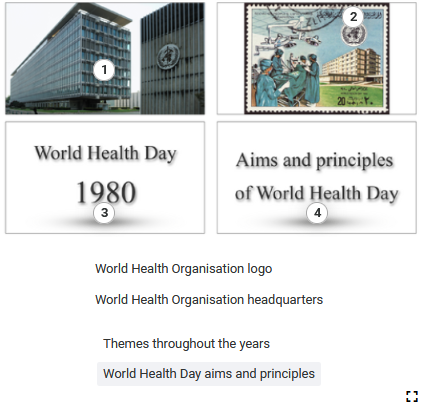
Grafika składa się z czterech zdjęć związanych ze Światową Organizacją Zdrowia. Ilustracja posiada cztery punkty interaktywne, po naciśnięciu których pojawiają się tekst oraz nagrania. Transkrypcja do nagrań znajduje się poniżej.
World Health Organisation headquarters
The World Health Organisation is headquartered in Geneva, Switzerland, and has six regional offices and 150 field offices worldwide. With its main building, inaugurated in 1966, standing as a symbol of its enduring mission, the organization continues to shed some light on effective health strategies. The main building is currently undergoing a renovation, scheduled to be finished in 2024. The six regional offices are: WHO Africa, WHO Americas, WHO Europe, WHO Eastern Mediterranean, WHO South East Asia and WHO Western Pacific. These regional offices play a crucial role in stepping up efforts to foster better health outcomes worldwide.
Zdjęcie nr 1 przedstawia budynek Światowej Organizacji Zdrowia.
World Health Organisation logo
WHO’s logo was chosen by the first World Health Assembly in 1948 and depicts planet Earth with a snake crawling up a staff, symbolising the journey of the healing process. This emblem's design originates from the story of Asclepius, the Greek god of healing. The projection of the world map is inscribed in a wreath consisting of branches of the olive tree.
Zdjęcie nr 2 przedstawia znaczek pocztowy, na którym widoczny jest zespół lekarzy przy operacji oraz budynek Światowej Organizacji Zdrowia.
Themes throughout the years
Since 1959, there have been many themes of World Health Day. Some themes worth noting have included: Clean water means better Health; Food for All; No Truce for Tuberculosis; Our Planet, our Earth: Think Globally, Act Locally; Small Bite, Big Threat; or Depression – Let’s Talk. These themes, year after year, serve as reminders of the selfless gift of life that health represents, urging individuals and communities worldwide to come together and collectively step up efforts for a healthier, more vibrant future.
Zdjęcie nr 3 zawiera tekst w języku angielskim: WORLD HEALTH DAY 1980.
World Health Day aims and principles
The main principle of World Health Day is to achieve health for all the people in the world, without any disregard for human rights. The campaigns focus on raising awareness about health inequity and highlighting its negative impacts on health and wellbeing, as well as social and economic development. They also aim to encourage public engagement in advocacy efforts, especially from government policy makers, to make health solutions accessible to everyone.
Zdjęcie nr 4 zawiera tekst w języku angielskim: AIMS AND PRINCIPLES OF HEALTH DAY.
a) World AIDS Day
b) World TB Day
c) World Health Day
d) World Hepatitis Day
2. Which celebrations remind people that some health issues are still deadly?
a) World Malaria Day
b) World No Tobacco Day
c) World Blood Donor Day
d) World TB Day
3. Which celebrations pay tribute to scientists?
a) World TB Day
b) World Malaria Day
c) World AIDS Day
d) World Hepatitis Day
4. Which celebrations do not focus on one health issue only?
a) World Malaria Day
b) World Immunisation Week
c) World Blood Donor Day
d) World Health Day
5. Which celebrations focus on children’s health?
a) World AIDS Day
b) World TB Day
c) World Immunisation Week
d) World Malaria Day
Answer the questions in 2–3 sentences.
Do you like the logo of the World Health Organisation? Why? Why not?
Would you be inspired by World Health Day to take some steps to improve your health? How?
Which of the official WHO Health Days resonates with you the most and why?