In the shadow of Vienna. Poland’s crisis in the second half of the 17th century
The Battle of Vienna – a battle on the outskirts of Vienna. In the background you can see how, despite the approaching relief and the disastrous situation of the Turkish army, the Janissaries are still storming the city walls
Source: Oblężenie i odsiecz wiedeńska, domena publiczna.
Poland’s wars in the 17th century led to the collapse of the position of the Polish state on the international arena. They led to the destruction of the country’s economy. A significant part of the country was destroyed. Urban and rural economy deteriorated. Many cultural goods were stolen. The Polish population decreased. The State Treasury was empty.
The dramatic situation of the Treasury and the state led to the weakening of the royal power. On the other hand, the significance of [magnates]pojecie‑ref={Magnates} increased. The Sejm, the most important national body of Poland, without which nothing could be done in the state, was being paralyzed by the use of the liberum vetoLiberum vetoliberum veto rule. It was first used by Lithuanian Member of the Sejm Władysław Siciński in 1652.
There was more and more chaos in the country. In 1654–1667, the Polish‑Russian war took place provoked by the Treaty of Pereyaslav, by virtue of which Ukraine found itself under the rule of the Tsar. The Russian army entered Lithuania and Ukraine. In 1655, Poles, supported by the Tatars with whom they had an alliance, won the Battle of Okhmativ. When the Swedish Deluge began, the Russians withdrew from Poland.
The Polish‑Russian war resumed in 1660. That same year, Stefan Czarniecki won the Battle of Polonka, while Stanisław Potocki and Jerzy Lubomirski – the Battle of Chudnov. The royal troops pushed the Russians out of Lithuania. The war ended in 1667 with the Truce of Andrusovo.
At the same time, in Poland there was a rebellionRebellionrebellion. Jerzy Lubomirski opposed the plans of the court, which wanted to organize an election with the king still living (vivente rege). He headed the Sejm opposition. He opposed the strengthening of royal power and political reforms, defending the golden freedom of the nobility. Soon, a civil war broke out. Lubomirski defeated the royal troops near Częstochowa and Mątwy. He was accused of inciting the army to rebel, and sentenced by a court of law to banishmentBanishmentbanishment and confiscation of property. Lubomirski’s Rebellion prevented any possible reformation of the political system in Poland.
In 1668, John II Casimir abdicated and emigrated to France. The nobility elected the new king – Michał Korybut Wiśniowiecki (Michael I). He reigned for a short time, only five years, during which the position of magnates was strengthened. Magnates, in turn, made it difficult for him to exercise power.
The second half of the 17th century also saw further wars between Poland and Turkey. In 1672, Turkey attacked Kamianets‑Podilskyi. The unprepared Polish‑Lithuanian state had to sign a truce in Buchach, by virtue of which Poland lost Podolia and Ukraine, and had to pay tributeTributetribute to Turkey. Due to this situation, the Sejm passed a new tax for the army. Forces were mobilized, which resulted in the victory of Jan Sobieski in the Battle of Khotyn. Unfortunately, this victory was not taken advantage of, because the nobility went for a free election after Wiśniowiecki’s death. John III Sobieski was proclaimed king.
However, the war with Turkey continued. Unfortunately, Poland carried out only defensive actions. In 1676, the Treaty of Żurawno was signed, which confirmed the incorporation of Podolia and Ukraine into Turkey. In 1675, Sobieski and the king of France concluded a treaty in Jaworzno directed against Brandenburg. It was to lead Poland to getting back the Duchy of Prussia. In 1683, Sobieski withdrew from the treaty with France in favor of a treaty signed with Austria. The combined Polish, Imperial, and Reich dukes’ forces defeated the army of vizier Kara Mustafa in the Battle of Vienna. In 1684, the Holy League was established – an alliance among Poland, Austria, Venice, and the papacy, against Turkey.
The Polish‑Turkish wars ended with the Treaty of Karlowitz, by virtue of which the Polish‑Lithuanian state regained Podolia with Kamianets as well as the left‑bank Ukraine.
Task 1
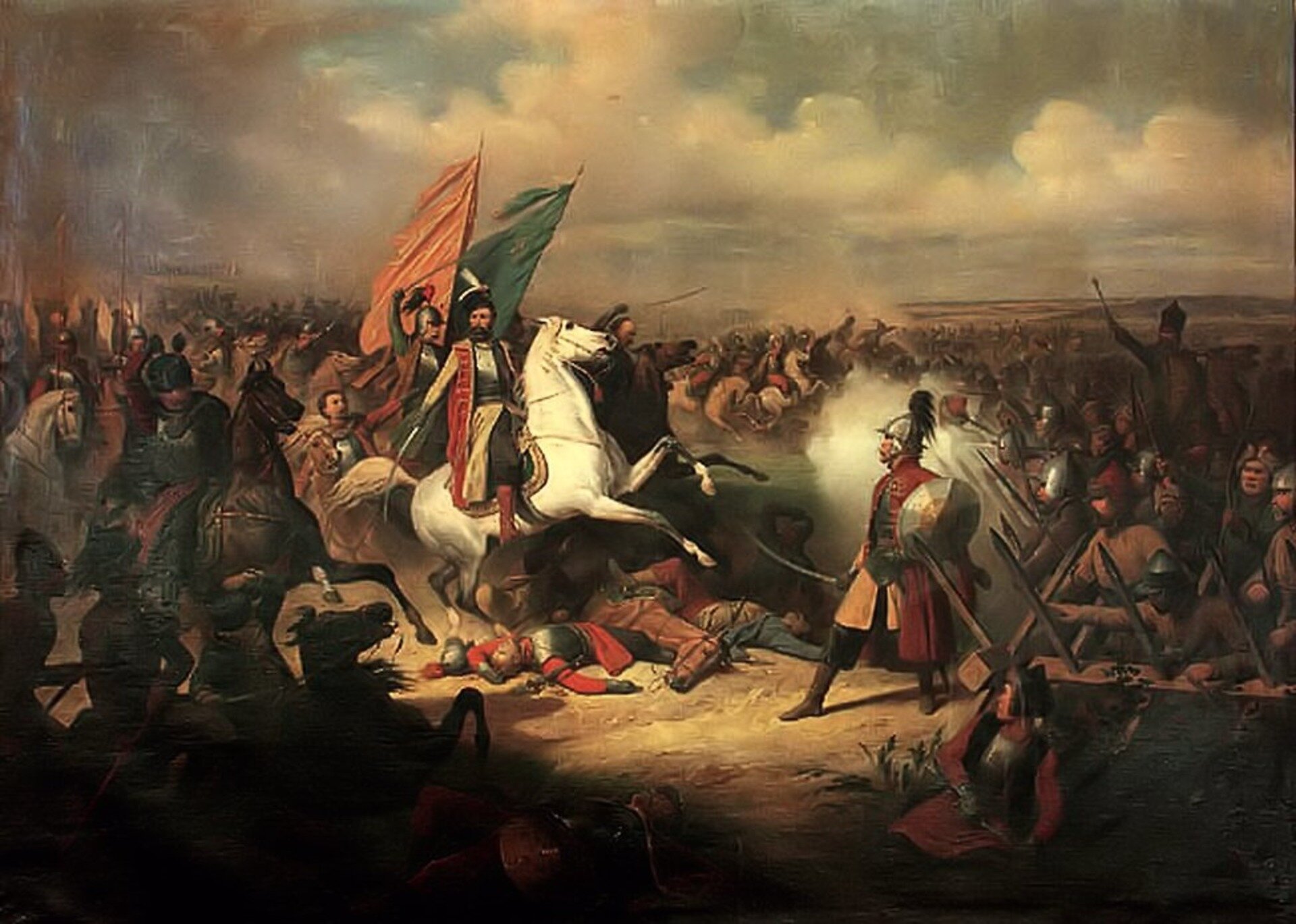
In which year Stefan Czarniecki won under Połonka?
RP55Z4nhHltul
Obraz przedstawiający postać Hetmana Stefana Czarnieckiego na polu bitwy. Wokół żołnierzy Hetman siedzi na białym koniu. W tle, na wietrze powiewają chorągwie.
Hetman Stefan Czarniecki on the battlefield.
Source: January Suchodolski, domena publiczna.
Task 2
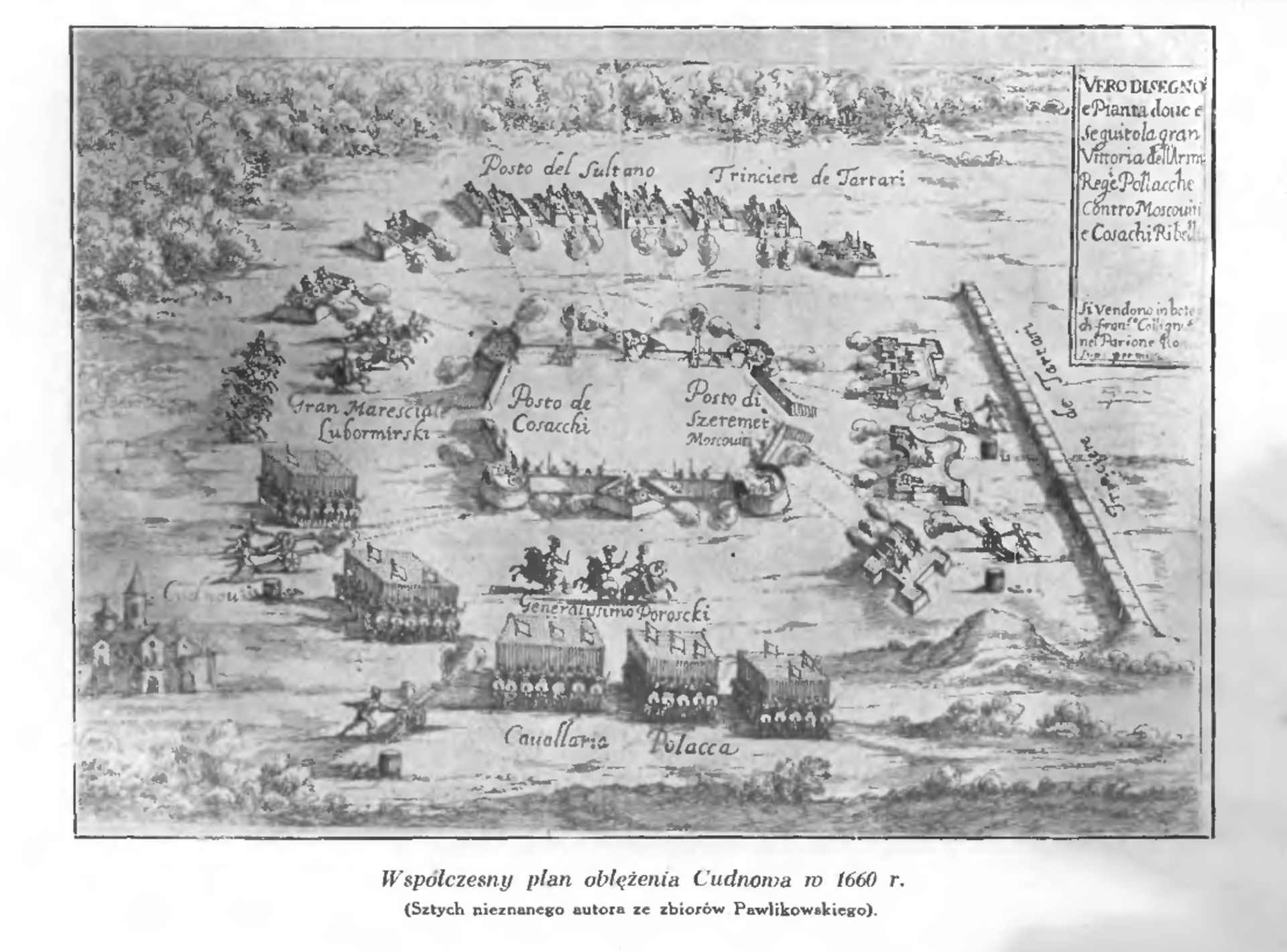
Which leaders won the battle of Cudnow?
Rtcgs4sAkwM04
Ilustracja przedstawiająca współczesny plan oblężenia Cudnowa w 1660 roku. Na ilustracji widać namalowane rozmieszczenie sił, wojsk pieszych i konnych, armat. Wszystko to jest ustawione wokół twierdzy, którą przeciwnik chce zdobyć.
Engraving, unknown author, presenting the battle of Cudnow in 1660 ("Przegląd Historyczno-Wojskowy" 1929, T. 1, book 2)
Source: a. nn., domena publiczna.
Task 3
Based on what you have learned as well as available sources, carry out a SWOT analysis for John II Casimir’s decision to abdicate.
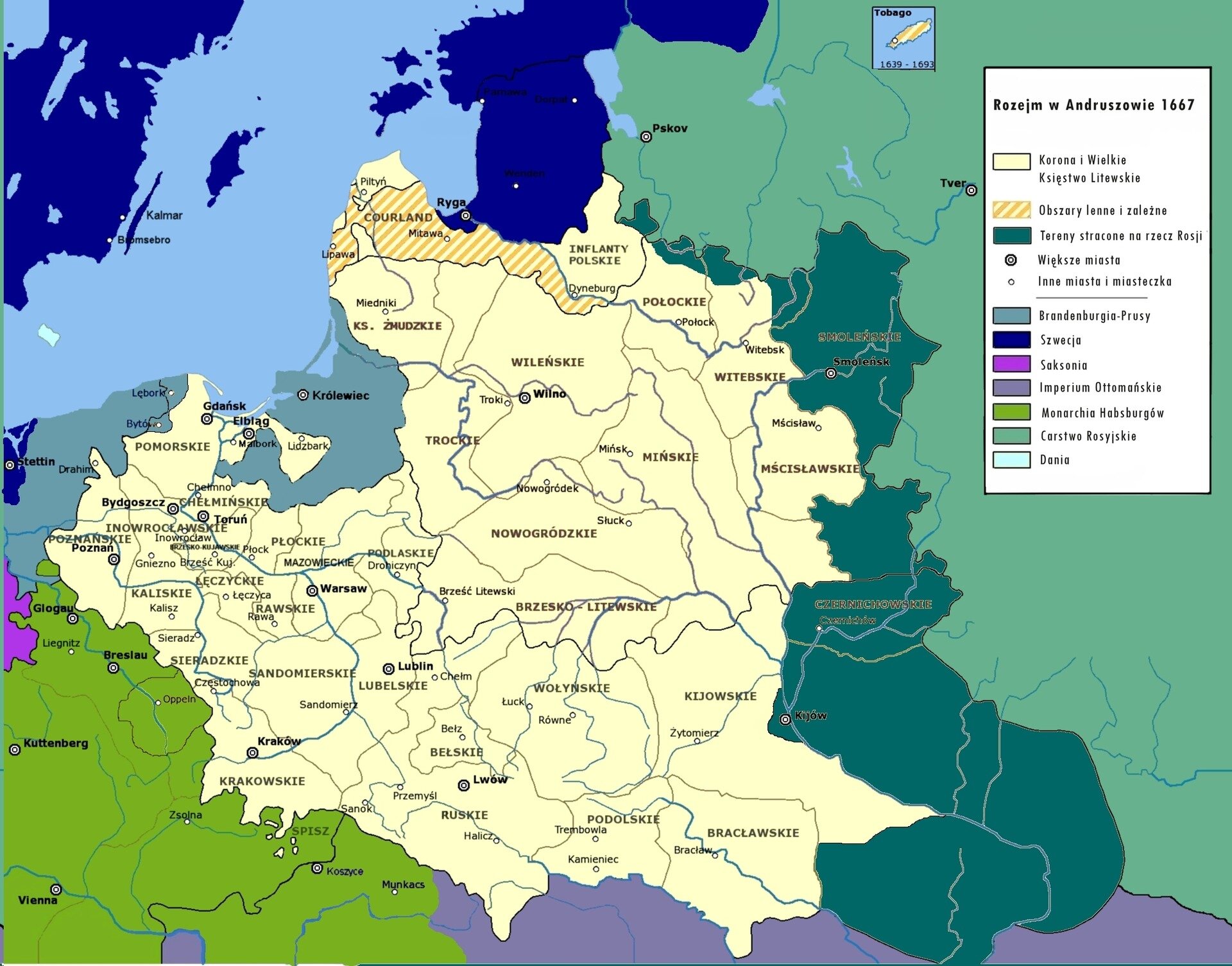
Jakie obszary Polski zostały utracone w wyniku rozejmu w Andruszowie? Poszukaj informacji w dostępnych ci źródłach.
Jakie obszary Polski zostały utracone w wyniku rozejmu w Andruszowie? Poszukaj informacji w dostępnych ci źródłach.
What areas of Poland were lost as a result of the truce in Andruszów?
RXbcEfNuTrVkW
Grafika mapy przedstawiającej Rzeczpospolita w 1667 r. - skutki zawieruchy Andruszowej. Ziemie Rzeczypospolitej przegrane z carem rosyjskim w ramach tego rozejmu oznaczone są w ciemnozielonym kolorze.
Commonwealth in 1667 - effects of the Andruszowa truce. Lands of the Commonwealth lost to the Russian Tsar under this truce are marked in the dark green colour..
Source: a. nn., domena publiczna.
R1Um666NzzHkg
Exercise 1
Match the terms to the definitions. Banishment Możliwe odpowiedzi: 1. election of a new king during the lifetime of the previous monarch., 2. the punishment of exile., 3. [Latin for ‘free veto’] – the name of the rule that allows each member of the Sejm to force an immediate end to the current session and to nullify any legislation that has already been passed at the session., 4. the highest layer of the nobility., 5. forced contribution or ransom paid by the party that lost the war., 6. a convention of the nobility or its armed revolt against the king in order to protect the former’s privileges. Tribute Możliwe odpowiedzi: 1. election of a new king during the lifetime of the previous monarch., 2. the punishment of exile., 3. [Latin for ‘free veto’] – the name of the rule that allows each member of the Sejm to force an immediate end to the current session and to nullify any legislation that has already been passed at the session., 4. the highest layer of the nobility., 5. forced contribution or ransom paid by the party that lost the war., 6. a convention of the nobility or its armed revolt against the king in order to protect the former’s privileges. Liberum veto Możliwe odpowiedzi: 1. election of a new king during the lifetime of the previous monarch., 2. the punishment of exile., 3. [Latin for ‘free veto’] – the name of the rule that allows each member of the Sejm to force an immediate end to the current session and to nullify any legislation that has already been passed at the session., 4. the highest layer of the nobility., 5. forced contribution or ransom paid by the party that lost the war., 6. a convention of the nobility or its armed revolt against the king in order to protect the former’s privileges. Magnates Możliwe odpowiedzi: 1. election of a new king during the lifetime of the previous monarch., 2. the punishment of exile., 3. [Latin for ‘free veto’] – the name of the rule that allows each member of the Sejm to force an immediate end to the current session and to nullify any legislation that has already been passed at the session., 4. the highest layer of the nobility., 5. forced contribution or ransom paid by the party that lost the war., 6. a convention of the nobility or its armed revolt against the king in order to protect the former’s privileges. Rebellion Możliwe odpowiedzi: 1. election of a new king during the lifetime of the previous monarch., 2. the punishment of exile., 3. [Latin for ‘free veto’] – the name of the rule that allows each member of the Sejm to force an immediate end to the current session and to nullify any legislation that has already been passed at the session., 4. the highest layer of the nobility., 5. forced contribution or ransom paid by the party that lost the war., 6. a convention of the nobility or its armed revolt against the king in order to protect the former’s privileges. Vivente rege Możliwe odpowiedzi: 1. election of a new king during the lifetime of the previous monarch., 2. the punishment of exile., 3. [Latin for ‘free veto’] – the name of the rule that allows each member of the Sejm to force an immediate end to the current session and to nullify any legislation that has already been passed at the session., 4. the highest layer of the nobility., 5. forced contribution or ransom paid by the party that lost the war., 6. a convention of the nobility or its armed revolt against the king in order to protect the former’s privileges.
Match the terms to the definitions. Banishment Możliwe odpowiedzi: 1. election of a new king during the lifetime of the previous monarch., 2. the punishment of exile., 3. [Latin for ‘free veto’] – the name of the rule that allows each member of the Sejm to force an immediate end to the current session and to nullify any legislation that has already been passed at the session., 4. the highest layer of the nobility., 5. forced contribution or ransom paid by the party that lost the war., 6. a convention of the nobility or its armed revolt against the king in order to protect the former’s privileges. Tribute Możliwe odpowiedzi: 1. election of a new king during the lifetime of the previous monarch., 2. the punishment of exile., 3. [Latin for ‘free veto’] – the name of the rule that allows each member of the Sejm to force an immediate end to the current session and to nullify any legislation that has already been passed at the session., 4. the highest layer of the nobility., 5. forced contribution or ransom paid by the party that lost the war., 6. a convention of the nobility or its armed revolt against the king in order to protect the former’s privileges. Liberum veto Możliwe odpowiedzi: 1. election of a new king during the lifetime of the previous monarch., 2. the punishment of exile., 3. [Latin for ‘free veto’] – the name of the rule that allows each member of the Sejm to force an immediate end to the current session and to nullify any legislation that has already been passed at the session., 4. the highest layer of the nobility., 5. forced contribution or ransom paid by the party that lost the war., 6. a convention of the nobility or its armed revolt against the king in order to protect the former’s privileges. Magnates Możliwe odpowiedzi: 1. election of a new king during the lifetime of the previous monarch., 2. the punishment of exile., 3. [Latin for ‘free veto’] – the name of the rule that allows each member of the Sejm to force an immediate end to the current session and to nullify any legislation that has already been passed at the session., 4. the highest layer of the nobility., 5. forced contribution or ransom paid by the party that lost the war., 6. a convention of the nobility or its armed revolt against the king in order to protect the former’s privileges. Rebellion Możliwe odpowiedzi: 1. election of a new king during the lifetime of the previous monarch., 2. the punishment of exile., 3. [Latin for ‘free veto’] – the name of the rule that allows each member of the Sejm to force an immediate end to the current session and to nullify any legislation that has already been passed at the session., 4. the highest layer of the nobility., 5. forced contribution or ransom paid by the party that lost the war., 6. a convention of the nobility or its armed revolt against the king in order to protect the former’s privileges. Vivente rege Możliwe odpowiedzi: 1. election of a new king during the lifetime of the previous monarch., 2. the punishment of exile., 3. [Latin for ‘free veto’] – the name of the rule that allows each member of the Sejm to force an immediate end to the current session and to nullify any legislation that has already been passed at the session., 4. the highest layer of the nobility., 5. forced contribution or ransom paid by the party that lost the war., 6. a convention of the nobility or its armed revolt against the king in order to protect the former’s privileges.
Match the terms to the definitions.
the punishment of exile., election of a new king during the lifetime of the previous monarch., forced contribution or ransom paid by the party that lost the war., the highest layer of the nobility., a convention of the nobility or its armed revolt against the king in order to protect the former’s privileges., [Latin for ‘free veto’] – the name of the rule that allows each member of the Sejm to force an immediate end to the current session and to nullify any legislation that has already been passed at the session.
Banishment
Tribute
Liberum veto
Magnates
Rebellion
Vivente rege
Task 5
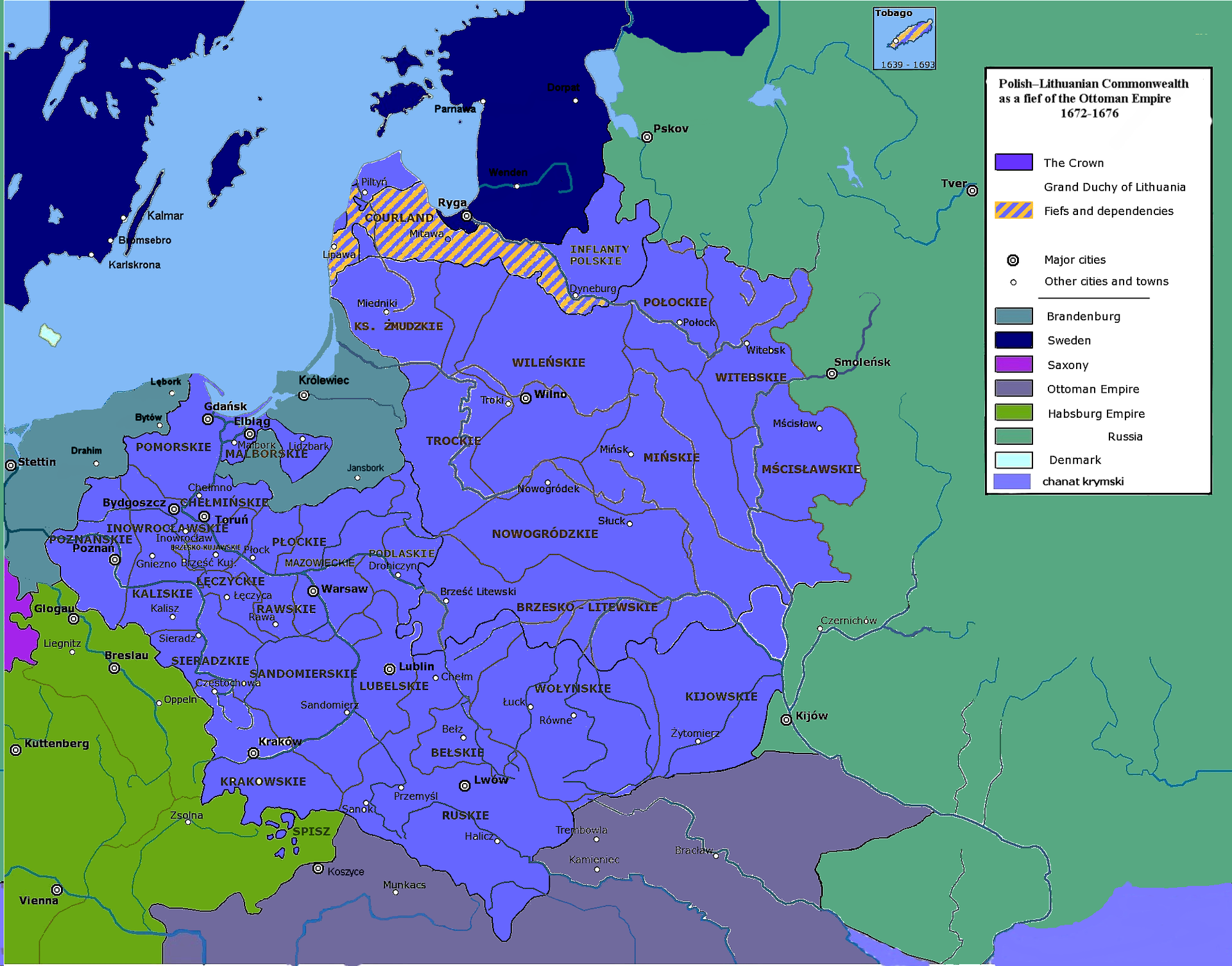
Discuss the terms of the Buczacz treaty. As a result of which events it was concluded?
RzmVUGEok5Avm
Grafika mapy przedstawiającej państwo po Traktacie w Buczaczu.
Commonwealth after the Treaty in Buczacz
Source: Mathiasrex, Wikimedia Commons, licencja: CC BY-SA 3.0.