Are you aware that, even now, you are moving with the Earth around the Earth's axis? Do you know at what speed? Much faster than the fastest Formula 1 cars! The inhabitants of Poland cover 1,000 kilometres within one hour together with the globe and people on the equator cover even 1,667 kilometres at the same time.
R4aBR6MjcHoO7
Nagranie filmowe: Simulation of apparent motion of the sun and stars. Sky observation in the stellarium program.
Nagranie filmowe: Simulation of apparent motion of the sun and stars. Sky observation in the stellarium program.
Nagranie filmowe: Simulation of apparent motion of the sun and stars. Sky observation in the stellarium program.
When living on the surface of Earth, it is difficult to directly observe the movements of our planet. However, we can notice the Sun’s apparent motion from east to west, which is a consequence of Earth's rotation around its own axis from west to east. A full rotation takes about 23 hours 56 minutes and 4 seconds. This time is called the sidereal daysidereal daysidereal day. We may be a bit more familiar with the solar daysolar daysolar day that lasts a bit longer, almost exactly 24 hours. This is the time that passes between two consecutive moments of the solar noonsolar noonsolar noon. Therefore, a solar day is longer than a sidereal day. This is due to the fact that Earth simultaneously rotates around its own axis and circles around the Sun (see: Earth’s revolution). For the next solar noon to occur at a given point on the surface of our planet – for example, the place where we live – after the full rotation, Earth must rotate around its axis almost 1° more than 360°.
R1QAZVdqKsDRO
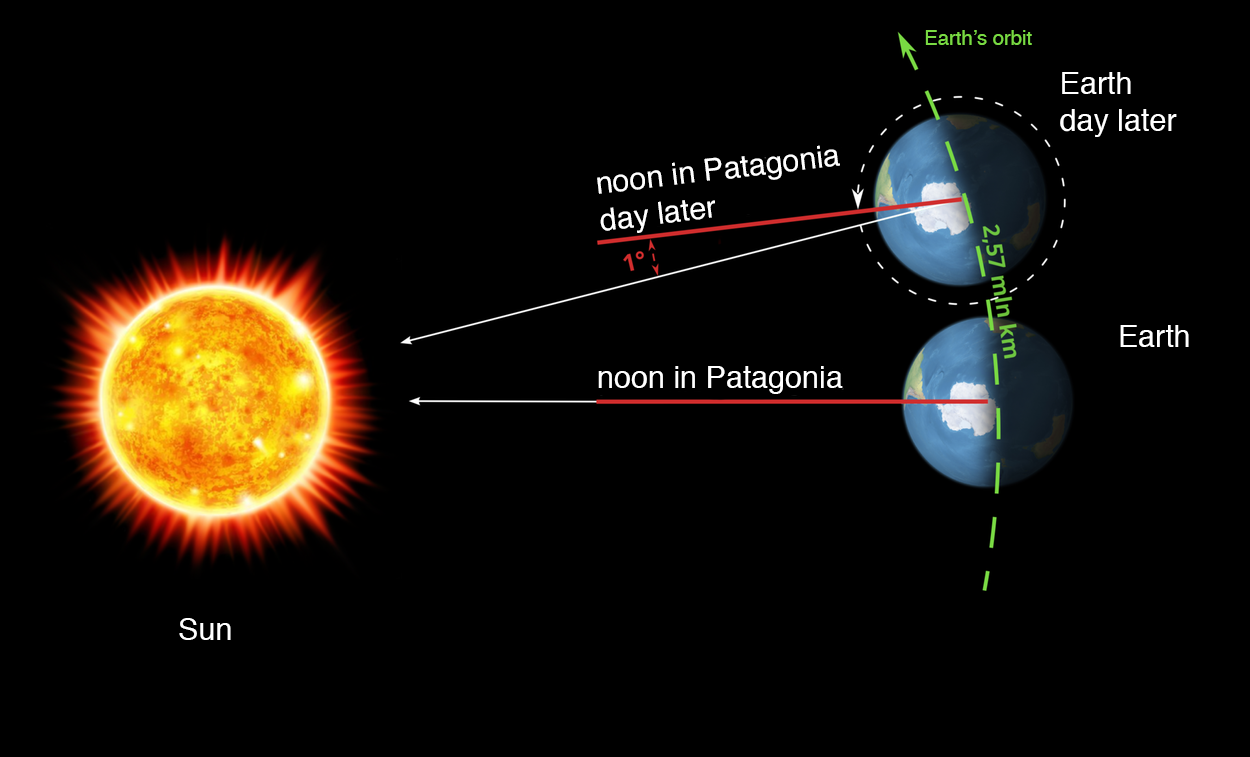
Na grafice zostały przedstawione słońce, sun i ziemia, earth i informacje związane z dniem słonecznym, solar day oraz dniem gwiezdnym, stellar day. Na grafice przedstawiono różnicę kąta padania promieni słonecznych, w południe w Patagonii. Różnica kąta padania promieni słonecznych w tym samym miejscu i o tej samej porze, wynosi jeden stopień. Jest spowodowana obrotem Ziemi, Earth wokół własnej osi. Na grafice zawarta jest informacja o odległości orbity ziemskiej, Earth's orbit od Słońca, wynosi ona dwa i pięćdziesiąt siedem setnych miliona kilometrów.
Solar day is slightly longer than the stellar day. This is due to the phenomenon of the Earth's rotation around its own axis and at the same time covering the distance of about 2.57 million km in orbit around the Sun. In other words, between one noon and the next noon the Earth going round the Sun must make a 360° + 1° rotation. This way, the Earth does one additional rotation around its axis during the year.
Source: Andrzej Boczarowski, edycja: Krzysztof Jaworski, Wikimedia Commons, licencja: CC BY 3.0.
The rotation speed of Earth is obvious when we give it in angular measures. The angular velocityangular velocityangular velocity is the size of the angle defined by a given point lying on the surface of Earth while moving in a circle per unit of time. In the case of Earth, the angular velocity has a constant value of 360°/24h.
It is harder to estimate the linear velocitylinear velocitylinear velocity, or the distance covered by a point lying on the surface of the Earth per unit of time. This depends on the latitude on which the point lies. The closer to the equator, the longer the parallels and the greater the linear velocity. This is why the inhabitants of Poland are traveling at a speed of about 1,000 km/h, or 667 km/h slower than the inhabitants of the equator, who in the same time unit have to overcome a much longer linear distance.
R1L0IWnERGYpj
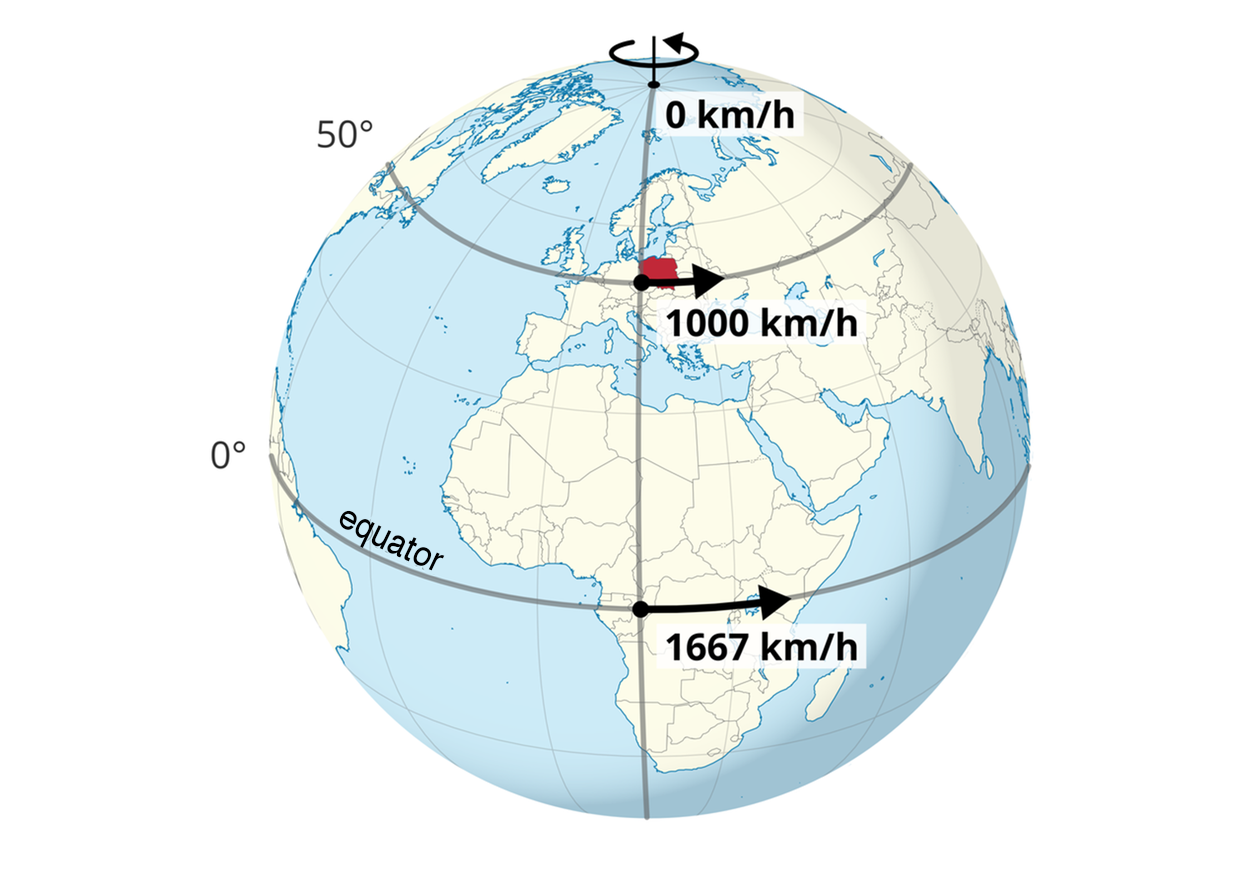
Grafika przedstawia kulę ziemską, na której wzdłuż oznaczono oś pionową oraz w poprzek dwie osie poziome, równoleżniki. Opisane zostały trzy punkty przecięcia osi. Górny, szczyt osi pionowej oznaczono strzałką, sygnalizującą obrót kuli ziemskiej w lewą stronę. Prędkość w tym miejscu wynosi zero kilometrów na godzinę. Punkt przecięcia osi pionowej z równoleżnikiem pięćdziesiąt stopni oznaczono strzałką wektorową z grotem skierowanym w prawo i prędkością równą tysiąc kilometrów na godzinę. Punkt przecięcia osi pionowej z równoleżnikiem, equator zero stopni, równikiem oznaczono dłuższą strzałką wektorową z grotem skierowanym w prawo i prędkością równą tysiąc sześćset sześćdziesiąt siedem kilometrów na godzinę.
The linear velocity of the points lying near the equator is much larger than the linear velocity of the points located near the poles. The linear speed of the poles is equal to zero.
Source: TUBS Krzysztof Jaworski, Roman Nowacki, Wikimedia Commons, licencja: CC BY-SA 3.0.
The rotational (earth) rotation of the Earth is based on the rotation of the Earth around its own axis. Points where the Earth's axis crosses the Earth's surface are poles. The pole closer to Europe is the North Pole and the opposite is the South Pole. At rocking you can not determine the main directions.
Earth's rotation is from west to east. The full rotation of the Earth around the axis takes 23 hours 56 minutes 4,091 seconds (starday), which time means the period between two consecutive times of the Ram's point. The basis for counting time is the average solar day lasting exactly 24 hours. The point located at the equator moves in a rotary motion at the speed of almost 465 m / s, and as it moves away from the equator, this speed drops to 0 m / s at the poles.
Task 1
Sformułuj zagadkę odnoszącą się do wybranego terminu słownikowego.
Sformułuj zagadkę odnoszącą się do wybranego terminu słownikowego.
Rotate the globe in the right direction by the angle that the Earth covers within:
- 1 hour,
- 12 hours,
- 1 day.
Task 2
Calculate by what angle Earth rotates in 1 hour, and by what in 4 minutes.
R1XUNNdWfiRWP
Exercise 1
Check the correct answers. Consequences of rotary motion... Możliwe odpowiedzi: 1. occurrence of night and day, 2. visible hike of the Sun and other celestial bodies on the blue vault, 3. flattening the globe with poles, making the Earth geoidal, 4. longer day in summer, shorter in winter, 5. seasons
Check the correct answers. Consequences of rotary motion... Możliwe odpowiedzi: 1. occurrence of night and day, 2. visible hike of the Sun and other celestial bodies on the blue vault, 3. flattening the globe with poles, making the Earth geoidal, 4. longer day in summer, shorter in winter, 5. seasons
Check the correct answers. Consequences of rotary motion...
occurrence of night and day
visible hike of the Sun and other celestial bodies on the blue vault
flattening the globe with poles, making the Earth geoidal
longer day in summer, shorter in winter
seasons
Exercise 2
R196Om61IPE9H
Divide the sentences into true and false. True Możliwe odpowiedzi: 1. The angular velocity of Earth's rotation is constant regardless of latitude., 2. Katowice moves around the Earth's rotation axis with exactly the same linear velocity as Zakopane., 3. Earth rotates from east to west., 4. The apparent motion of the Sun and stars in the sky is a consequence of Earth’s rotation., 5. The length of the solar day is exactly the same as the length of the sidereal day. False Możliwe odpowiedzi: 1. The angular velocity of Earth's rotation is constant regardless of latitude., 2. Katowice moves around the Earth's rotation axis with exactly the same linear velocity as Zakopane., 3. Earth rotates from east to west., 4. The apparent motion of the Sun and stars in the sky is a consequence of Earth’s rotation., 5. The length of the solar day is exactly the same as the length of the sidereal day.
Divide the sentences into true and false. True Możliwe odpowiedzi: 1. The angular velocity of Earth's rotation is constant regardless of latitude., 2. Katowice moves around the Earth's rotation axis with exactly the same linear velocity as Zakopane., 3. Earth rotates from east to west., 4. The apparent motion of the Sun and stars in the sky is a consequence of Earth’s rotation., 5. The length of the solar day is exactly the same as the length of the sidereal day. False Możliwe odpowiedzi: 1. The angular velocity of Earth's rotation is constant regardless of latitude., 2. Katowice moves around the Earth's rotation axis with exactly the same linear velocity as Zakopane., 3. Earth rotates from east to west., 4. The apparent motion of the Sun and stars in the sky is a consequence of Earth’s rotation., 5. The length of the solar day is exactly the same as the length of the sidereal day.
True or false? Divide the sentences into true and false.
Earth rotates from east to west., The apparent motion of the Sun and stars in the sky is a consequence of Earth’s rotation., The length of the solar day is exactly the same as the length of the sidereal day., The angular velocity of Earth's rotation is constant regardless of latitude., Katowice moves around the Earth's rotation axis with exactly the same linear velocity as Zakopane.
True
False
Exercise 3
Rzflh0CRucvnC
Which of the following units of time relate to Earth’s rotation around its own axis? Możliwe odpowiedzi: 1. a second, 2. a minute, 3. an hour, 4. a day, 5. a month, 6. a year
Which of the following units of time relate to Earth’s rotation around its own axis? Możliwe odpowiedzi: 1. a second, 2. a minute, 3. an hour, 4. a day, 5. a month, 6. a year
Which of the following units of time relate to Earth’s rotation around its own axis?
a second
a minute
an hour
a day
a month
a year
Exercise 4
Rx5NJBc1zB3JF
Match the definition to each of the concepts below. sidereal day Możliwe odpowiedzi: 1. the rotation period of the Earth around its own axis, 2. the size corresponding to the angle determined by the body moving in a circle per unit of time, 3. the period between two successive solar noons over a given meridian, 4. the moment the sun is at its highest point over the local meridian, 5. the size corresponding to the distance travelled by the body per unit of time solar day Możliwe odpowiedzi: 1. the rotation period of the Earth around its own axis, 2. the size corresponding to the angle determined by the body moving in a circle per unit of time, 3. the period between two successive solar noons over a given meridian, 4. the moment the sun is at its highest point over the local meridian, 5. the size corresponding to the distance travelled by the body per unit of time solar noon Możliwe odpowiedzi: 1. the rotation period of the Earth around its own axis, 2. the size corresponding to the angle determined by the body moving in a circle per unit of time, 3. the period between two successive solar noons over a given meridian, 4. the moment the sun is at its highest point over the local meridian, 5. the size corresponding to the distance travelled by the body per unit of time angular velocity Możliwe odpowiedzi: 1. the rotation period of the Earth around its own axis, 2. the size corresponding to the angle determined by the body moving in a circle per unit of time, 3. the period between two successive solar noons over a given meridian, 4. the moment the sun is at its highest point over the local meridian, 5. the size corresponding to the distance travelled by the body per unit of time linear velocity Możliwe odpowiedzi: 1. the rotation period of the Earth around its own axis, 2. the size corresponding to the angle determined by the body moving in a circle per unit of time, 3. the period between two successive solar noons over a given meridian, 4. the moment the sun is at its highest point over the local meridian, 5. the size corresponding to the distance travelled by the body per unit of time
Match the definition to each of the concepts below. sidereal day Możliwe odpowiedzi: 1. the rotation period of the Earth around its own axis, 2. the size corresponding to the angle determined by the body moving in a circle per unit of time, 3. the period between two successive solar noons over a given meridian, 4. the moment the sun is at its highest point over the local meridian, 5. the size corresponding to the distance travelled by the body per unit of time solar day Możliwe odpowiedzi: 1. the rotation period of the Earth around its own axis, 2. the size corresponding to the angle determined by the body moving in a circle per unit of time, 3. the period between two successive solar noons over a given meridian, 4. the moment the sun is at its highest point over the local meridian, 5. the size corresponding to the distance travelled by the body per unit of time solar noon Możliwe odpowiedzi: 1. the rotation period of the Earth around its own axis, 2. the size corresponding to the angle determined by the body moving in a circle per unit of time, 3. the period between two successive solar noons over a given meridian, 4. the moment the sun is at its highest point over the local meridian, 5. the size corresponding to the distance travelled by the body per unit of time angular velocity Możliwe odpowiedzi: 1. the rotation period of the Earth around its own axis, 2. the size corresponding to the angle determined by the body moving in a circle per unit of time, 3. the period between two successive solar noons over a given meridian, 4. the moment the sun is at its highest point over the local meridian, 5. the size corresponding to the distance travelled by the body per unit of time linear velocity Możliwe odpowiedzi: 1. the rotation period of the Earth around its own axis, 2. the size corresponding to the angle determined by the body moving in a circle per unit of time, 3. the period between two successive solar noons over a given meridian, 4. the moment the sun is at its highest point over the local meridian, 5. the size corresponding to the distance travelled by the body per unit of time
Match the definition to each of the concepts below.
the period between two successive solar noons over a given meridian, the size corresponding to the angle determined by the body moving in a circle per unit of time, the moment the sun is at its highest point over the local meridian, the rotation period of the Earth around its own axis, the size corresponding to the distance travelled by the body per unit of time
sidereal day
solar day
solar noon
angular velocity
linear velocity
Keywords
solar day, sidereal day, Earth’s rotation, angular velocity, linear velocity
doba słoneczna – okres pomiędzy dwoma kolejnymi górowaniami Słońca nad określonym południkiem; średnia długość przyjęta umownie za wartość stałą wynosi 24 godziny
południe słoneczne – moment, w którym w ciągu doby Słońce znajduje się na maksymalnej wysokości kątowej nad horyzontem; moment ten bywa nazywany także górowaniem Słońca