Molecules are constantly interacting with each other. These impacts are complex. Some of the physical properties of the bodies, such as e.g. states of matter, are a direct consequence of the interactions.
When molecules are too close to each other, i.e. at distances close to their diameter or smaller, a very strong repulsive effect prevails. At distances greater than the diameter of the particles, the attracting effect begins to dominate. In solids that exhibit intense intermolecular interactions, the described phenomena cause the particles approach each other and can only vibrate around their equilibrium positions.
RWt1uQtOqjIaF
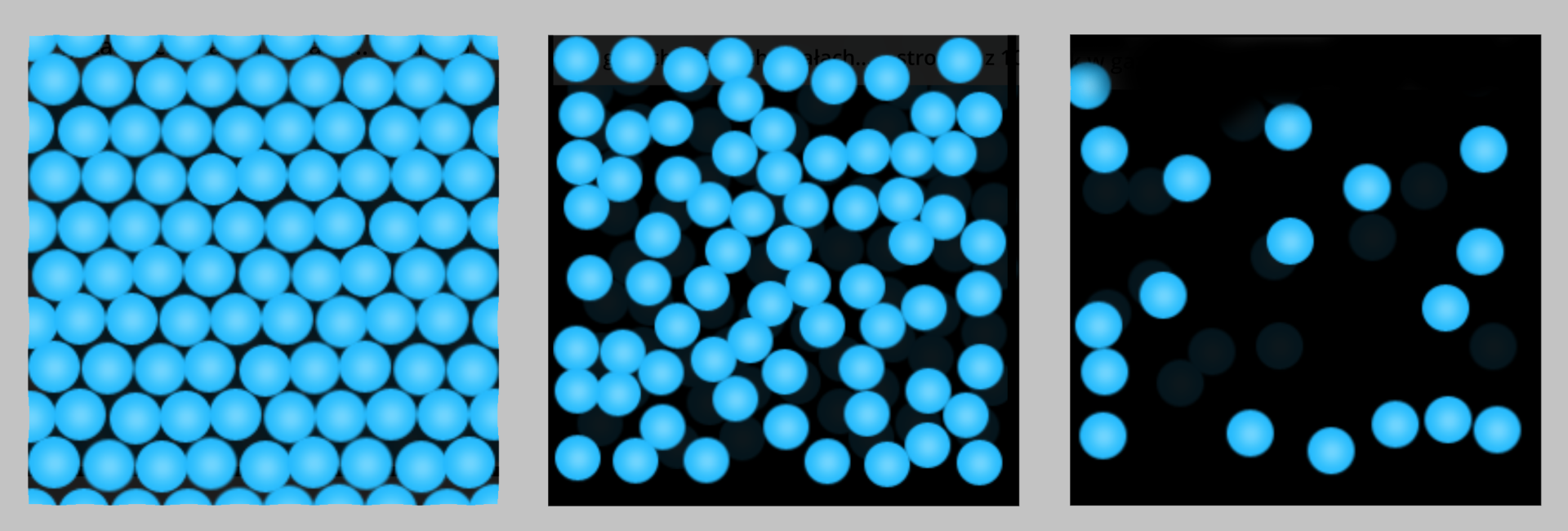
Ilustracja interaktywna przedstawia trzy naczynia (kwadraty) - opisane odpowiednio numerami: 1, 2 oraz 3. W pierwszym kulki imitujące cząsteczki ułożone bardzo gęsto, jedna obok drugiej. W drugim kulki imitujące cząsteczki w naczyniu, pomiędzy kulkami odległości równe są ich średnicy. W trzecim kulki imitujące cząsteczki w naczyniu, pomiędzy kulkami znaczne odległości. Na ilustracji widoczne są numery, a na nich podpisy. 1. In solids, particles only vibrate around certain positions. The average distances between adjacent particles are very small. {audio}, 2. In liquids, the particles move chaotically in a relatively small space. The interaction of molecules in liquids is clearly smaller than in solids. {audio}, 3. In gases, particles have a very large freedom of movement. Gas molecules interact only in moments of collisions. {audio}.
Ilustracja interaktywna przedstawia trzy naczynia (kwadraty) - opisane odpowiednio numerami: 1, 2 oraz 3. W pierwszym kulki imitujące cząsteczki ułożone bardzo gęsto, jedna obok drugiej. W drugim kulki imitujące cząsteczki w naczyniu, pomiędzy kulkami odległości równe są ich średnicy. W trzecim kulki imitujące cząsteczki w naczyniu, pomiędzy kulkami znaczne odległości. Na ilustracji widoczne są numery, a na nich podpisy. 1. In solids, particles only vibrate around certain positions. The average distances between adjacent particles are very small. {audio}, 2. In liquids, the particles move chaotically in a relatively small space. The interaction of molecules in liquids is clearly smaller than in solids. {audio}, 3. In gases, particles have a very large freedom of movement. Gas molecules interact only in moments of collisions. {audio}.
1
2
3
1. In solids, particles only vibrate around certain positions. The average distances between adjacent particles are very small. {audio}
2. In liquids, the particles move chaotically in a relatively small space. The interaction of molecules in liquids is clearly smaller than in solids. {audio}
3. In gases, particles have a very large freedom of movement. Gas molecules interact only in moments of collisions. {audio}
The behavior of molecules in solids, liquids and gases
Between two planes there occur intermolecular interactions depending on the distance between the moleculesmoleculesmolecules of the surfaces in contact. The presence of an intermediate liquidliquidliquid layer can affect the adhesionadhesionadhesion forces of the two contacting surfaces.
1. The teacher presses two optical disks putting sides with a label towards each other and then checks if there is a clear interaction between the surfaces of the optical disks.
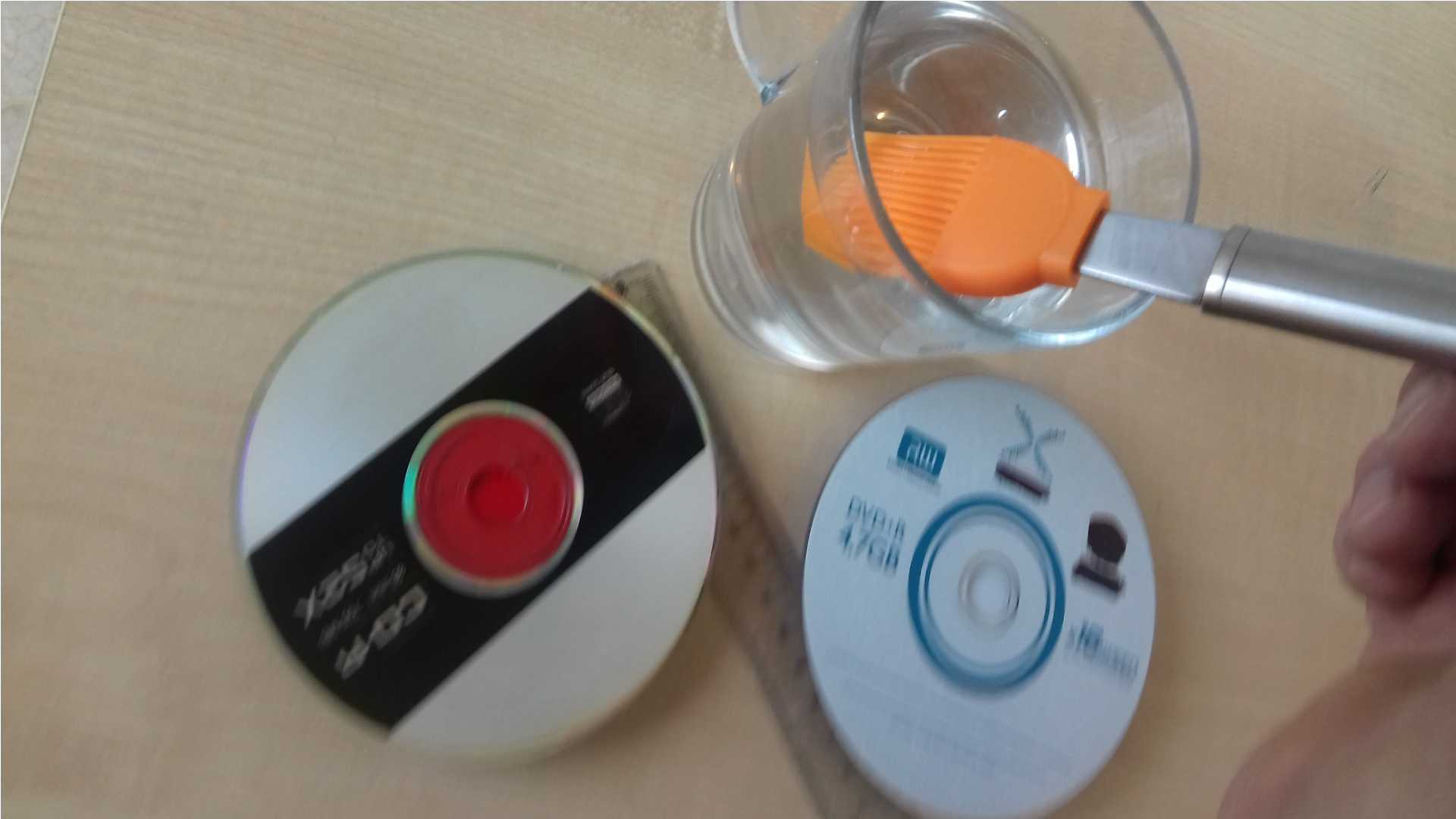
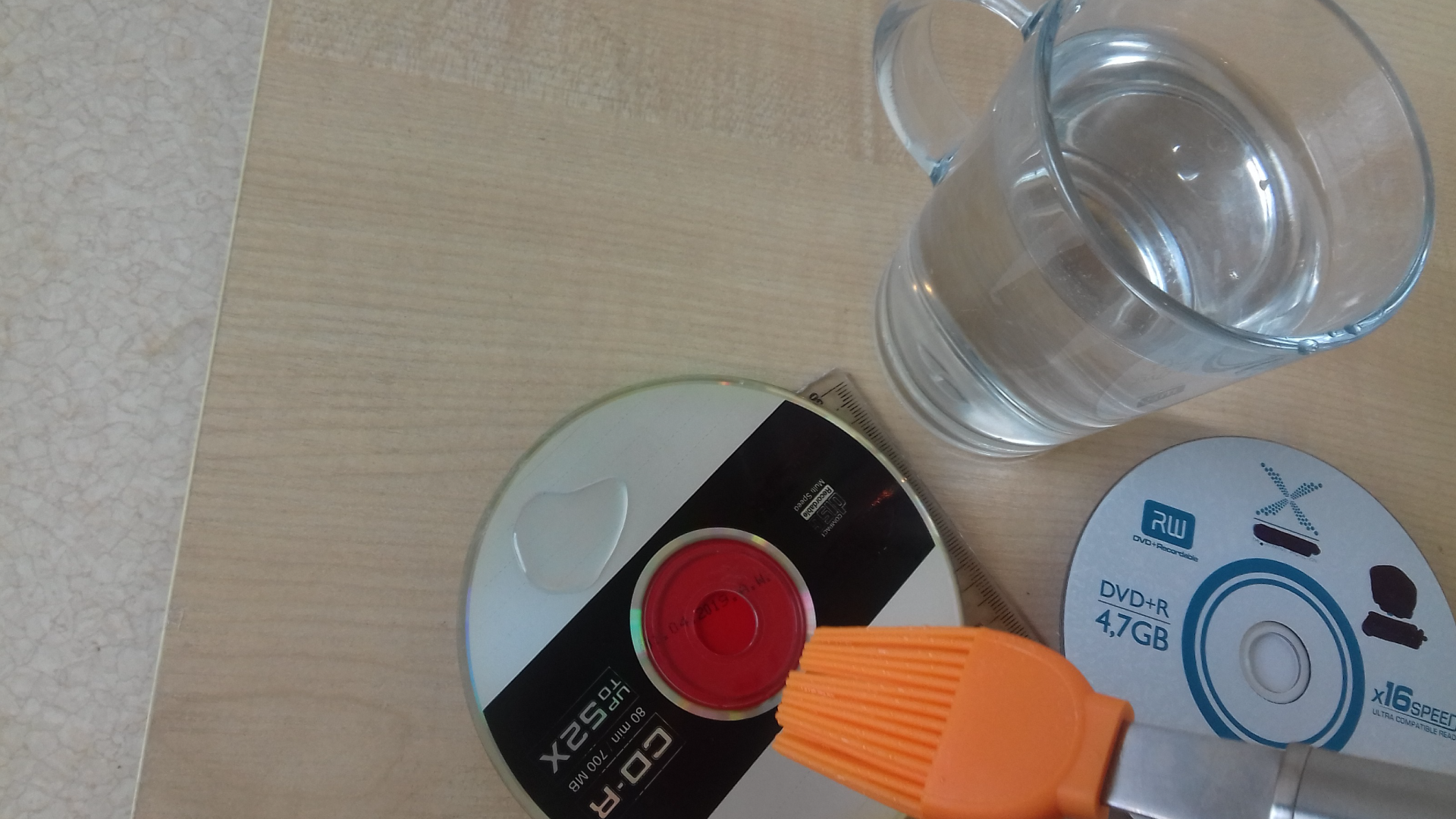
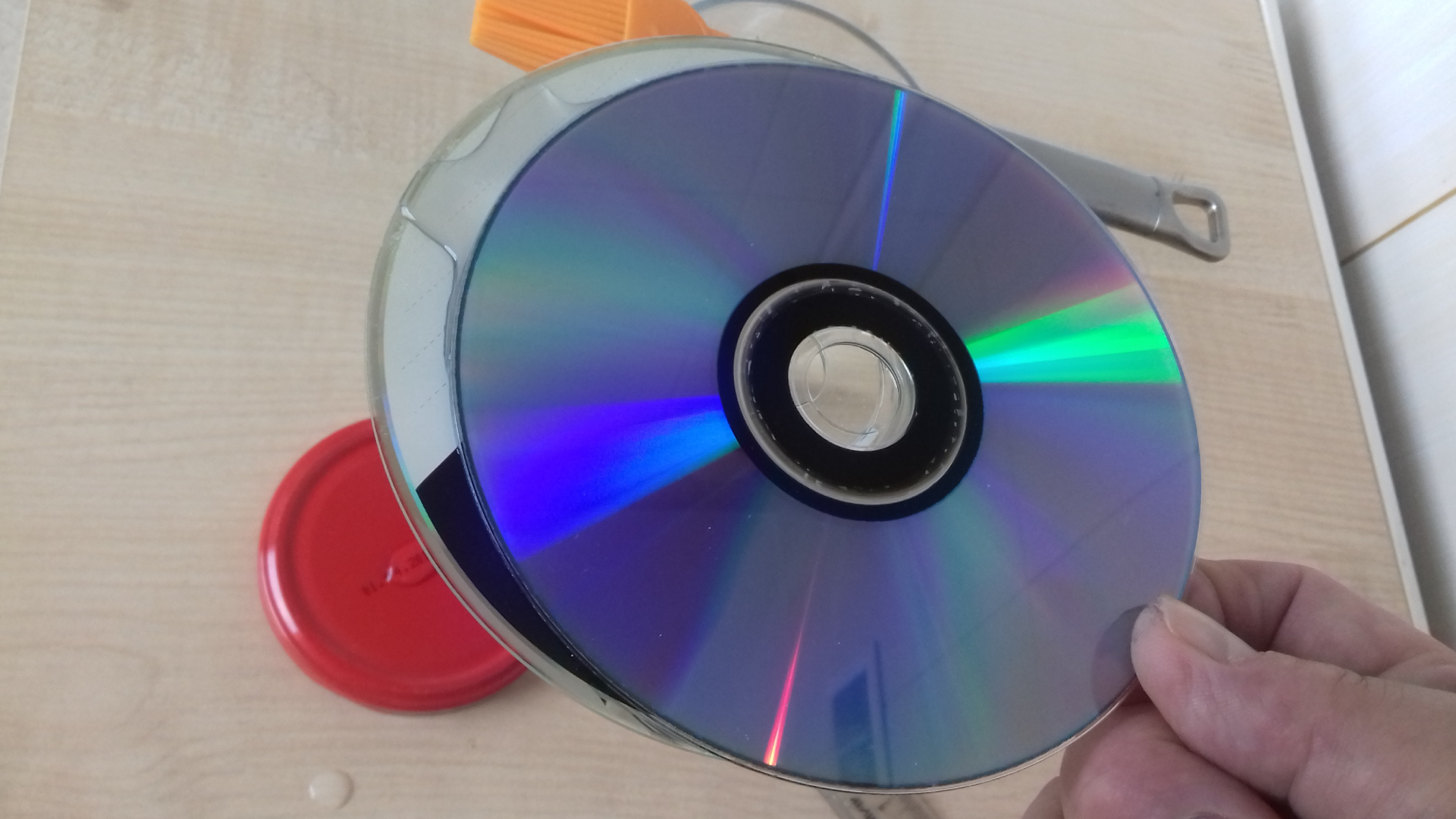
2. The teacher applies some water (with a brush) onto the surface with the label of one of the optical discs (photo 1 and photo 2) and presses the second optical disc (the surface with the label) to the first one. After squeezing the excess water from the gap between the disks, the teacher raises the upper disk, which lifts the lower disk with adsorption forces (photo 3) (in this case these forces are adhesionadhesionadhesion ones).
RJC7en6FyHexb1
Zdjęcie przedstawia dwa dyski optyczne, linijkę oraz szklankę wody i pędzel w szklance wody.
Source: GroMar, licencja: CC BY 3.0.
R8dWmUQsz5qXw1
Zdjęcie przedstawia przedstawia 2 dyski optyczne, linijkę oraz szklankę wody i pędzel nad jedną z płyt. Na płycie widoczna jest woda.
Source: GroMar, licencja: CC BY 3.0.
R1apbPqr01Wai1
Zdjęcie przedstawia przyleganie obu dysków optycznych podczas podnoszenia, pomiędzy płytami jest woda.
In the case of dry surfaces, the strength of their interaction is very small. Both surfaces are not perfectly flat and have unevenness, which results in the fact that the effective contact area between both surfaces is a fraction of a percent of the entire surface. After wetting the surface, squeezing the air and soaking the mirror, the effective contact surface of both surfaces increases. The intermediate medium between the two surfaces is water, whose moleculesmoleculesmolecules strongly interact with each other. The strength of these interactions is much greater than that in the gasgasgas that previously filled the gaps between the surfaces of the covers of the optical disc. This force is called the adhesionadhesionadhesion force. The experiment proves that the magnitude of intermolecular interactions depends on the average distance between the moleculesmoleculesmolecules of the physical body.
RW4FtYhWeHU69
Exercise 1
Wersja alternatywna ćwiczenia: Determine which sentence is true. Możliwe odpowiedzi: 1. Gas molecules have their own volume., 2. Between the particles of a solid the distances are so small that they can only vibrate around their equilibrium positions., 3. The repulsive forces between molecules increase rapidly during the compression of the solid body., 4. Gas molecules act on each other only during collisions., 5. Two dry surfaces of a solid body are not in contact with each other because the surface of the real contact of these surfaces is too small., 6. Molecules in the gas cannot move freely relative to each other.
Wersja alternatywna ćwiczenia: Determine which sentence is true. Możliwe odpowiedzi: 1. Gas molecules have their own volume., 2. Between the particles of a solid the distances are so small that they can only vibrate around their equilibrium positions., 3. The repulsive forces between molecules increase rapidly during the compression of the solid body., 4. Gas molecules act on each other only during collisions., 5. Two dry surfaces of a solid body are not in contact with each other because the surface of the real contact of these surfaces is too small., 6. Molecules in the gas cannot move freely relative to each other.
Determine which sentence is true.
Gas molecules have their own volume.
Between the particles of a solid the distances are so small that they can only vibrate around their equilibrium positions.
The repulsive forces between molecules increase rapidly during the compression of the solid body.
Gas molecules act on each other only during collisions.
Two dry surfaces of a solid body are not in contact with each other because the surface of the real contact of these surfaces is too small.
Molecules in the gas cannot move freely relative to each other.
MoleculesmoleculesMolecules constantly interact with each other.
Intermolecular interactions occur between moleculesmoleculesmolecules or atoms of liquidliquidliquid, gasgasgas and solids.
If the distances between the moleculesmoleculesmolecules are close to their diameter or smaller, the interaction is repulsiverepulsiverepulsive and if these distances are greater, the attractingattractingattracting effect dominates.
The movement of moleculesmoleculesmolecules in the solids is the least free, i.e. they vibrate around certain positions of their equilibrium and the intermolecular interactions are the strongest.
In liquids, the moleculesmoleculesmolecules move more freely and more quickly than in solids.
In gases, the interactions between the moleculesmoleculesmolecules are the weakest. GasgasGasmoleculesmoleculesmolecules have high velocities and the freedom of movement.
Exercises
R1dlI2qiIDQmr
Exercise 2
Wersja alternatywna ćwiczenia: Decide which sentences are true. Możliwe odpowiedzi: 1. The formation of water drops indicates the existence of mutual attraction forces., 2. Repulsive forces between the molecules increase very much while squeezing the solid., 3. Wet gloves can be easily removed from the hand, because there are no intermolecular interactions., 4. In cold water sugar will dissolve faster than in warm water., 5. Fish in water breathe thanks to the process of dissolving air in water.
Wersja alternatywna ćwiczenia: Decide which sentences are true. Możliwe odpowiedzi: 1. The formation of water drops indicates the existence of mutual attraction forces., 2. Repulsive forces between the molecules increase very much while squeezing the solid., 3. Wet gloves can be easily removed from the hand, because there are no intermolecular interactions., 4. In cold water sugar will dissolve faster than in warm water., 5. Fish in water breathe thanks to the process of dissolving air in water.
Decide which sentences are true.
The formation of water drops indicates the existence of mutual attraction forces.
Repulsive forces between the molecules increase very much while squeezing the solid.
Wet gloves can be easily removed from the hand, because there are no intermolecular interactions.
In cold water sugar will dissolve faster than in warm water.
Fish in water breathe thanks to the process of dissolving air in water.
zadanie
Source: GroMar, licencja: CC BY 3.0.
Exercise 3
While making a metal fence, the blacksmith joins two pieces of metal by first making it red hot, next putting them on each other and then repeatedly hitting them with a hammer. Why does the blacksmith hit them with a hammer?
The hitting makes the pieces of hot metals approach each other and as a consequence it causes the increase of the mutual attraction forces of metal pieces as the result of mixing of the particles on the surfaces of both pieces. It results in an effective increase of the contact surface, i.e. the surface in which adsorption forces (adhesion forces) act.
Exercise 4
How would a physical solid body behave if the forces of mutual attraction between the molecules of this body disappeared at one moment?
The solid body would turn into gas. Thus, such transformation would make the physical body in question lose its shape and cease to have a fixed volume. The newly formed gas would dissolve in the whole volume of the container in which the solid would be placed.
R1MSPfKt4FWb6
Exercise 5
Wersja alternatywna ćwiczenia: Indicate which pairs of expressions or words are translated correctly. Możliwe odpowiedzi: 1. odpychający - repulsive, 2. położenie równowagi - neutral position, 3. ciecz - liquid, 4. gaz - molecules, 5. attracting - przyciąganie, 6. adhezja - attraction force
Wersja alternatywna ćwiczenia: Indicate which pairs of expressions or words are translated correctly. Możliwe odpowiedzi: 1. odpychający - repulsive, 2. położenie równowagi - neutral position, 3. ciecz - liquid, 4. gaz - molecules, 5. attracting - przyciąganie, 6. adhezja - attraction force
Indicate which pairs of expressions or words are translated correctly.
odpychający - repulsive
położenie równowagi - neutral position
ciecz - liquid
gaz - molecules
attracting - przyciąganie
adhezja - attraction force
zadanie
Source: GroMar, licencja: CC BY 3.0.
R10f0Cl2ecvcn1
Interaktywna gra, polegająca na łączeniu wyrazów w pary w ciągu jednej minuty. Czas zaczyna upływać wraz z rozpoczęciem gry. Jeden ruch to odkrywanie najpierw jednej potem drugiej karty z wyrazem. Każdy wyraz jest odczytywany. Kolejny ruch to odkrywanie trzeciej i czwartej karty. W ten sposób odsłuchasz wszystkie wyrazy. Nawigacja z poziomu klawiatury za pomocą strzałek, odsłuchiwanie wyrazów enterem lub spacją. Znajdź wszystkie pary wyrazów.
Interaktywna gra, polegająca na łączeniu wyrazów w pary w ciągu jednej minuty. Czas zaczyna upływać wraz z rozpoczęciem gry. Jeden ruch to odkrywanie najpierw jednej potem drugiej karty z wyrazem. Każdy wyraz jest odczytywany. Kolejny ruch to odkrywanie trzeciej i czwartej karty. W ten sposób odsłuchasz wszystkie wyrazy. Nawigacja z poziomu klawiatury za pomocą strzałek, odsłuchiwanie wyrazów enterem lub spacją. Znajdź wszystkie pary wyrazów.
Match Polish terms with their English equivalents.
adhesion
neutral position
oddziaływanie międzycząsteczkowe
położenie równowagi
siły przyciągania
intermolecular interaction
repulsion force
attraction force
adhezja
siły odpychania
Source: Zespół autorski Politechniki Łódzkiej, licencja: CC BY 3.0.