Most of the chemical elements do not occur in nature in the free state, but form chemical compounds with other elements. Only few simple substances exist in the form of individual atoms. These include noble gases, i.e. chemical elements belonging to the 18th group of the periodic table (helium). Their relatively stable electron configuration is a model for other elements. During the formation of typical chemical bonds atoms of the elements strive to obtain an electron configuration of the closest noble gas in the periodic system. This is done in a variety of ways. Elemental atoms can share electrons. They can also give them to other atoms of the elements or take them from atoms. As a result of these processes, ionsion (straight ion)ions arise from atoms.
R1Fjl7W9gaUSs
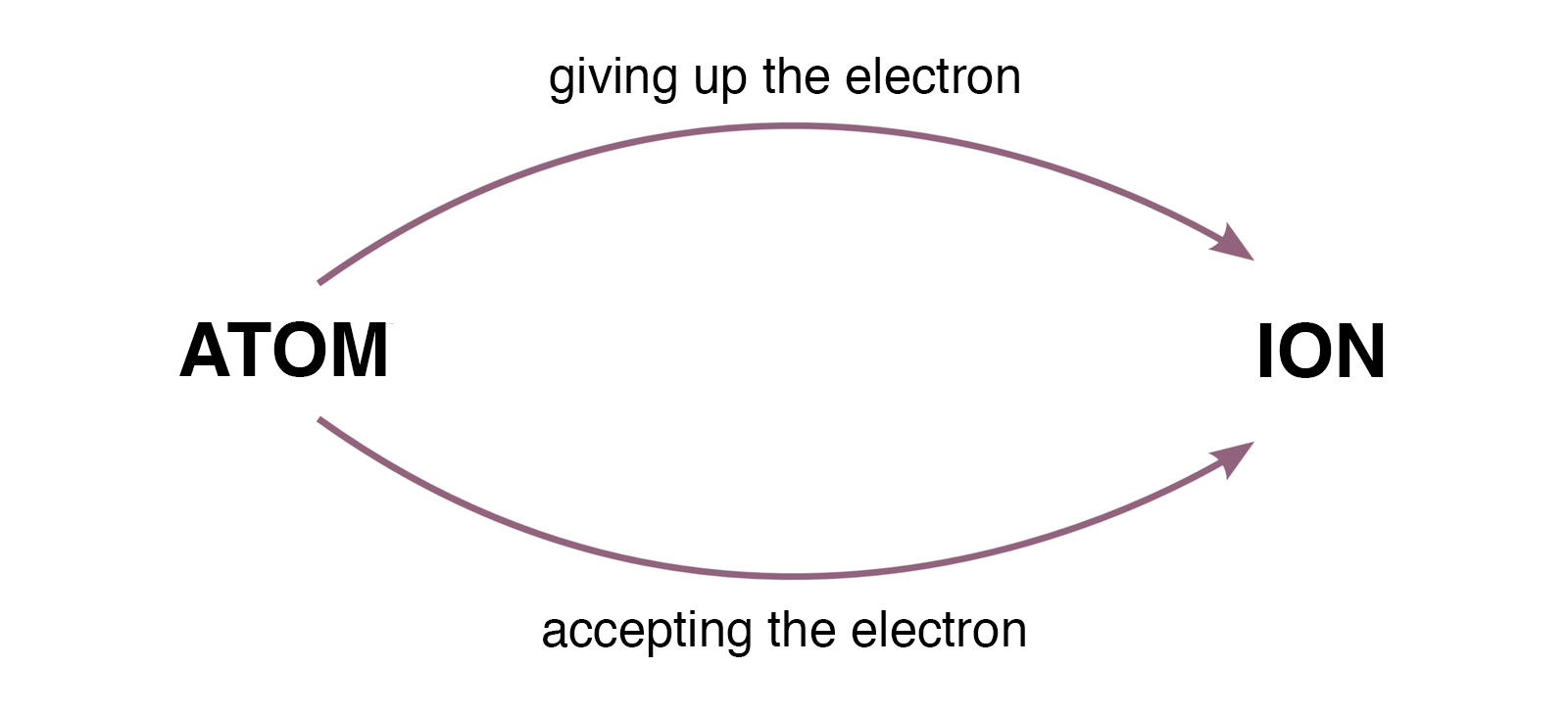
Schemat powstawania jonu z atomu. Nad atom strzałka górą w stronę ion. Nad strzałką napis: giving up the electron. Od ion strzałka dołem w kierunku atom z napisem accepting the electron.
The diagram of an ion formation from an atom
Source: Krzysztof Jaworski, licencja: CC BY 3.0.
Ion type
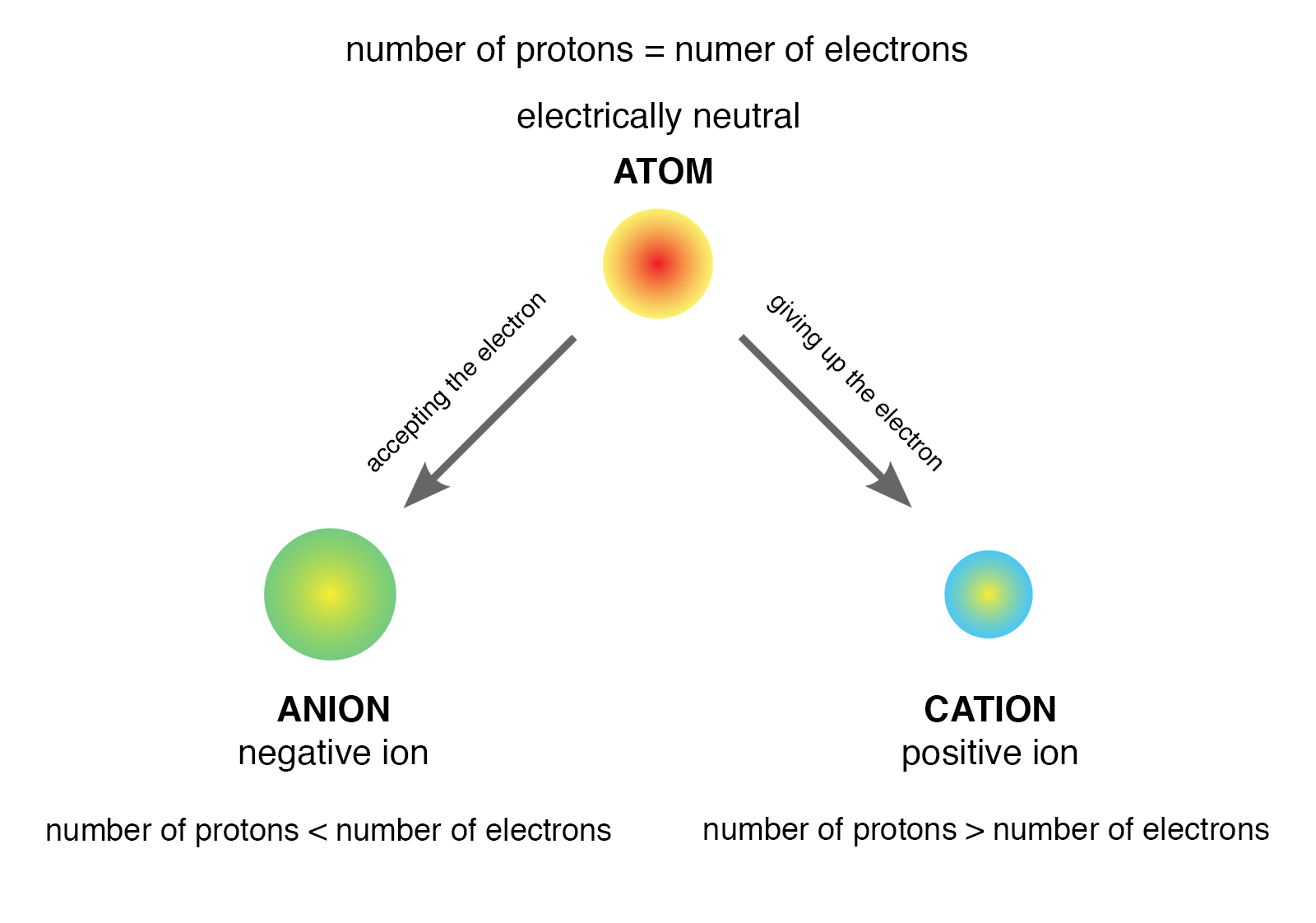
Ions with a positive charge are called cationscationcations, while those with a negative charge – anionsanionanions. The sodium ion, which was created by electron donation of sodium atom, is a cation. In turn, the chlorine atom, which accepted the electron, becomes an anion.
Atoms of metals (especially those belonging to the 1st and 2nd group of the periodic table) form cations. The atoms of some nonmetals may form anions as a result of electrons acceptation.
R13i6MhQcrckE
Schemat przedstawia proces przekształcania się atomów w jony i ma postać grafu. Centralną górną część zajmuje żółto-czerwone koło podpisane jako Atom. Odchodzą od niego dwie strzałki skierowane w stronę kół żółto-zielonego w lewym dolnym rogu podpisanego Anion oraz żółto-niebieskiego w prawym dolnym rogu podpisanego Kation. Dodatkowe informacje zawarte w schemacie głoszą, że anion to jon ujemny negative ion, w którym liczba protonów number of protons jest mniejsza od liczby elektronów number of electrons, a powstaje w wyniku przyjęcia elektronu przez atom, zaś kation to jon dodatni positive ion o liczbie protonów większej od liczby elektronów i powstaje w wyniku oddania elektronu przez atom.
Types of ions
Source: Dariusz Adryan, licencja: CC BY 3.0.
How is sodium ion formed?
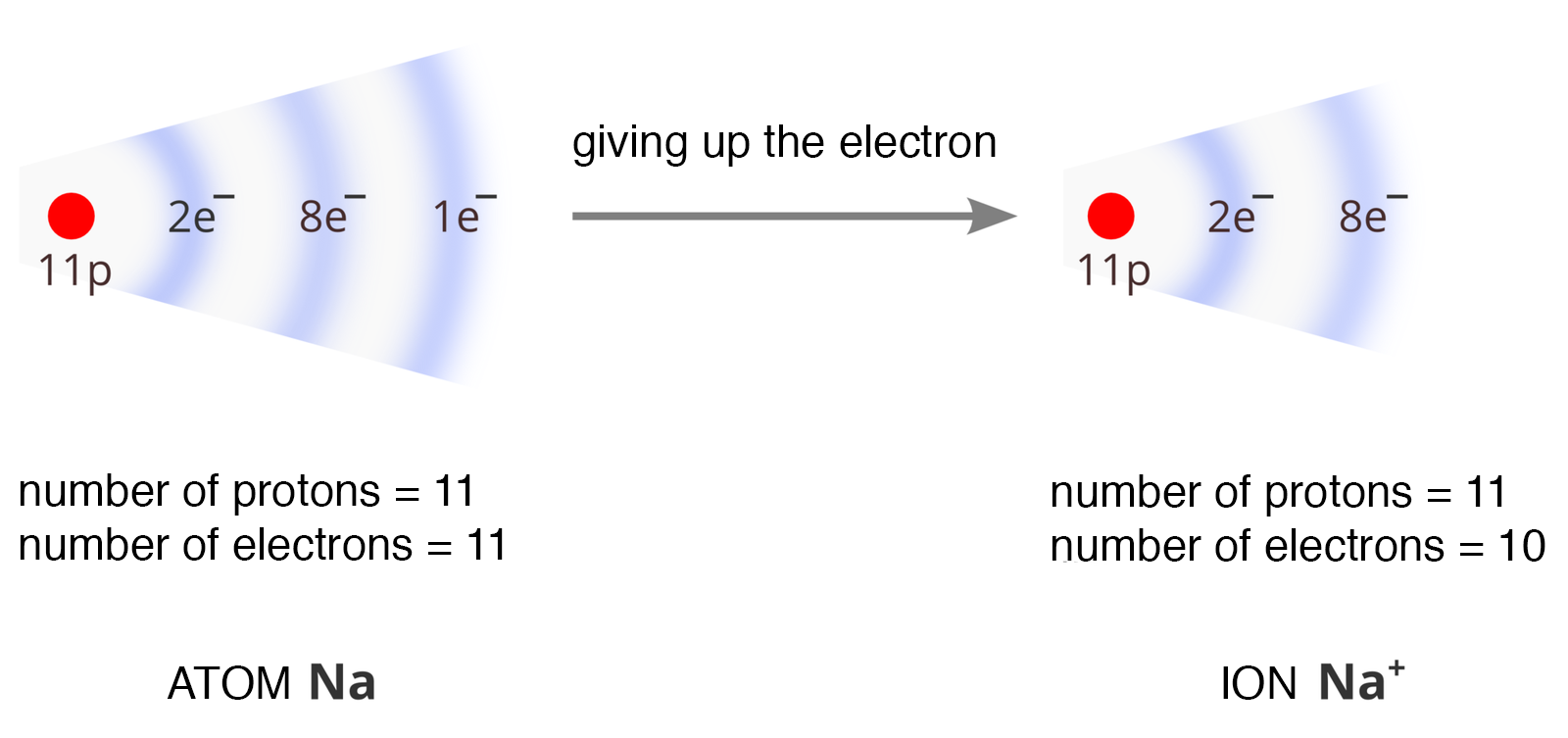
As a result of the electron transfer from the sodium atom, an ion is formed. As you remember, in every atom the positive charge of the nucleus is equal to the negative charge of the electron cloud (the number of protons is equal to the number of electrons) and the atom is electrically neutral. Note that in the sodium ion the number of protons and electrons are not identical: there are 11 protons in the atomic nucleus and 10 electrons in the space around the nucleus. Thus, 1 proton is not „balanced” by the electron. Therefore, the whole ion has a charge of a proton (equal to the elementary positive charge). The sodium ion is said to be positive. This ion is described by the „+” sign next to the symbol of the chemical element: .
The diagram below shows the changes in the electron configuration of the sodium atom during the formation of the ion.
R1d5Ll7zIJSOF
Na poniższym schemacie przedstawiono zmiany konfiguracji elektronowej atomu sodu podczas powstawania jonu. Po lewej stronie number of protons 11, number of electrons 11, atom en a, grafika: czerwona kropka pod nią 11 p, po prawej stronie od 11 p: 2 e minus, 8 e minus, 1 e minus strzałka w prawo, nad strzałką napis: giving up the electron za strzałką czerwona kropka 11 p i kolejno 2e minus, 8 e minus. Pod tą częścią ilustracji: number of protons 11, numbers of electrons 10, ion en a plus.
Source: GroMar Sp. z o.o., licencja: CC BY-SA 3.0.
The mechanism of formation of a positive sodium ion can be written using the Lewis structures or only the symbol of the chemical element:
The process of sodium ion formation can also be presented using the electron configurations of the atom and its ion:
The sodium atom has 11 electrons. One of them is placed on the last shell. After its release, the sodium atom has 10 electrons and an electron configuration of the noble gas closest it in the periodic table – neon. Thanks to this, he gains a permanent configuration.
How is chlorine ion formed?
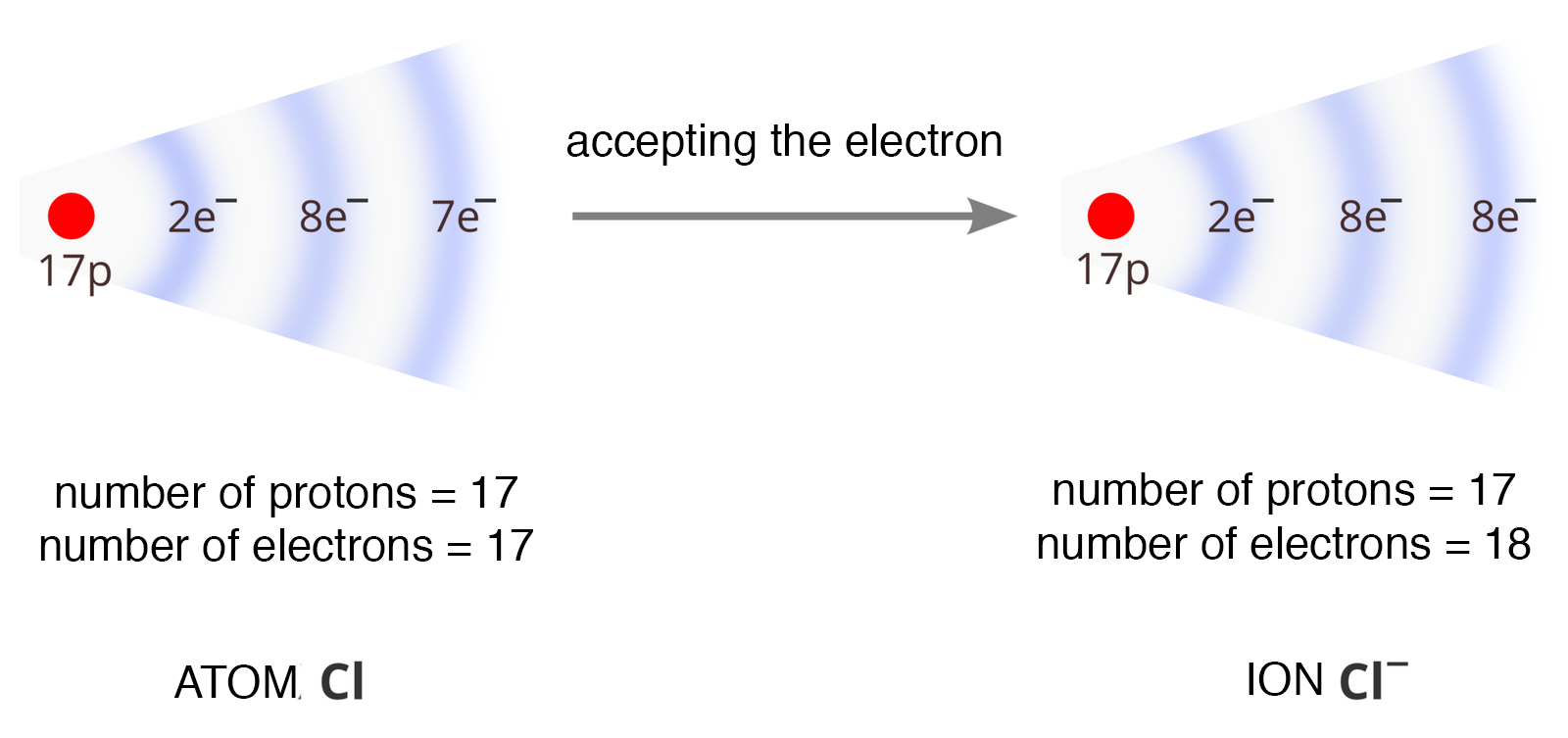
As a result of the electron being accepted by the chlorine atom, an ion is formed. Due to the presence of an additional electron, this ion is charged with a negative charge (equal to the elementary negative charge). This ion is described by the “–” sign next to the symbol of the chemical element:
The process of this ion formation can be described by the equations:
The diagram below shows the changes in the electron configuration of the chlorine atom during the formation of the ion.
R1aOXyhR32XTJ
Na schemacie przedstawiono zmiany konfiguracji elektronowej atomu chloru podczas powstawania jonu. NA grafice czerwona kropka pod nią 17 p i kolejno 2 e minus, 8 e minus, 7 e minus, po ta częścią grafiki napisy: number of protons 17, number of electrons 17, atom ce el. Od grafiki strzałka w prawo, nad strzałką napis: accepting the electron i czerwona kropka 17 p, 2 e minus, 8e minus, 8 e minus. Pod spodem napisy: number of protons 17, number of electrons 18, ion ce el minus.
Source: GroMar Sp. z o.o., licencja: CC BY-SA 3.0.
As you remember, the chlorine atom in the molecules or , to achieve an stable electron configuration, shares a single electron with a different atom. However, in the presence of a sodium atom, it behaves differently - it receives an electron from it to its outer shell. The number of its electrons is then increased by 1 and the atom gains the electron configuration proper to argon, which in the periodic table is located just after the chlorine.
What charge values can ions have?
Atoms can donate and accept more than 1 electron.
Magnesium ion
In the magnesium atom () there are 12 protons and the same number of electrons. When interacting with other atoms, the atom can „get rid of” 2 electrons forming its external electron shell. In the formed ion the number of electrons decreases and there is an excess of positive charges (12 p) in relation to the negative ones (10). Therefore, the magnesium ion is a cation and its charge is equal to two elementary positive charges. Such cations are said to be dications and are recorded as follows:.
The process of magnesium ions formation can be described by the equation:
Changes in the electron configurations of the atom and magnesium cation are as follows:
Note that the magnesium cation has been recognized as a permanent neon electron configuration ().
Sulfide ion
The sulfur atom forms a dianion.
Aluminum ion
The aluminum atom forms aluminum ions of the formula . The number ‘3+’ means that the formed ion is a cation that was formed after the aluminum atom donated 3 electrons. The formation of aluminum ion can be described by the following equation:
After taking into account the electron configuration, it has the form:
The electron configuration in the aluminum cation is the same as in the neon atom ().
Task 1
Watch the presentation „Ions formation”. Explain the equation of ion formation on the boards.
R1NpcoryPaMYX
Ilustracja przedstawia napis Ions formation.
Ions formation
Source: GroMar Sp. z o.o., licencja: CC BY-SA 3.0.
R1O3IlVfMXpGq
Ilustracja zawiera napis Ions are formed from atoms by giving up or receiving electrons.
Ions are formed from atoms by giving up or receiving electrons.
Source: GroMar Sp. z o.o., licencja: CC BY-SA 3.0.
Rv4XPZrFOcIRN
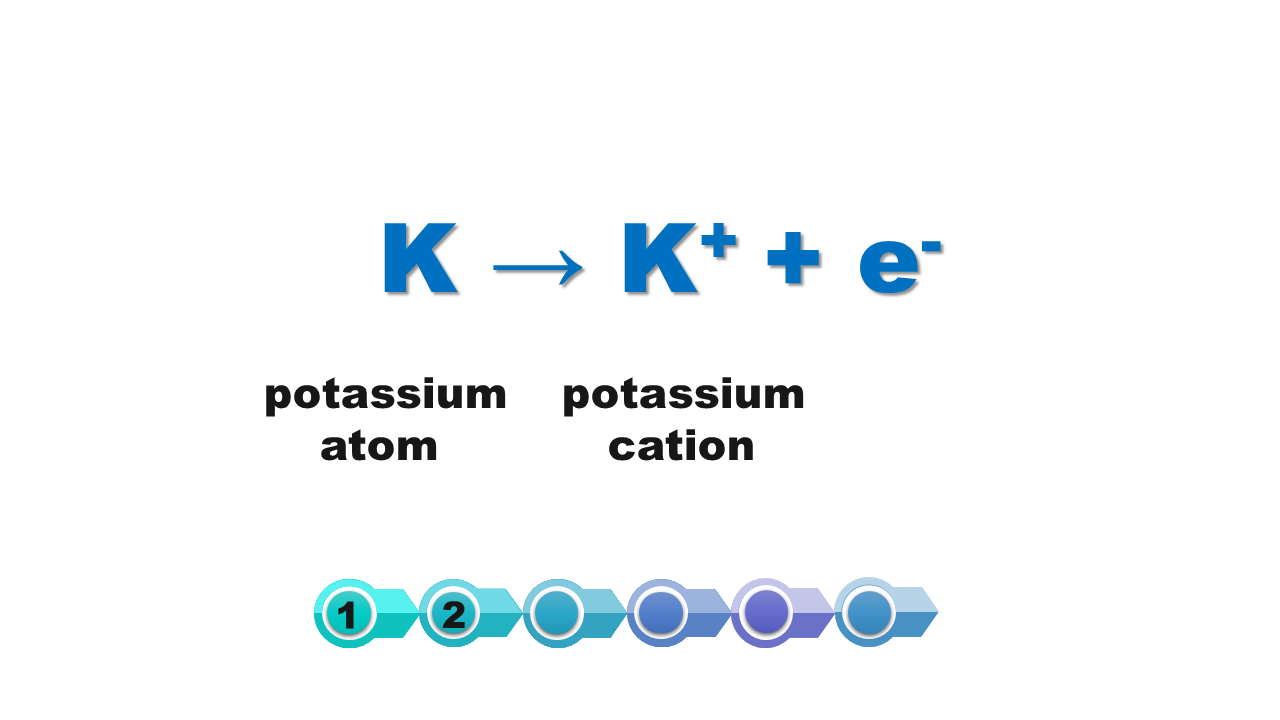
Ilustracja przedstawia równanie reakcji powstawania jonu potasu z atomu potasu: ka strzałka w prawo ka plus dodać e minus. Ilustracja zawiera anglojęzyczne nazwy: potassium atom po lewej stronie równania, potassium cation po prawej stronie równania.
The potassium atom has 19 electrons. One of them is placed on the last shell. After its release, the sodium atom has 18 electrons and an electron configuration of the noble gas closest it in the periodic table – argon. Thanks to this, he gains a permanent configuration.
Source: GroMar Sp. z o.o., licencja: CC BY-SA 3.0.
R1SdvbNP58xSx
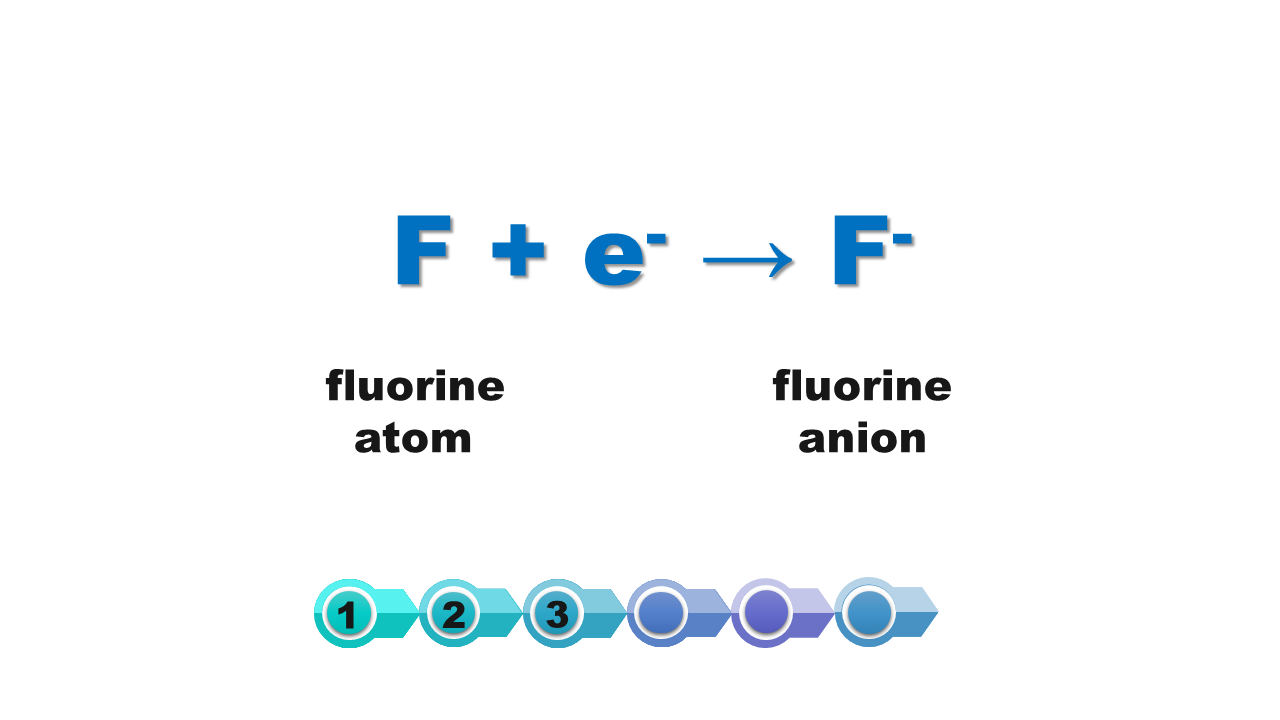
Ilustracja przedstawia równanie reakcji powstawania jonu fluorkowego z atomu fluoru: ef dodać e minus strzałka w prawo ef minus. Ilustracja zawiera anglojęzyczne nazwy: fluorine atom po lewej stronie równania, fluorine anion po prawej stronie równania.
Fluorine receives an electron from others atom to its outer shell. The number of its electrons is then increased by 1 and the atom gains the electron configuration proper to neon, which in the periodic table is located just after the fluorine.
Source: GroMar Sp. z o.o., licencja: CC BY-SA 3.0.
RlQdaysry2vjh
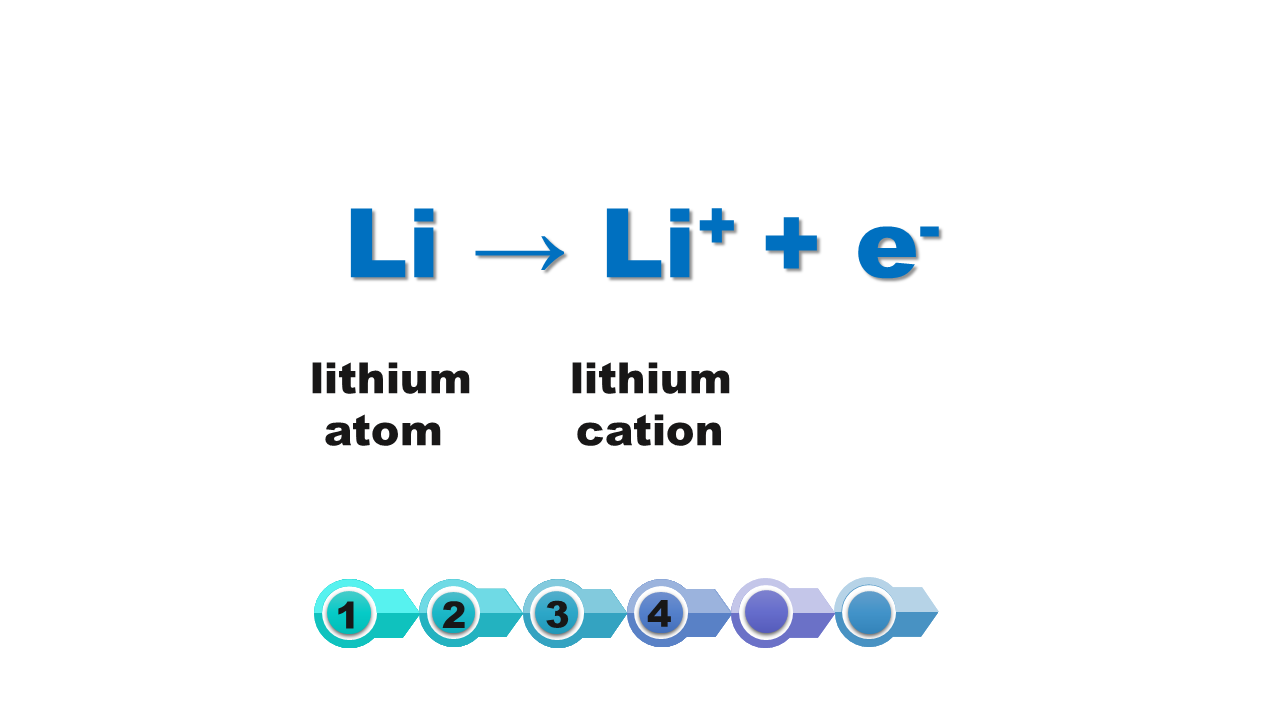
Ilustracja przedstawia równanie reakcji powstawania jonu litu z atomu litu: el i strzałka w prawo el i plus dodać e minus. Ilustracja zawiera anglojęzyczne nazwy: lithium atom po lewej stronie równania, lithium cation po prawej stronie równania.
When interacting with other atoms, the atom Li can „get rid of” 1 electrons forming its external electron shell. In the formed ion the number of electrons decreases and there is an excess of positive charges (3 p) in relation to the negative ones (2 e−).
Source: GroMar Sp. z o.o., licencja: CC BY-SA 3.0.
Rfbbdys701jl0
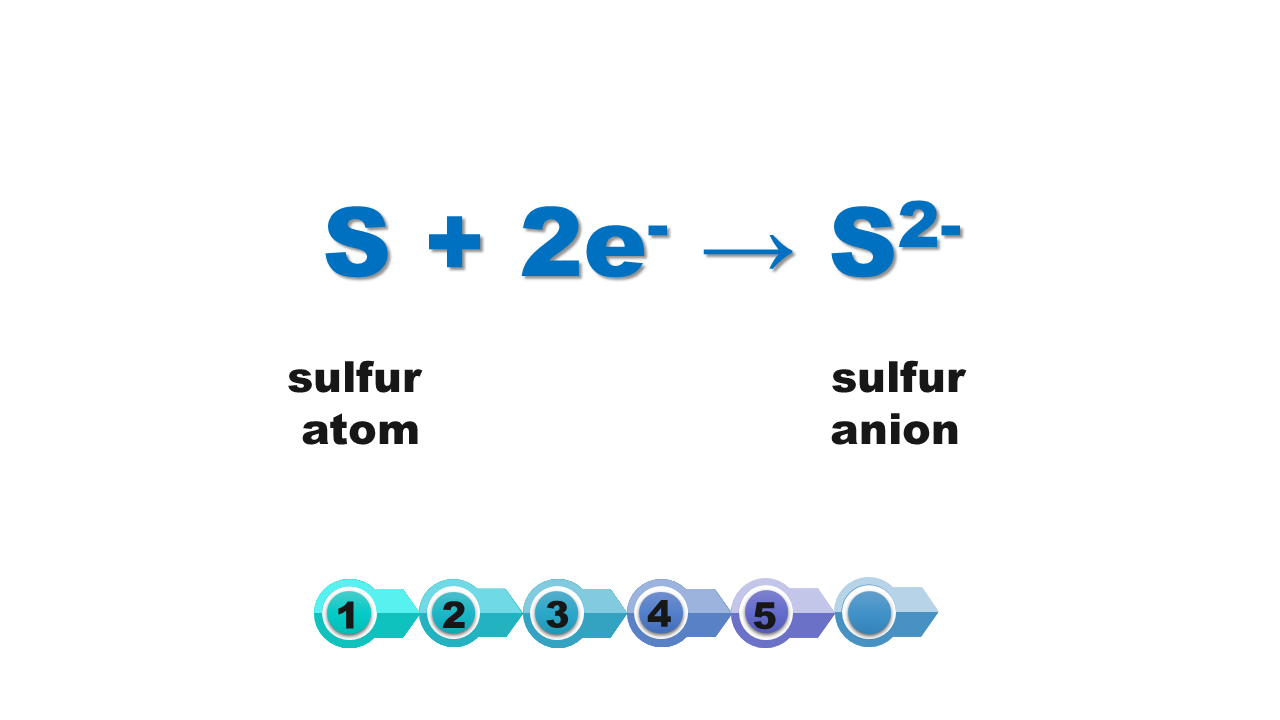
Ilustracja przedstawia równanie reakcji powstawania jonu siarczkowego z atomu siarki: es dodać dwa e minus strzałka w prawo es dwa minus. Ilustracja zawiera anglojęzyczne nazwy: sulfur atom po lewej stronie równania, sulfur anion po prawej stronie równania.
The sulfur atom has 16 protons in the nucleus and the same number of electrons forming the electron cloud. There are 6 electrons on its last shell. To obtain an octet he lacks two electrons.
Source: GroMar Sp. z o.o., licencja: CC BY-SA 3.0.
RQu8ZIH5NAZqv
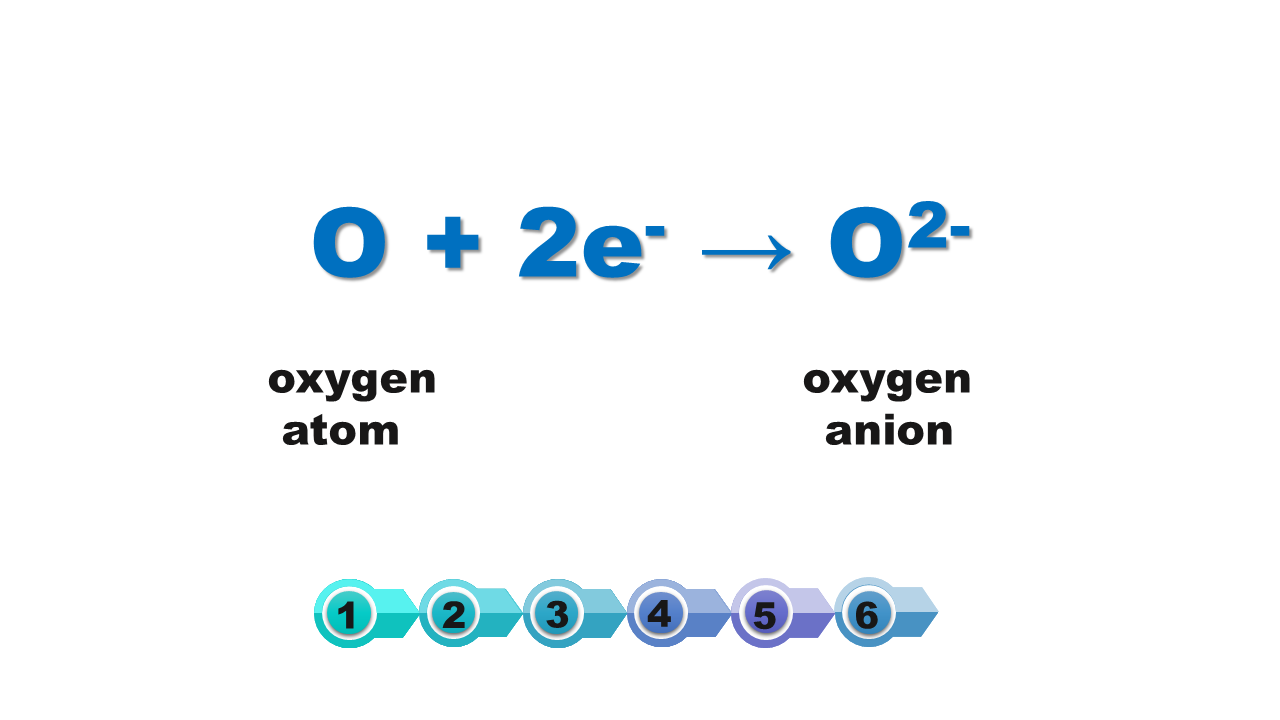
Ilustracja przedstawia równanie reakcji powstawania jonu tlenu z atomu tlenu: O dodać dwa e minus strzałka w prawo O dwa minus. Ilustracja zawiera anglojęzyczne nazwy: oxygen atom po lewej stronie równania, oxygen anion po prawej stronie równania.
Oxygen ion is a anion that was formed after the oxygen atom received 2 electrons.
Source: GroMar Sp. z o.o., licencja: CC BY-SA 3.0.
R1KaT5B2unZ1x
Watch the presentation "Ions formation". Explain the equation of ion formation on the boards. Potassium cation (Uzupełnij). Fluorine anion (Uzupełnij). Lithium cation (Uzupełnij). Sulfur anion (Uzupełnij). Oxygen anion (Uzupełnij).
Watch the presentation "Ions formation". Explain the equation of ion formation on the boards. Potassium cation (Uzupełnij). Fluorine anion (Uzupełnij). Lithium cation (Uzupełnij). Sulfur anion (Uzupełnij). Oxygen anion (Uzupełnij).
Watch the presentation "Ions formation". Explain the equation of ion formation on the boards.
RZSLI0SO0EUbn
Exercise 1
Select the statement saying the truth. Możliwe odpowiedzi: 1. Ion is a particle charged positively and negatively, 2. Cation - ion with a negative charge, 3. Chemical bond, which is based on the electrostatic attraction of metal cations and non-metal anions, is ionic bonding, 4. Magnesium ion is formed by accepting 2 electrons from the atom/atoms of a nonmetal, 5. The sulfur atom in the reaction with metals accept 2 electrons from the atom/atoms of metals, 6. Electronegativity is the ability of an atom of a given chemical element to attract electrons that form a chemical bond, 7. Nonmetals have the greatest electronegativity and metals have the least electronegativity
Select the statement saying the truth. Możliwe odpowiedzi: 1. Ion is a particle charged positively and negatively, 2. Cation - ion with a negative charge, 3. Chemical bond, which is based on the electrostatic attraction of metal cations and non-metal anions, is ionic bonding, 4. Magnesium ion is formed by accepting 2 electrons from the atom/atoms of a nonmetal, 5. The sulfur atom in the reaction with metals accept 2 electrons from the atom/atoms of metals, 6. Electronegativity is the ability of an atom of a given chemical element to attract electrons that form a chemical bond, 7. Nonmetals have the greatest electronegativity and metals have the least electronegativity
Select the statement saying the truth.
Ion is a particle charged positively and negatively
Cation - ion with a negative charge
Chemical bond, which is based on the electrostatic attraction of metal cations and non-metal anions, is ionic bonding
Magnesium ion is formed by accepting 2 electrons from the atom/atoms of a nonmetal
The sulfur atom in the reaction with metals accept 2 electrons from the atom/atoms of metals
Electronegativity is the ability of an atom of a given chemical element to attract electrons that form a chemical bond
Nonmetals have the greatest electronegativity and metals have the least electronegativity
Summary
Ions are formed from atoms that have donated or accepted at least 1 electron.
Ions having positive charge are cations; arise from atoms after donation at least 1 electron.
Negatively charged ions are anions; arise from atoms that have accepted at least 1 electron.
Cations are mainly formed from metal atoms, and anions – among others from the atoms of some non‑metals.
R18Tcfx8PL0qw1
Grafika przedstawiająca tablicę szkolną, na której znajdują się zdania do dokończenia. Finish selected sentences. 1 It was easy for me (uzupełnij). 2 It was difficult for me (uzupełnij). 3 Today I learned (uzupełnij). 4 I understood that (uzupełnij). 5 It surprised me (uzupełnij). 6. Today I found out (uzupełnij). 7. I was interested in (uzupełnij). 8. I still have to repeat (uzupełnij).
Grafika przedstawiająca tablicę szkolną, na której znajdują się zdania do dokończenia. Finish selected sentences. 1 It was easy for me (uzupełnij). 2 It was difficult for me (uzupełnij). 3 Today I learned (uzupełnij). 4 I understood that (uzupełnij). 5 It surprised me (uzupełnij). 6. Today I found out (uzupełnij). 7. I was interested in (uzupełnij). 8. I still have to repeat (uzupełnij).
Source: GroMar Sp. z o.o., licencja: CC BY-SA 3.0.
wiązanie jonowe (struktura jonowa) – rodzaj wiązania chemicznego, które powstaje w wyniku elektrostatycznego przyciągania się jonów o przeciwnych znakach