After accepting or donating one or more electrons, the atoms change their size. Cations have a smaller radius than the atoms from which they are formed, while anions – a larger one.
Task 1
Watch the presentation ‘The formation of a hydrogen chloride molecule’. Write down your observations and concluding remarks.
R1O0B7GKYiuMZ
Ilustracja przedstawia biały napis na niebieskim tle - tytuł prezentacji - tworzenie się cząsteczek chlorowodoru.
The formation of a hydrogen chloride molecule
Source: GroMar Sp. z o.o., licencja: CC BY-SA 3.0.
R1HTpTiomUVdv
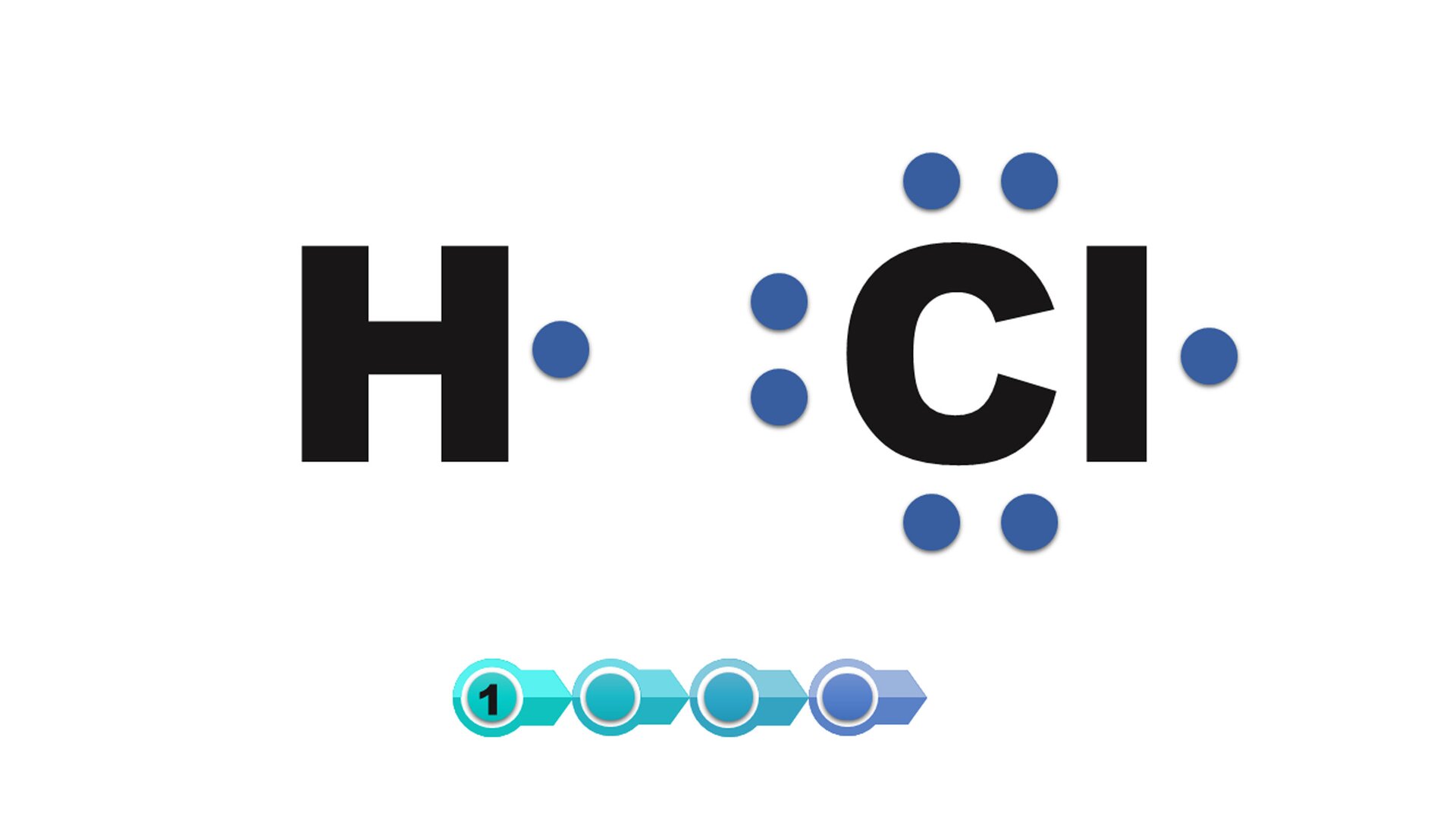
Ilustracja przedstawia umieczone obok siebie symbole atomów wodoru (H) i chloru (Cel). Obok symbolu atomu wodoru znajduje się jedna niebieska kropka, symbolizująca elektron walencyjny atomu wodoru, natomiast wokół symbolu atomu chloru znajduje się siedem niebieskich kropek- dwie po stronie lewej, dwie na górze, dwie na dole, jedna po prawej stronie. Symbolizują one elektrony walencyjne atomu chloru.
How is a hydrogen chloride molecule formed? We will show it step by step. First step. We determine the number of valence electrons in the atoms of hydrogen and chlorine. Hydrogen is in the first group of the periodic table of elements, therefore it has 1 valence electron. Chlorine is in the 17th group of the periodic table of elements, therefore it has 7 valence electrons.
Source: GroMar Sp. z o.o., licencja: CC BY-SA 3.0.
RqtqEWoQvnLt4
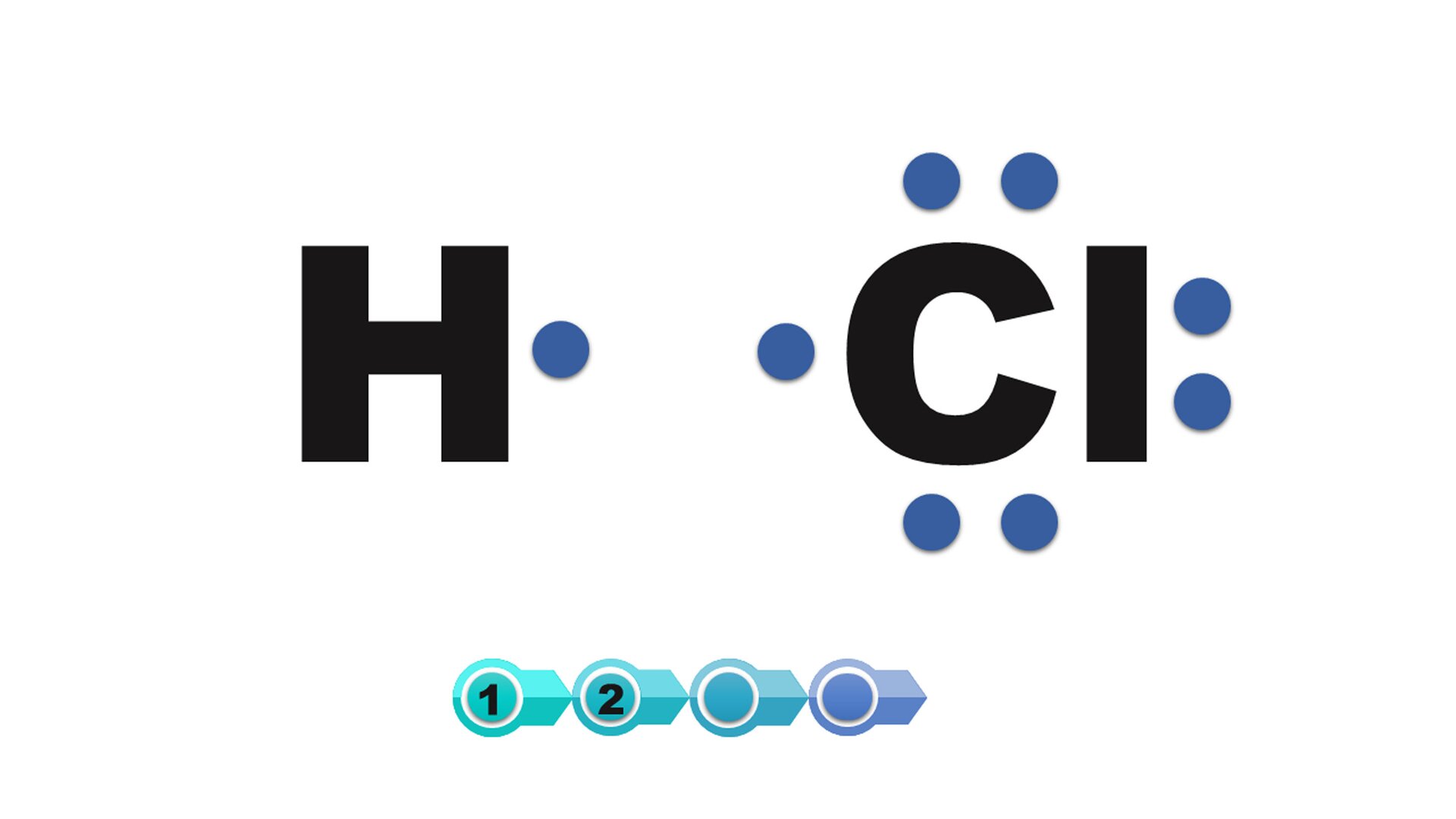
Ilustracja przedstawia umieczone obok siebie symbole atomów wodoru (H) i chloru (Cel). Obok symbolu atomu wodoru znajduje się jedna niebieska kropka, symbolizująca elektron walencyjny atomu wodoru, natomiast wokół symbolu atomu chloru znajduje się siedem niebieskich kropek- dwie po stronie prawej, dwie na górze, dwie na dole, jedna po lewej stronie. Symbolizują one elektrony walencyjne atomu chloru.
Step two. We determine how many electrons are missing to create electron pairs. The hydrogen atom has 1 valence electron, so one electron is missing to create an electron pair. It will be shared with one chlorine atom in which one of the seven valence electrons is unpaired. Thus, in the molecule of the hydrogen chloride formed, the atoms form the following configurations on the last coatings: a hydrogen atom - a pair of electrons, or two, a chlorine atom - eight electrons.
Source: GroMar Sp. z o.o., licencja: CC BY-SA 3.0.
RsKpTCDbjHnyq
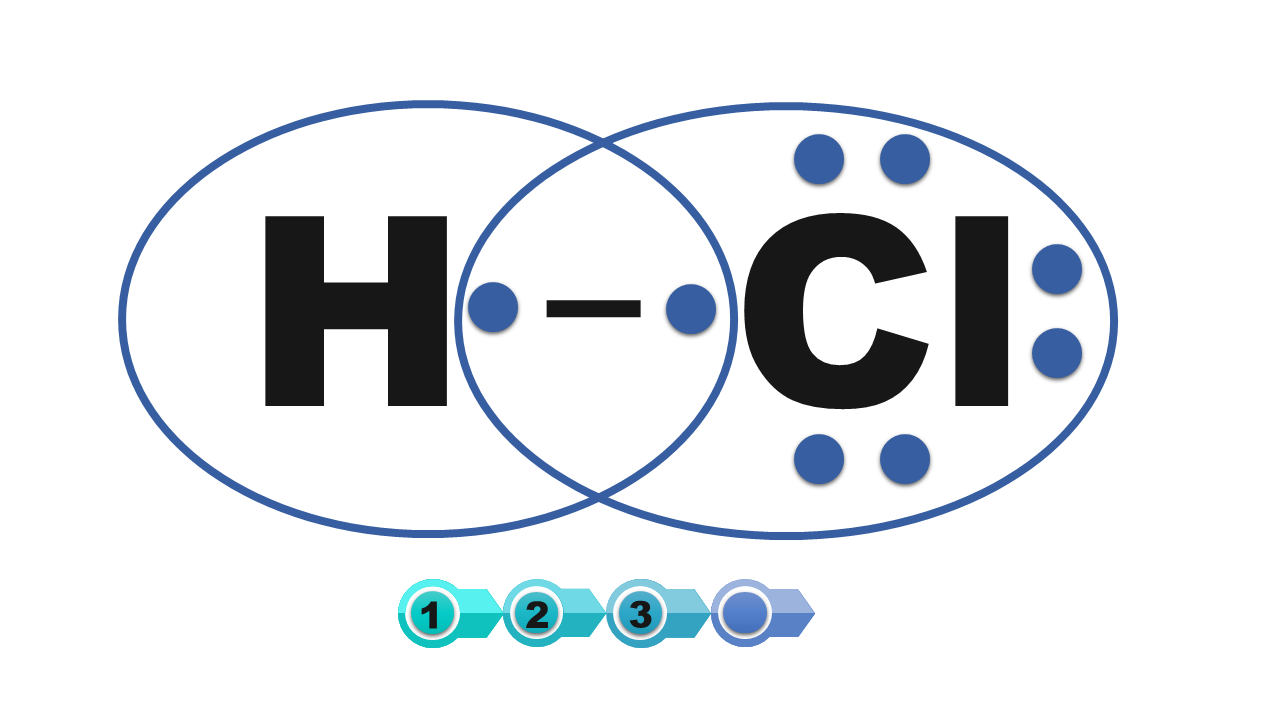
Ilustracja przedstawia tworzenie się wiązania pomiędzy atomami wodoru i atomem chloru. Na ilustracji widać atom wodoru oznaczony literą H po prawej jego stronie znajduje się jedna niebieska kropka. Obok znajduje się atom chloru chlor oznaczony symbolem Cl, obok którego znajduje się siedem kropek, jedna kropka po lewej stronie i po dwie na górze, dole oraz po prawej stronie. Wiązanie tworzy się pomiędzy niesparowanymi elektronami obu atomów (pojedyncze kropki). Wiązanie oznaczono czarną kreską utworzoną pomiędzy symbolami atomów.
Step three. Let's now write an electron formula and determine the number of common electron pairs. The molecule of hydrogen chloride produces 1 single bond. As a result, a durable electronic configuration of noble gas is created: the hydrogen atom - helium, the chlorine atom - argon.
Source: GroMar Sp. z o.o., licencja: CC BY-SA 3.0.
R1E7A1EyxWkPA
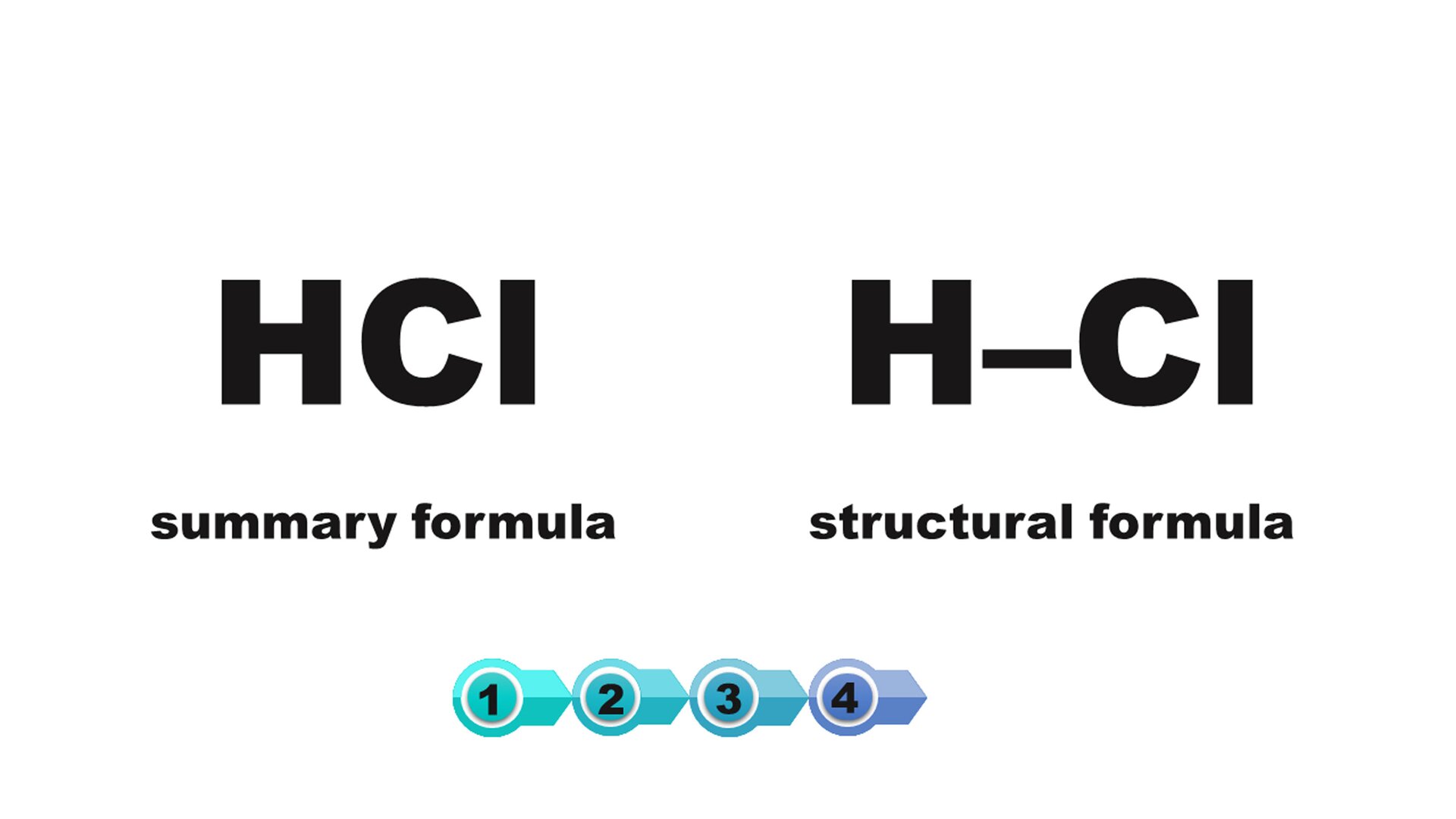
Ilustracja przedstawia sumaryczny oraz strukturalny wzór chlorowodoru. Sumaryczny ha c el, strukturalny ha pozioma kreska ce el.
The fourth and last step: we write the summary and structural formulas of hydrogen chloride.
Source: GroMar Sp. z o.o., licencja: CC BY-SA 3.0.
RT54mJr6rdsmf
Zapisz swoje obserwacje i wnioski.
Zapisz swoje obserwacje i wnioski.
Ionic bond (ionic structure)
The striving to achieve the electronic configuration of the closest in the periodic table noble gas is the basic cause of chemical bonds formation. Atoms of some elements, in order to achieve the appropriate number of electrons on the last shell, form common electron pairs, others - donate or accept electrons. An example of a chemical compound that can arise from the donation and acceptance of electrons is sodium chloride NaCl i.e. kitchen salt.
The mechanism of ion formation from sodium and chlorine atoms can be described as follows:
RQaZCUOBk5UTp
Ilustracja przedstawia mechanizm powstawania jonów z atomów sodu i chloru. Sól kuchenna powstaje wskutek oddawania i przyjmowania elektronów. Każdy z atomów pierwiastków w chlorku sodu osiąga konfigurację elektronową najbliższego w układzie okresowym gazu szlachetnego: kation sodu – neonu, anion chlorkowy – argonu. Pierwszym substratem reakcji jest atom sodu- "Na" z jednym elektronem walencyjnym oznaczonym kropką. Drugim substratem jest atom chloru - "Cl" z siedmioma elektronami walencyjnymi zaznaczonymi kropkami. Kropki umieszczone są wokół symbolu. Wynikiem reakcji jest przeniesienie elektronów. Atom sodu oddaje elektron i powstaje jon sodu o ładunku dodatnim plus jeden. Atom chloru przyjmuje elektron i powstaje jon o ładunku minus jeden, symbol otoczony jest ośmioma kropkami oznaczającymi obecność ośmiu elektronów walencyjnych oraz opatrzony ładunkiem minus jeden.
Each of the elemental atoms in sodium chloride achieves the electronic configuration of the nearest in the periodic table of noble gas: sodium cation - neon, chloride anion - argon.
Sodium chloride has other properties than sodium and chlorine, the chemical elements from which it was created. Sodium chloride is made up of sodium cations and chloride anions, which as opposite ions attract each other with electrostatic forces. Such connections in chemical compounds are called ionic bondsionic bond (ionic structure)ionic bonds.
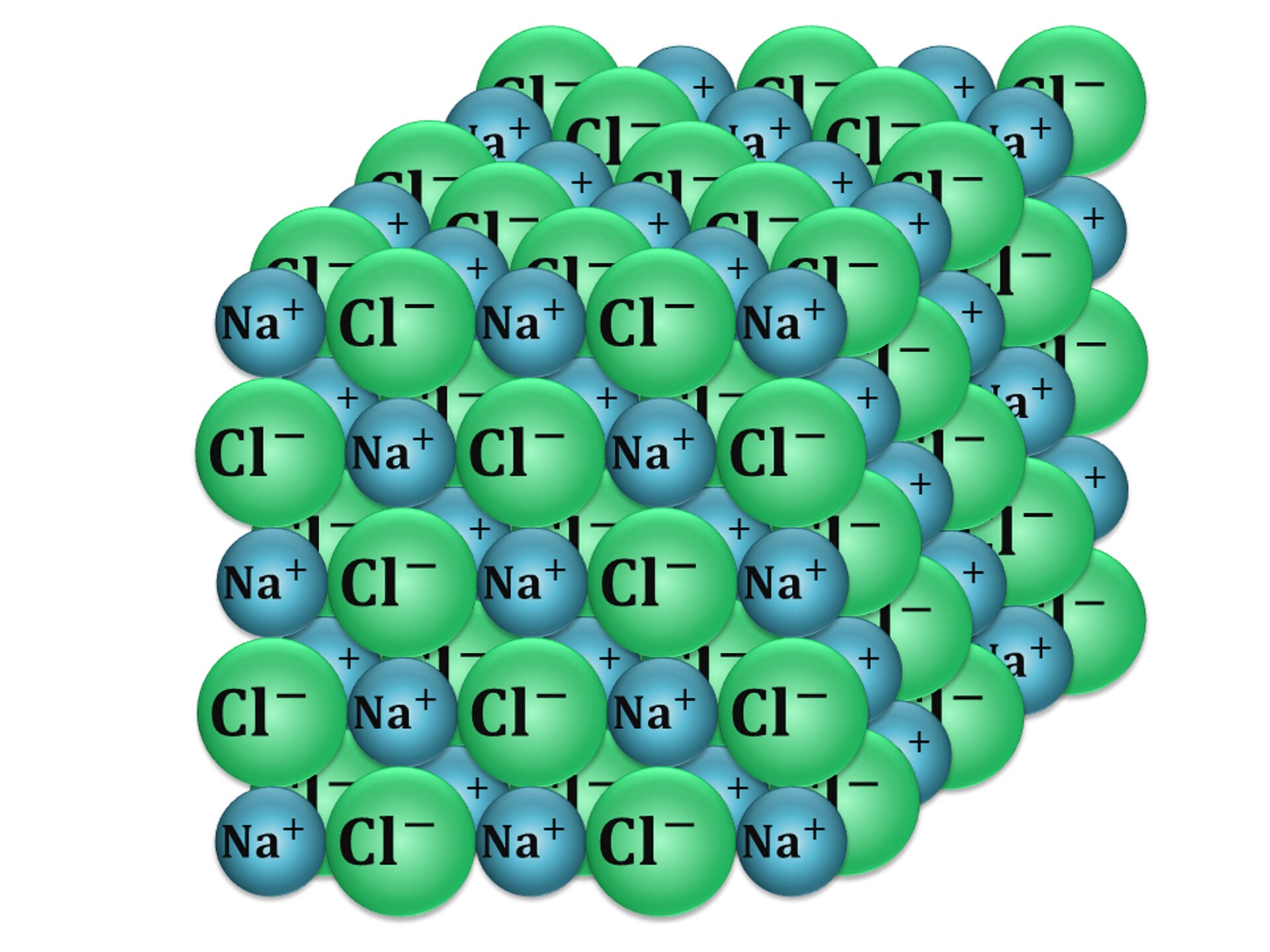
Ionic bond is a type of chemical bond that arises as a result of attracting ions with opposite signs. The chemical compounds in which ionic binding occurs are said to be ionic compounds. Ions with the same charge repel each other, so they can not be next to each other. For this reason, in the ionic compound, cations and anions are arranged alternately. The structure they form is called an ionic crystal. In the ionic compound crystal, each cation is surrounded by anions, and each anion – by cations.
How are ionic compounds constructed?
Ionic compounds are not made up of ions with opposite signs. These ions are attracted each other by the action of electrostatic forces. Ionic compound – sodium chloride – at room temperature is a solid substance consisting of alternating sodium and chloride ions. The numbers of cations and anions in the crystals of the ionic compounds are such that, as a result, the crystal is electrically neutral (not charged with an electric charge). In the case of sodium chloride for one sodium cation there is one chloride anion . Molecular formula of this compound is . Record: emphasizes that this compound is composed of ions.
Ionic compounds are made up of molecules. In their crystals one can distinguish the smallest set of repeating cations and anions, which corresponds to the compound's molecular formula.
R13xEuyjimYzp
Ilustracja przedstawia model kryształu chlorku sodu. Naprzemiennie ułożone kationy sodu i aniony chlorkowe tworzą przestzrenną strukturę sześcianu. Jony sodu są nieco mniejsze od jonów chlorkowych.
Another example of an ionic compound is magnesium chloride, made of magnesium cations and chloride anions .
Like every ion compound, magnesium chloride is composed of alternating ions: cations and anions.
REMIMvg9jfmfY
Ilustracja przedstawia model chlorku magnezu. Składa się z trzech kulek symbolizujących poszczególne jony - dwie większe to jony chlorkowe c el minus oraz umieszczona pomiędzy nimi mniejsza kulka symbolizująca jon magnezu o ładunku dwa plus. Jony przylegają do siebie, ale nie nachodzą na siebie.
The molecular formula of magnesium chloride is: .
Ionic structure is also made of aluminum chloride. It is a substance consisting of aluminum cations and chloride anions . In the crystal that forms, on 1 tri‑positive aluminum ion there are 3 mono‑negative chloride ions . Molecular formula of this compound is .
Ionic bonds are formed between metals and some non‑metals.
Ionic compound
Magnesium chloride
Aluminium chloride
Sodium sulfide
Cation
Anion
The ratio of the number of cations to the number of anions
1 : 2
1 : 3
2 : 1
Molecular formula of a chemical compound
Ionic substances and covalent substances
Chemical compounds made of ions differ from compounds that exist in the form of molecules. Ionic compounds (containing ionic bonds) are formed as a result of interaction of metals with non‑metals. However, covalent compounds (containing covalent bonds) arise from non‑metals.
RiYWDO1IHZYf8
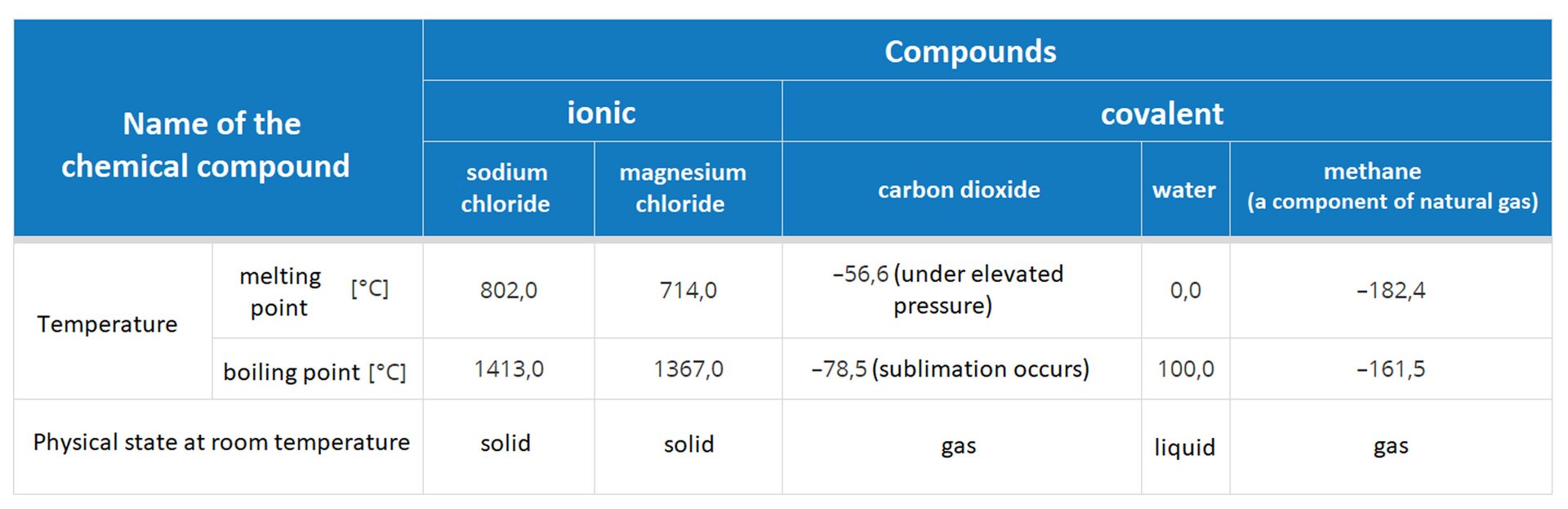
Grafika przedstawia tabelkę prezentującą temperatury wrzenia i topnienia przykładowych substancji jonowych i kowalencyjnych. Pierwsza kolumna zawiera przykłady chemicznych właściwości - temperatury (punkt topnienia i wrzenia) oraz postać w temperaturze pokojowej. Druga kolumna zawiera poszczególne związki chemiczne - jonowe oraz kowalencyjne. Wymienione związki jonowe to: chlorek sodu z wartościami- temperaturą topnienia 802,0 i tempaeraturą wrzenia 1413,0; w temperaturze pokojowej chlorek sodu ma postać stałą; chlorek magnezu o temperaturze topnienia 714, 0 oraz wrzenia 1367,0; w temperaturze pokojowej chlorek magnezu ma stały stan skupienia. Wśród związków kowalencyjnych w tabeli występują: dwutlenek węgla z wartościami- temperatura topnienia- (-56,6) pod podwyższonym ciśnieniem, temperatura wrzenia (-78,5) - występuje sublimacja.; w temperaturze pokojowej dwutlenek węglajest gazem; woda z wartościami- temperatura topnienia- 0,0, temperatura wrzenia -100,0, w temperaturze pokojowej woda ma postać ciekłą oraz metan (będący składnikiem gazu ziemnego) z wartościami- tempaeratura topnienia- (-182,4), temperatura wrzenia (-161,5), metan w temperaturze pokojowej występuje pod postacią gazu. Wszystkie wartości zostały przedstawione w stopniach Celsjusza.
Boiling and melting temperatures of exemplary ionic and covalent substances
Source: GroMar Sp. z o.o., licencja: CC BY-SA 3.0.
Ionic compounds at room temperature are solid substances with high melting and boiling points. Under the same conditions, some covalent compounds are gases, others – solids, and still others – liquids. They usually have much lower boiling and melting points than ionic compounds. Most ionic compounds, unlike covalent ones, dissolve very well in water.
R1nuV00tXJMm6
Exercise 1
Select the statement saying the truth. Możliwe odpowiedzi: 1. Ionic compounds most often have higher boiling and melting points in relation to covalent compounds; they are also usually more soluble in water compared to substances made of molecules., 2. Ionic compounds are composed of alternating cations and anions that form an ordered structure called an ionic crystal., 3. After accepting or donating one or more electrons, the atoms change their size: cations have a smaller radius than the atoms they form, while the anions have the same radius as atoms., 4. In an ionic compound crystal, ions with opposite signs attract each other as a result of the action of electrostatic forces.
Select the statement saying the truth. Możliwe odpowiedzi: 1. Ionic compounds most often have higher boiling and melting points in relation to covalent compounds; they are also usually more soluble in water compared to substances made of molecules., 2. Ionic compounds are composed of alternating cations and anions that form an ordered structure called an ionic crystal., 3. After accepting or donating one or more electrons, the atoms change their size: cations have a smaller radius than the atoms they form, while the anions have the same radius as atoms., 4. In an ionic compound crystal, ions with opposite signs attract each other as a result of the action of electrostatic forces.
Select the statement saying the truth.
Ionic compounds most often have higher boiling and melting points in relation to covalent compounds; they are also usually more soluble in water compared to substances made of molecules.
Ionic compounds are composed of alternating cations and anions that form an ordered structure called an ionic crystal.
After accepting or donating one or more electrons, the atoms change their size: cations have a smaller radius than the atoms they form, while the anions have the same radius as atoms.
In an ionic compound crystal, ions with opposite signs attract each other as a result of the action of electrostatic forces.
Summary
Ionic compounds are composed of alternating cations and anions that form an ordered structure called an ionic crystal.
In an ionic compound crystal, ions with opposite signs attract each other as a result of the action of electrostatic forces.
Covalent compounds usually consist of molecules.
Ionic compounds most often have higher boiling and melting points in relation to covalent compounds; they are also usually more soluble in water compared to substances made of molecules.
R18Tcfx8PL0qw1
Grafika przedstawiająca tablicę szkolną, na której znajdują się zdania do dokończenia. Finish selected sentences. 1 It was easy for me (uzupełnij). 2 It was difficult for me (uzupełnij). 3 Today I learned (uzupełnij). 4 I understood that (uzupełnij). 5 It surprised me (uzupełnij). 6. Today I found out (uzupełnij). 7. I was interested in (uzupełnij). 8. I still have to repeat (uzupełnij).
Grafika przedstawiająca tablicę szkolną, na której znajdują się zdania do dokończenia. Finish selected sentences. 1 It was easy for me (uzupełnij). 2 It was difficult for me (uzupełnij). 3 Today I learned (uzupełnij). 4 I understood that (uzupełnij). 5 It surprised me (uzupełnij). 6. Today I found out (uzupełnij). 7. I was interested in (uzupełnij). 8. I still have to repeat (uzupełnij).
Source: GroMar Sp. z o.o., licencja: CC BY-SA 3.0.