Let’s talk about the authorities
Links to lessons: 1, 2, 3, 4, 5
Links to the abstracts: 1, 2, 3, 4, 5
You are able to explain the competences of the President of the Republic of Poland and the Prime Minister.
You are able to describe and explain the process of forming the Council of Ministers, describe its structure and name its competences. You are able to explain the political and constitutional responsibility of the executive power. You are able to explain the relations between the executive bodies and the legislative in Poland.
You are able to explain who can be elected to the Sejm and the Senate, and how the elections are organized.
You are able to name and explain the functions of the parliament, and to describe the internal organization of both chambers of the Polish parliament.
You are able to explain the difference between a formal and material immunity of deputies and senators, as well as discuss the advantages and disadvantages of granting immunity to our representatives in the parliament.
You are able to describe the court system in Poland and explain the jurisdiction of each of the courts: common, military and administrative.
You are able to name and explain the competences of the Supreme Court, the Constitutional Tribunal, and the Tribunal of State.
You will talk and discuss topics from the given themes.
You will consolidate the material from the lesson „What do we need the President for?”, „To be the Prime Minister”, „The legislative power – the Sejm and the Senate”, „The executive power – the President of the Republic of Poland and the Council of Ministers”, „The judicial power – courts and tribunals”.
You will ask questions and answer your friends' questions.
You will consolidate the vocabulary learned during the lesson.
Before you begin solving the exercises, review abstracts „What do we need the President for?”, „To be the Prime Minister”, „The legislative power – the Sejm and the Senate”, „The executive power – the President of the Republic of Poland and the Council of Ministers”, „The judicial power – courts and tribunals” to recall the most important information and vocabulary. Then you will be able to check your knowledge. Good luck!
Arrange a crossword, whose main password will be related to the content of lesson „To be the Prime Minister”.
Listen to the recording „What do we need the President for?” and write down questions you could ask your friend or colleague to check if he understood the text. Also note the expected answers. You can also read the contents of the abstract „What do we need the President for?”.
Do you know which categories the presented competencies of the President of the Republic of Poland belong to? Match the pairs.
competencies towards the Sejm and the Senate, competencies in terms of authority over the armed forces and state security, competencies towards the Council of Ministers, competencies in terms of foreign affairs
| Convening the Cabinet Council (the Council of Ministers meeting presided over by the President, convened in matters of particular importance to the State). | |
| Ordering the promulgation (publication) of a statute or an international agreement in the Journal of Laws of the Republic of Poland. | |
| Receiving Letters of Credence and recall of diplomatic representatives of other states and international organizations accredited to him. | |
| In times of peace exercising command over the Armed Forces through the Minister of National Defence. |
Do you know the rules which govern the elections to the Sejm and the Senate? Match the statements below to an appropriate group.
Candidates are elected in 100 single-mandate districts., Committees of national minorities are exempt from the necessity of exceeding the electoral threshold., Candidates are elected in 41 districts. In each district, 7 to 19 deputies are elected., After determining how many mandates the election committee has received in a specific district, the mandates are given to those candidates from the district who received the most indications on the list., The elections are carried out according to another ordinance – a majoritarian vote.
| The rules of elections to the Sejm of the Republic of Poland | |
|---|---|
| The rules of elections to the Senate of the Republic of Poland |
Complete a multiple-choice test question for the lesson „The executive power – the President of the Republic of Poland and the Council of Ministers”. Then exchange your questions with a classmate.
Question: ...
- ...
- ...
- ...
- ...
Do you know the structure of common courts in Poland? Arrange the puzzles and find out.
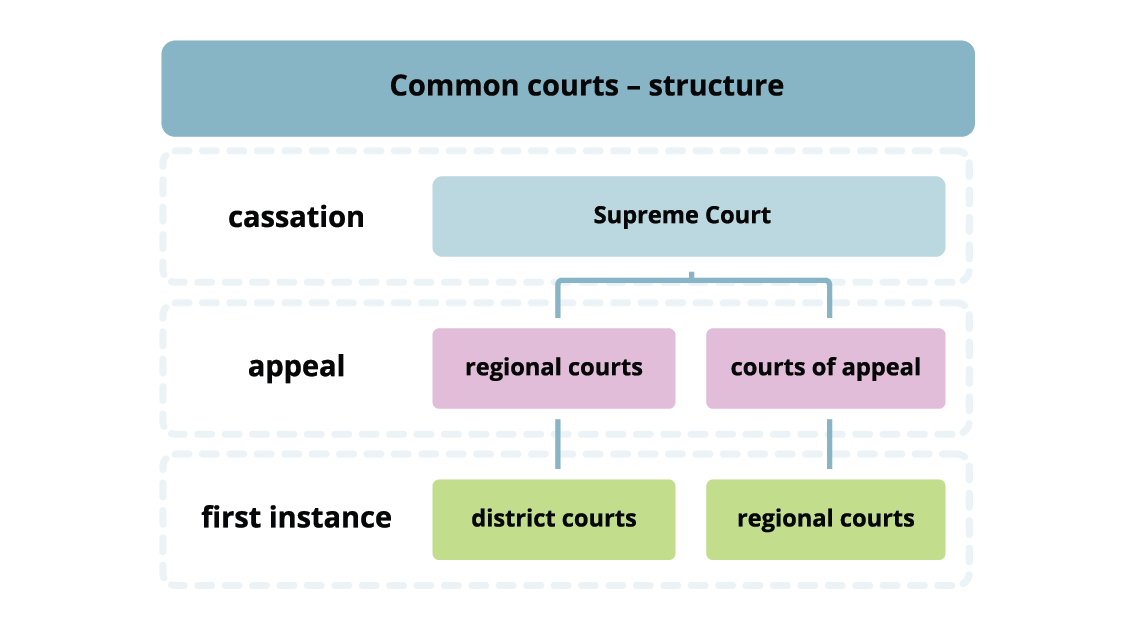
Review what the common, military and administrative courts do. Read the text carefully and fill in the gaps.
complaints, criminal, jurisdiction, resolutions, decisions, administration, self‑governmental, Military, Common, offences, Administrative, labour, in active service
...................................... courts settle, among others, ......................................, civil, family and guardianship, and ...................................... law cases, as well as all other matters that are not reserved for the ...................................... of other courts.
...................................... courts deal first and foremost with matters related to ...................................... committed by soldiers .......................................
...................................... courts primarily control the activities of public ...................................... bodies, both governmental and ...................................... (local governments). The control applies to, among others, administrative ......................................, ...................................... issued in administrative proceedings or ...................................... about inactivity of administrative bodies.
Do the vocabulary exercise. Match the pairs: English and Polish words.
wydawać (rozporządzenia), uprawniony, naruszenie prawa, zwoływać, proces, rozdzielać (funkcje), izba, wybory
| to discharge (functions) | |
| issue (regulations) | |
| eligible | |
| chamber | |
| to convene | |
| hearing | |
| offence | |
| elections |
Keywords
the law‑making process, introduce legislation, veto, bill, the Constitutional Tribunal, executive power, head of government, the cabinet, exposé, state power ministries, the Council of Ministers, the Sejm, the Senate, deputy, senator, parliamentary club, deputies’ group, the Marshal, the Presidium, the Council of Elders, committees, legislative/scrutiny/European function of the parliament, formal/material immunity, vote on non‑confidence, Council of Ministers, the Prime Minister, vote of (no-)confidence, department ministers, ministers without portfolio, political responsibility, regulations, executive branch, judicial, jurisdiction, common/military/administrative courts, the Supreme Court, the Tribunal of State, constitutional accountability
Glossary
przestrzeganie
suwerenność
nienaruszalność
zapewnić
ponowne rozpatrzenie
ustawowa
zgodność
zgodnie z
stworzyć rząd
wziąć pod uwagę
zemdleć
być zapamiętanym za (coś)
hiperinflacja
minister pracy
Ministerstwo Spraw Wewnętrznych
Ministerstwo Obrony
być powierzony (w posiadaniu)
szlachta
a zatem, w ten sposób
uprawniony
osiągać
ubezwłasnowolnienie
przestępstwo umyślne ścigane z oskarżenia publicznego
izba
zwoływać
nakładać
opróżniony
doradczy
konsultacyjny
pomocniczy
kontrola, nadzór
przede wszystkim
podporządkowany
zwolnienie, dymisja
tak zwany
zostać pociągniętym do odpowiedzialności
zakres
odtąd, tego, z tego, od tego
naruszyć
wygaśnięcie
zgoda
ustanowiony
przedawnienie, bieg przedawnienia
równowartość
Nagranie dostępne na portalu epodreczniki.pl
Nagranie słówka: to be brought to criminal accountability
zostać pociągniętym do odpowiedzialności karnej
wypadek, przypadek
zatrzymywać
Nagranie dostępne na portalu epodreczniki.pl
Nagranie słówka: apprehended in the commission of an offence
złapany na gorącym uczynku
zwalniać, uwalniać
niemal, praktycznie, właściwie
wyłącznie
sprzeczne z
rozdzielać (funkcje)
przedzielony
pochodzić z
wyznaczony do/na
wydawać (rozporządzenia)
nadzór
wyższego rzędu
zrezygnować, podać się do dymisji
wdrażać (politykę)
jurysdykcja, zakres rozstrzyganych spraw
proces
zbędna zwłoka, nieuzasadnione opóźnienie
bezstronny
rozstrzygać
prawo rodzinne i opiekuńcze
przede wszystkim
naruszenie prawa
Nagranie dostępne na portalu epodreczniki.pl
Nagranie słówka: resolution in administrative proceeding
postanowienie w postępowaniu administracyjnym
środki odwoławcze (wobec orzeczeń sądu)
rozbieżność
prawoznawstwo
ważność
projekt ustawy
orzekać
niższego rzędu
zaprzestać
Nagranie dostępne na portalu epodreczniki.pl
Nagranie słówka: complaint concerning infringements of the Constitution
skarga konstytucyjna
naruszenie
ordery i odznaczenia
Skarb Państwa
Narodowy Bank Polski
Najwyższa Izba Kontroli
Nagranie dostępne na portalu epodreczniki.pl
Nagranie słówka: National Council of Radio Broadcasting and Television
Krajowa Rada Radiofonii i Telewizji
Naczelny Dowódca Sił Zbrojnych