The ear collects energy only from the area which it occupies. For the sensation of volume, the energy expressed in a unit of time per a unit of surface is important.
A volume of the sound is its characteristic property. The volume represents the ratio of energy transmitted by the sound wave in a time unit per surface. Thus, it is the ratio of the sound powersound powersound power in relation to a particular surface.
where: - volume of sound in relation to the surface , - the power of the acoustic wave reaching the surface (the power emitted by the sound source in the form of an acoustic wave), - the surface which the sound falls on.
A 10 times higher volume is not perceived by a human as 10 times louder sound.
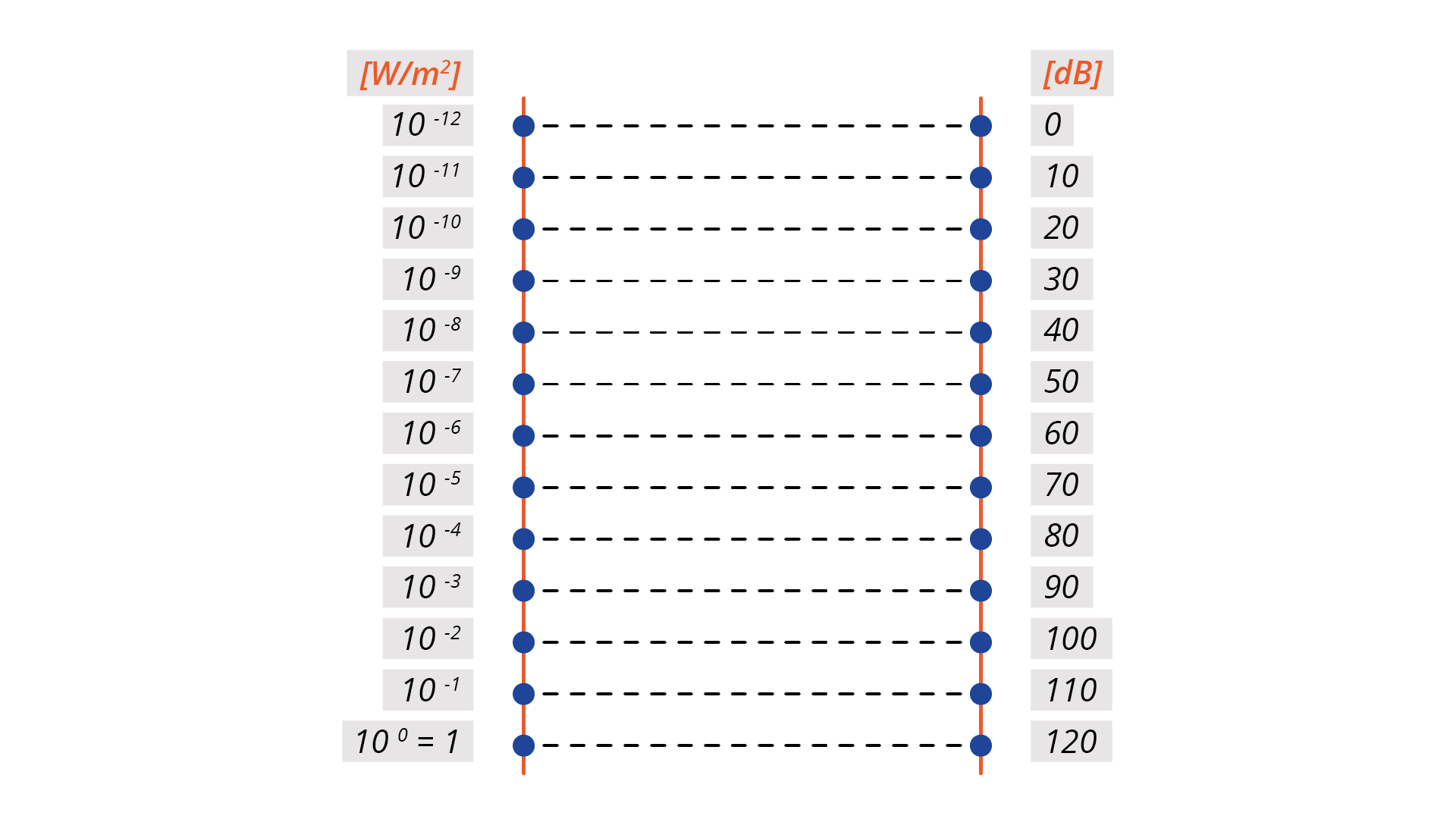
That is why we enter unit called the sound level [dB]. To determine the level of sound intensity, the reference frequency is set to f = 1000 Hz. The threshold of hearing is . This is the zero point of the new scale. The intensity of 10 times greater is 10 dB, 100 more is 20 dB, etc.
R1TDQgebaMFvj1
Ilustracja przedstawia schematyczny układ przeliczania natężenia dźwięku na decybele. Wartości dziesięciu do minus dwunastu watów na metr kwadratowy odpowiada zero decybeli. Wartości dziesięciu do minus jedenastu watów na metr kwadratowy odpowiada dziesięć decybeli. Wartości dziesięciu do minus dziesięciu watów na metr kwadratowy odpowiada dwadzieścia decybeli. Wartości dziesięciu do minus dziewięciu watów na metr kwadratowy odpowiada trzydzieści decybeli. Wartości dziesięciu do minus ośmiu watów na metr kwadratowy odpowiada czterdzieści decybeli. Wartości dziesięciu do minus siedmiu watów na metr kwadratowy odpowiada pięćdziesiąt decybeli. Wartości dziesięciu do minus sześciu watów na metr kwadratowy odpowiada sześćdziesiąt decybeli. Wartości dziesięciu do minus pięciu watów na metr kwadratowy odpowiada siedemdziesiąt decybeli. Wartości dziesięciu do minus czterech watów na metr kwadratowy odpowiada osiemdziesiąt decybeli. Wartości dziesięciu do minus trzech watów na metr kwadratowy odpowiada dziewięćdziesiąt decybeli. Wartości dziesięciu do minus dwóch watów na metr kwadratowy odpowiada sto decybeli. Wartości dziesięciu do minus jednego wata na metr kwadratowy odpowiada sto dziesięć decybeli. Wartości dziesięciu do zera watów równej jeden wat na metr kwadratowy odpowiada sto dwadzieścia decybeli.
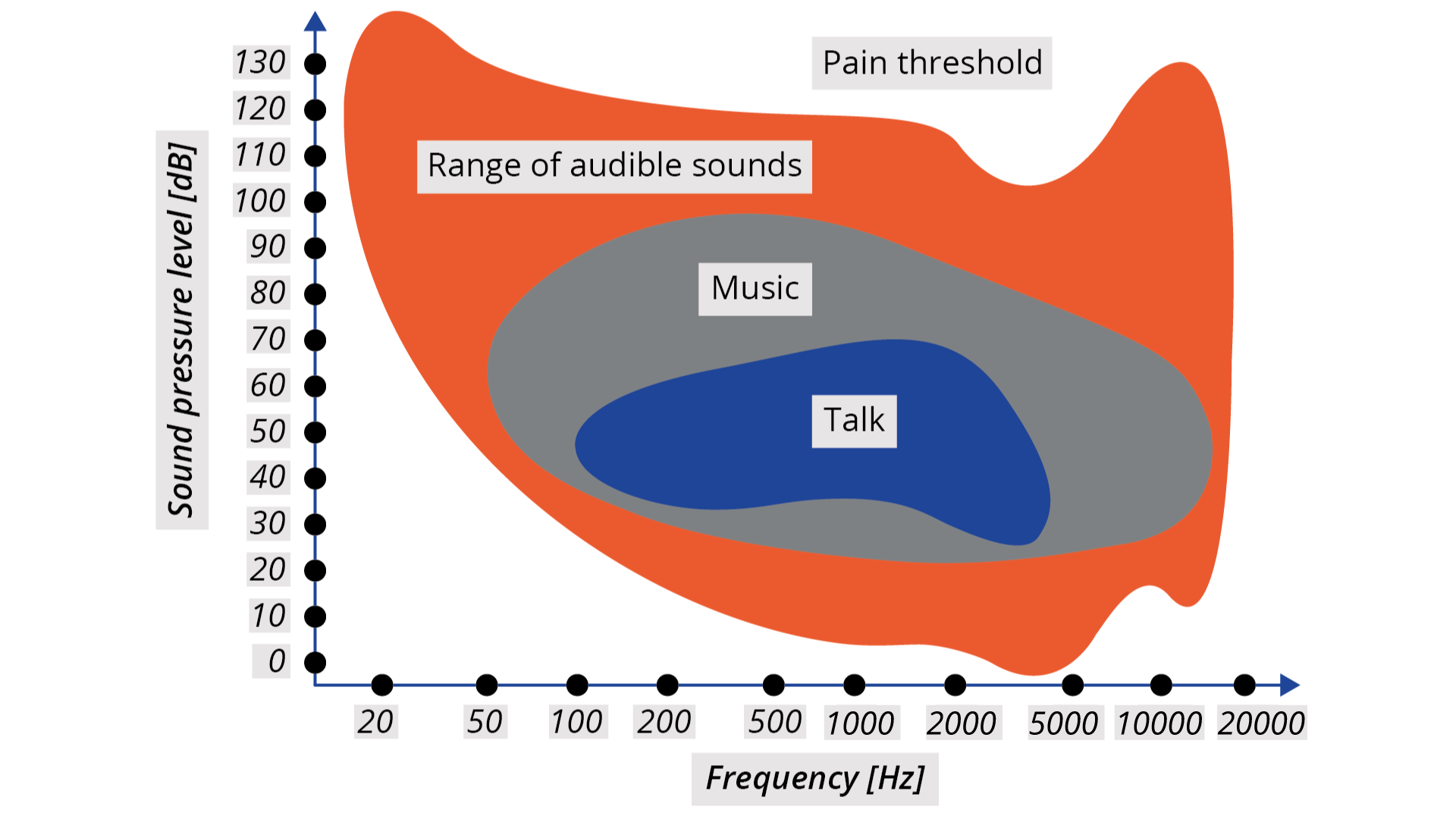
In order to hear a given sound, it is not enough that the frequency of sound is in the range of 16 Hz – 20000 Hz (20 kHz). The volume of sound should also be over a certain threshold, below which we will not perceive auditory sensationsauditory sensationsauditory sensations. It is called „the hearing thresholdhearing thresholdhearing threshold”.
However, above a certain volume of sound, it is not possible to perceive any auditory sensations. We will only feel pain. In his case the threshold of the volume of sound is called „the pain thresholdpain thresholdpain threshold”.
R6Y7R46fonI2B1
Ilustracja przedstawia schematyczny wykres zakresu słyszalności. Oś pozioma opisana Frequency, w nawiasie kwadratowym Hz, z zaznaczonymi punktami 20, 50, 100, 200, 500, 1000, 2000, 5000, 10000 i 20000. Oś pionowa opisana Sound pressure level, w nawiasie kwadratowym dB, z zaznaczonymi punktami od 0 do 130, z odcinkiem jednostkowym 10. Na górze po prawej napis Pain threshold wskazuje obszar powyżej progu bólu, w którym natężenie dźwięku jest tak wysokie, że człowiek nie odbiera żadnych wrażeń słuchowych, jedynie ból. Poniżej zaznaczony Range of audible sounds kolorem pomarańczowym zajmującym prawie całą powierzchnię między osiami, wskazuje obszar słyszalności, w którym częstotliwości są z zakresu od szesnastu herców do dwudziestu tysięcy herców. Wewnątrz na środku zaznaczony Music - szary kształt przypominający elipsę, wskazujący obszar słyszalności podczas słuchania muzyki, poziom natężenia dźwięku jest z zakresu od 20 do 100 decybeli, częstotliwość od 50 do 10000 herców. Wewnątrz na środku zaznaczony Talk - niebieski kształt przypominający elipsę, wskazujący obszar słyszalności podczas rozmowy, natężenie dźwięku jest z zakresu od 30 do 70 decybeli, częstotliwość od 100 do 5000 herców.
Source: GroMar, licencja: CC BY 3.0.
RqqXl4WxTBvnh
Na ilustracji interaktywnej zatytułowanej ‘How many decibels?’ pokazane są schematycznie przykładowe wartości poziomu natężenia dźwięku w decybelach. Narysowana jest strzałka pionowa skierowana do góry opisana Noise. Na niej zaznaczone są punkty od dołu, od 0 do 140, co 10, podpisane dB. Dolny koniec strzałki podpisany Audibility threshold. Pod grotem strzałki, powyżej punktu 140, narysowana jest ikona samolotu oznaczona numerem 1, podpisana Pain threshold. Na wysokości punktu 110 narysowana jest ikona koparki oznaczona numerem 2. Na wysokości punktu 100 narysowana jest ikona młota pneumatycznego oznaczona numerem 3. Między punktem 90 a 80 narysowana jest ikona samochodu ciężarowego oznaczona numerem 4. Między punktem 70 a 60 narysowana jest ikona symbolizująca biuro (dwa dymki z trzykropkiem) oznaczona numerem 5. Na wysokości punktu 60 narysowana jest ikona symbolizująca rozmowę (dymek z trzykropkiem) oznaczona numerem 6. Między punktem 40 a 30 narysowana jest ikona słupów wysokiego napięcia oznaczona numerem 7 oraz na tej samej wysokości ikona symbolizująca bibliotekę (trzy książki na półce) oznaczona numerem 8. Między punktem 20 a 10 narysowana jest ikona symbolizująca las (trzy drzewa) oznaczona numerem 9. Na ilustracji widoczne są numery, a na nich podpisy. 1. airplane start {audio}, 2. construction {audio}, 3. pneumatic hammer {audio}, 4. heavy transport {audio}, 5. office {audio}, 6. conversation {audio}, 7. HV transmission lines {audio}, 8. library {audio}, 9. forest {audio}.
Na ilustracji interaktywnej zatytułowanej ‘How many decibels?’ pokazane są schematycznie przykładowe wartości poziomu natężenia dźwięku w decybelach. Narysowana jest strzałka pionowa skierowana do góry opisana Noise. Na niej zaznaczone są punkty od dołu, od 0 do 140, co 10, podpisane dB. Dolny koniec strzałki podpisany Audibility threshold. Pod grotem strzałki, powyżej punktu 140, narysowana jest ikona samolotu oznaczona numerem 1, podpisana Pain threshold. Na wysokości punktu 110 narysowana jest ikona koparki oznaczona numerem 2. Na wysokości punktu 100 narysowana jest ikona młota pneumatycznego oznaczona numerem 3. Między punktem 90 a 80 narysowana jest ikona samochodu ciężarowego oznaczona numerem 4. Między punktem 70 a 60 narysowana jest ikona symbolizująca biuro (dwa dymki z trzykropkiem) oznaczona numerem 5. Na wysokości punktu 60 narysowana jest ikona symbolizująca rozmowę (dymek z trzykropkiem) oznaczona numerem 6. Między punktem 40 a 30 narysowana jest ikona słupów wysokiego napięcia oznaczona numerem 7 oraz na tej samej wysokości ikona symbolizująca bibliotekę (trzy książki na półce) oznaczona numerem 8. Między punktem 20 a 10 narysowana jest ikona symbolizująca las (trzy drzewa) oznaczona numerem 9. Na ilustracji widoczne są numery, a na nich podpisy. 1. airplane start {audio}, 2. construction {audio}, 3. pneumatic hammer {audio}, 4. heavy transport {audio}, 5. office {audio}, 6. conversation {audio}, 7. HV transmission lines {audio}, 8. library {audio}, 9. forest {audio}.
Examples of different levels of sound intensity (dB)
10 dB - rustling of leaves with a moderate wind, 20 dB - whisper, 30 dB - very quiet street without traffic, 40 dB - rustle at home, 50 dB - rustle in offices, 60 dB - vacuum cleaner, 70 dB - the interior of a noisy restaurant, tearing paper, the interior of a car, 80 dB - loud music indoors, toot, 90 dB - traffic, 100 dB - motorcycle without a silencer, 110 dB - chainsaw, 120 dB - helicopter rotor at a distance of 5 meters, 140 dB - start of a jet fighter, 160 dB - explosion of firecrackers, 190 dB - launch of a spacecraft, 220 dB - atomic bomb explosion.
The volume of the sound is a quantity which describes the power of the acoustic wave per a unit area .
A unit called the sound level [dB] is introduced.
f = 1000 Hz is the reference value of frequency.
Thus, the hearing thresholdhearing thresholdhearing threshold equals . This is the zero point of the new scale.
In order to hear a given sound, it is not enough that the frequency of sound is in the range of 16 Hz - 20 kHz. The volume of sound should also be over a certain threshold, below which we will not perceive auditory sensationsauditory sensationsauditory sensations. It is called „the hearing threshold”.
However, above a certain volume of sound, it is not possible to perceive any auditory sensations. We will only feel pain. In his case the threshold of the volume of sound is called „the pain thresholdpain thresholdpain threshold”.
Exercises
R5guOW1S50qzt
Exercise 1
Wersja alternatywna ćwiczenia: Determine which sentences are true. Możliwe odpowiedzi: 1. The double increase in sound intensity result in a double increase in the hearing perception., 2. We hear a single singer voice at a sound level of 70 dB. A simultaneous singing of 10 of the same singers will be received at the level of 80 dB., 3. The increase in the sound level of 20 dB is always result in the 200-times increase in sound intensity., 4. Sound intensity 1 000 000 000 times greater than the threshold intensity will be taken as an auditory impression.
Wersja alternatywna ćwiczenia: Determine which sentences are true. Możliwe odpowiedzi: 1. The double increase in sound intensity result in a double increase in the hearing perception., 2. We hear a single singer voice at a sound level of 70 dB. A simultaneous singing of 10 of the same singers will be received at the level of 80 dB., 3. The increase in the sound level of 20 dB is always result in the 200-times increase in sound intensity., 4. Sound intensity 1 000 000 000 times greater than the threshold intensity will be taken as an auditory impression.
Determine which sentences are true.
The double increase in sound intensity result in a double increase in the hearing perception.
We hear a single singer voice at a sound level of 70 dB. A simultaneous singing of 10 of the same singers will be received at the level of 80 dB.
The increase in the sound level of 20 dB is always result in the 200-times increase in sound intensity.
Sound intensity 1 000 000 000 times greater than the threshold intensity will be taken as an auditory impression.
Exercise 2
The volume of the sound which propagates in the air decreases with the square of the distance from the source: . At the distance of 1 m from the sound source, the volume is .
a) Calculate the sound intensity at the distance of 10 m from the source.
b) By how many dB did the sound level decrease?
a) .
b) .
Exercise 3
Download a free application on your phone and then every day during the week, measure the sound level in several places which you chose. Analyze the measurement results you obtained and write a short report on the experiment in English.
RZoxbU7Za73su
Exercise 4
Wersja alternatywna ćwiczenia: Indicate which pairs of expressions or words are translated correctly. Możliwe odpowiedzi: 1. moc akustyczna - sound power, 2. natężenie dźwięku - sound intensity, 3. poziom natężenia dźwięku - level of sound intensity, 4. hałas - noise, 5. próg słyszalności - pain threshold, 6. źródło dźwięku - auditory sensations
Wersja alternatywna ćwiczenia: Indicate which pairs of expressions or words are translated correctly. Możliwe odpowiedzi: 1. moc akustyczna - sound power, 2. natężenie dźwięku - sound intensity, 3. poziom natężenia dźwięku - level of sound intensity, 4. hałas - noise, 5. próg słyszalności - pain threshold, 6. źródło dźwięku - auditory sensations
Indicate which pairs of expressions or words are translated correctly.
moc akustyczna - sound power
natężenie dźwięku - sound intensity
poziom natężenia dźwięku - level of sound intensity
hałas - noise
próg słyszalności - pain threshold
źródło dźwięku - auditory sensations
zadanie
Source: GroMar, licencja: CC BY 3.0.
R14Et2eb8TaWl1
Interaktywna gra, polegająca na łączeniu wyrazów w pary w ciągu jednej minuty. Czas zaczyna upływać wraz z rozpoczęciem gry. Jeden ruch to odkrywanie najpierw jednej potem drugiej karty z wyrazem. Każdy wyraz jest odczytywany. Kolejny ruch to odkrywanie trzeciej i czwartej karty. W ten sposób odsłuchasz wszystkie wyrazy. Nawigacja z poziomu klawiatury za pomocą strzałek, odsłuchiwanie wyrazów enterem lub spacją. Znajdź wszystkie pary wyrazów.
Interaktywna gra, polegająca na łączeniu wyrazów w pary w ciągu jednej minuty. Czas zaczyna upływać wraz z rozpoczęciem gry. Jeden ruch to odkrywanie najpierw jednej potem drugiej karty z wyrazem. Każdy wyraz jest odczytywany. Kolejny ruch to odkrywanie trzeciej i czwartej karty. W ten sposób odsłuchasz wszystkie wyrazy. Nawigacja z poziomu klawiatury za pomocą strzałek, odsłuchiwanie wyrazów enterem lub spacją. Znajdź wszystkie pary wyrazów.
Match Polish terms with their English equivalents.
granica bólu
próg słyszalności
hearing threshold
sound power
level of sound intensity
moc akustyczna
pain threshold
natężenie dźwięku
sound intensity
poziom natężenia dźwięku
Source: Zespół autorski Politechniki Łódzkiej, licencja: CC BY 3.0.