R1e9GpWNGD913

Make the suffrage universal. Feminist movement

The arrest of Emmeline Pankhurst
Source: Aresztowanie Emmeline Pankhurst, 1914, domena publiczna.

Link to the lesson

You will learn
  • to describe the postulates and achievements of the emancipation and feminist movement;

  • to list the leading activists of the emancipation and feminist movement;

  • to indicate the countries which granted women the suffrage before the First World War, during it and in 1918.

R16KptDPtojJY
Nagranie abstraktu

In the mid‑19th century in the USA, a social movement called feminism took on an organised form, and the period of its greatest mobilisation was the end of the century, when it became particularly evident in Great Britain. The concept of emancipation was its basic slogan, used in campaigns for the empowerment of women. In the 90s. of the 19th century, British women's movement activists, called SuffragettesSuffragettesSuffragettes, started a fight for political rights and voting rights. Under the leadership of Emmeline Pankhurst and her daughters, the suffragettes took much more radical steps.

1
Task 1

Read about the most important activists of the women's movement in Poland and their initiatives.

R1XzDjBGmtjee
Women’s movement in Poland 1819 Klementyna Hoffmanowa from the family of Tański The history of the Polish feminism starts usually with Klementyna Hoffmanowa. Due to the fact that she was an independent woman, working for a living only as a writer and teacher, which was rare at the time. But was she a feminist?She was promoting education among girls, but in her work she supported the traditional division of roles. She debuted in 1819 with a pedagogical treaty entitled Memento of a Good Mother, and regularly wrote to the magazine “Evening Entertainments”. In 1825, she was appointed an inspector of finishing schools and other schools for women in Warsaw. A year later (1826), she become a lecturer in the study of manners at the newly established National Institute for Education of Women., 1838 Narcyza Żmichowska The real revolution was made by the students of Klementyna Hoffmanowa from the family of Tański, mainly Narcyza Żmichowska. After graduating from the Warsaw Governesses’ Institute, she was employed as a home teacher by the family of Zamoyski in Paris. There she came across a democratic movement and soaked in the ideas of the first wave of feminism, because of which she was, after all, fired. She returned to Poland in a changed form. She engaged in educational and public activities (she was even imprisoned for some time), she was shocking with the "male lifestyle” (smoking cigars, horse riding). She brought together a group of supporters who created an informal group called "Entuzjastki". They aimed to increase the participation of women in public life, equalise access to education and promote the ideals of self-fulfilment and economic independence. Women from “Entuzjastki” group expressed their views in public debates and in opinion-forming magazines: “Pierwiosnek” (1838-1843), “Pielgrzym” (1842-1846) and “Przegląd Naukowy”. (1842-1848), 1908 Maria Dulębianka Among the many demands of the emancipation movement in the era of partitions, two came to the fore - political rights and universal access to education. The most famous speech was made in 1908 when Maria Dulębianka, a private friend/partner of Maria Konopnicka, took part in the elections to the Galicia Sejm. She won more than four hundred votes (male, of course), which was a good result, but her candidacy was rejected "for formal reasons". Polish suffragettes were not imprisoned and beaten like, for example, their British colleagues, but many people were reluctant towards their slogans or mocked them. The press started publishing rough caricatures or comments. They were criticised for dealing with matters so insignificant when an entire nation was enslaved. "Is a woman standing outside her nation?” - Dulębianka retorted them., 1907 Paulina Kuczalska-Reinschmit One of the most important figures of the women's movement in the early 20th century. She was the founder of the Związek Równouprawnienia Kobiet Polskich [Union for the Equal Rights of Polish Women] in 1907 and the editor-in-chief of the "Ster" magazine. The magazine was a platform of the Polish women's movement "Ster" and was intended for the exchange of information between emancipated women dispersed within the boundaries of the three partitions. Not only fervent journalistic texts were included, there was also a literary corner where Orzeszkowa, Konopnicka and Żeromski published, as well as Ludwika Ćwierczakiewiczowa, the author of widely sought-after cookbooks and guides for housewives., 1897 Kazimiera Bujwidowa Also Kazimiera Bujwidowa was indefatigable in the struggle for women's access to higher education - she was a founder of the first female junior high school in Poland where it was possible to pass secondary school final examinations (matura), and the initiator of the campaign for women consisting in sending applications for admission to the Jagiellonian University. The action resulted in the admission of the first female students in the history of the university in 1897.
Source: domena publiczna.
Task 2

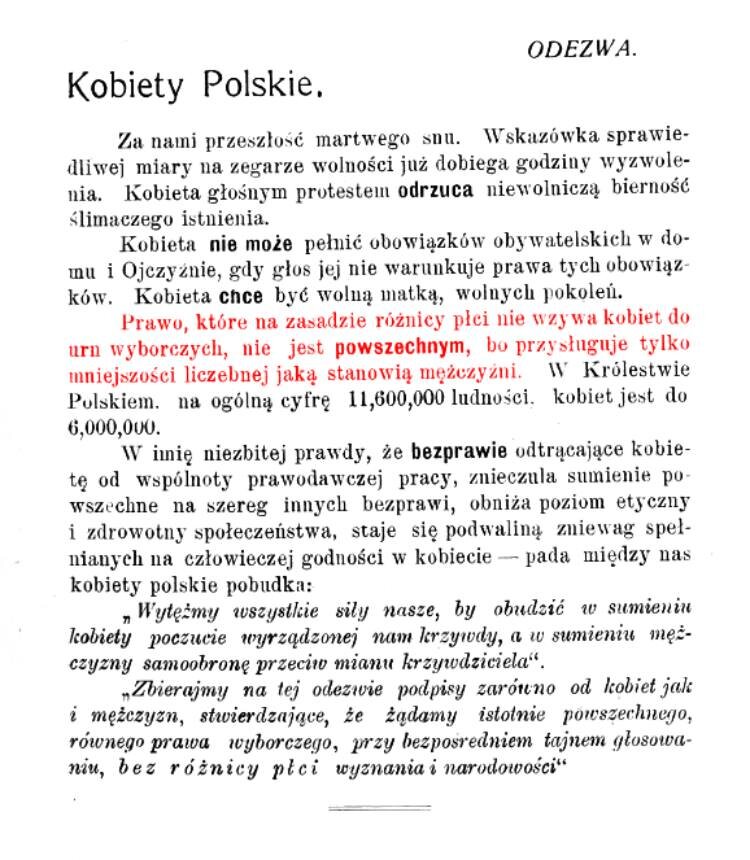
Read an excerpt from a leaflet from 1905. What are the arguments that support the demand for universal suffrage without gender difference?
RHw1Du3kyIPVf
Proclamation of the feminists from the group of the magazine “Ster”
Source: Odezwa feministek z kręgu pisma "Ster", domena publiczna.
feminism
Walka o prawa wyborcze. Odezwa 1905

Kobiety Polskie!

Za nami przeszłość martwego snu. Wskazówka sprawiedliwej miary już dobiega godziny wyzwolenia. Kobieta głośnym protestem odrzuca niewolniczą bierność ślimaczego istnienia.

Kobieta nie może pełnić obowiązków obywatelskich w domu i ojczyźnie, gdy głos jej nie warunkuje prawa tych obowiązków. Kobieta chce być wolną matką wolnych pokoleń.

Prawo, które na zasadzie różnicy płci nie wzywa kobiet do urn wyborczych nie jest powszechnym, bo przysługuje tylko mniejszości liczebnej, jaka stanowią mężczyźni. W Królestwie Polskim na ogólną cyfrę 11 600 000 ludności – kobiet jest do 6 000 000.

W imię niezbitej prawdy, że bezprawie odtrącające kobietę od wspólnoty prawodawczej pracy znieczula sumienie powszechne na szereg innych bezprawi, obniża poziom etyczny i zdrowotny społeczeństwa, staje się podwaliną zniewag spełnianych na człowieczej godności w kobiecie – pada między nas, kobiety polskie, pobudka:

„Wytężmy wszystkie siły nasze, by obudzić w sumieniu kobiety poczucie wyrządzonej nam krzywdy, a w sumieniu mężczyzny samoobronę przeciw mianu krzywdziciela.”

„Zbierajmy na tej odezwie podpisy zarówno od kobiet, jak i mężczyzn, stwierdzające, że żądamy istotnie powszechnego, równego prawa wyborczego, przy bezpośrednim tajnym głosowaniu, bez różnicy płci, wyznania i narodowości.”

feminizm Source: Walka o prawa wyborcze. Odezwa 1905, [w:] A. Górnicka-Boratyńska, Chcemy całego życia. Antologia polskich tekstów feministycznych z lat 1870-1939, s. 171.
RFLR3OUOkxhMo
Exercise 1
Sort the calendar of suffrage for women in chronological order. Which country provided these rights already after the end of the First World War? Elementy do uszeregowania: 1918 -- Germany, 1918 -- Poland, 1869 -- Free Territory of Wyoming (USA), 1928 -- Great Britain and Northern Ireland, 1906 -- Finland, 1931 -- Portugal, 1915 -- Denmark, 1902 -- Australia, 1913 -- Norway, 1893 -- New Zealand, 1918 -- Austria, 1944 -- France, 1920 -- USA
RPrVampbiodDi
Exercise 2
Sformułuj zagadkę odnoszącą się do wybranego terminu słownikowego.
Anti-suffrage postcard
Source: Anti-suffrage postcard, c. 1910, domena publiczna.
Task 3

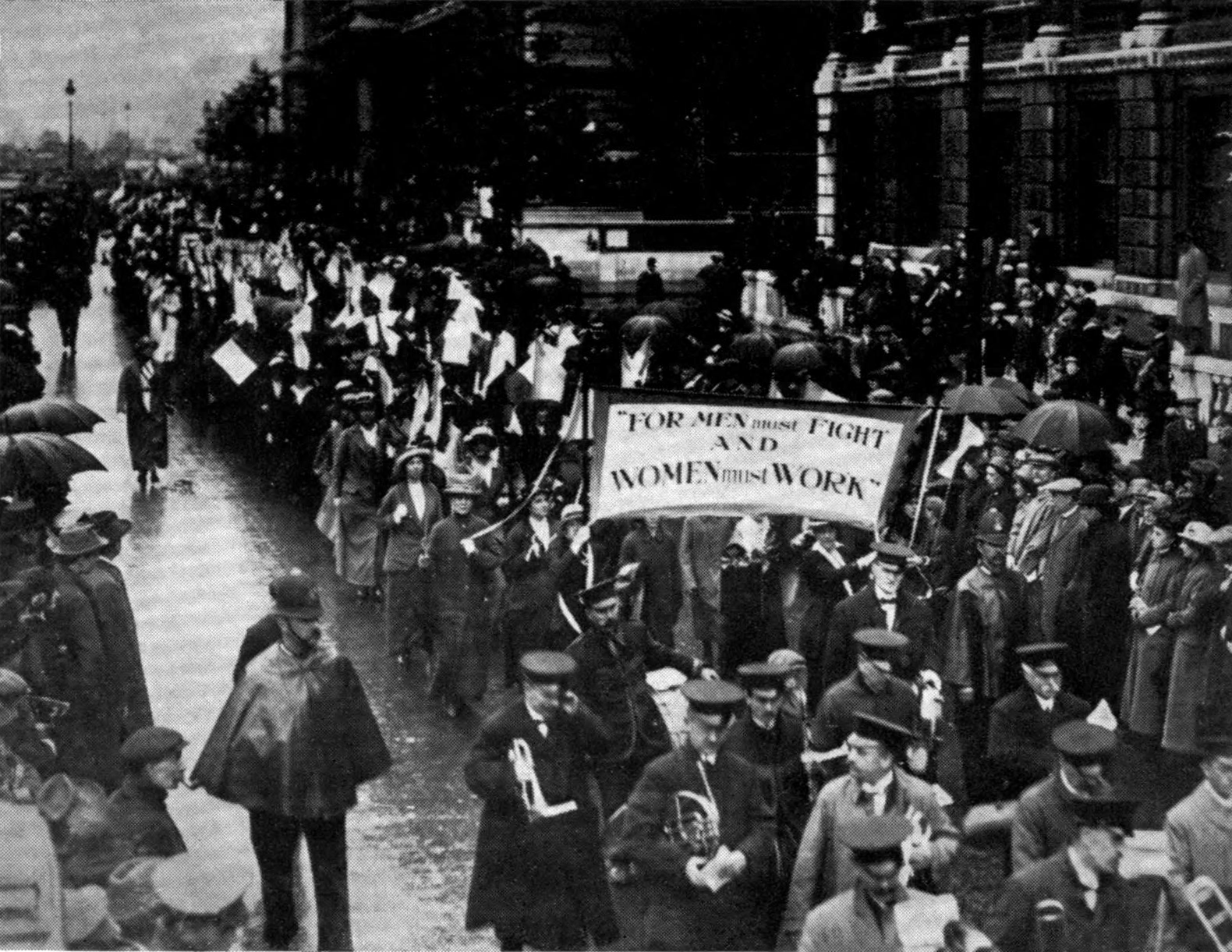
Analyze at the photo of Suffragette Parade from 1915. What were their demands? Explain their meaning, using English language information concerning the Women’s Social and Political Union Emmeline Pankhurst.
RxXXEUnyJNd7t
Suffragette Parade in 1915
Source: Parada sufrażystek w 1915 roku, 1915, domena publiczna.

Keywords

suffragettes, emancipation movement, women’s emancipation, feminism

Glossary

suffragettes
suffragettes
RJOvH83umNmo1
Nagranie słówka: suffragettes

sufrażystki – działaczki ruchu kobiecego w II połowie XIX wieku i na początku XX wieku, przede wszystkim w USA i Wielkiej Brytanii; uczestniczki walki o prawa wyborcze kobiet.

emancipation of women
RPMNrS1J9ewwu
Nagranie słówka: emancipation of women

emancypacja kobiet – zapewnienie kobietom możliwości swobodnego kształcenia, zwiększenia udziału w życiu publicznym i zawodowym oraz przyznanie im pełnych praw politycznych

feminizm
feminizm
RgK7SnU1KXDBN
Nagranie słówka: feminizm

feminizm – ruch społeczny i ideologia polityczna, której celem jest emancypacja kobiet i równouprawnienie płci. Początkowo (przełom XIX i XX w.) dążył do reformy prawa rodzinnego i wyborczego oraz poprawy warunków ekonomicznych kobiet. Za pierwszą feministkę uważa się francuską pisarkę Christine de Pisan.