Mammalian cloning
somatic cells have diploid nuclei, and gametes – haploid nuclei;
DNA present in a nucleus contains complete instructions on the structure and functioning of an organism;
vegetative reproduction allows for creating genetic copies of a parent organism.
to present the history of cloning;
to explain cloning techniques;
to assess the usefulness of human cell cloning;
to list advantages and disadvantages of mammalian cloning, as well as hopes and fears in this regard.
Cloning in nature
Cloning of organisms consist in creating their genetically identical copies. This process sometimes occurs in nature, for example, during the development of a human embryo. Then, during the first two weeks of zygote development, the embryo divides and each of its parts independently develops into a separate organism. Children born this way come from one pair of gametes and therefore have the same genotype which makes their physicality and mentality very similar. Identical (monozygotic) twins are thus their own copies – clonesclones. However, the birth of such twins in humans is quite rare and affects about 0.35% of all pregnancies.
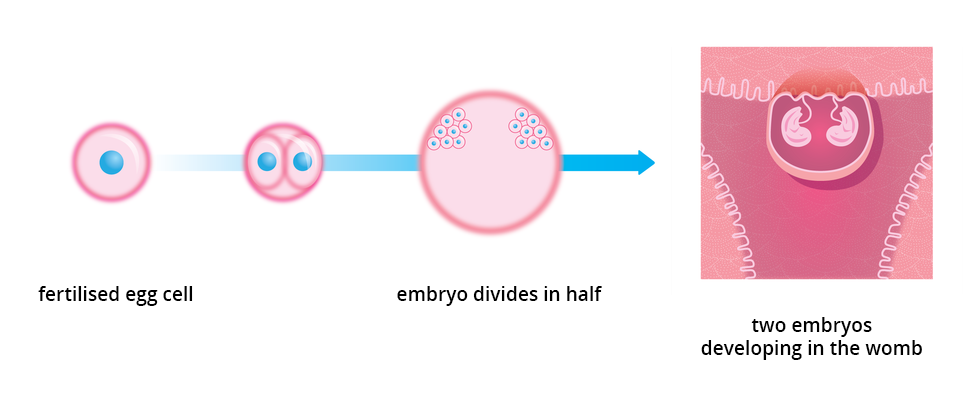
Brief history of mammalian cloning
The first attempts at cloning animals were made at the turn of the 19th century. They consisted in dividing an embryo consisting of 2‑8 cells. Unfortunately, the resulting twin nuclei showed high mortality. In 1901, Hans Spemann succeeded in his attempts and divided a salamander embryo into two parts. A fully functional individual developed from each of them. This experience shows that embryo cells at early stages of division retain genetic information necessary for a complete organism to be born. Later on, numerous attempts at cloning mouse and frog embryos were made, but they failed.
As late as 1996, i.e. after changing the technique of creating embryos, the first cloned animal – Dolly – was born. A mouse was cloned two years later and a rhesus monkey – later on. At the beginning of the 21st century, as a result of the multiplication of organisms, scientists obtained a pig and 5 identical piglets, a buffalo, a cow, a rabbit and even a cat named CopyCat. A deer, a Snuppy dog and a wolf were successfully cloned later. A camel was cloned from cells isolated from ovaries of a female killed for meat 4 years earlier.
Clonning by somatic nuclear cell transfer
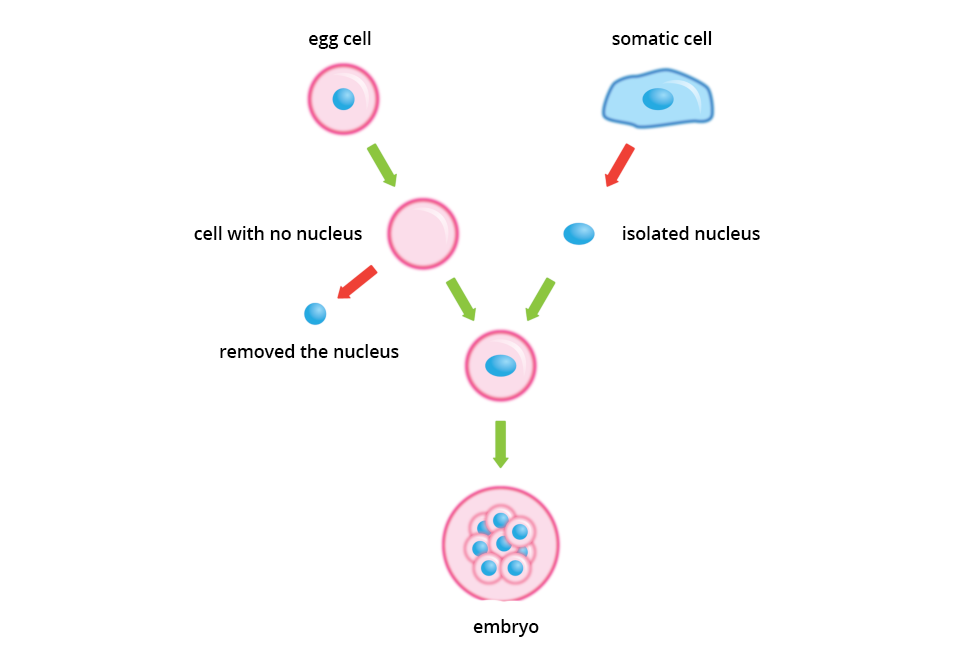
The most commonly used method of cloning animals is the so‑called cellular transplantation method. It consists in replacing an egg cell nucleus of one individual with a somatic cell nucleus of another individual. Cloning takes place at several stages. The nucleus of the recipient's egg cell is removed. A diploid cell is isolated from a selected tissue (e.g. skin) of another organism of the same species (donor), and the nucleus of the cell is removed and transferred to a pre‑prepared egg. It is then subjected to an electric shock which causes it to divide and create a several cell embryo. All these stages take place in vitro, i.e. outside the organism. To allow the embryo to develop further, it must be implanted in the womb of a surrogate mother – a female of the same species as the clone or very closely related to it.
Cloning of extinct and endangered species
Cloning makes it possible to reproduce extinct species if their genetic material is preserved. One example is a subspecies of a Pyrenean ibex (bucardo) which has been eradicated in recent years. It was possible, as the frozen skin of one individual of the subspecies has been stored since 1999, so scientists had complete genetic material. Egg cells were taken from domestic goats closely related to a bucardo, and surrogate mothers were female crossbreedscrossbreeds of a bucardo and a male goat. Embryos (clones) were implanted into 208 goats, of which 7 got pregnant, but only one female gave birth to a bucardo lamb. Unfortunately, the animal lived for only 7 minutes due to lung malformations. The premature termination of pregnancy in the other goats was due to the fact that the embryonic development environment was not sufficiently similar to that created by females of the proper species. That is why other extinct species, whose DNA we have, cannot be brought back on Earth for now.
At present, cloning makes it possible to preserve particularly rare species threatened with extinction and to increase the number of species whose reproduction is very slow. We face one huge problem when it comes to cloning species threatened with extinction, i.e. obtaining an egg cell. To get a gamete from a female giant panda, you have to put her to sleep which can kill her. A panda surrogate mother can only be a female of other bears. Using mothers of another species to carry pregnancy significantly reduces the chances of success.
A mammoth will not be cloned soon. Complete genetic material has not yet been found in its remains.
Match each of the following terms with its definition.
genetically identical organisms, organisms at an early stage of development initiated by the division of a fertilised egg cell, crossbreeds
| clones | |
| hybrids | |
| embryos |
Put the steps of cloning a mammal by transplanting cell nuclei in the right order. Remember that this method will fail if a somatic cell is not retrieved.
- birth of a clone
- placing the embryo in the womb of a surrogate mother
- removing a nucleus from the collected somatic cell
- taking a somatic cell of an organism to be cloned
- placing the somatic cell nucleus in an egg cell with no nucleus
- inducing the division of the egg cell with the transplanted nucleus
Select all factors contributing to failures in cloning mammals.
- high mortality of produced embryos
- some species have no suitable surrogate mothers
- finding it hard to obtain egg cells of the right species
- finding it hard to obtain somatic cells of the living species
Select the animal that we are unable to clone, using today's state of knowledge.
- mammoth
- cat
- sheep
- salamander
Summary
Cloned organisms have identical genetic information.
How was this lesson? Did you like it? Finish selected sentences.

Keywords
cloning, cellular transplantation, nuclei
Glossary
mieszaniec – organizm powstały w wyniku krzyżówki międzygatunkowej, np. muł – potomek klaczy i samca osła
klony – organizmy identyczne pod względem genetycznym