Mapa pojęć
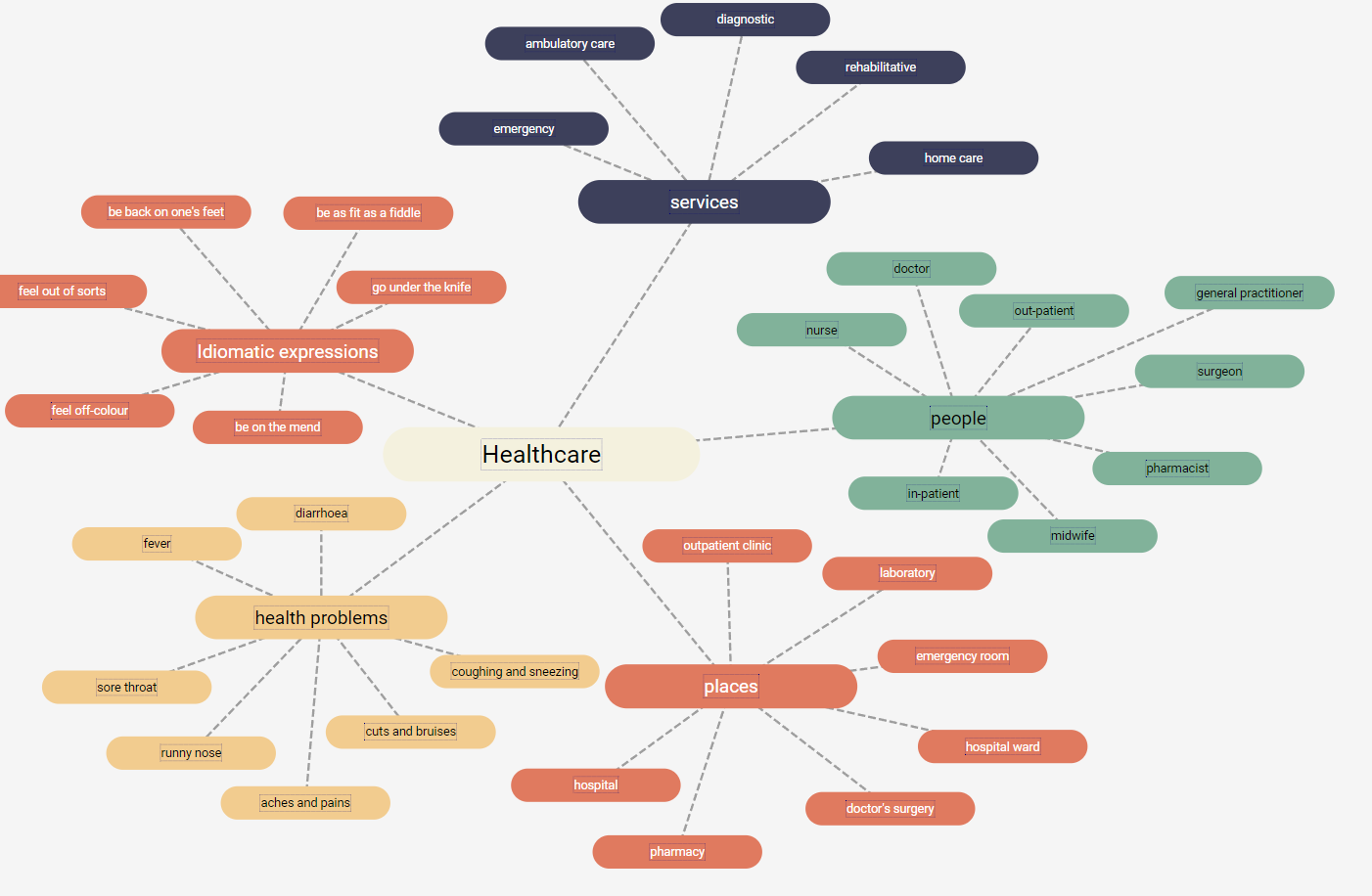
So, now you know what cyberchondria is. Hopefully, next time you have some symptoms, you will see a real doctor. Study the mind map below to learn more words connected with the health care system.
Wiesz już, czym jest cyberchondria. Dlatego następnym razem, gdy pojawią się u ciebie jakieś objawy, pójdziesz do prawdziwego lekarza. Przeanalizujesz poniższą mapę pojęć, aby poznać więcej wyrazów/zwrotów związanych z systemem opieki zdrowotnej.

Drag the following words connected with healthcare and drop them in the correct category.
Przeciągnij poniższe wyrazy związane z opieką zdrowotną i umieść je w odpowiedniej kategorii.
Analyse the mind map and do the exercises which follow.
Study the mind map and add one element to each group. Use the following words and expressions. Add them by clicking twice on the field.
be on the mend
hospital ward
pharmacist
ambulatory care
diarrhoea
Match the following words to make the correct expressions.
Połącz poniższe wyrazy tak, aby powstały poprawne wyrażenia.
2. When you’re treated in a hospital, you are a(n) out-patient nurse in-patient pharmacist.
3. After an accident, you need rehabilitative emergency home care ambulatory services to get better and improve your physical condition.
4. A(n) surgeon general practitioner midwife pharmacist helps women deliver babies.
5. You go to a(n) emergency room outpatient clinic hospital ward pharmacy to buy medicine prescribed by your doctor.
6. If you have a sore throat diarrhoea fever runny nose, you have eaten something bad.
7. You can say you’re feeling out of fiddle off-colour sorts your feet when you’re not feeling well.
8. When you’re on the mend your feet fiddle sorts, you’re recovering from an illness.
a) are coughing and sneezing.
b) are as fit as a fiddle.
c) will probably go under the knife.
d) probably have a runny nose.
2. If you’ve had an accident, you will probably:
a) be in an emergency room.
b) see a surgeon.
c) see a midwife.
d) have a sore throat.
3. If you have to have your blood tested, you need:
a) home care services.
b) ambulatory services.
c) diagnostic services.
d) emergency services.
4. You are likely to see a general practitioner in a(n):
a) laboratory.
b) doctor’s surgery.
c) hospital ward.
d) outpatient clinic.
5. If you’re feeling off-colour, you can consult a(n):
a) pharmacist.
b) midwife.
c) out-patient.
d) general practitioner.