Since consumerism has got more than one definition, the opinions about it are divided. People tend to focus on negatives. However, phenomena which we commonly consider to have uniquely bad effects sometimes turn out to have their other, brighter side. How do you understand the concept of consumerism? Can you think of any positive aspects of it? Study the recordings explaining some aspect of this phenomenon and find out.
Ponieważ konsumpcjonizm może być zdefiniowany na kilka sposobów, zdania na jego temat są podzielone. Ludzie zwykli skupiać się na negatywnych aspektach, a czasami okazuje się, że zjawiska, które powszechnie uważamy za złe, mają swoją drugą stronę. W jaki sposób ty rozumiesz konsumpcjonizm? Czy dostrzegasz jakieś jego pozytywny strony? Zapoznaj się z nagraniami dotyczącymi różnych aspektów tego zjawiska i dowiedz się więcej na ten temat.
1
RQWFs7x2jSVMy
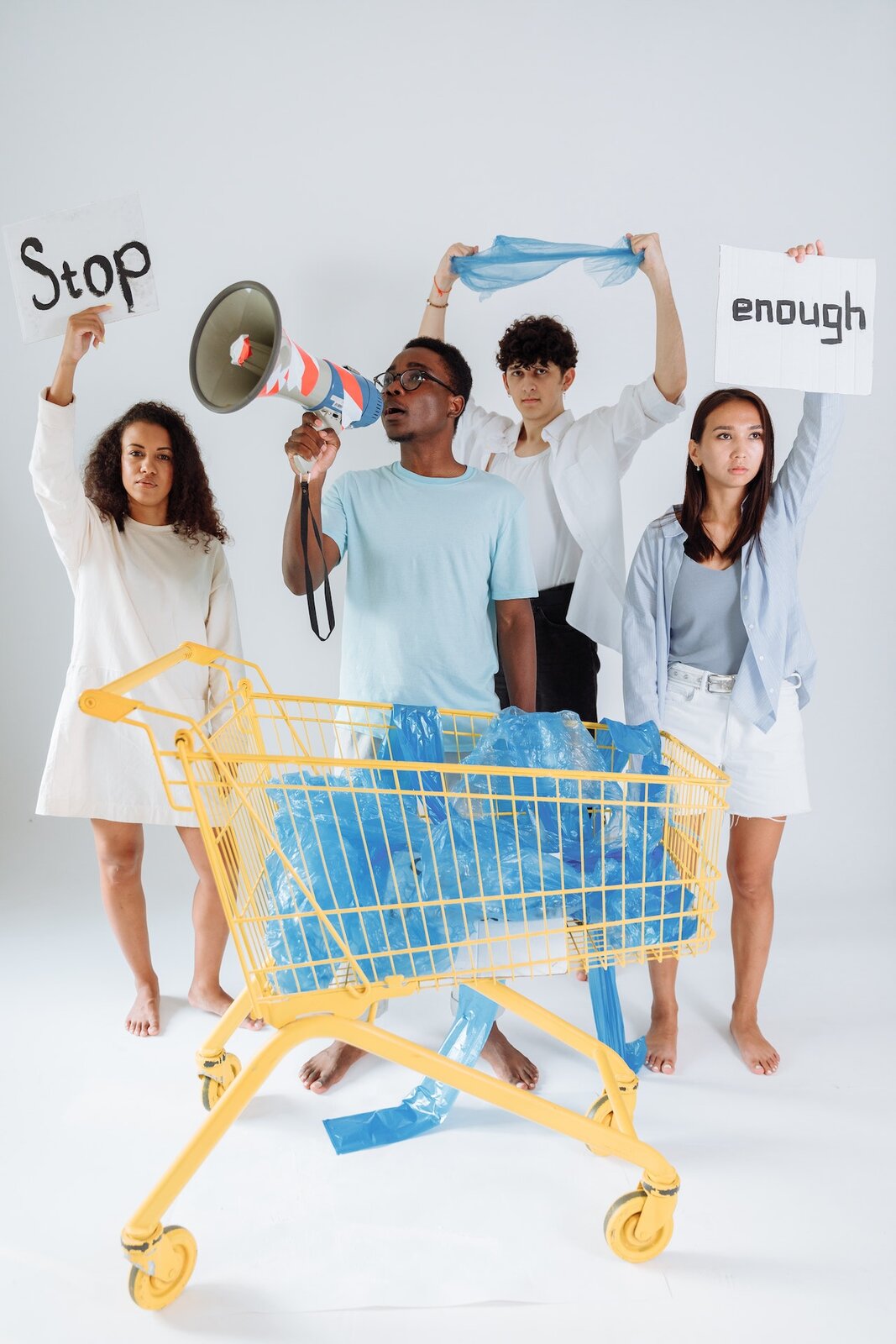
Zdjęcie przedstawia 4 osoby stojące obok siebie. Dwie kobiety stojące po bokach trzymają białe kartony z napisem "STOP i "ENOUGH". Między nimi jest dwóch młodych mężczyzn, jeden stoi z megafonem przystawionym do otwartych ust, drugi trzyma nad głową foliowy worek, którymi jest wypełniony wózek zakupowy stojący z przodu przed całą grupą. Transkrypcja nagrań znajduje się poniżej.
Time to rethink our approach to consumerism!
Czas przemyśleć nasze podejście do konsumpcjonizmu!
Źródło: dostępny w internecie: www.pexels.com [dostęp 21.03.2020], domena publiczna.
Exercise1
R1QUtqDmZJ3cr
Complete the money idioms with the correct words. 1. Some people are lucky to live their lives in the Tu uzupełnij. They are never short of anything. 2. It seems we’ll have to Tu uzupełnij our belt since I don’t earn as much now as I did in the previous job. 3. Have you seen his new car? It’s the third one in three years. He spends money like Tu uzupełnij! 4. When we were students, we used to live on a Tu uzupełnij and everybody was happy. Now, we have much more money and never seem to be satisfied. 5. Are you kidding me? This salary is Tu uzupełnij for somebody with your experience and qualifications! You cannot accept this job! 6. I can’t buy you a new toy every time we pop into a shop, I'm not Tu uzupełnij!
Complete the money idioms with the correct words. 1. Some people are lucky to live their lives in the Tu uzupełnij. They are never short of anything. 2. It seems we’ll have to Tu uzupełnij our belt since I don’t earn as much now as I did in the previous job. 3. Have you seen his new car? It’s the third one in three years. He spends money like Tu uzupełnij! 4. When we were students, we used to live on a Tu uzupełnij and everybody was happy. Now, we have much more money and never seem to be satisfied. 5. Are you kidding me? This salary is Tu uzupełnij for somebody with your experience and qualifications! You cannot accept this job! 6. I can’t buy you a new toy every time we pop into a shop, I'm not Tu uzupełnij!
Źródło: GroMar Sp. z o.o., licencja: CC BY-SA 3.0.
1
Put the expressions in the spots marked “fill this place yourself” by double‑clicking on the text and typing in the correct word from the list above.
Źródło: GroMar Sp. z o.o., licencja: CC BY-SA 3.0.
RkLVJ9F5k8V2u1
Źródło: GroMar Sp. z o.o., licencja: CC BY-SA 3.0.
RznctQ08ABPpE
Exercise2
Drag the following words to make correct expressions in each category.
Drag the following words to make correct expressions in each category.
Źródło: GroMar Sp. z o.o., licencja: CC BY-SA 3.0.
1
Exercise2
R1X2DmBdoo0Qe
Match the elements to form correct phrases and check if you completed the mind map correctly. GLOBAL Możliwe odpowiedzi: 1. GROWTH, 2. AS INFORMED DECISION MAKERS, 3. FOOTPRINT, 4. LIVING, 5. OF CLASS BARRIERS REINFORCEMENT Możliwe odpowiedzi: 1. GROWTH, 2. AS INFORMED DECISION MAKERS, 3. FOOTPRINT, 4. LIVING, 5. OF CLASS BARRIERS CONSUMERS Możliwe odpowiedzi: 1. GROWTH, 2. AS INFORMED DECISION MAKERS, 3. FOOTPRINT, 4. LIVING, 5. OF CLASS BARRIERS ECONOMIC Możliwe odpowiedzi: 1. GROWTH, 2. AS INFORMED DECISION MAKERS, 3. FOOTPRINT, 4. LIVING, 5. OF CLASS BARRIERS SIMPLE Możliwe odpowiedzi: 1. GROWTH, 2. AS INFORMED DECISION MAKERS, 3. FOOTPRINT, 4. LIVING, 5. OF CLASS BARRIERS
Match the elements to form correct phrases and check if you completed the mind map correctly. GLOBAL Możliwe odpowiedzi: 1. GROWTH, 2. AS INFORMED DECISION MAKERS, 3. FOOTPRINT, 4. LIVING, 5. OF CLASS BARRIERS REINFORCEMENT Możliwe odpowiedzi: 1. GROWTH, 2. AS INFORMED DECISION MAKERS, 3. FOOTPRINT, 4. LIVING, 5. OF CLASS BARRIERS CONSUMERS Możliwe odpowiedzi: 1. GROWTH, 2. AS INFORMED DECISION MAKERS, 3. FOOTPRINT, 4. LIVING, 5. OF CLASS BARRIERS ECONOMIC Możliwe odpowiedzi: 1. GROWTH, 2. AS INFORMED DECISION MAKERS, 3. FOOTPRINT, 4. LIVING, 5. OF CLASS BARRIERS SIMPLE Możliwe odpowiedzi: 1. GROWTH, 2. AS INFORMED DECISION MAKERS, 3. FOOTPRINT, 4. LIVING, 5. OF CLASS BARRIERS
Źródło: GroMar Sp. z o.o., licencja: CC BY-SA 3.0.
Click the numbers 1–6 on the interactive mind map below, study the recordings and learn more about different aspects of consumerism. Then do the exercises below.
1
RGDSeOnKuZJOP1
Ilustracja przedstawia nazwę kategorii: CONSUMERISM.
Ilustracja nr 1 przedstawia element należący do kategorii consumerism: DEFINITION.
Ilustracja nr 2 przedstawia element należący do kategorii Examples, OVERSPENDING.
Ilustracja nr 3 przedstawia element należący do kategorii Ramifications, CREATION OF INEQUALITIES.
Ilustracja nr 4 przedstawia element należący do kategorii Advantages, PROTECTION OF CONSUMER RIGHTS.
Ilustracja nr 5 przedstawia element należący do kategorii Alternatives, SUSTAINABLE CONSUMPTION.
Ilustracja nr 6 przedstawia element należący do kategorii Alternatives, SLOW LIVING.
Ilustracja przedstawia nazwę kategorii: CONSUMERISM.
Ilustracja nr 1 przedstawia element należący do kategorii consumerism: DEFINITION.
Ilustracja nr 2 przedstawia element należący do kategorii Examples, OVERSPENDING.
Ilustracja nr 3 przedstawia element należący do kategorii Ramifications, CREATION OF INEQUALITIES.
Ilustracja nr 4 przedstawia element należący do kategorii Advantages, PROTECTION OF CONSUMER RIGHTS.
Ilustracja nr 5 przedstawia element należący do kategorii Alternatives, SUSTAINABLE CONSUMPTION.
Ilustracja nr 6 przedstawia element należący do kategorii Alternatives, SLOW LIVING.
Źródło: GroMar Sp. z o.o., licencja: CC BY-SA 3.0.
Ilustracja przedstawia mapę myśli. Ilustracja posiada sześć punktów interaktywnych, po naciśnięciu których pojawia się tekst oraz nagranie. Transkrypcja do nagrań znajduje się poniżej.
Ilustracja nr 1 przedstawia element należący do kategorii Consumerism: DEFINITION.
Ilustracja nr 2 przedstawia element należący do kategorii Examples, OVERSPENDING.
Ilustracja nr 3 przedstawia element należący do kategorii Ramifications, CREATION OF INEQUALITIES.
Ilustracja nr 4 przedstawia element należący do kategorii Advantages, PROTECTION OF CONSUMER RIGHTS.
Ilustracja nr 5 przedstawia element należący do kategorii Alternatives, SUSTAINABLE CONSUMPTION.
Ilustracja nr 6 przedstawia element należący do kategorii Alternatives, SLOW LIVING.
TRANSCRIPTazurewhite
Consumerism is defined in scientific literature in two ways. The first interpretation is negative and rotates around the concept of overconsumption. It’s giving in to materialistic cravings and indulging in egoistic and rampant consumerist behaviour. The second one, though, is rather neutral and descriptive. In this respect, consumerism is considered a study of consumers’ behaviour which can be used to draw conclusions and help people make more informed decisions. To some extent, these two definitions complement each other, as you can also come to some useful conclusions looking into negative behaviours.
Overspending is not an uncommon phenomenon these days. Due to the frivolous use of financial resources and sometimes as a result of the lack of elementary knowledge regarding the functioning of financial instruments, people end up in the trap of debt. According to the 2021 CNBC survey, an average American has over $90,000 debt to pay resulting from credit cards, personal loans and mortgages. While some of these commitments are taken up with the view to improving one’s future circumstances, for example student loans, many of them are results of living beyond one’s means. For that reason, skills, such as budgeting and managing your own spending, should be mandatory school subjects.
The contemporary economic boom has created a new class of consumers, the so‑called status‑seekers. Everything, from a water bottle to a car, becomes a manifestation of such people’s position in the society, which is defined through money. However, there is a widening gap between those, who, through hard work, luck or sometimes barely legal practices, managed to elevate themselves well above the average income and those who are left behind, at times through no fault of their own. Social inequality makes people question their value in society. They also experience anxiety and uncertainty about their future.
The study of consumers’ behaviour has brought about some positive outcomes. In response to such malpractices as planned obsolescence, certain regulations have been introduced to ensure fair treatment of buyers. Protection measures found their place in legal systems of individual countries as well as in institutions such as the European Union. Complaints, warranties and the right to return an item are now regulated by law, so consumers can be sure that if they follow the rules, their rights will be protected too.
Although sustainable consumption may sound as an oxymoron, these two words do not necessarily contradict each other. Consumption understood entirely as an economic activity can be studied and regulated. It means that decisions can be taken at any level of production, distribution and acquisition to prevent inflicting damage on the environment and, on the flip side, to promote responsible consumer choices.
Slow living is supposed to be positioned at the opposite end of the scale from consumerism understood as overindulgence. It’s a lifestyle built around mindfulness and appreciation of small pleasures mostly coming from nature and contact with other people. The assumption is that no great amounts of money or large numbers of objects are necessary to attain the state of happiness. People who decide to live their lives slowly can be successful professionals who, nevertheless, chose to focus on relations with the outer world more than proving their status through material possessions.
Exercise3
Rtpsnytd0gpJ1
Źródło: GroMar Sp. z o.o., licencja: CC BY-SA 3.0.
Exercise4
ROtPXesLQ64AY
Match the words and expressions from the recordings with the correct definitions. a strong desire to possess material goods Możliwe odpowiedzi: 1. overindulgence, 2. economic boom, 3. malpractice, 4. materialistic craving, 5. commitment, 6. mortgage, 7. informed decision, 8. acquisition, 9. average income, 10. warranty a decision made on the basis of solid knowledge Możliwe odpowiedzi: 1. overindulgence, 2. economic boom, 3. malpractice, 4. materialistic craving, 5. commitment, 6. mortgage, 7. informed decision, 8. acquisition, 9. average income, 10. warranty a loan taken from a bank to buy a house or a flat Możliwe odpowiedzi: 1. overindulgence, 2. economic boom, 3. malpractice, 4. materialistic craving, 5. commitment, 6. mortgage, 7. informed decision, 8. acquisition, 9. average income, 10. warranty an obligation a person chooses or must fulfil Możliwe odpowiedzi: 1. overindulgence, 2. economic boom, 3. malpractice, 4. materialistic craving, 5. commitment, 6. mortgage, 7. informed decision, 8. acquisition, 9. average income, 10. warranty a rapid growth or expansion of an economy Możliwe odpowiedzi: 1. overindulgence, 2. economic boom, 3. malpractice, 4. materialistic craving, 5. commitment, 6. mortgage, 7. informed decision, 8. acquisition, 9. average income, 10. warranty the amount of money a worker can earn in a given industry or country, which is the typical value for its category Możliwe odpowiedzi: 1. overindulgence, 2. economic boom, 3. malpractice, 4. materialistic craving, 5. commitment, 6. mortgage, 7. informed decision, 8. acquisition, 9. average income, 10. warranty a kind of action or behaviour that is illegal or neglects the professional code of conduct Możliwe odpowiedzi: 1. overindulgence, 2. economic boom, 3. malpractice, 4. materialistic craving, 5. commitment, 6. mortgage, 7. informed decision, 8. acquisition, 9. average income, 10. warranty a promise given to the buyer which guarantees that the product they bought will be repaired free of charge if it breaks in a particular period of time Możliwe odpowiedzi: 1. overindulgence, 2. economic boom, 3. malpractice, 4. materialistic craving, 5. commitment, 6. mortgage, 7. informed decision, 8. acquisition, 9. average income, 10. warranty an act of obtaining or buying something Możliwe odpowiedzi: 1. overindulgence, 2. economic boom, 3. malpractice, 4. materialistic craving, 5. commitment, 6. mortgage, 7. informed decision, 8. acquisition, 9. average income, 10. warranty a situation of having too much of something enjoyable Możliwe odpowiedzi: 1. overindulgence, 2. economic boom, 3. malpractice, 4. materialistic craving, 5. commitment, 6. mortgage, 7. informed decision, 8. acquisition, 9. average income, 10. warranty
Match the words and expressions from the recordings with the correct definitions. a strong desire to possess material goods Możliwe odpowiedzi: 1. overindulgence, 2. economic boom, 3. malpractice, 4. materialistic craving, 5. commitment, 6. mortgage, 7. informed decision, 8. acquisition, 9. average income, 10. warranty a decision made on the basis of solid knowledge Możliwe odpowiedzi: 1. overindulgence, 2. economic boom, 3. malpractice, 4. materialistic craving, 5. commitment, 6. mortgage, 7. informed decision, 8. acquisition, 9. average income, 10. warranty a loan taken from a bank to buy a house or a flat Możliwe odpowiedzi: 1. overindulgence, 2. economic boom, 3. malpractice, 4. materialistic craving, 5. commitment, 6. mortgage, 7. informed decision, 8. acquisition, 9. average income, 10. warranty an obligation a person chooses or must fulfil Możliwe odpowiedzi: 1. overindulgence, 2. economic boom, 3. malpractice, 4. materialistic craving, 5. commitment, 6. mortgage, 7. informed decision, 8. acquisition, 9. average income, 10. warranty a rapid growth or expansion of an economy Możliwe odpowiedzi: 1. overindulgence, 2. economic boom, 3. malpractice, 4. materialistic craving, 5. commitment, 6. mortgage, 7. informed decision, 8. acquisition, 9. average income, 10. warranty the amount of money a worker can earn in a given industry or country, which is the typical value for its category Możliwe odpowiedzi: 1. overindulgence, 2. economic boom, 3. malpractice, 4. materialistic craving, 5. commitment, 6. mortgage, 7. informed decision, 8. acquisition, 9. average income, 10. warranty a kind of action or behaviour that is illegal or neglects the professional code of conduct Możliwe odpowiedzi: 1. overindulgence, 2. economic boom, 3. malpractice, 4. materialistic craving, 5. commitment, 6. mortgage, 7. informed decision, 8. acquisition, 9. average income, 10. warranty a promise given to the buyer which guarantees that the product they bought will be repaired free of charge if it breaks in a particular period of time Możliwe odpowiedzi: 1. overindulgence, 2. economic boom, 3. malpractice, 4. materialistic craving, 5. commitment, 6. mortgage, 7. informed decision, 8. acquisition, 9. average income, 10. warranty an act of obtaining or buying something Możliwe odpowiedzi: 1. overindulgence, 2. economic boom, 3. malpractice, 4. materialistic craving, 5. commitment, 6. mortgage, 7. informed decision, 8. acquisition, 9. average income, 10. warranty a situation of having too much of something enjoyable Możliwe odpowiedzi: 1. overindulgence, 2. economic boom, 3. malpractice, 4. materialistic craving, 5. commitment, 6. mortgage, 7. informed decision, 8. acquisition, 9. average income, 10. warranty
Źródło: GroMar Sp. z o.o., licencja: CC BY-SA 3.0.
Exercise5
React to these comments on an internet forum. Write 2–3 sentences in each case.
Economic boom is the worst thing that may happen to a society!
RT3bt9SQqVfHm
(Uzupełnij).
Źródło: GroMar Sp. z o.o., licencja: CC BY-SA 3.0.
Show hintazurewhite
I don’t…! We all want to… and unfortunately,... people cannot… Whether we like it or not,…
Show answerazurewhite
I don’t think so! We all want to improve our lives and unfortunately, without a robust economy, people cannot live stable and happy lives. Whether we like it or not, economic growth is a part of our world.
People who understand consumerism only in a negative way are wrong.
RdxETnBaJvpF1
(Uzupełnij).
Źródło: GroMar Sp. z o.o., licencja: CC BY-SA 3.0.
Show hintazurewhite
I couldn’t agree more! Consumerism is not only… but it is also… Useful conclusions can… and it can help…
Show answerazurewhite
I couldn’t agree more! Consumerism is not only about going on a shopping spree but it is also a scientific approach to consumer behaviours. Useful conclusions can be drawn from such research and it can help people understand how they are manipulated by some producers.
You cannot achieve happiness without possessing material goods.
RxTgfd2fdffKW
(Uzupełnij).
Źródło: GroMar Sp. z o.o., licencja: CC BY-SA 3.0.
Show hintazurewhite
It’s hard, especially nowadays, but I don’t think… I believe there are people who…
Show answerazurewhite
It’s hard, especially nowadays, but I don’t think it is entirely impossible. I believe there are people who reject material goods and choose simple living far away from conspicuous consumption.