Mechanisms of biological evolution
that all the organisms on Earth are related to each other;
that there is evidence for the common origin of the organisms.
to indicate the genetic and ecological factors influencing the formation of the species;
to explain how the natural selection works;
to give examples of artificial selection;
to compare natural selection with artificial selection;
to explain how the species are formed.
Charles Darwin and his studies
One of the first scientists to explain the origins of the great diversity of species on Earth at the moment and in the past, was Charles Darwin. His research, conducted during a scientific expedition around the world, culminated in the coining of the theory of evolution and became the basis for further research.
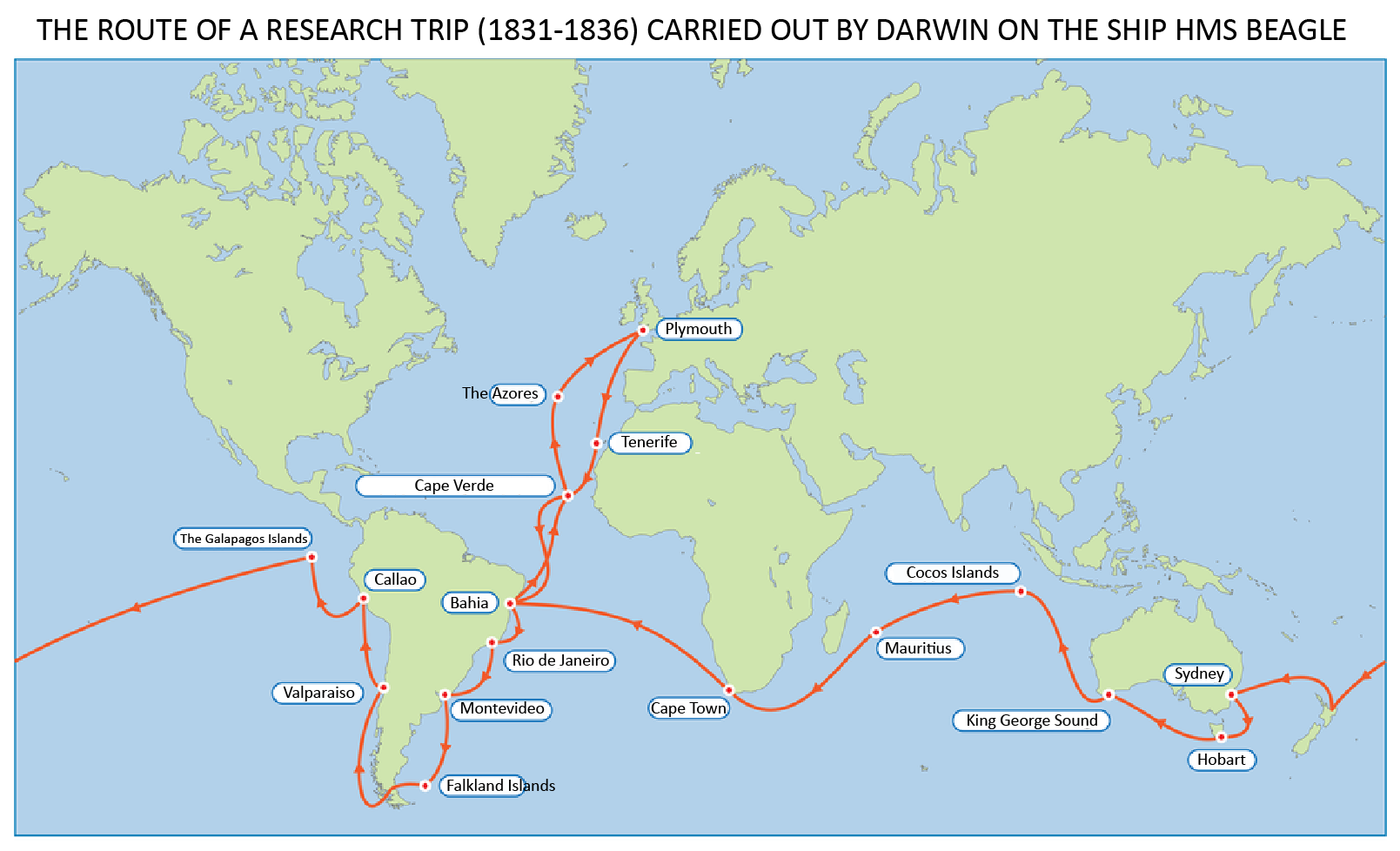
During his journey, Darwin had the opportunity to study, among other things, animals, plants, fossils and rock formations. His observations concerned such characteristics of organisms, which were adaptations to such diverse environments as the damp forests of Brazil, the grasslands of Argentina and the mighty peaks of the Andes.
During his stay in the Galapagos Islands, Darwin compared plants and animals that inhabited the area with the ones of the land of South America. He noted that despite some similarities, the species of animals from the islands and the mainland are clearly different. He also noticed the differences between the animals living on different islands of the archipelago. One of the groups that attracted his attention were Darwin's finches, that differed between each other, for example, in the shape and size of their beaks, which was a result of the adaptation of these birds to obtain different kinds of food. Based on the structure of the beak, Darwin distinguished, among others, fruit‑eater finches, leaf‑eater finches, insectivorous finches.
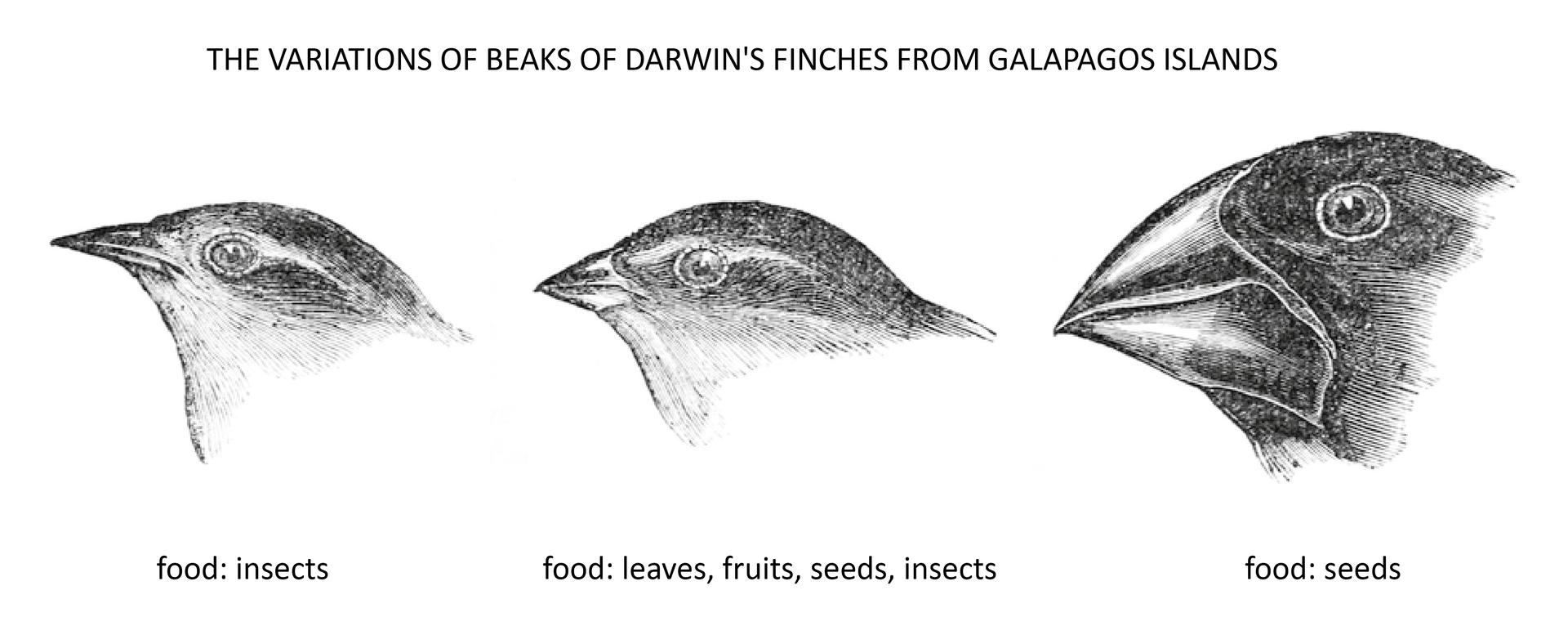
While trying to explain the diversity of the Darwin's finches from Galapagos Islands, Darwin assumed that in the remote past, each island was inhabited by birds that had managed to leave the mainland of South America. Slightly different living conditions on the islands meant that the birds had to adapt to the food available there and diversify, giving origin to new species.
Having returned to England, the naturalist worked for many years on the specimens collected during the expedition and analysed the observations. The result of these works was the coining of the theory of natural selectiontheory of natural selection, that explained the causes of evolution, published in the work „On the Origin of Species by Means of Natural Selection” in 1835.
Provide examples of modifying the characteristics of different organisms by environmental factors. Consider whether these features are hereditary. Justify your answer.
How does natural selection work?
The theory of natural selection created by Charles Darwin and complemented by research on the essence of inheritance is based on facts from observations of the natural world. It is easy to notice that:
species produce more offspring than can survive in the environment and more than is needed to replace the parents; of the many eggs laid, born individuals or scattered seeds, only a small part will become mature and produce offspring;
individuals of one species are not identical and many of their characteristics differ, e.g. their size, colour of coating or skin, fitness and susceptibility to diseases
tens, hundreds and sometimes thousands of descendants appear in the environment. Since its resources are limited, there is a very strong intra‑species competition;
only the organisms that dispose of the most beneficial features prevail, i.e. those with the most favourable gene composition under given conditions; they also leave more offspring, while genes of the less adapted organisms are eliminated upon their death.
Therefore, environmental conditions cause the selection of individuals, as a result of which, the genes (and adaptations) that remain in the population are favourable in given conditions. The population survives, although the less adapted individuals die or do not pass on their genes to the offspring.
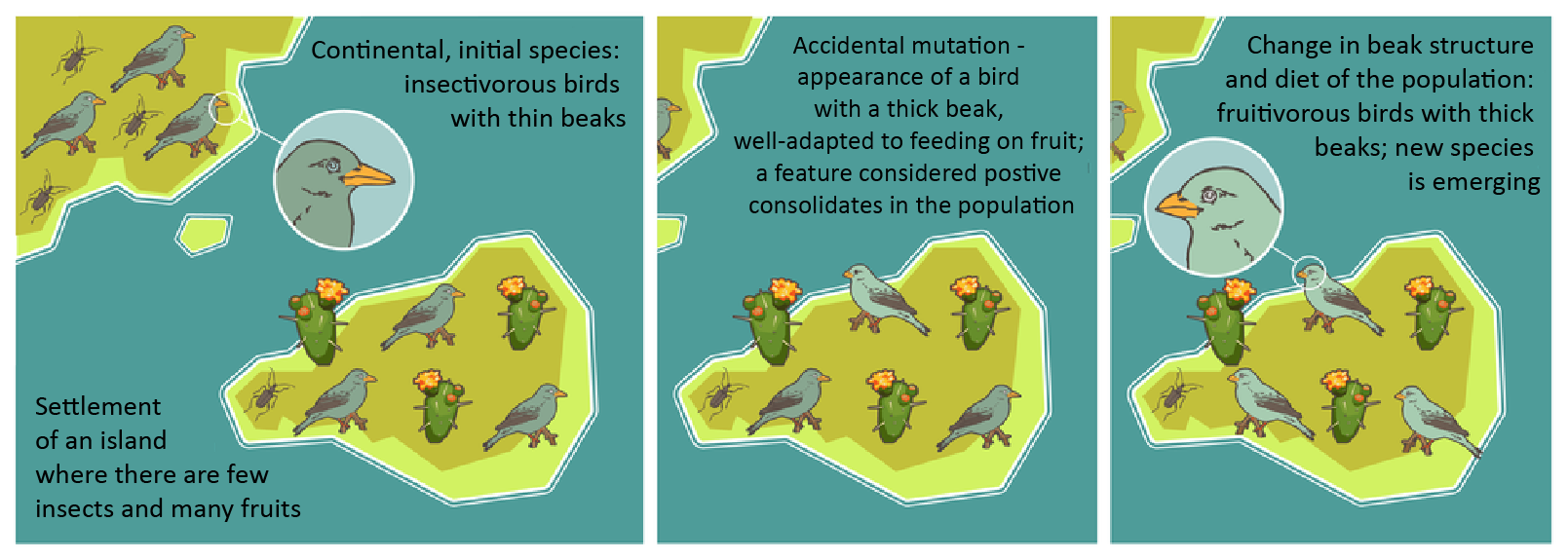
The environment (abiotic and biotic agents) is the selector of organisms. Natural selection is accidental, its effect being the intensified competition of organisms for environmental resources. Changes in populations due to selection result in the consolidation of features facilitating survival in the environment. If individuals of one species are separated by a barrier that is difficult to overcome (e.g. ocean waters or high mountains), populations with slightly different characteristics may emerge. The differences between them may deepen from generation to generation. When separate populations come into contact again, their individuals may be so different that they will not be able to interbreed and produce offspring. They will therefore become separate species.
Assuming that one fish lays 500,000 eggs each year, estimate how much offspring one female could leave after five years. Determine how many individuals would be sufficient to maintain a constant number of specimens if none of them died prematurely.
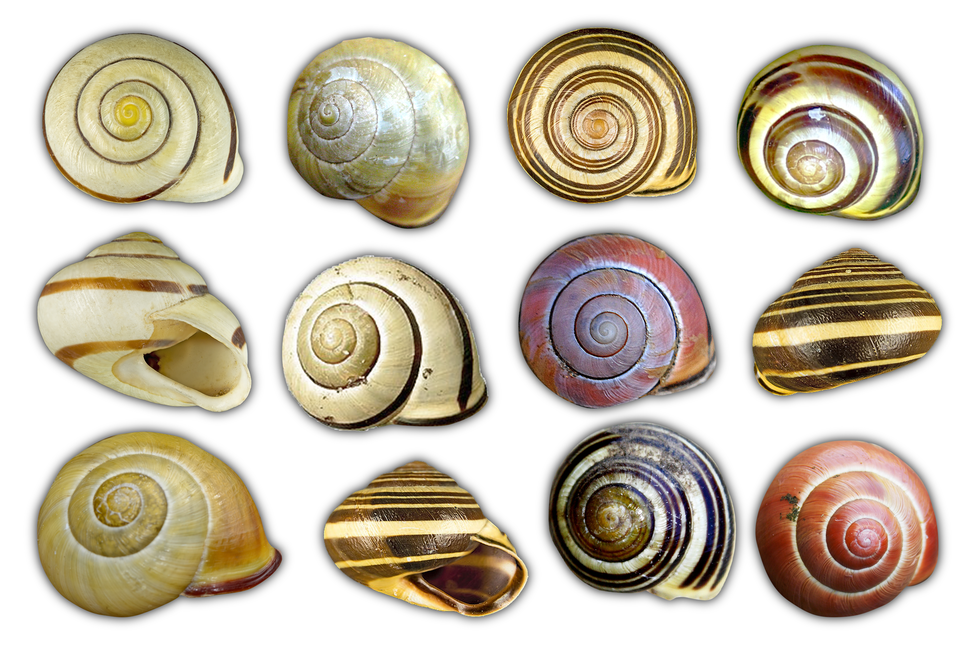
Which snails have the shells coloured in a way that makes them poorly visible to predators?
List the environmental resources for which white storks of early breeding compete. Explain why storks throw some offspring out of the nest when heavy snowfall occurs in May.
Natural selection and artificial selection
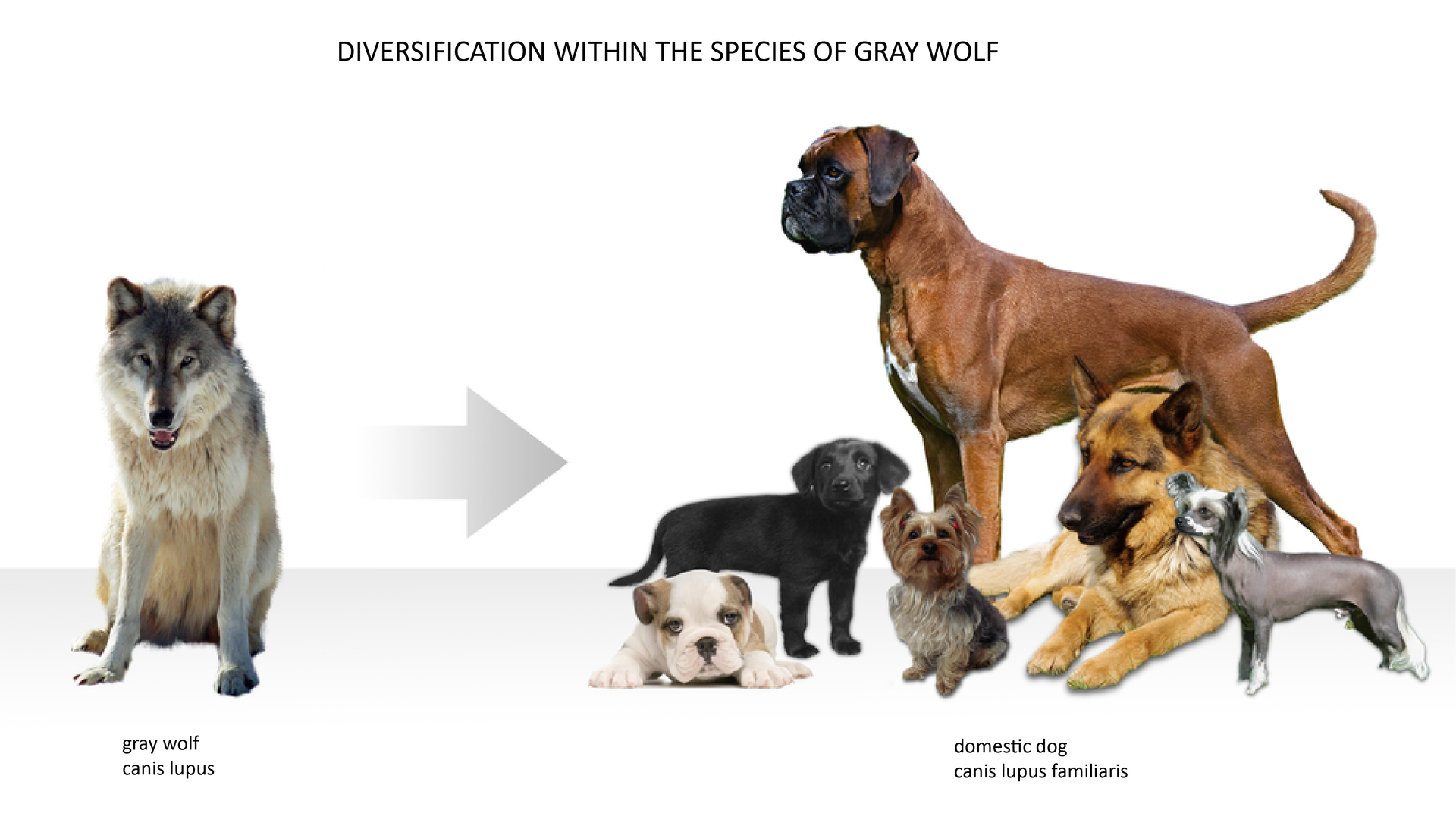
Observations of the diversification of organisms within the species were made well before Darwin. The first breeders had already noticed that among cattle, for example, each individual was slightly different from the others and so for breeding, they would chose those animals which best met their current needs: which would give more milk or more meat. During the following years, they interbred only those individuals that had the desired traits. This method is called artificial selectionartificial selection and it leads to the reinforcement of a selected characteristic in the population, e.g. more muscular pigs. As a result of an artificial selection, crops and the livestock started to differ from their wild ancestors. Artificial selection can also be used for plants, e.g. for bigger and more juicy fruits.
Characteristics | Natural selection | Artificial selection |
place of occurrence | natural environment | animal farms or plant cultivation |
action | accidental | intended by humans |
characteristics of an organism | favourable for the organism in given conditions | favourable for humans |
survival of the individuals | survival of the individuals best adapted to the environment | survival of the individuals chosen by humans |
duration | long, usually hundreds of thousands or millions of years | short, several years, hundreds or thousands of years |
meaning | basic evolutionary process | basic process used in farming and agriculture |
Move each item to the appropriate category.
it allows the best adapted individuals to survive and reproduce, may lead to consolidation of a characteristic unfavorable for surviving in natural conditions, consolidates chracteristics favorable for surviving in given environmental conditions, is intentionally used to create new plant varieties and animal breeds, it is the intentional selection and interbreeding of individuals with some desired characteristics, functions in a natural environment, consolidates or strenghtens characteristics of plants or animals that are desired by humans
| natural selection | |
|---|---|
| artificial selection |
Summary
Biological evolution happens due to excessive reproduction, single species variability, competition for limited environmental resources and selection of maladjusted organisms.
Natural selection takes place under the influence of environmental factors - only best adapted individuals, who are able to get the resources necessary for survival, survive and reproduce successfully.
Artificial selection is used by breeders to select specimens with desired characteristics for breeding , resulting in new animal breeds and plant varieties.
The emergence of new species is the result of long‑lasting isolation of two or more populations of the same species influenced by natural selection.
Keywords
natural selection, artificial selection, Charles Darwin, diversification of species
Glossary
dobór naturalny – mechanizm ewolucji działający w środowisku naturalnym, który sprawia, że w walce o ograniczone zasoby środowiska przeżywają i rozmnażają się osobniki najlepiej przystosowane; w wyniku doboru naturalnego utrwalają się zestawy genów warunkujących cechy korzystne dla przetrwania w danych warunkach środowiska
dobór sztuczny – selekcja i krzyżowanie osobników o cechach pożądanych przez człowieka; ich celem jest utrwalenie lub wzmocnienie określonych właściwości roślin lub zwierząt; tą drogą powstało wiele odmian roślin i ras zwierząt