Mesopotamian civilization
to explain who lived in the ancient Middle East;
to define when the antiquity started;
to characterize the rules of the Code of Hammurabi;
to describe the most important inventions of ancient Mesopotamians;
to explain why the ancient civilizationscivilizations developed in the Tigris‑Euphrates basin area.
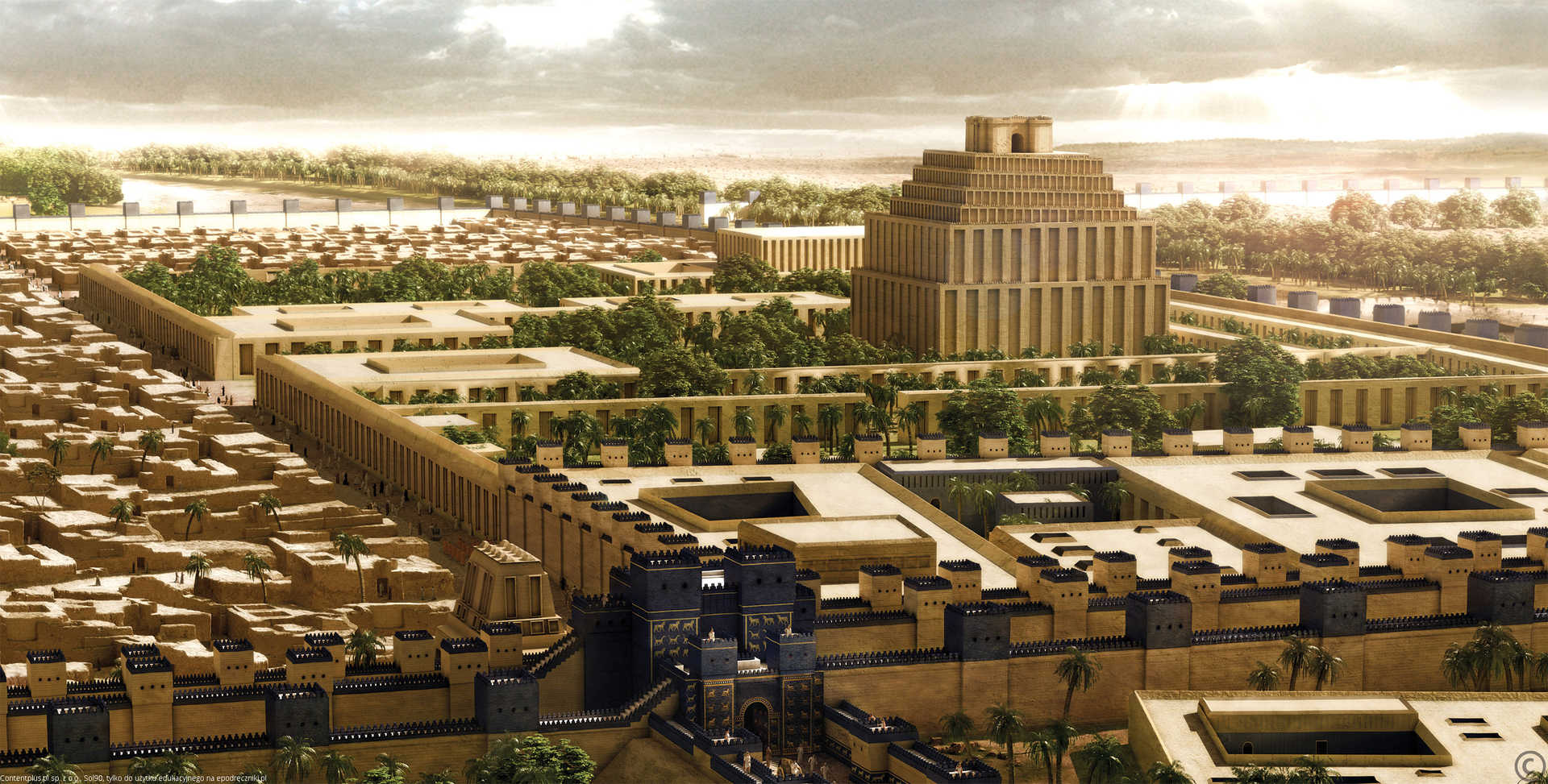
In the 4th millennium BCE, in Mesopotamia (from Greek mesos ‘middle’ + potamos ‘river’), a land located between the great rivers Euphrates and Tigris (in the territory of today’s Iraq), the Sumerians appeared. They came up with many inventions, the most important of which were writing and bronze. The Mesopotamians also developed a system of canals that brought water from rivers to fields, which led to the development of agriculture. They lived in numerous city‑states, in which they built huge zigguratsziggurats – buildings resembling pyramids, on top of which there were temples dedicated to various gods. Later, Mesopotamia came under the rule of the kings of the city of Babylon. The most famous of them was Hammurabi, who ordered that a code, i.e., a set of laws, be written down. This is one of the oldest known codes. In the 8th century BCE, Mesopotamia was conquered by Assyrians who, thanks to a well‑trained army, formed the first great empire of antiquity with its capital in the city of Nineveh.
Read the text carefully and then mark the fragments describing what the effects of floods are, and how they are used by the inhabitants.
effects of floods how they are used by the inhabitants
Floods of the Euphrates
“The Euphrates overflows in early summer, and starts to swell in spring, when snow melts in the mountaints of Armenia to such an extent that fields would turn into lakes and then bogs, if excess water was not removed via ditches and canals. This is why canals were created. They, however, require a lot of work. The soil is deep, soft, and yielding, so the current easily lifts it and impoverishes the plains. On the other hand, silt fills the canals and clogs their outlets. This is how excess water, flooding the plains by the sea, creates lakes , bogs and bulrushes, from which various woven products are made.
It is impossible to prevent such floods altogether, but it is the duty of a good ruler to bring all possible help. It consists in preventing excessive flooding by building levees, and in preventing the silting by cleaning the canals and keeping the outlets open. The cleaning is easy, but the building of levees requires many helping hands. This is due to the fact that soft and yielding soil does not hold the excavated silt but, yielding to the current, drags the silt with it and makes the outlet of the canal difficult to close.
And the canals must be closed relatively quickly if they are to hold the water in. If they go dry in summer they will also dry the river. And if water levels are reduced in the river, it cannot deliver water to the irrigation system at a time when soil scorched by summer heat needs it the most. It is equally bad when crops are flooded by excess water and affected by its shortage.
Source: Strabon, Geografia (in:) Starożytny Wschód. Teksty źródłowe do nauki w szkole, edited by J. Wolski, Warsaw 1959, pp.12-13.
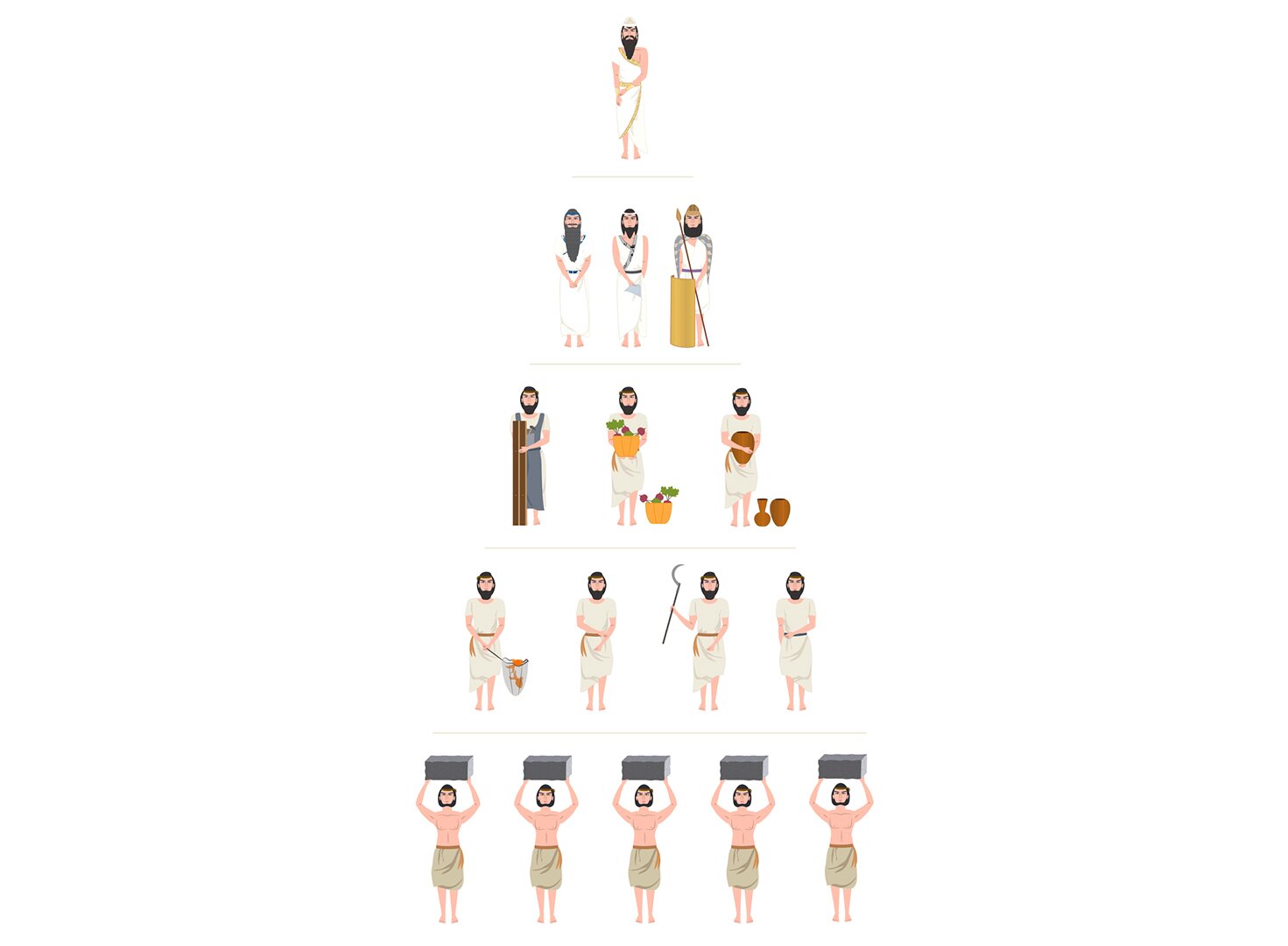
Take a close look at the illustration – social hierarchy of Mesopotamia – and name each layer.
Read the information presented in the illustration.
By order of the ruler of Babylonia – Hammurabi – around 1770‑1750 BCE, one of the oldest sets of laws was written down. It probably resulted from the intention to unify the laws and customs of the people who were under the control of the ruler, as well as the desire that “the strong might not injure the weak, in order to protect the widows and orphans” and “that the wronged should be given justice” – as we can read in the code’s introduction.
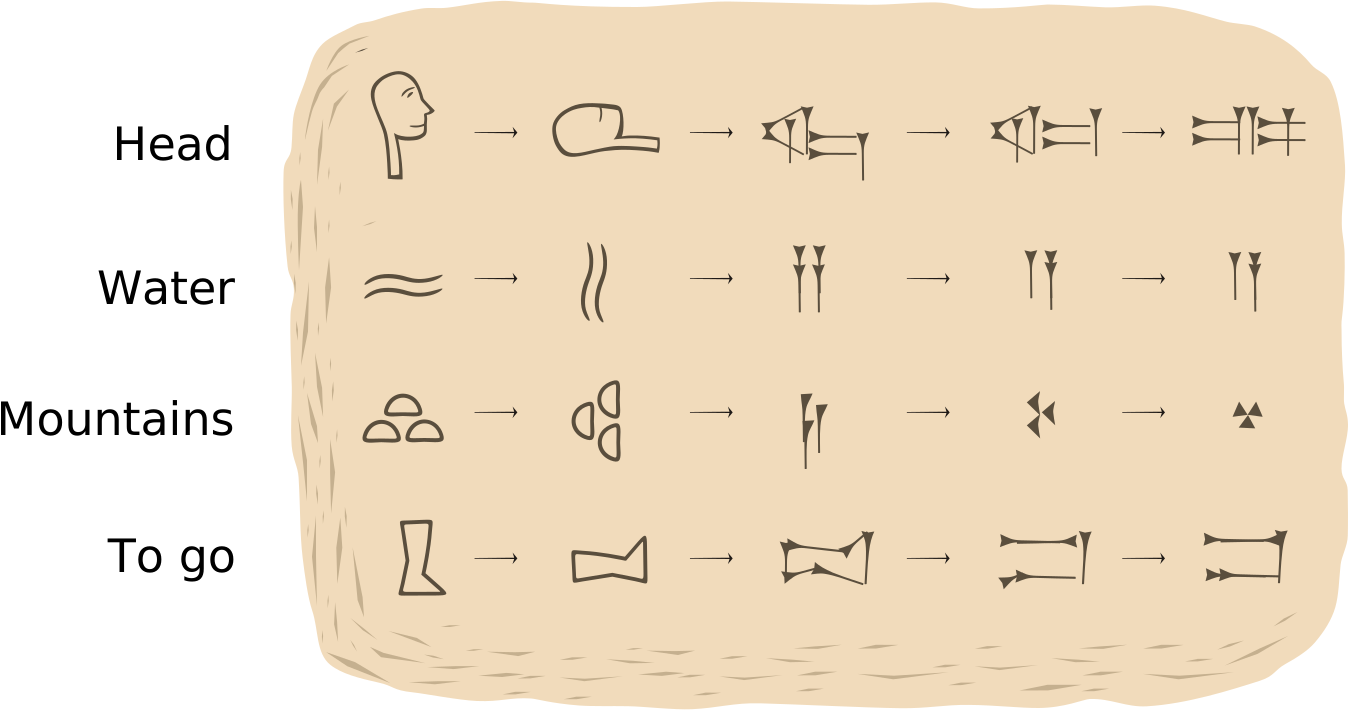
Take a close look at the figure below. Do you think that the evolution of cuneiform writing shows its simplification or, on the contrary, its complication? Which of the characters were easier to draw using a reed?
Match the achievements of ancient Mesopotamia with their descriptions.
Akkadian literary work describing the search for the mystery of immortality by a legendary ruler, architectural work created at the request of King Nebuchadnezzar II as a gift for his wife Amytis, Babylonian collection of laws edited and written down in the 18th century BC at the initiative of the king, a network of channels carrying water to places without it, a system of characters by means of which spoken language is transmitted
| Code of Hammurabi | |
| Epic of Gilgamesh | |
| Hanging Gardens of Babylon | |
| Invention of writing | |
| Irrigation system |
Keywords
the Neolithic, civilization, the Neolithic Revolution, the Fertile Crescent, ziggurat
Glossary
Żyzny Półksiężyc – żyzny pas ziemi w kształcie łuku rozciągający się od Zatoki Perskiej (Mezopotamii) do półwyspu Synaj (Egiptu). Był powstania pierwszych stałych osad ludzkich i miejscem narodzin pierwszych cywilizacji.
Neolit – zwany też młodszą epoką kamienia, to okres w dziejach świata (9000‑3500 lat p.n.e.), którego charakterystyczną cechą było pojawienie się rolnictwa, hodowli zwierząt i osiadły tryb życia ludzi – rewolucja neolityczna.
Rewolucja neolityczna – zmiany w życiu ludzi zachodzące w neolicie, których najważniejszym efektem był osiadły tryb życia, umiejętność hodowli zwierząt i uprawy roli (zbóż).
Cywilizacja – najwyższy poziom rozwoju danego społeczeństwa, charakteryzujący się wysokim poziomem kultury materialnej i obecnością m.in. zorganizowanego życia miejskiego, rozwiniętym handlem, obiektami sakralnymi i pismem.
Irygacja – sztuczne nawadnianie, dostarczanie wody w celu zapewnienia wzrostu roślin i umożliwienia ich uprawy.
Ziggurat – piętrowe wieże wznoszone na planie kwadratu, pełniły wiele funkcji. Najprawdopodobniej na ich szczycie znajdowały się świątynie dostępne tylko kapłanom.
Telle – pozostałości po starożytnych budowlach składające się z piasku i gliny w postaci wzgórza. Charakterystyczne dla cywilizacji Bliskiego Wschodu.
Politeizm – wiara w wielu bogów, którzy zajmują się odrębnymi sferami życia.