Metals and their properties part 2
what properties matter has in various states of matter;
how to identify and distinguish physical and chemical properties;
how to indicate metals in the periodic table of elements;
What are the applications of metals in everyday life;
how to plan experiments to test the properties of metals.
plan experiments to compare the properties of metals.
Analyse the table below and remember about metalsmetals. Then complete the tasks.
a. Present in the form of a graph of the melting point of metals.
b. Sort the metals on the graph according to the increasing atomic number.
Metal (symbol) | Colour | Gloss | Density [kg/m³] | Melting point [°C] | Boiling point [°C] |
zinc (Zn) | silvery‑white | metallic | 7140 | 419 | 907 |
aluminium (Al) | silvery‑white | metallic | 2700 | 660 | 2520 |
copper (Cu) | silvery‑pink (salmon pink) | metallic | 8930 | 1085 | 2570 |
lead (Pb) | silvery‑grey | metallic | 11340 | 327 | 1756 |
potassium (K) | silvery‑white | metallic | 860 | 63 | 757 |
mercury (Hg) | silvery‑white | metallic | 13534 | −39 | 357 |
sodium (Na) | silvery‑white | metallic | 970 | 98 | 883 |
silver (Ag) | silvery‑white | metallic | 10500 | 962 | 2155 |
calcium (Ca) | silvery‑white | metallic | 1550 | 842 | 1490 |
gold (Au) | yellow | metallic | 19280 | 1064 | 2856 |
iron (Fe) | silvery‑grey | metallic | 7870 | 1538 | 2861 |
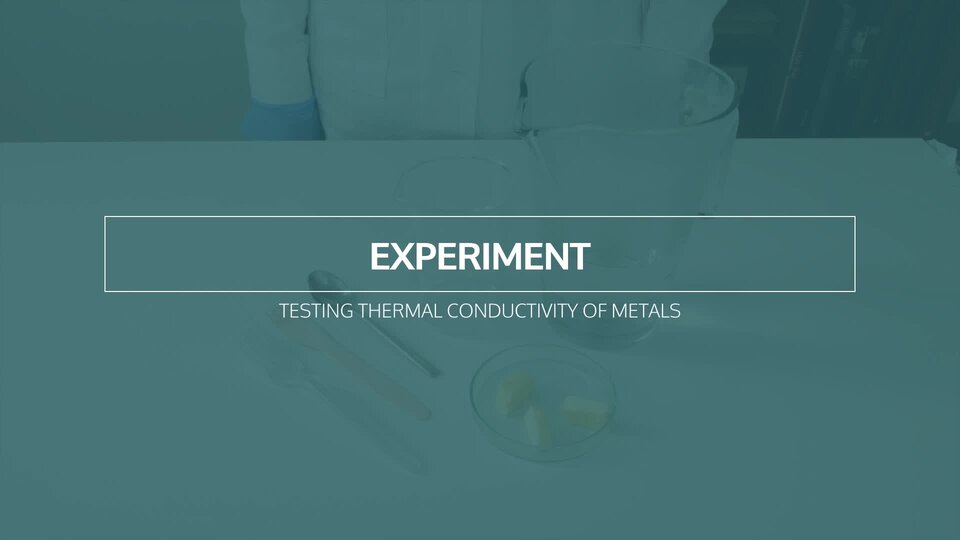
Before you watch the movie „Testing thermal conductivitythermal conductivity of metals”, formulate a research question and hypotheses. During the screening, pay attention to what happens to the butter during the test. What does it mean?
Film dostępny na portalu epodreczniki.pl
Nagranie video abstraktu przedstawiające eksperyment "Badanie przewodności cieplnej metali". Do eksperymentu użyte są: szklane naczynie (beaker), gorąca woda (hot water), 3 małe kostki masła (butter), metalowa łyżka (metal spoon), drewniany widelec (wooden fork), plastikowy widelec (plastic fork). Na każdy ze sztućców naukowiec nadziewa po jednej kostce masła i wkłada do szklanego naczynia uchwytem do dołu w taki sposób że masło wystaje ponad szklane naczynie.Następnie wlewa gorącą wodę. Po kilkunastu sekundach masło na metalowej łyżce zaczyna się topić i spada.
The butter placed on the fork made of stainless steel begins to melt after some time. The gradual heating of the fork by immersion in hot water caused the melting of the butter. It means that the steal from which the fork was made conducts heat. Metals are good conductors of heat.
Before doing the experiment „Examination of metallic gloss and plasticity of metals”, formulate a research question and hypothesis.
You will need
metals: iron nail, aluminum foil, zinc sheet, copper wire, silver plate, magnesium ribbon, lead sample, tungsten wire, tin
scalpel or knife;
hammer;
anvil.
Instruction
Look carefully at various objects made of metals.
Using an anvil to immobilize the objects and carefully try to cut with a knife or tap the surface with a hammer.
Write down the information about their color, gloss and susceptibility to shape change.
Metals have many features in common - metallic gloss, which reflects light, giving the effect of shine, and the color of silvery‑white or silver‑gray. The exception is gold - yellow and copper - silver colored pink (well cleaned) to red‑brown.
The hardness, malleability, ductility of metals can be explained by the existence of forces that they maintain the crystal lattice. The forces of attraction between metal ions and electron cloud work in all directions. The result of this is the large ease of moving the ion in the z network one position in the other.
Which of the following terms relate to the typical properties of metals? Select the correct answer.
- solid, red, brittle, does not dissolve in water
- solid, white, odourless, brittle, conducts electricity
- solid, silvery-grey, hard, glossy, conducts electricity and heat
- solid, yellow, does not dissolve in water, brittle
Summary
Metals at room temperature are characterized by: a constant state of matter (except mercury), silvery‑white or silvery‑grey colour (with the exception of gold, copper), metallic gloss, thermal conductivity, conductivity, electric conductivity, tenacity, ductility.
Keywords
metal, thermal conductivity, electrical conductivity, properties of metals, gold, argentum
Glossary
przewodnictwo cieplne – zdolność substancji do przewodzenia ciepła. W tych samych warunkach więcej ciepła przepłynie przez substancję o większej przewodności cieplnej.
metale – substancje o metalicznym połysku, bardzo dobrze przewodzą ciepło i prąd elektryczny
przewodnictwo elektryczne – zjawisko skierowanego przenoszenia ładunków elektrycznych przez dodatnie lub ujemne nośniki (elektrony, jony) zachodzące w ośrodku materialnym pod wpływem przyłożonego zewnętrznego pola elektrycznego.