a) Provide characteristics of gases. b) Are there any intermolecular interactions in gases? c) What will the strength of these interactions depend on? d) What is the strength of intermolecular interactions in gases in relation to intermolecular interactions in liquids or solids?
a) Gases take on the shape of the vessel in which they are and fill all its volumevolumevolume. b) Molecular interactions in gases are very weak. c) The strength of molecular interactions in a gas depends on the type of gas, i.e. on the chemical structure of its molecules and on the gas pressurepressurepressure. d) Interactions in gases are much weaker than in liquids and solids.
a) balloon, b) effervescent tablet, c) a narrow test tube filled with water.
Using only the items above, suggest the sequence of the action that must be performed to show that the gases take up the volume of the vessel they are in.
1. I fill the test tube halfway with water. 2. I throw an effervescent tablet into the water in the test tube. 3. I quickly put the balloon on the test tube opening. 4. I observe the filling of the balloon with gas released from the effervescent tablet 5. I record the results of observations in the form of a note.
a) In an inflated balloon, do gases only occupy a specific part of the balloon volumevolumevolume? b) What examples do you know which demonstrates that gases fill the entire volume available to them?
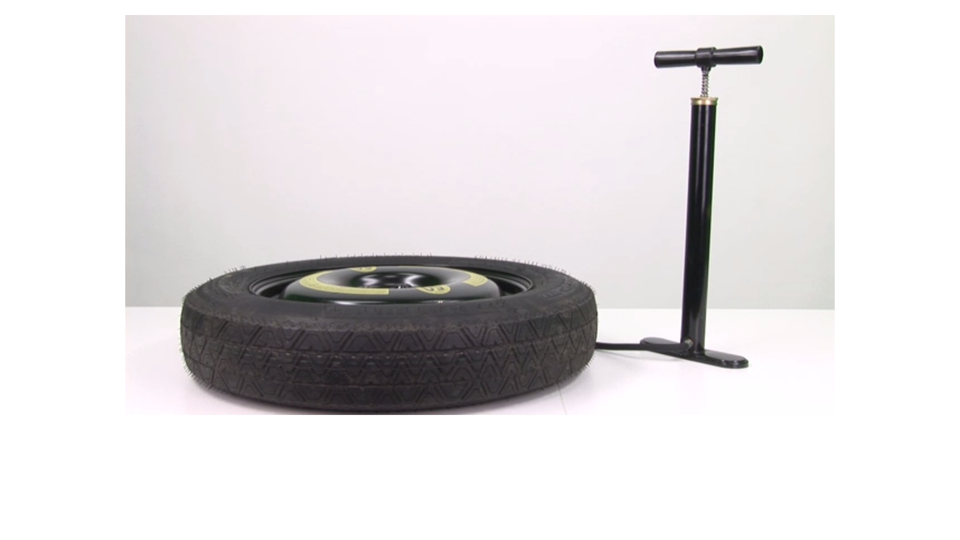
a) In the inflated balloon, you can observe that gas always fills the entire volume. b) When inflating a bicycle tire, the air fills the entire volume of the tire. In the entire house, on the ground floor, in the basement and on the first floor there is always atmospheric airatmospheric airatmospheric air, whose properties are the same everywhere.
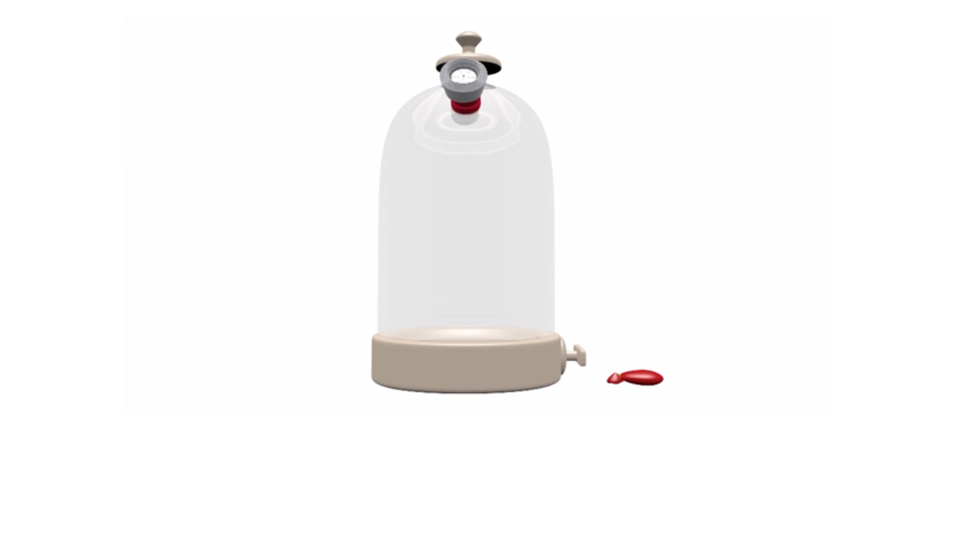
Watch slideshows „Gas expansion - tire” and „Gas expansionexpansionexpansion - balloon” where you can see experiment related to gas expansion.
Please note that increasing the volumevolumevolume occupied by gas is not related to increasing the total amount of gas molecules in the tank.
R1eya8WaD1hbk
Pokaz slajdów - rozprężanie gazu. Instrukcja obsługi z poziomu klawiatury: 1. Uruchomienie aplikacji - ENTER, 2. Na każdym ze slajdów czytany jest automatycznie tekst alternatywny po polsku, 3. Przy pierwszym uruchomieniu na pierwszym slajdzie, czytanie tekstu po angielsku - TAB, 4. Przejście między slajdami: do następnego slajdu - TAB, do poprzedniego slajdu - TAB + SHIFT, 5. Przejście do czytania napisu po angielsku - strzałka w górę + strzałka w dół (czyta tekst po angielsku widoczny na slajdzie).
Pokaz slajdów - rozprężanie gazu. Instrukcja obsługi z poziomu klawiatury: 1. Uruchomienie aplikacji - ENTER, 2. Na każdym ze slajdów czytany jest automatycznie tekst alternatywny po polsku, 3. Przy pierwszym uruchomieniu na pierwszym slajdzie, czytanie tekstu po angielsku - TAB, 4. Przejście między slajdami: do następnego slajdu - TAB, do poprzedniego slajdu - TAB + SHIFT, 5. Przejście do czytania napisu po angielsku - strzałka w górę + strzałka w dół (czyta tekst po angielsku widoczny na slajdzie).
Pokaz slajdów - rozszerzalność gazu, balonik. Instrukcja obsługi z poziomu klawiatury: 1. Uruchomienie aplikacji - ENTER, 2. Na każdym ze slajdów czytany jest automatycznie tekst alternatywny po polsku, 3. Przy pierwszym uruchomieniu na pierwszym slajdzie, czytanie tekstu po angielsku - TAB, 4. Przejście między slajdami: do następnego slajdu - TAB, do poprzedniego slajdu - TAB + SHIFT, 5. Przejście do czytania napisu po angielsku - strzałka w górę + strzałka w dół (czyta tekst po angielsku widoczny na slajdzie).
Pokaz slajdów - rozszerzalność gazu, balonik. Instrukcja obsługi z poziomu klawiatury: 1. Uruchomienie aplikacji - ENTER, 2. Na każdym ze slajdów czytany jest automatycznie tekst alternatywny po polsku, 3. Przy pierwszym uruchomieniu na pierwszym slajdzie, czytanie tekstu po angielsku - TAB, 4. Przejście między slajdami: do następnego slajdu - TAB, do poprzedniego slajdu - TAB + SHIFT, 5. Przejście do czytania napisu po angielsku - strzałka w górę + strzałka w dół (czyta tekst po angielsku widoczny na slajdzie).
a) The gases can expand, it was evident in the experiment with the expansion of air from the inflated tire to the pump cylinder or to the bicycle tire. b) The reason for the fact that the inflated balloon placed in the air retains its shape is to balance the interaction of molecules inside the balloon by the interaction of the air molecules on the balloon walls. c) Reducing the amount of air molecules as a result of pumping out with a vacuum pumpvacuum pumpvacuum pump causes the pressure exerted by the air molecules on the outer surface of the balloon to decrease. Thanks to this the balloon expands.
The air pressurepressurepressure depends on the concentration of air molecules.
The expansionexpansionexpansion of the gas causes a reduction in the concentration of particles, which in effect may reduce not only the pressure, but also the temperature of the gas.
1. Bring the deodorant valve close to the mirror and empty the deodorant towards the mirror for a few seconds. 2. Observe the condensation of water on the mirror.
As a result of cooling caused by the stream of expanding gas coming out of the deodorant valve, the mirror is covered with a mist of condensation from the air.
Conclusion
The expansion of gas is often accompanied by a decrease in its temperature, which is most clearly visible when this process occurs rapidly.
Determine whether the sentences below are true or false.
a) Gas molecules exhibit large attractive and weak repulsive interactions. b) Gases increase in volume as interactions between molecules are very weak. c) Gases easily reduce their volume, because their molecules are far away from each other. d) Reducing the volume of the gas tank as a result of gas compressioncompressioncompression forces causes an increase in the gas pressure in the tank.
a) False. b) True. c) True. d) True.
RayU29sNJKhSZ1
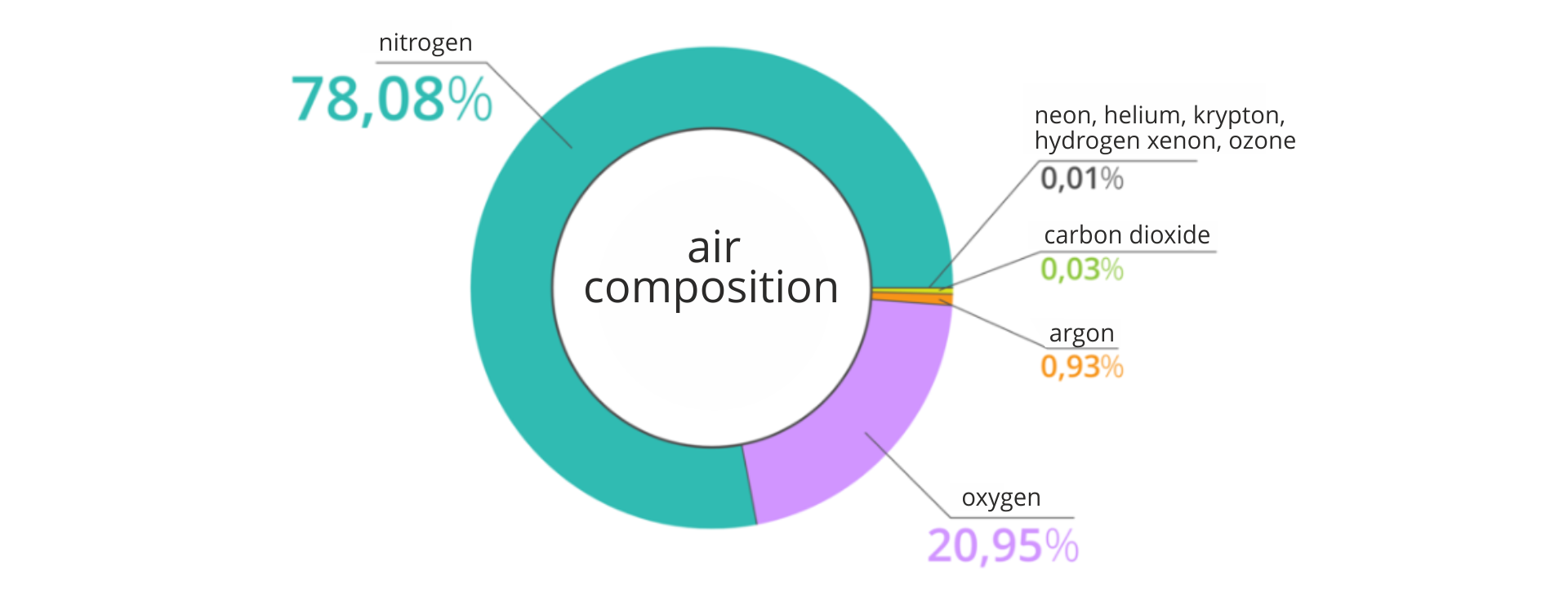
Ilustracja przedstawia wykres kołowy chemicznego składu suchego powietrza atmosferycznego podpisany air composition: 78, 08% - nitrogen, 20,95% - oxygen, 0,93% - argon, 0,03% - carbon dioxide, 0,01% - neon, helium, krypton, hydrogen xenon, ozone.
Molecules in gases interact weakly between themselves, their motion is chaotic and takes place in the entire available space.
Gas molecules completely fill the volumevolumevolume of the vessel, regardless of its shape. During the movement, they collide with each other and „bombard” the walls of the container.
The most widespread gas in nature is air. Dry air is a mixture of nitrogen (78%) and oxygen (21%). The remaining 1% of the composition are carbon dioxide and noble gases.
Gases have no shape - they take the shape of the vessel in which they in.
Gases have no specific volume - they take on the volume of the vessel they are in.
Gases are compressible (unlike solids and liquids).
ExpansionexpansionExpansion of the gas consists in increasing its volume and decreasing pressurepressurepressure.
The expansion of gas is often accompanied by a decrease in its temperature, which is most clearly visible when this process occurs rapidly.
The speed of most gas molecules at room temperature do not excieed 1000 .
Exercises
R1Y5MlKLCJCeX
Exercise 5
Wersja alternatywna ćwiczenia: Determine which sentences are true. Możliwe odpowiedzi: 1. Gases retain their own shape., 2. Diffusion occurs fastest in gases, because the particles move at high speed., 3. Molecules in gases move in a straight line., 4. The speed of most gas molecules at room temperature do not excieed 1000 ., 5. The common feature of gases and liquids is the variable volume.
Wersja alternatywna ćwiczenia: Determine which sentences are true. Możliwe odpowiedzi: 1. Gases retain their own shape., 2. Diffusion occurs fastest in gases, because the particles move at high speed., 3. Molecules in gases move in a straight line., 4. The speed of most gas molecules at room temperature do not excieed 1000 ., 5. The common feature of gases and liquids is the variable volume.
Determine which sentences are true.
Gases retain their own shape.
Diffusion occurs fastest in gases, because the particles move at high speed.
Molecules in gases move in a straight line.
The speed of most gas molecules at room temperature do not excieed 1000 .
The common feature of gases and liquids is the variable volume.
zadanie
Source: GroMar, licencja: CC BY 3.0.
Exercise 6
How does the gas in the balloon behave when it is heated? Explain this based on the molecular structure of the gas.
When heated, the gas increases its volume. As the temperature rises, the average speed of the gas molecules increases, and the force, which the gas molecules exert on the inside walls of the balloon increases simultaneously during molecules collisions. Consequently, this leads to an increase in volume.
Exercise 7
Write in English what are the examples of the use of compression and expansion of gases?
Compression of gases: inflation of tires in a bicycle, in the car, storage of gases in cylinders.
Expansion of gases: air turbines, fire extinguishers, deodorants, pneumatic tools in plants.
Rzgs1QS44AFGz
Exercise 8
Wersja alternatywna ćwiczenia: Indicate which pairs of expressions or words are translated correctly. Możliwe odpowiedzi: 1. rozprężanie - expansion, 2. sprężanie - compression, 3. ciśnienie - pressure, 4. cząsteczka - molecule, 5. chaotyczny ruch - vessel volume, 6. objętość naczynia - chaotic motion
Wersja alternatywna ćwiczenia: Indicate which pairs of expressions or words are translated correctly. Możliwe odpowiedzi: 1. rozprężanie - expansion, 2. sprężanie - compression, 3. ciśnienie - pressure, 4. cząsteczka - molecule, 5. chaotyczny ruch - vessel volume, 6. objętość naczynia - chaotic motion
Indicate which pairs of expressions or words are translated correctly.
rozprężanie - expansion
sprężanie - compression
ciśnienie - pressure
cząsteczka - molecule
chaotyczny ruch - vessel volume
objętość naczynia - chaotic motion
zadanie
Source: GroMar, licencja: CC BY 3.0.
R6oSDY9MHEITG1
Interaktywna gra, polegająca na łączeniu wyrazów w pary w ciągu jednej minuty. Czas zaczyna upływać wraz z rozpoczęciem gry. Jeden ruch to odkrywanie najpierw jednej potem drugiej karty z wyrazem. Każdy wyraz jest odczytywany. Kolejny ruch to odkrywanie trzeciej i czwartej karty. W ten sposób odsłuchasz wszystkie wyrazy. Nawigacja z poziomu klawiatury za pomocą strzałek, odsłuchiwanie wyrazów enterem lub spacją. Znajdź wszystkie pary wyrazów.
Interaktywna gra, polegająca na łączeniu wyrazów w pary w ciągu jednej minuty. Czas zaczyna upływać wraz z rozpoczęciem gry. Jeden ruch to odkrywanie najpierw jednej potem drugiej karty z wyrazem. Każdy wyraz jest odczytywany. Kolejny ruch to odkrywanie trzeciej i czwartej karty. W ten sposób odsłuchasz wszystkie wyrazy. Nawigacja z poziomu klawiatury za pomocą strzałek, odsłuchiwanie wyrazów enterem lub spacją. Znajdź wszystkie pary wyrazów.
Match Polish terms with their English equivalents.
rozprężanie
molecules
sprężanie
pressure
ciśnienie
atmospheric air
cząsteczki
expansion
compression
powietrze
Source: Zespół autorski Politechniki Łódzkiej, licencja: CC BY 3.0.