All substances are made of the smallest indivisible particles of matter (the smallest elements of the structure of matter that retain the chemical properties of the material). The creators of the atomistic theory of matter structure include: Democritus from Abdera (V‑IV century BC), John Dalton (1766‑1844).
R1J4J4lSuYYWG1
Ilustracja przedstawia układ symbolicznie przedstawionych cząstek materii dla trzech stanów skupienia, trzy kwadraty opisane kolejno gas, liquid, solid. W każdym kwadracie są rozłożone nierównomiernie kulki. W kwadracie gas jest najmniej, a w kwadracie solid najwięcej.
Familiarize yourself with the slideshow „Molecular structure of bodies”.
Note what substance is made up of and what is the difference between an atomatomatom and a moleculemoleculemolecule.
R1bpYeCJAoPKt1
Pokaz multimedialny - budowa cząsteczkowa ciał. Instrukcja obsługi z poziomu klawiatury: 1. Uruchomienie aplikacji - ENTER, 2. Na każdym ze slajdów czytany jest automatycznie tekst alternatywny po polsku, 3. Przy pierwszym uruchomieniu na pierwszym slajdzie, czytanie tekstu po angielsku - TAB, 4. Przejście między slajdami: do następnego slajdu - TAB, do poprzedniego slajdu - TAB + SHIFT, 5. Przejście do czytania napisu po angielsku - strzałka w górę + strzałka w dół (czyta tekst po angielsku widoczny na slajdzie).
Pokaz multimedialny - budowa cząsteczkowa ciał. Instrukcja obsługi z poziomu klawiatury: 1. Uruchomienie aplikacji - ENTER, 2. Na każdym ze slajdów czytany jest automatycznie tekst alternatywny po polsku, 3. Przy pierwszym uruchomieniu na pierwszym slajdzie, czytanie tekstu po angielsku - TAB, 4. Przejście między slajdami: do następnego slajdu - TAB, do poprzedniego slajdu - TAB + SHIFT, 5. Przejście do czytania napisu po angielsku - strzałka w górę + strzałka w dół (czyta tekst po angielsku widoczny na slajdzie).
a) Atom is the smallest portion of matter that retains chemical properties. b) There are as many kinds of atoms as there are elements. c) Atoms of the same element are identical. d) Atoms of the same or different elements can be combined and form molecules of chemical compounds. e) Substances are made up of atoms or molecules.
Based on the slideshow viewed above, state whether the sentences are true or false.
a) The physical body is made up of atoms or molecules. b) The atomatomatom consists of a positive nucleusnucleusnucleus and a lot of lighter negative electrons. c) The atom is made of molecules. d) The molecule is always made up of identical atoms.
Familiarize yourself with the photo gallery „Increase in temperature as a cause of increased molecular motion”.
R1EpXbqCj2wyX
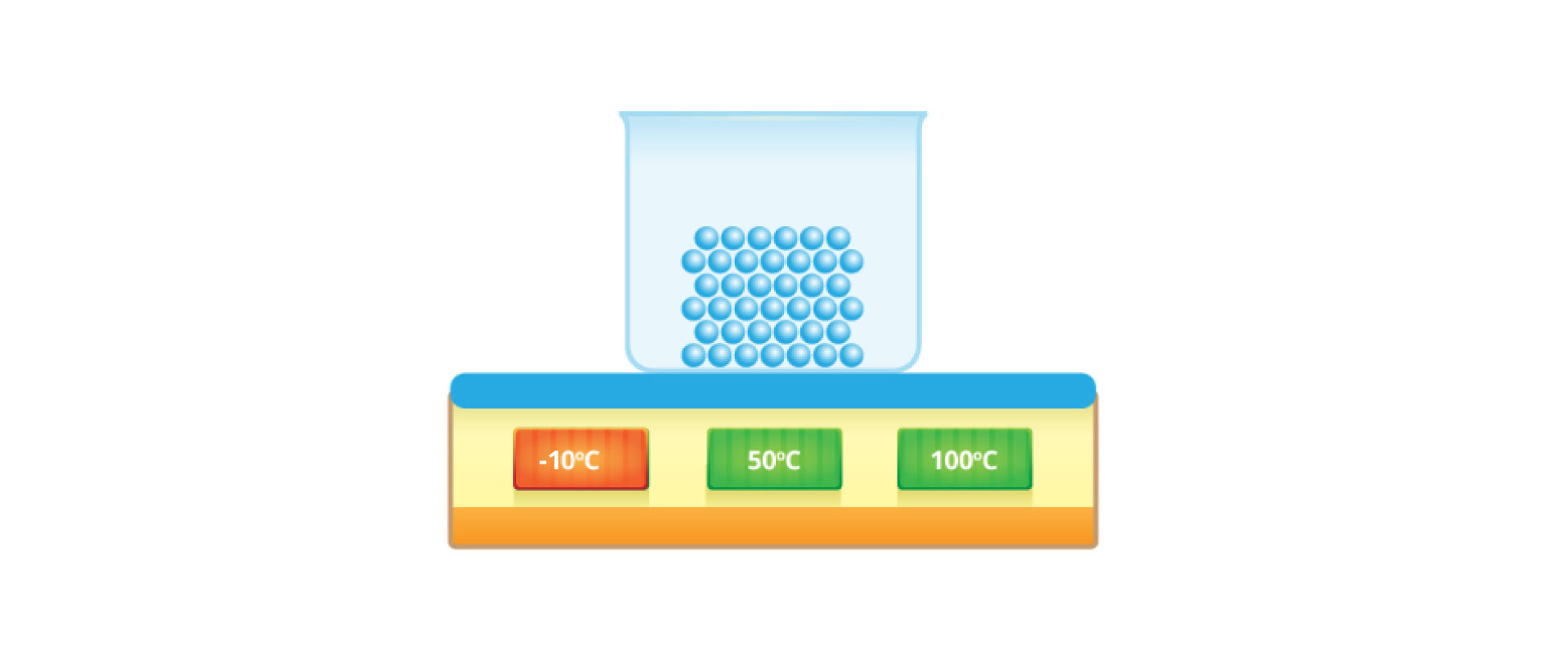
Na ilustracji przedstawiony jest prostokąt z oznaczeniami temperatury, od lewej: wyróżnione -10 stopni Celsjusza, 50 stopni Celsjusza, 100 stopni Celsjusza. Na prostokącie w przezroczystej menzurce ułożone są równomiernie na sobie kulki. Ilustracja przedstawia sytuację, kiedy woda w temperaturze 0°C jest w postaci krystalicznego lodu, cząsteczki tworzą uporządkowaną sieć.
Water at -10°C is in the form of crystalline ice, molecules form an ordered pattern
Source: GroMar, licencja: CC BY 3.0.
R1DmyCVAdGM0r
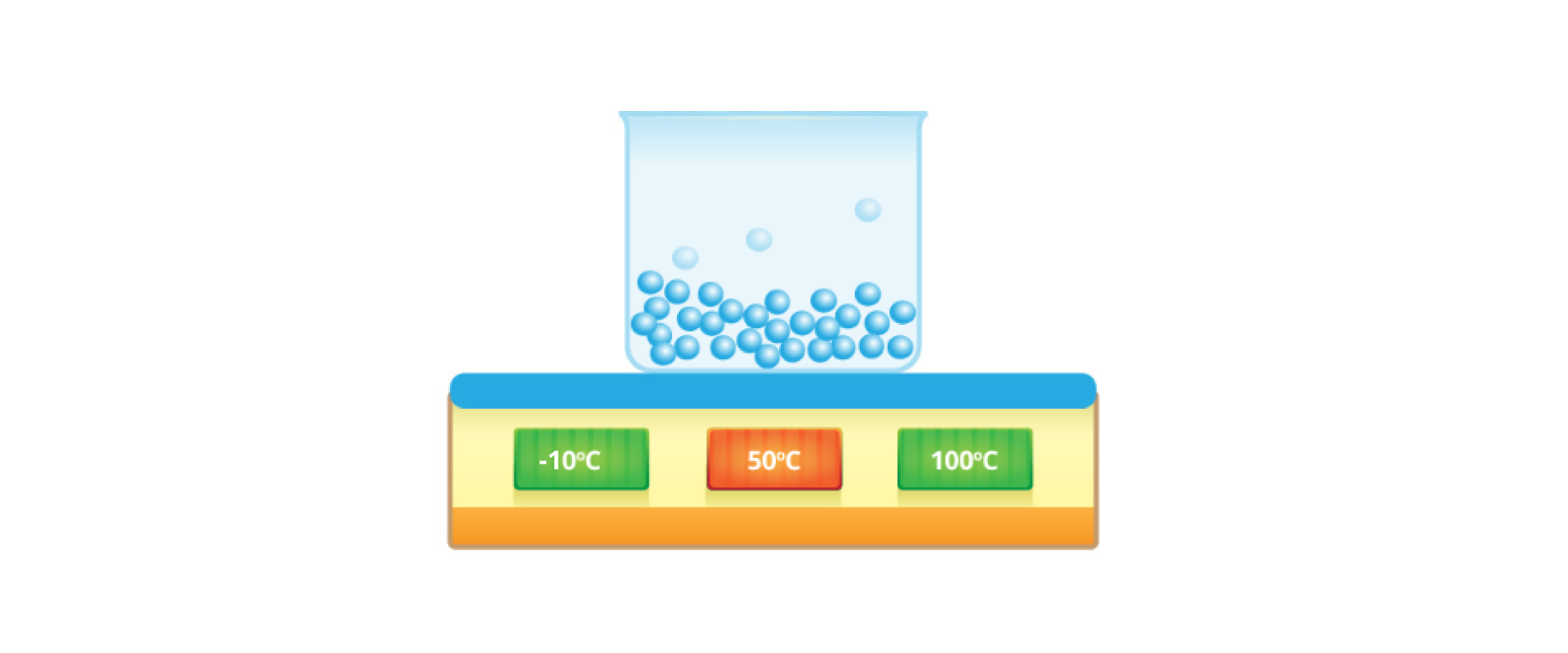
Na ilustracji przedstawiony jest prostokąt z oznaczeniami temperatury, od lewej: -10 stopni Celsjusza, wyróżnione 50 stopni Celsjusza, 100 stopni Celsjusza. Na prostokącie w przezroczystej menzurce ułożone są nierównomiernie kulki. Ilustracja przedstawia sytuację, kiedy cząsteczki w wodzie o temperaturze 50 stopni Celsjusza wykonują silne ruchy powodujące wzajemne przemieszczanie się cząsteczek, występuje dość silne parowanie.
Molecules in water at 50°C make strong movements that cause mutual displacement of molecules, there is quite strong evaporation
Source: GroMar, licencja: CC BY 3.0.
R5N8Ob1eGzbKV
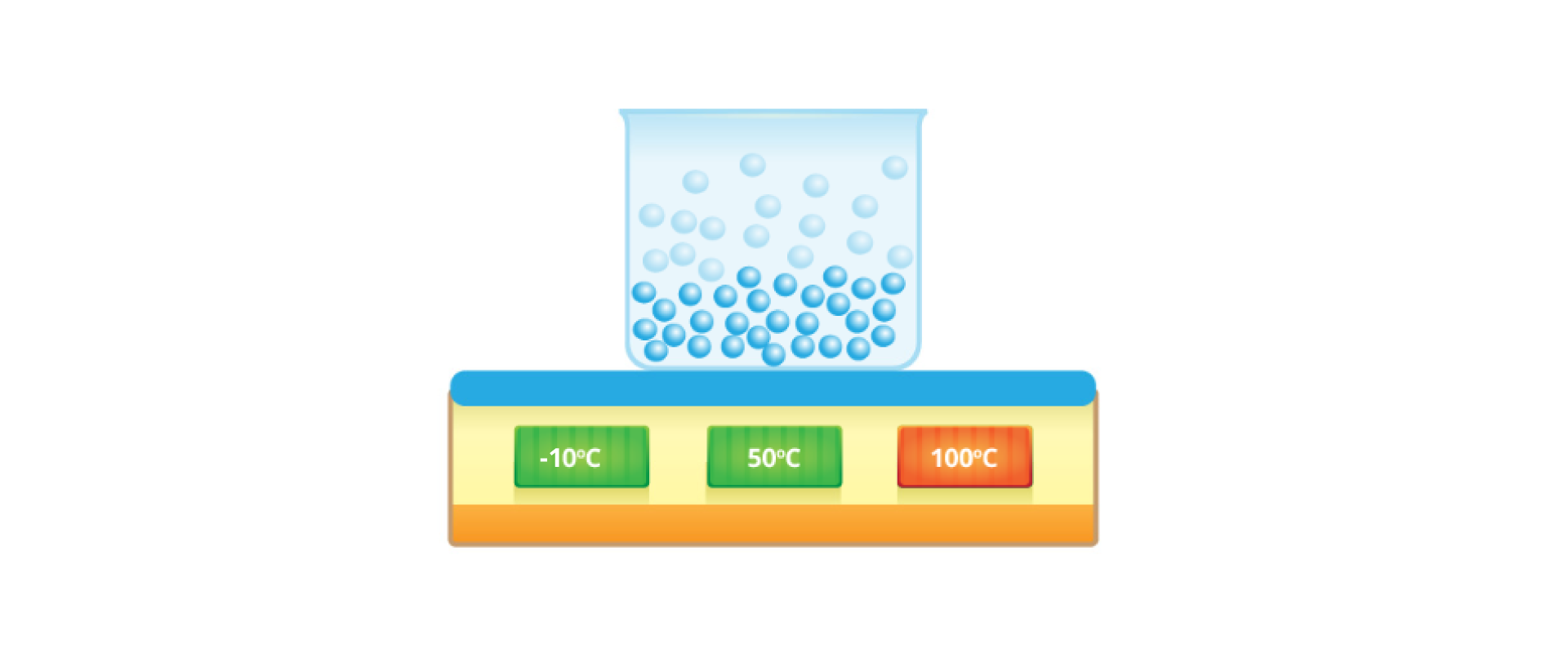
Na ilustracji przedstawiony jest prostokąt z oznaczeniami temperatury, od lewej: -10 stopni Celsjusza, 50 stopni Celsjusza, wyróżnione 100 stopni Celsjusza. Na prostokącie w przezroczystej menzurce ułożone są nierównomiernie kulki w całej objętości menzurki. Ilustracja przedstawia sytuację, kiedy cząsteczki w wodzie o temperaturze 100 stopni Celsjusza wykonują bardzo silne ruchy powodujące gwałtowne wzajemne przemieszczanie się cząsteczek, występuje parowanie w całej objętości cieczy. Takie zjawisko nazywamy wrzeniem cieczy.
Molecules in water at 100°C make very strong movements causing rapid mutual displacement of molecules, evaporation occurs in the whole volume of liquid. This phenomenon is called liquid boiling
a) Increase in temperature causes the ice to go into water and then into water vapour. b) The ice has an ordered internal structure. Water molecules as a liquid and water vapour are in chaotic motion. c) Increasing the temperature from 50°C to 100°C causes an increase in the number of water vapour molecules in relation to the amount of water molecules.
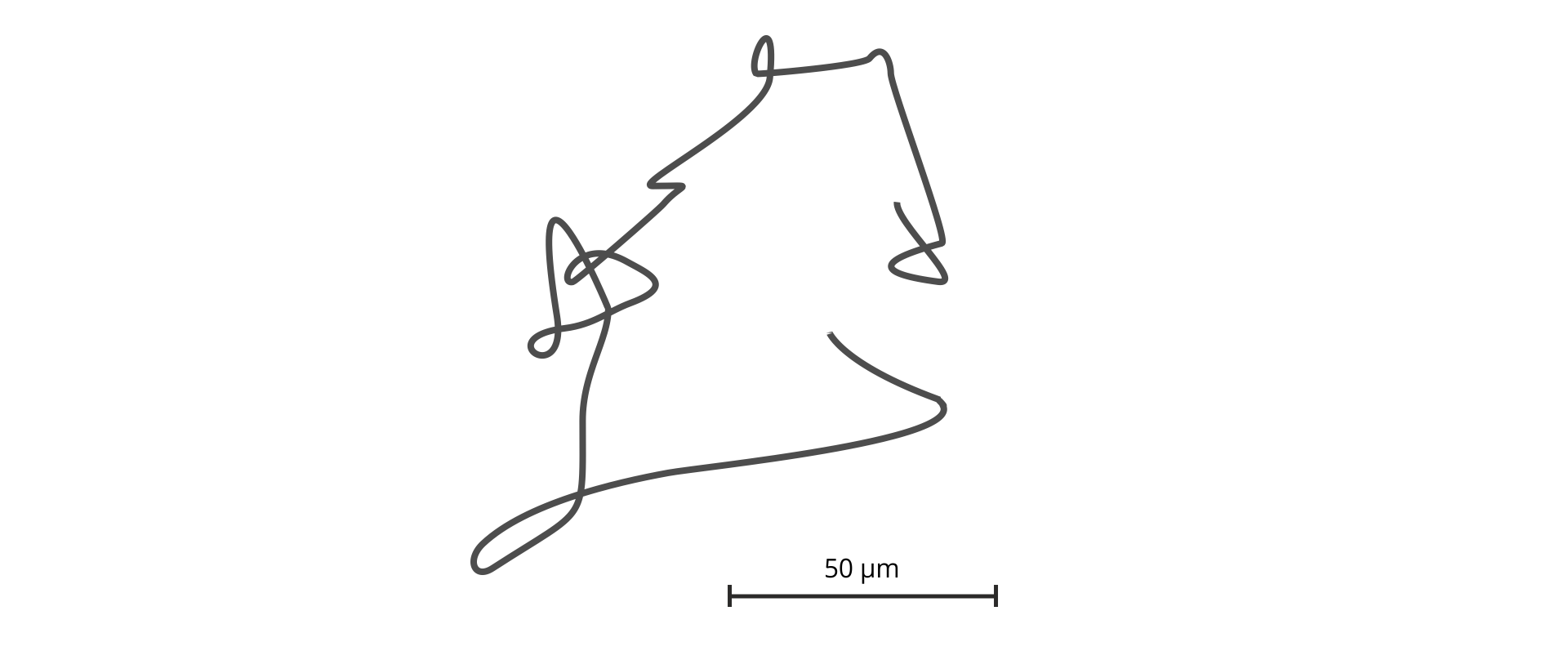
Brownian motionBrownian motionBrownian motion is an irregular motion and collisions of particles of pollen or other microscopic bodies visible under the microscope placed in gases and liquids.
RRjM27iM2Qebo1
Ilustracja przedstawia krzywą przypominającą literę C, wyglądającą jak narysowana odręcznie z kilkoma pętelkami i zagięciami. Pod nią widnieje odcinek o długości 50 mikrometrów. Ilustracja obrazuje tor ruchu bakterii E. coli, obserwowany pod mikroskopem.
a) What determines the motion of molecules that make up the physical body? b) What is Brownian motion? c) What theory of matter structure Brownian motion confirms?
a) The motion of molecules that make up the physical body depends on the temperature. b) Brownian motion consist in the chaotic motion of a pollen or other microscopic body suspended in a liquid. This motion is caused by collisions of the microscopic body (pollen) with liquid molecules. c) Brownian motion confirms the atomistic theory of matter structure.
Is the microscopic motion of gas associated with the macroscopic transfer of matter?
Hypothesis
Molecules of the sprayed deodorant moving around in the vicinity of air molecules can spread over a considerable distance.
Summary
Observation
Even though they are not in the immediate vicinity of the deodorant container, the students smell the fragrance.
Conclusion
As a result of the motion of the deodorant molecules, the deodorant molecules propagate in the air over a long distance. This phenomenon is called diffusiondiffusiondiffusion.
During the lesson, we learned about the structure of matter and some phenomena confirming the kinetic molecular theory of the structure of matter.
Matter consists of molecules in constant motion. These molecules are in constant chaotic motion, and their speeds are related to body temperature. The higher the moleculemoleculemolecule speed, the higher the body temperature. When we lower its temperature, we slow down the motion of its molecules.
Brownian motionBrownian motionBrownian motion is the chaotic motion of the visible molecule caused by collisions with molecules that are too small to be seen.
DiffusiondiffusionDiffusion the process of spontaneous expansion of molecules of one substance in another. It occurs in gases, liquids and solids.
Exercises
RkQvyjeK9m94m
Exercise 3
Wersja alternatywna ćwiczenia: Determine which sentences are true. Możliwe odpowiedzi: 1. All bodies are made up of atoms., 2. Brownian motion occurs in solids., 3. The atomic nucleus does not contain neutrons., 4. The speed of diffusion depends on the temperature., 5. Diffusion occurs fastest in solids., 6. Brownian motion is a confirmation of the kinetic molecular theory of the structure of matter.
Wersja alternatywna ćwiczenia: Determine which sentences are true. Możliwe odpowiedzi: 1. All bodies are made up of atoms., 2. Brownian motion occurs in solids., 3. The atomic nucleus does not contain neutrons., 4. The speed of diffusion depends on the temperature., 5. Diffusion occurs fastest in solids., 6. Brownian motion is a confirmation of the kinetic molecular theory of the structure of matter.
Determine which sentences are true.
All bodies are made up of atoms.
Brownian motion occurs in solids.
The atomic nucleus does not contain neutrons.
The speed of diffusion depends on the temperature.
Diffusion occurs fastest in solids.
Brownian motion is a confirmation of the kinetic molecular theory of the structure of matter.
Exercise 4
Find information about contraction in the literature.
What is the common feature of liquids for which no contraction occurs during mixing? Explain why?
These are liquids with comparable molecule sizes. There is a lack of free spaces between these molecules.
Exercise 5
Provide examples in English of the phenomenon of diffusion occurring between:
solid and liquid,
solid and gas.
Sugar cube immersed in tea.
Reducing the air volume in a ball or balloon after some time.
R1ESdG6i8sOfW
Exercise 6
Wersja alternatywna ćwiczenia: Match Polish terms with their English equivalents. wrzenie Możliwe odpowiedzi: 1. molecule, 2. nucleus, 3. evaporation, 4. diffusion, 5. boiling dyfuzja Możliwe odpowiedzi: 1. molecule, 2. nucleus, 3. evaporation, 4. diffusion, 5. boiling parowanie Możliwe odpowiedzi: 1. molecule, 2. nucleus, 3. evaporation, 4. diffusion, 5. boiling cząsteczka Możliwe odpowiedzi: 1. molecule, 2. nucleus, 3. evaporation, 4. diffusion, 5. boiling jądro Możliwe odpowiedzi: 1. molecule, 2. nucleus, 3. evaporation, 4. diffusion, 5. boiling
Wersja alternatywna ćwiczenia: Match Polish terms with their English equivalents. wrzenie Możliwe odpowiedzi: 1. molecule, 2. nucleus, 3. evaporation, 4. diffusion, 5. boiling dyfuzja Możliwe odpowiedzi: 1. molecule, 2. nucleus, 3. evaporation, 4. diffusion, 5. boiling parowanie Możliwe odpowiedzi: 1. molecule, 2. nucleus, 3. evaporation, 4. diffusion, 5. boiling cząsteczka Możliwe odpowiedzi: 1. molecule, 2. nucleus, 3. evaporation, 4. diffusion, 5. boiling jądro Możliwe odpowiedzi: 1. molecule, 2. nucleus, 3. evaporation, 4. diffusion, 5. boiling
Match Polish terms with their English equivalents.
Interaktywna gra, polegająca na łączeniu wyrazów w pary w ciągu jednej minuty. Czas zaczyna upływać wraz z rozpoczęciem gry. Jeden ruch to odkrywanie najpierw jednej potem drugiej karty z wyrazem. Każdy wyraz jest odczytywany. Kolejny ruch to odkrywanie trzeciej i czwartej karty. W ten sposób odsłuchasz wszystkie wyrazy. Nawigacja z poziomu klawiatury za pomocą strzałek, odsłuchiwanie wyrazów enterem lub spacją. Znajdź wszystkie pary wyrazów.
Interaktywna gra, polegająca na łączeniu wyrazów w pary w ciągu jednej minuty. Czas zaczyna upływać wraz z rozpoczęciem gry. Jeden ruch to odkrywanie najpierw jednej potem drugiej karty z wyrazem. Każdy wyraz jest odczytywany. Kolejny ruch to odkrywanie trzeciej i czwartej karty. W ten sposób odsłuchasz wszystkie wyrazy. Nawigacja z poziomu klawiatury za pomocą strzałek, odsłuchiwanie wyrazów enterem lub spacją. Znajdź wszystkie pary wyrazów.
Match Polish terms with their English equivalents.
contraction
kontrakcja
atom
molecule
atom
ruchy Browna
diffusion
dyfuzja
Brownian motion
cząsteczka
Source: Zespół autorski Politechniki Łódzkiej, licencja: CC BY 3.0.