Motion of the planets on the celestial sphere. The heliocentric system. The development of the Copernican concept
Ruch planet na sferze niebieskiej. System heliocentryczny. Rozwój idei kopernikańskiej
to explain the differences between geocentric and heliocentric theory.
Before you start, answer the question.
Explain what it means to say about Nicolaus Copernicus that he „stopped the Sun and moved the Earth”.
Our understanding of the Universe has evolved over time.
Most of all the early cosmologic models assumed that the Earth was the centre of the Solar System, and not only this, but of the entire Universe.
Aristarchus of Samos proposed the first heliocentric model in the third century B.C., but at this time this model did not play an important role.
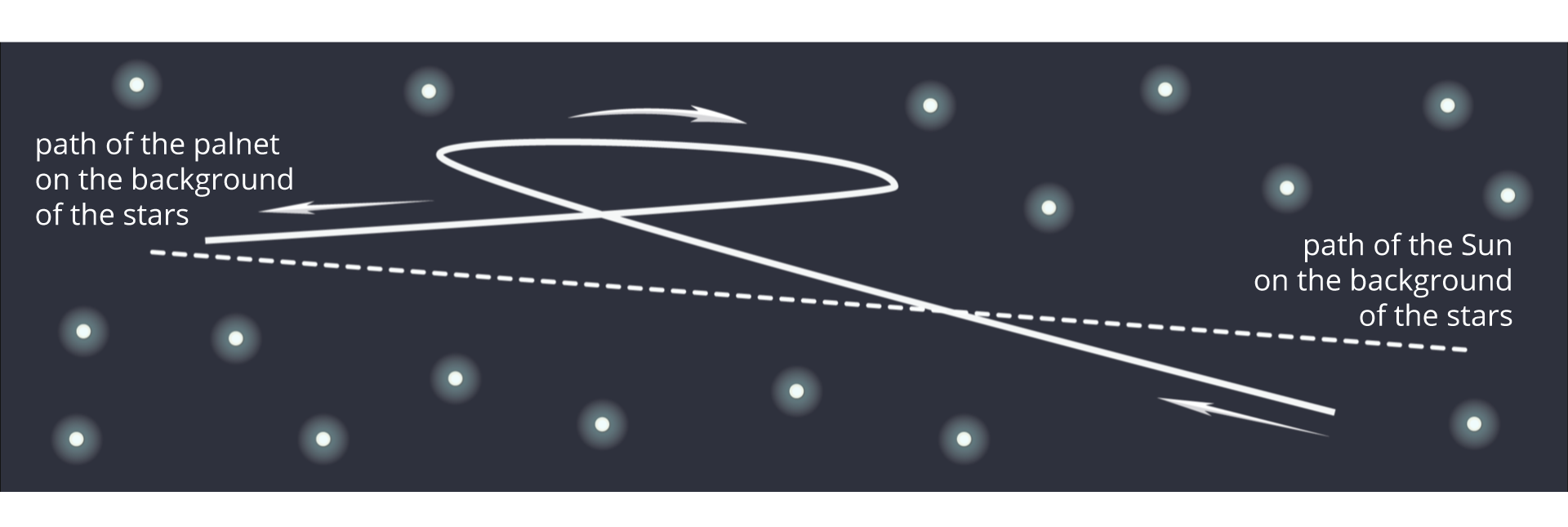
The ancient astronomers observed that planets usually moved east to west against the distant stars, but from time to time they changed the direction and the speed. This motionmotion in the opposite direction was called retrograde motionretrograde motion. Nowadays we know that it is an apparentapparent motion.
The Greek astronomer Ptolemy used measurements of the sky to create geocentric model of the Universe. In this model the Earth was at the centre and all the planets and the Sun were orbiting around it. He explained the observed retrograde motion of the planets in such way that each planet moved on a small circle, called an epicycleepicycle whose centre moved on a larger circle, called a deferentdeferent. The stars revolved on a celestial spherecelestial sphere around the outside of the planetary orbits.
The geocentric model was in use over many centuries. In 16Indeks górny thth century Nicolaus Copernicus came up with a different model. In 1543, few months before his death Copernicus published his theory in a book De revolutionibus orbium coelestium („On the revolutions of the heavenly bodies”).
Copernicus theory stated that the Sun is at the centre of the system and all planets, including the Earth, revolve around it. This theory is named heliocentric, what means that the Sun is at the centre (“helios” in Greek means “Sun”). In Copernicus theory the Moon is the only celestial body in this system which orbits the Earth, and together with the Earth, they orbit the Sun. The planets orbitorbit the Sun in circular paths modified by epicycles. The planet’s speed is uniform. The theory assumed that the stars are immovable and their apparentapparent daily motionmotion was caused by the daily rotation of the Earth. The retrograde motionretrograde motion of the planets was the result of the Earth’s orbital motion.
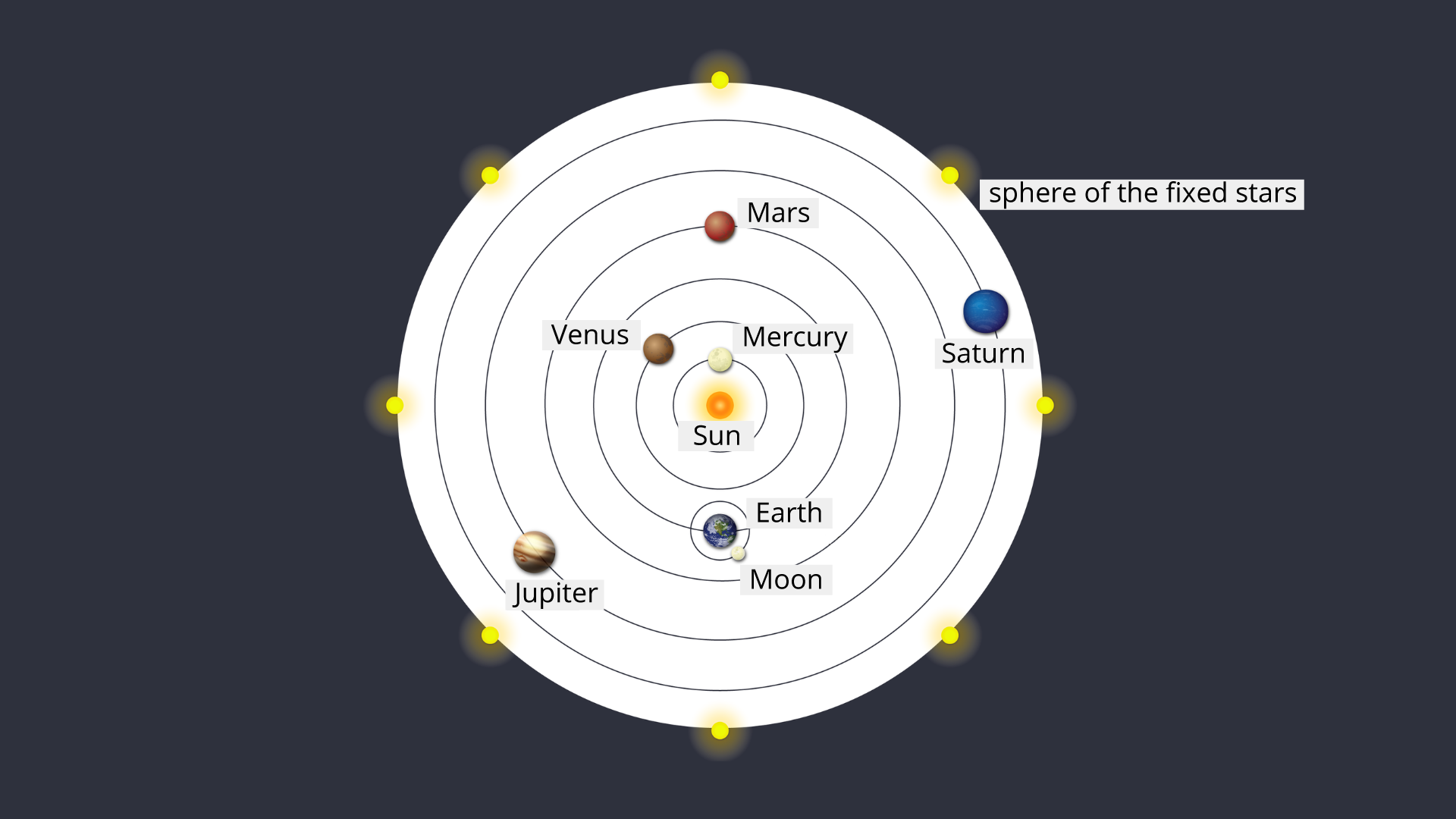
Decades later, Johannes Kepler, using very precise data collected by his former mentor Tycho Brahe, found that planets do not move in circles, but in ellipses.
With time, the instruments used by astronomers has been developed and allowed to provide more accurate measurements.
Galileo Galilei was the first astronomer who used a telescope to study the sky. He made a number of observations that finally helped convince people that the heliocentric model was correct. Galileo discovered spots on the Sun and also saw that the surface of the Moon was rough. He discovered that Venus has phases, much like our Moon does.
The heliocentric theoryheliocentric theory claimed by Galileo had many opponents and officially was banned for a long time. He was also forced to recant this theory and placed under house arrest for the last eight years of his life.
Few decades later Newton generalized Kepler laws and showed that the planets and the Sun all revolve around the centre‑of‑mass of the Solar System.
Final proof of the heliocentric theory for the Solar System appeared in 1838, when the first measurement of the distance between a star and the Earth was done. Bessel determined the distance to 61 Cygni by measuring its parallax. His measurements were consistent with orbital motionmotion of the Earth around the Sun.
At present, the knowledge status is such that the Sun is not regarded as a centre of the Universe anymore but a star among many. The Sun lies at the focus of the elliptical orbits of planets revolving around it. And the Solar System is one of thousands of other similar systems in the Universe.
Remember
The heliocentric theoryheliocentric theory states that the Earth revolves around the Sun. It replaced the geocentric theorygeocentric theory which stated that the Earth was the centre of the Universe.
The heliocentric theory gave an input for intensive astronomical observations and calculations which are still ongoing.
Exercises
Determine which sentences are true.
- Ptolemy’s model and many earlier ideas of the Solar System had the Earth at the centre of it.
- When we observe the sky from the Earth, the planets appear to move from east to west.
- Galileo advocated the heliocentric model.
- Copernicus discovered moons orbiting Jupiter and sunspots.
Search in the internet and collect some biographical facts about Nicolaus Copernicus. Write them to your notebook.
Explain in English why the heliocentric theory was revolutionary in Copernicus times.
Indicate which pairs of expressions or words are translated correctly.
- teoria geocentryczna - geocentric theory
- ruch wsteczny - celestial sphere
- sfera niebieska - retrograde motion
- epicykl - epicycle
- deferent - deferent
- ruch - motion
- epicycle
- deferent
- deferent
- teoria geocentryczna
- geocentric theory
- celestial sphere
- sfera niebieska
- teoria heliocentryczna
- epicykl
- heliocentric theory
Glossary
pozorny
Nagranie dostępne na portalu epodreczniki.pl
wymowa w języku angielskim: apparent
sfera niebieska
Nagranie dostępne na portalu epodreczniki.pl
wymowa w języku angielskim: celestial sphere
deferent
Nagranie dostępne na portalu epodreczniki.pl
wymowa w języku angielskim: deferent
epicykl
Nagranie dostępne na portalu epodreczniki.pl
wymowa w języku angielskim: epicycle
teoria geocentryczna
Nagranie dostępne na portalu epodreczniki.pl
wymowa w języku angielskim: geocentric theory
teoria heliocentryczna
Nagranie dostępne na portalu epodreczniki.pl
wymowa w języku angielskim: heliocentric theory
ruch
Nagranie dostępne na portalu epodreczniki.pl
wymowa w języku angielskim: motion
orbita
ruch wsteczny
Nagranie dostępne na portalu epodreczniki.pl
wymowa w języku angielskim: retrograde motion
Keywords
celestial spherecelestial sphere
deferentdeferent
epicycleepicycle
geocentric theorygeocentric theory
heliocentric theoryheliocentric theory