Germany is a large country in Western Europe, with an area of 357 thousand kmIndeks górny 22, which is between ten and twenty percent larger than that of Poland. It is located between the North Sea, Jutland and the Baltic Sea in the north, and the Alps in the south. The border with Poland is 467 km long and runs mainly on the Oder and Lusatian Neisse rivers.
RLlTFEReAIsIj
Wymień Twoje główne skojarzenia z Niemcami.
Wymień Twoje główne skojarzenia z Niemcami.
What are your thoughts associated with Germany?
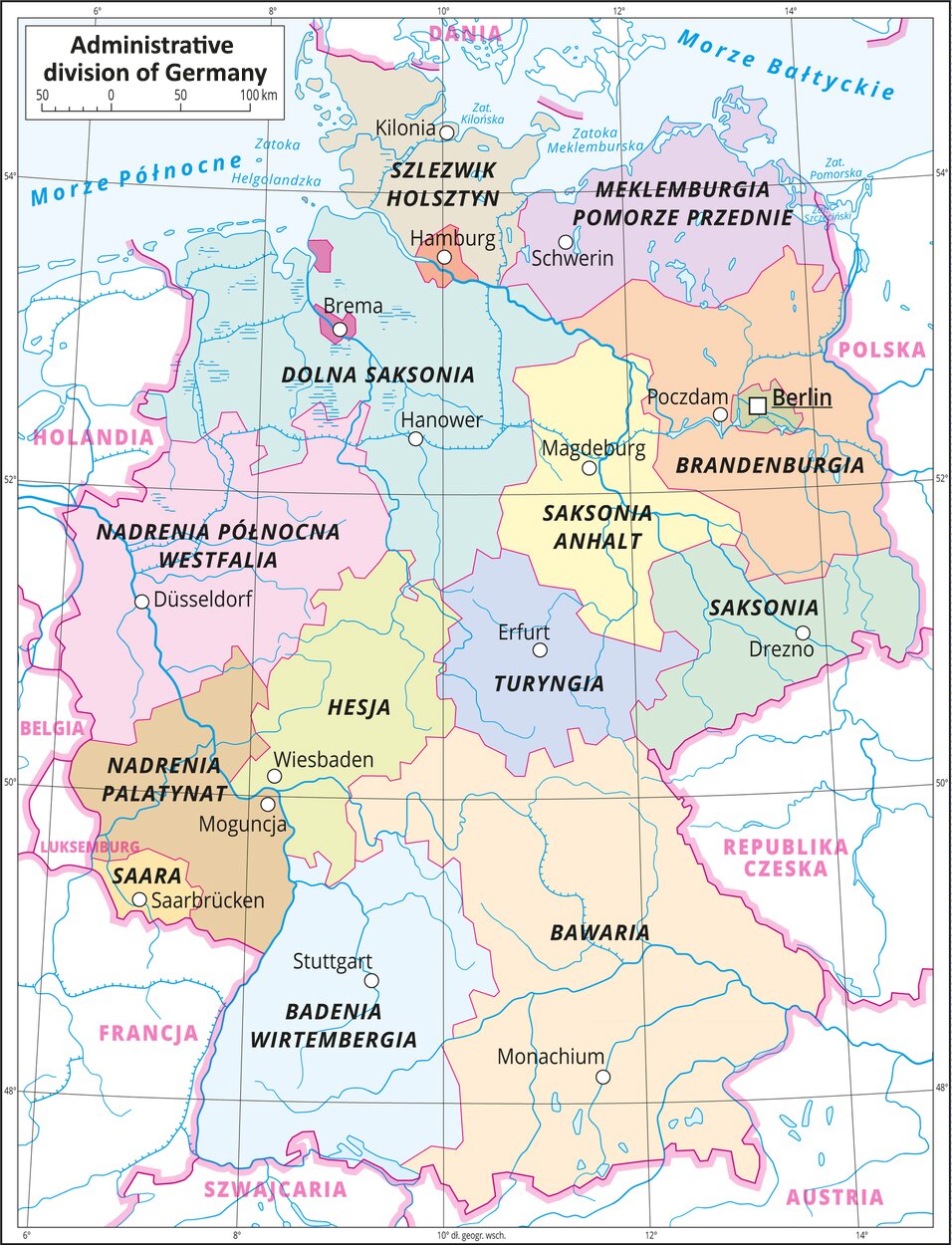
The administrative division of Germany is based on historical regions. The basic units are the 16 States of Germany, also known as Lands. 13 of them are (usually large) historical regions, and 3 lands constitute the areas of separated cities – Berlin, Hamburg, and Bremen together with Bremerhaven. The names of the lands are used very frequently in Germany, much more often than the names of voivodeships in our country. The local people usually feel strong emotional ties to their land.
Rmb6AJucKE7zt
Ilustracja przedstawia mapę polityczną Niemiec z podziałem na jednostki administracyjne – landy i miasta wydzielone. Wyróżniono na niej landy: Badenia-Wirtembergia, Bawaria, Brandenburgia, Dolna Saksonia, Hesja, Meklemburgia-Pomorze Przednie, Nadrenia Północna-Westfalia, Nadrenia-Palatynat, Saara, Saksonia, Saksonia-Anhalt , Szlezwik-Holsztyn, Turyngia. Miasta wydzielone: Berlin, Brema, Hamburg. Kropkami oznaczono główne miasta i opisano je. Mapa pokryta jest równoleżnikami i południkami. Dookoła mapy w ramce opisano współrzędne geograficzne co dwa stopnie.
Administrative division of Germany
Source: Wydawnictwo Edukacyjne Wiking, licencja: CC BY 3.0.
Natural conditions
Task 1
Describe the natural environment of Germany: the lay of the land, and the network of waterways. Indicate the climate and soils that occur in Germany.
R13sg3MymyKmw
Omów klimat, rodzaje gleb, sieć wodą oraz położenie Niemiec.
Omów klimat, rodzaje gleb, sieć wodą oraz położenie Niemiec.
Population of Germany
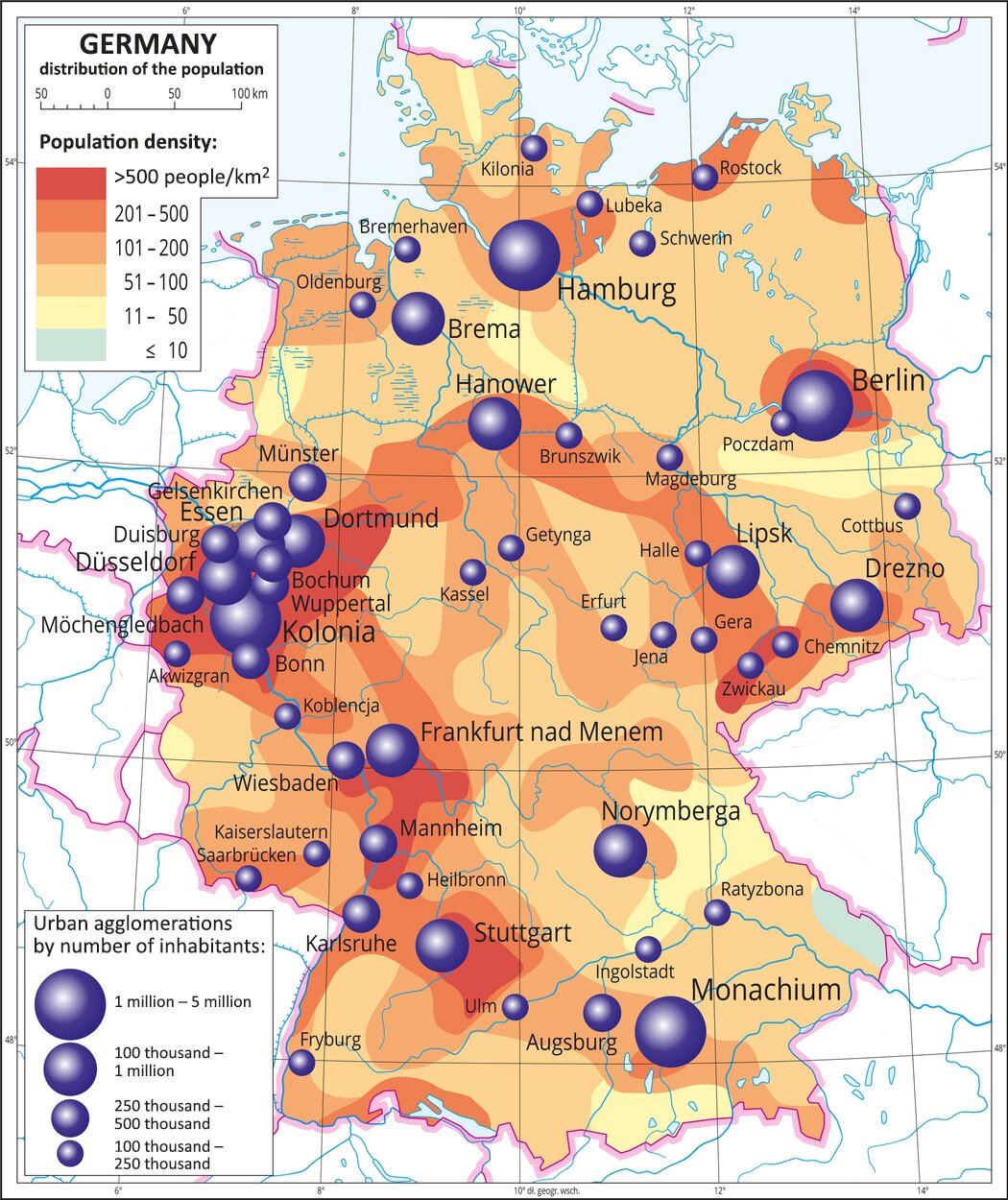
Germany has 82 million inhabitants, which is more than twice as many as Poland. It is the second most populated country in Europe after Russia. The population of Germany is distributed quite densely virtually throughout the country. The average population density is 230 people per 1 kmIndeks górny 22, but there are several areas with very high population density:
RuxOFYT2rpCCp
Ilustracja przedstawiająca mapę zaludnienia Niemiec. Oznaczono na niej tereny o zaludnieniu powyżej pięciuset mieszkańców na kilometr kwadratowy, które znajdują się w okolicach Kolonii, Berlina, Frankfurtu, Stuttgartu oraz tereny o zaludnieniu od dwieście jeden do pięciuset mieszkańców na kilometr kwadratowy, które znajdują się w okolicach Drezna, Norymbergi, Monachium, Hanoweru, Hamburga oraz tereny teryny o mniejszym zaludnieniu od stu jeden do dwustu mieszkańców na kilometr kwadratowy, od pięćdziesięciu jeden do stu mieszkańców na kilometr kwadratowy, od jedenastu do pięćdziesięciu mieszkańców na kilometr kwadratowy oraz poniżej dziesięciu mieszkańców na kilometr kwadratowy, które znajdują się pomiędzy dużymi niemieckim miastami. Na mapie kropkami oznaczona główne miasta min. miasta od jednego miliona do pięciu milionów mieszkańców takie jak Berlin, Monachium, Kolonia, miasta od stu tysięcy do jednego miliona mieszkańców takie jak np. Dortmund, Stuttgart, Norymberga, Drezno, Hanower oraz mniejszymi kropkami miasta od dwustu pięćdziesięciu do pięciuset tysięcy mieszkańców i miasta od stu tysięcy do dwustu pięćdziesięciu tysięcy mieszkańców. Mapa pokryta jest równoleżnikami co dwa stopnie oraz południkami co 10 stopni. Mapa otoczona jest ramką w której lewym górnym rodu znajduję się legenda mapy, natomiast w lewym dolnym rogu informacja o graficznym oznaczeniu miast.
Distribution of the German population
Source: licencja: CC BY 3.0.
RFkTRA33VfwiP
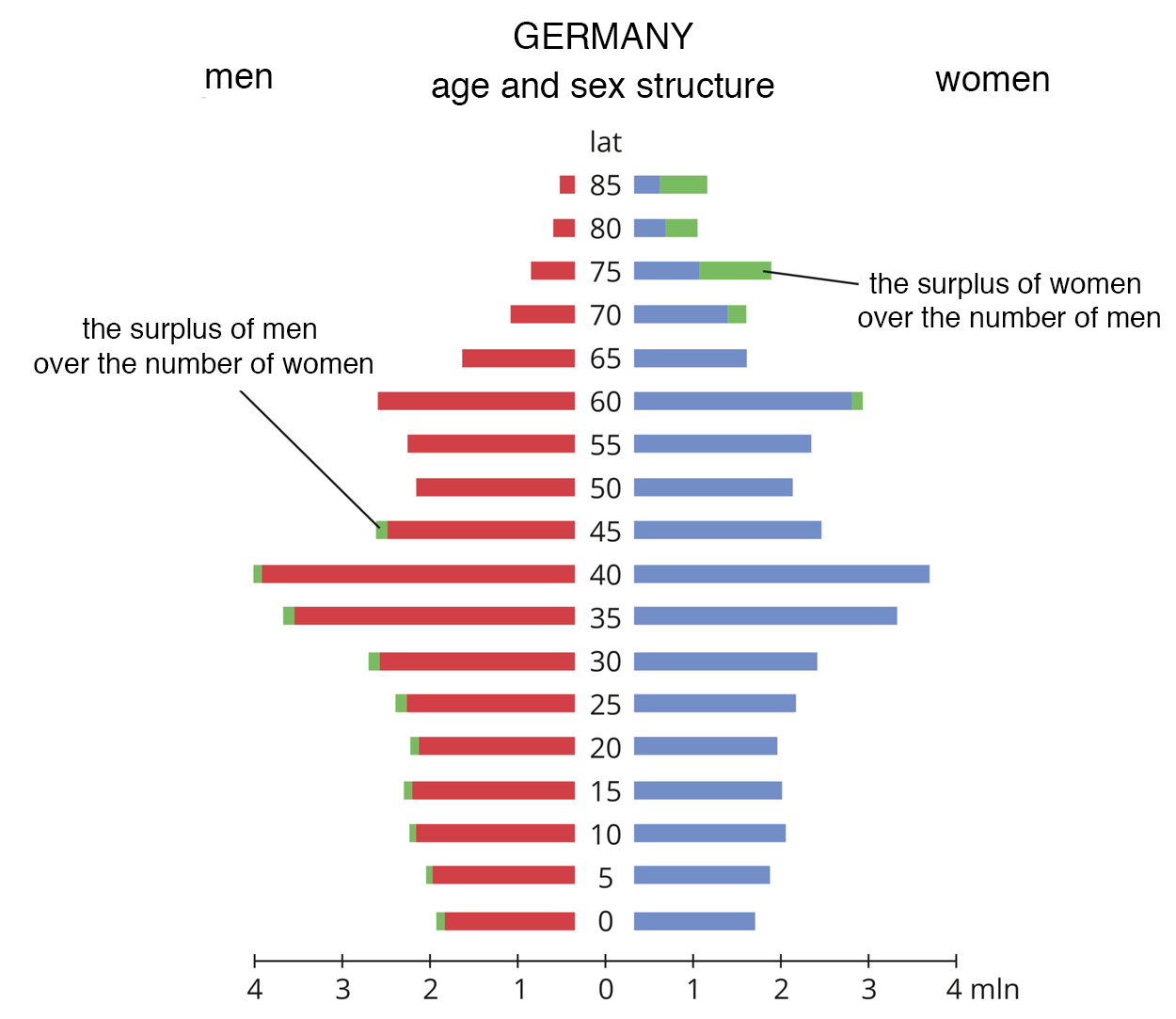
Na ilustracji piramida płci i wieku ludności charakteryzująca się wąską podstawą, świadczącą o niskim udziale młodych w społeczeństwie, a rozszerzająca się w górnej części, co wskazuje na duży udział ludności starej.
Dzieci płci męskiej urodziło się blisko dwa miliony. Dzieci płci męskiej urodziło się blisko dwa miliony.
Dzieci w wielu 5 lat (obu płci) jest po około 2 miliony. Dzieci (chłopców i dziewczynek) w wieku 10 jest powyżej 2 milionów. Chłopców w wieku 15 lat jest powyżej 2 milionów. Dziewczyn w wieku 15 lat jest powyżej 2 milionów. Chłopców w wieku 20 lat jest powyżej 2 milionów. Dziewczyn w wieku 20 lat jest powyżej 2 milionów. Chłopców w wieku 25 lat jest około 2,5 miliona. Dziewczyn w wieku 25 lat jest około 2 milionów.
Mężczyzn w wieku 30 lat jest około 3 milionów. Kobiet w wieku 30 lat jest około 2,5 miliona.
Mężczyzn w wieku 35 lat jest blisko 3,5 miliona. Kobiet w wieku 35 lat jest około 3,5 miliona.
Mężczyzn w wieku 40 lat jest blisko 4 miliony. Kobiet w wieku 40 lat jest około 4 miliony.
Mężczyzn w wieku 45 lat jest około 2,5 miliona. Kobiet w wieku 45 lat jest około 2,5 miliona. Mężczyzn w wieku 50 lat jest 2 miliony. Kobiet w wieku 50 lat jest 2 miliony. Mężczyzn w wieku 55 lat jest ponad 2 miliony. Kobiet w wieku 55 lat jest ponad 2 miliony.
Mężczyzn w wieku 60 lat jest 2,5 miliona. Kobiet w wieku 60 lat jest około 2,5 miliona.
Mężczyzn w wieku 65 lat jest ponad 1,5 miliona. Kobiet w wieku 65 lat jest ponad 1,5 miliona.
Mężczyzn w wieku 70 lat jest około 1 miliona. Kobiet w wieku 70 lat jest około 1,5 miliona.
Mężczyzn w wieku 75 lat jest około 1 miliona. Kobiet w wieku 75 lat jest około 2 milionów.
Mężczyzn w wieku 80 lat jest około 0,5 miliona. Kobiet w wieku 80 lat jest około 1 miliona.
Mężczyzn w wieku 85 lat jest około 250 tysięcy. Kobiet w wieku 85 lat jest ponad milion.
The gender and age structure of the German population.
Source: licencja: CC BY 3.0.
Task 2
Give reasons for the aging of the German population. Formulate conclusions.
R1HC1jhyO22Y3
Jakie są przyczyny starzejącego się społeczeństwa Niemiec? Podaj przyczyny i wnioski.
Jakie są przyczyny starzejącego się społeczeństwa Niemiec? Podaj przyczyny i wnioski.
Economy of Germany
Germany is the world’s fourth largest economic power after the United States, China, and Japan. The total value of the Gross Domestic Product of our western neighbors is 8 times higher than that of Poland. Germany owes its economic success, among others, to the American Marshall Plan, which after World War II covered the countries of Western Europe, including the Federal Republic of Germany. As part of this plan, the US gave a huge amount of money to rebuild war damage, securing lasting political support in return. In addition, the very good organization of work and discipline, for which our neighbors are well known, also contributed to Germany’s intensive economic development.
The post‑war development of the German economy was based on heavy industry concentrated in the Ruhr Area. Hard coal was mined there. There were numerous ironworks and plants of the electromechanical and chemical industry. In 1951, Germany together with France, Belgium, the Netherlands, Luxembourg and Italy formed the European Coal and Steel Community, which was the beginning of the construction of today's common Europe. In 1957, the same countries established the European Economic Community (EEC), which after the accession of another six countries in the 1970s and 1980s transformed into the European Union in 1993.
The German economy today is based mainly on high‑end services in which nearly 70% of all employees work. These services are located primarily in cities, where - as we remember - over 70% of the population lives. Trade (including foreign trade) and transport - road, rail, air as well as sea and inland waterways are of the greatest importance.
German industry has significantly changed in the last few decades. In the industrial Ruhr Area less and less hard coal is mined. It becomes unprofitable. However, large amounts of steel are still produced there. The steel is used, among others, for the production of means of transport. Germany's industrial flagship is cars, whose production has long gone beyond the borders of the country. Opel Astra and Volkswagen Caddy vans are assembled in Poland. Various other German factories operate in the countries of Central and Eastern Europe due to cheaper workforce. Our western neighbors operate less and less mass production plants that are located in the country. However, there are still specialist equipment factories known for high quality. They manufacture machines and devices for industry, agriculture or services. In addition, modern technologies (Hi‑Tech) are developed in numerous scientific centers.
The most important mineral resource is lignite. Germany takes first place in the world in the lignite mininig. The potassium salts are also very important. In addition extracted are, rock salt, oil, and natural gas. The output is not very large, although several times more than in Poland.
The map of the main German mineral resources is published in the e‑textbook.
Task 3
Germany – an economic power. List the following: industrial districts, mineral resources, major international concerns (based in Germany). Use source materials such as geography textbooks, the Internet, and geographical atlases.
R5OiliIcbUbqW
Omów gospodarkę Niemiec. okręgi przemysłowe, surowce mineralne, największe międzynarodowe koncerny.
Omów gospodarkę Niemiec. okręgi przemysłowe, surowce mineralne, największe międzynarodowe koncerny.
RNOix6EIDIcOZ
Exercise 2
Fill the gaps in the sentences. Germany is a large country in Western Europe with more than 1. third, 2. the Ruhr district, 3. RNN, 4. NDR, 5. the German Democratic Republic, 6. 80, 7. fourth, 8. 90, 9. the North Sea, 10. Hanover, 11. Hamburg, 12. The Black Forest District, 13. Dresden, 14. the Black Sea, 15. continental, 16. transitional million inhabitants.
After World War II, until 1990, Germany was divided into two countries – the Federal Republic of Germany and 1. third, 2. the Ruhr district, 3. RNN, 4. NDR, 5. the German Democratic Republic, 6. 80, 7. fourth, 8. 90, 9. the North Sea, 10. Hanover, 11. Hamburg, 12. The Black Forest District, 13. Dresden, 14. the Black Sea, 15. continental, 16. transitional. Germany has access to two seas – 1. third, 2. the Ruhr district, 3. RNN, 4. NDR, 5. the German Democratic Republic, 6. 80, 7. fourth, 8. 90, 9. the North Sea, 10. Hanover, 11. Hamburg, 12. The Black Forest District, 13. Dresden, 14. the Black Sea, 15. continental, 16. transitional and the Baltic Sea. Germany has a temperate, warm climate – marine and 1. third, 2. the Ruhr district, 3. RNN, 4. NDR, 5. the German Democratic Republic, 6. 80, 7. fourth, 8. 90, 9. the North Sea, 10. Hanover, 11. Hamburg, 12. The Black Forest District, 13. Dresden, 14. the Black Sea, 15. continental, 16. transitional. Germany is a densely populated country where the largest population centers are the conurbation of 1. third, 2. the Ruhr district, 3. RNN, 4. NDR, 5. the German Democratic Republic, 6. 80, 7. fourth, 8. 90, 9. the North Sea, 10. Hanover, 11. Hamburg, 12. The Black Forest District, 13. Dresden, 14. the Black Sea, 15. continental, 16. transitional and the agglomerations of Berlin, 1. third, 2. the Ruhr district, 3. RNN, 4. NDR, 5. the German Democratic Republic, 6. 80, 7. fourth, 8. 90, 9. the North Sea, 10. Hanover, 11. Hamburg, 12. The Black Forest District, 13. Dresden, 14. the Black Sea, 15. continental, 16. transitional, and Munich.
Germany is the 1. third, 2. the Ruhr district, 3. RNN, 4. NDR, 5. the German Democratic Republic, 6. 80, 7. fourth, 8. 90, 9. the North Sea, 10. Hanover, 11. Hamburg, 12. The Black Forest District, 13. Dresden, 14. the Black Sea, 15. continental, 16. transitional largest economic power in the world after the US, China, and Japan.
Fill the gaps in the sentences. Germany is a large country in Western Europe with more than 1. third, 2. the Ruhr district, 3. RNN, 4. NDR, 5. the German Democratic Republic, 6. 80, 7. fourth, 8. 90, 9. the North Sea, 10. Hanover, 11. Hamburg, 12. The Black Forest District, 13. Dresden, 14. the Black Sea, 15. continental, 16. transitional million inhabitants.
After World War II, until 1990, Germany was divided into two countries – the Federal Republic of Germany and 1. third, 2. the Ruhr district, 3. RNN, 4. NDR, 5. the German Democratic Republic, 6. 80, 7. fourth, 8. 90, 9. the North Sea, 10. Hanover, 11. Hamburg, 12. The Black Forest District, 13. Dresden, 14. the Black Sea, 15. continental, 16. transitional. Germany has access to two seas – 1. third, 2. the Ruhr district, 3. RNN, 4. NDR, 5. the German Democratic Republic, 6. 80, 7. fourth, 8. 90, 9. the North Sea, 10. Hanover, 11. Hamburg, 12. The Black Forest District, 13. Dresden, 14. the Black Sea, 15. continental, 16. transitional and the Baltic Sea. Germany has a temperate, warm climate – marine and 1. third, 2. the Ruhr district, 3. RNN, 4. NDR, 5. the German Democratic Republic, 6. 80, 7. fourth, 8. 90, 9. the North Sea, 10. Hanover, 11. Hamburg, 12. The Black Forest District, 13. Dresden, 14. the Black Sea, 15. continental, 16. transitional. Germany is a densely populated country where the largest population centers are the conurbation of 1. third, 2. the Ruhr district, 3. RNN, 4. NDR, 5. the German Democratic Republic, 6. 80, 7. fourth, 8. 90, 9. the North Sea, 10. Hanover, 11. Hamburg, 12. The Black Forest District, 13. Dresden, 14. the Black Sea, 15. continental, 16. transitional and the agglomerations of Berlin, 1. third, 2. the Ruhr district, 3. RNN, 4. NDR, 5. the German Democratic Republic, 6. 80, 7. fourth, 8. 90, 9. the North Sea, 10. Hanover, 11. Hamburg, 12. The Black Forest District, 13. Dresden, 14. the Black Sea, 15. continental, 16. transitional, and Munich.
Germany is the 1. third, 2. the Ruhr district, 3. RNN, 4. NDR, 5. the German Democratic Republic, 6. 80, 7. fourth, 8. 90, 9. the North Sea, 10. Hanover, 11. Hamburg, 12. The Black Forest District, 13. Dresden, 14. the Black Sea, 15. continental, 16. transitional largest economic power in the world after the US, China, and Japan.
Fill the gaps in the sentences.
the Ruhr district, Hanover, third, 80, Hamburg, the German Democratic Republic, The Black Forest District, the North Sea, fourth, transitional, Dresden, the Black Sea, NDR, continental, RNN, 90
Germany is a large country in Western Europe with more than ............................................................ million inhabitants.
After World War II, until 1990, Germany was divided into two countries – the Federal Republic of Germany and ............................................................. Germany has access to two seas – ............................................................ and the Baltic Sea. Germany has a temperate, warm climate – marine and ............................................................. Germany is a densely populated country where the largest population centers are the conurbation of ............................................................ and the agglomerations of Berlin, ............................................................, and Munich.
Germany is the ............................................................ largest economic power in the world after the US, China, and Japan.
R1B4tINDaI4dY
Exercise 3
Match the German lands to their capitals. Bavaria Możliwe odpowiedzi: 1. Düsseldorf, 2. Munich, 3. Erfurt, 4. Hanover, 5. Potsdam, 6. Magdeburg, 7. Dresden Saxony Możliwe odpowiedzi: 1. Düsseldorf, 2. Munich, 3. Erfurt, 4. Hanover, 5. Potsdam, 6. Magdeburg, 7. Dresden Lower Saxony Możliwe odpowiedzi: 1. Düsseldorf, 2. Munich, 3. Erfurt, 4. Hanover, 5. Potsdam, 6. Magdeburg, 7. Dresden Saxony-Anhalt Możliwe odpowiedzi: 1. Düsseldorf, 2. Munich, 3. Erfurt, 4. Hanover, 5. Potsdam, 6. Magdeburg, 7. Dresden Brandenburg Możliwe odpowiedzi: 1. Düsseldorf, 2. Munich, 3. Erfurt, 4. Hanover, 5. Potsdam, 6. Magdeburg, 7. Dresden Thuringia Możliwe odpowiedzi: 1. Düsseldorf, 2. Munich, 3. Erfurt, 4. Hanover, 5. Potsdam, 6. Magdeburg, 7. Dresden North Rhine-Westphalia Możliwe odpowiedzi: 1. Düsseldorf, 2. Munich, 3. Erfurt, 4. Hanover, 5. Potsdam, 6. Magdeburg, 7. Dresden
Match the German lands to their capitals. Bavaria Możliwe odpowiedzi: 1. Düsseldorf, 2. Munich, 3. Erfurt, 4. Hanover, 5. Potsdam, 6. Magdeburg, 7. Dresden Saxony Możliwe odpowiedzi: 1. Düsseldorf, 2. Munich, 3. Erfurt, 4. Hanover, 5. Potsdam, 6. Magdeburg, 7. Dresden Lower Saxony Możliwe odpowiedzi: 1. Düsseldorf, 2. Munich, 3. Erfurt, 4. Hanover, 5. Potsdam, 6. Magdeburg, 7. Dresden Saxony-Anhalt Możliwe odpowiedzi: 1. Düsseldorf, 2. Munich, 3. Erfurt, 4. Hanover, 5. Potsdam, 6. Magdeburg, 7. Dresden Brandenburg Możliwe odpowiedzi: 1. Düsseldorf, 2. Munich, 3. Erfurt, 4. Hanover, 5. Potsdam, 6. Magdeburg, 7. Dresden Thuringia Możliwe odpowiedzi: 1. Düsseldorf, 2. Munich, 3. Erfurt, 4. Hanover, 5. Potsdam, 6. Magdeburg, 7. Dresden North Rhine-Westphalia Możliwe odpowiedzi: 1. Düsseldorf, 2. Munich, 3. Erfurt, 4. Hanover, 5. Potsdam, 6. Magdeburg, 7. Dresden
Based on the photos and descriptions, select the correct mountains. In the south‑west of Germany, in Baden‑Württemberg, there is a mountain range composed of old fault blocks. They are covered with dense deciduous forests and mixed forests. There, you will find, among others, the springs of the Danube as well as deep valleys and gorges of other rivers, which create picturesque landscapes. There are also many mineral waters and related spa towns.
R1ELgFVOXsoPu
Wybierz jedno nowe słowo poznane podczas dzisiejszej lekcji i ułóż z nim zdanie.
Wybierz jedno nowe słowo poznane podczas dzisiejszej lekcji i ułóż z nim zdanie.
Source: licencja: CC 0.
Keywords
lands, North Rhine‑Westphalia, the Ruhr district, German Democratic Republic, Federal Republic of Germany
Zagłębie Ruhry - zagłębie przemysłowe w Niemczech, w kraju związkowym Nadrenia Północna‑Westfalia. Położone jest nad rzeką Ruhrą, a także w pobliżu rzeki Ren.