Natural environment and economy of Ukraine
what the current territorial division of Europe is;
what the Soviet Union (USSR) was;
what the characteristics of the temperate warm continental climate are.
to determine the location of Ukraine on the map of Europe;
to discuss the current political situation in Ukraine;
to characterize the natural environment of Ukraine;
to list the main branches of the Ukrainian economy.
Location and division of Ukraine
Specify the geographical location of Ukraine and indicate the countries it borders.
Ukraine is a large country in Eastern Europe – the second largest on our continent, after the Russian Federation. It has an area of over 603 thousand kmIndeks górny 22, which is almost twice as large as that of Poland. The capital of Ukraine is Kiev.
Natural conditions
Describe the natural conditions of Ukraine: the coastline, the lay of the land, and the network of waterways. Use geographical atlases and the geography textbook, as well as the e‑textbook.
Ukraine is a lowland and upland country with a small share of mountains. These mountains include, among others, the narrow range of the Eastern Carpathians, which crosses the south‑western part of the country along a stretch of about 200 km. The highest peak of Ukraine can be found there – Hoverla – 2061 m above sea level. Another mountainous region in Ukraine are the coastal Crimean Mountains. From the geological point of view, they are similar to the Carpathians – they too were created in the Alpine orogeny and are mainly composed of sandstones, shales, and limestones. Due to their coastal location, they have high relative heights. The highest peak is Roman‑Kosh (1545 m above sea level).
On the eastern side of the Ukrainian Carpathians, there are vast, undulating upland areas – Podolia and Volhynia, as well as the Dnieper Upland (on the right bank of the Dnieper River). The central part of Ukraine is covered by great lowlands – the Dnieper Lowland (on the left bank of the Dnieper River), and the Black Sea Lowland (along the sea coast). Another lowland is Polesye, which stretches in the north‑western part of Ukraine, along the border with Belarus. On the other hand, in the east of the country, there is the relatively small and low Donets Ridge.
The biggest river in Ukraine is the Dnieper – the fourth longest river of Europe. It flows through the middle of the country from the north to the south, escaping to the Black Sea.
Ukraine has a temperate, warm, continental climate. This climate has the lowest precipitation among other temperate climates, and the greatest annual temperature variations. In practice, this means that summers are generally hot and dry, and winters – cold and dry. In the western part of Ukraine, near the border with Poland, there is a slightly milder type of climate, similar to our transitional climate. However, these are relatively high areas, which means that the climate there remains harsh, especially in winter. The warmest weather is recorded in the south, on the Black Sea coast, where the climate has Mediterranean characteristics.
Population of Ukraine
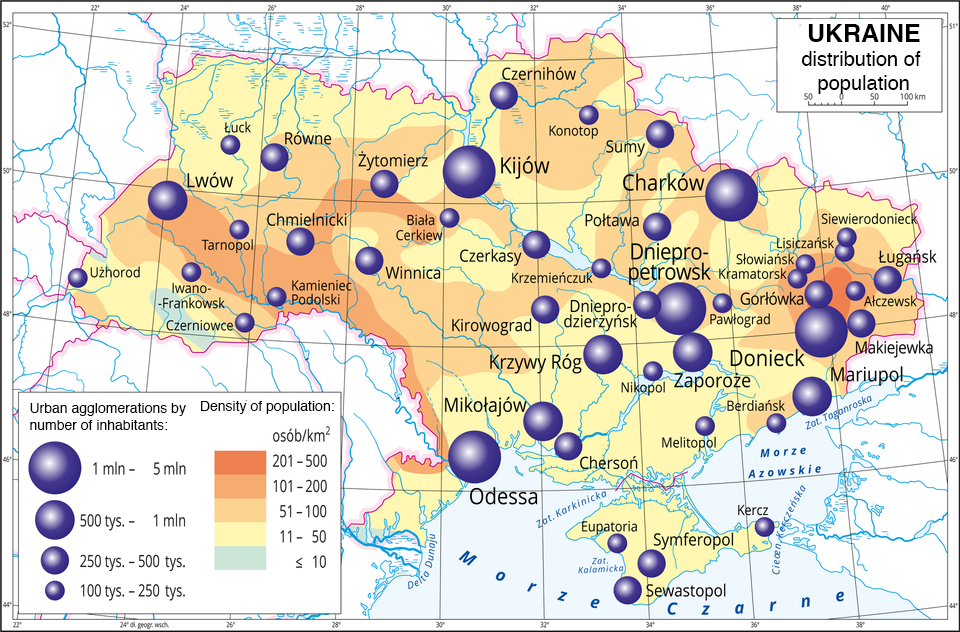
Ukraine currently has around 45 million inhabitants, slightly more than Poland. However, the population of our eastern neighbors has been steadily decreasing for years – after gaining independence in 1991, Ukraine had more than 52 million inhabitants. This decrease in population is mainly due to the unstable economic situation and poor economic development of the country. Uncertain future discourages young people from starting families and deciding to have children, and often forces them to emigrate. Moreover, on average, Ukrainians live much shorter (68 years) than other Europeans, which results in more deaths. All these factors contribute to a significant negative rate of natural increase and thus a negative actual rate of increase. The net migration rate oscillates around 0.
Economy of Ukraine
Discuss the following issues based on the maps in the e‑textbook, using geographical atlases, geography textbooks, and the Internet. Economy of Ukraine: Agriculture (soils and crops), industry (mineral resources and branches of industry).
Ukraine is an agricultural and industrial country. Figuratively speaking, the occurrence of fertile black earths over large areas left no choice but to develop them for growing crops. Large harvests are reaped and sold abroad – Ukraine is presently a significant exporter of wheat, corn, and sunflower. In addition, sugar beets, barley, and other cereals, as well as vegetables and fruit, are grown there. In the south of the country, the climate is the warmest and allows to grow, e.g., grapes, or even citrus fruits.
Animal husbandry in Ukraine is also highly developed. Pigs, cattle, and poultry dominate, among which ducks are of high export importance.
The Ukrainian industry has developed on the basis of mineral resources. In the Donetsk region, bituminous coal (in the past also brown coal) is mined, and in the area of Kryvyi Rih – iron ores. Ukraine is one of the world’s leading producers of these two raw materials. In addition, manganese and uranium ores as well as small quantities of crude oil and natural gas are extracted. Ukraine, like Poland, is dependent on supplies of Russian oil and gas.
The political situation of Ukraine is complicated.
The war with Russia continues in the east of Ukraine. On March 17, 2014, the authorities of the Autonomous Republic of Crimea unrecognized by Ukraine announced Crimea as an independent state. Then they asked Russia to join it. On the same day, Russian President Vladimir Putin signed a decree on the recognition of Crimea as a sovereign and independent state. A day later, the new creation became another entity of the Russian Federation.
Keywords
Crimea, Black Sea, Kiev
Match the pairs: English words with Polish definition.
typ wybrzeża, na którym w czasie przypływu zalewane są ujściowe odcinki rzek o charakterze lejkowym. Wraz z odpływem fale morskie unoszą muł z rzeki i budują wał między ujściem a otwartym morzem. Powstaje liman, czyli zatoka utworzona z ujściowego odcinka jaru rzeki., ruch społeczny związany z falą największych manifestacji i protestów przelewających się na Ukrainie od momentu uzyskania przez ten kraj niepodległości w 1991 roku. Rozpoczęły się one 21 listopada 2013 demonstracją przeciwko odłożeniu przez prezydenta Wiktora Janukowycza podpisania umowy stowarzyszeniowej z Unią Europejską.
| liman coast | |
| Euromaidan |
Glossary
wybrzeże limanowe - typ wybrzeża, na którym w czasie przypływu zalewane są ujściowe odcinki rzek o charakterze lejkowym. Wraz z odpływem fale morskie unoszą muł z rzeki i budują wał między ujściem a otwartym morzem. Powstaje liman, czyli zatoka utworzona z ujściowego odcinka jaru rzeki.
Euromajdan - ruch społeczny związany z falą największych manifestacji i protestów przelewających się na Ukrainie od momentu uzyskania przez ten kraj niepodległości w 1991 roku. Rozpoczęły się one 21 listopada 2013 demonstracją przeciwko odłożeniu przez prezydenta Wiktora Janukowycza podpisania umowy stowarzyszeniowej z Unią Europejską.