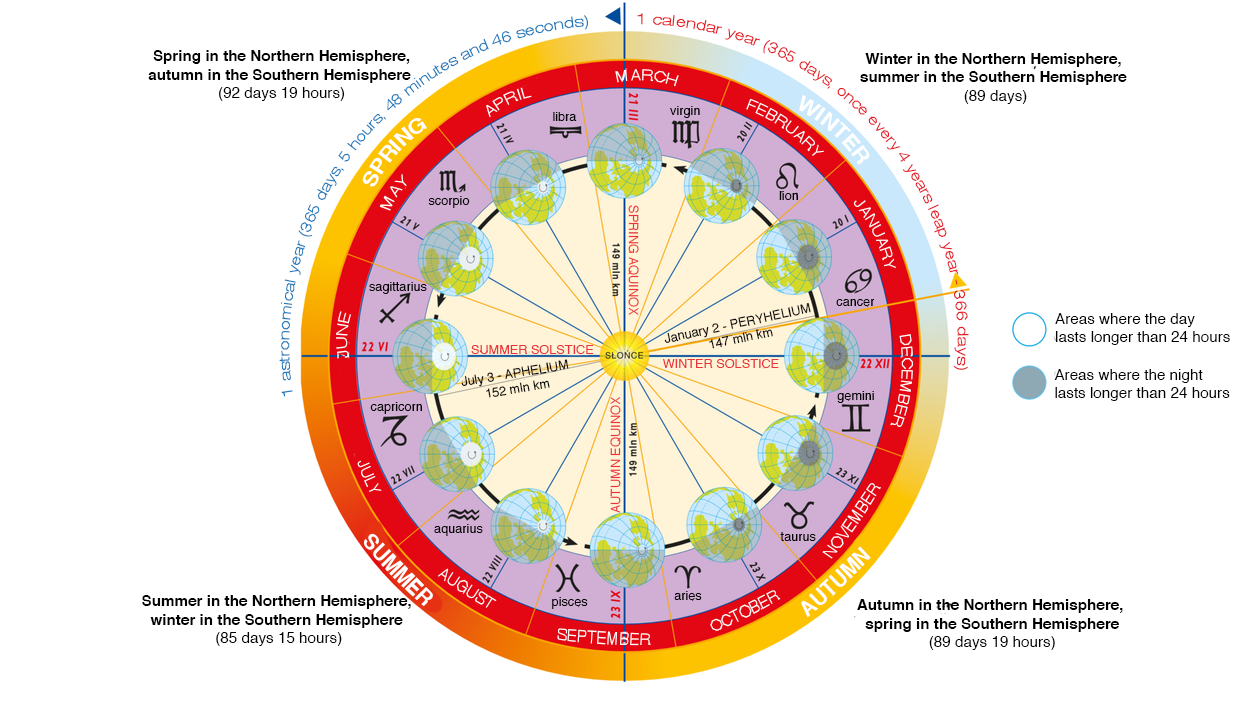
The Earth orbits the Sun on a slightly elongated elliptical orbit similar to a circle. This movement is called Earth’s revolution. The movement of the Earth around the Sun takes place in a counter‑clockwise direction (looking at the Earth‑Sun system from the Northern Hemisphere). The circulation time is slightly different in subsequent years, so we can only give a approximate time. It is commonly said that the solar yearsolar yearsolar year lasts 365 days 5 hours and 49 minutes. This means that, after this time, Earth returns to its starting position relative to the Sun. A sidereal yearsidereal yearsidereal year is a bit longer, it lasts about 365 days 6 hours 9 minutes and around 9 seconds. After this time has passed, Earth returns to the place from which the Sun is visible in the same position in relation to distant stars. Note that none of these measures of time has an equal number of days, which has consequences in determining when a year actually passes, and when constructing the calendar.
You now know that Earth's axial tilt in relation to its circulation plane around the Sun is around 66°33'. Astronomers talk about the tilting of the axis to the ecliptic planeecliptic planeecliptic plane, i.e. the plane containing the orbit, on which the Earth orbits the Sun. What is extremely important for the Earth is the fact that the tilting of its axis in relation to the plane of the orbit does not change during the entire cycle around the Sun, that is, during one year. This means that for a part of the year, the axis is directed towards the Sun with its northern end, which makes the Northern Hemisphere more illuminated. For the second half of the year, the Earth's axis is directed towards the Sun with its southern end, which causes the Southern Hemisphere to be more illuminated. On the other hand, twice a year, the Earth's axis sets itself in relation to the Sun, so that both Hemispheres are illuminated identically.
RojPpMLpzWObv
Ilustracja barwna, przedstawia okrąg, na którym jest schemat jak ruch Ziemi odbywa się na orbicie wokół Słońca w ciągu roku. Przedstawiono również pory roku i znaki zodiaku, które im odpowiadają.
The Earth's movement carried out in orbit around the Sun during the year. The Earth's circular motion makes the Sun appear against other constellations
Source: Roman Nowacki, Krzysztof Jaworski, Wikimedia Commons, licencja: CC BY 3.0.
Task 1
In available sources (you can use the Internet) find information about Earth's annual journey.
In available sources (you can use the Internet) find information about Earth's annual journey.
Using the globe and any object playing the role of the Sun, reconstruct Earth's annual journey.
RFHNpR7MjteaU
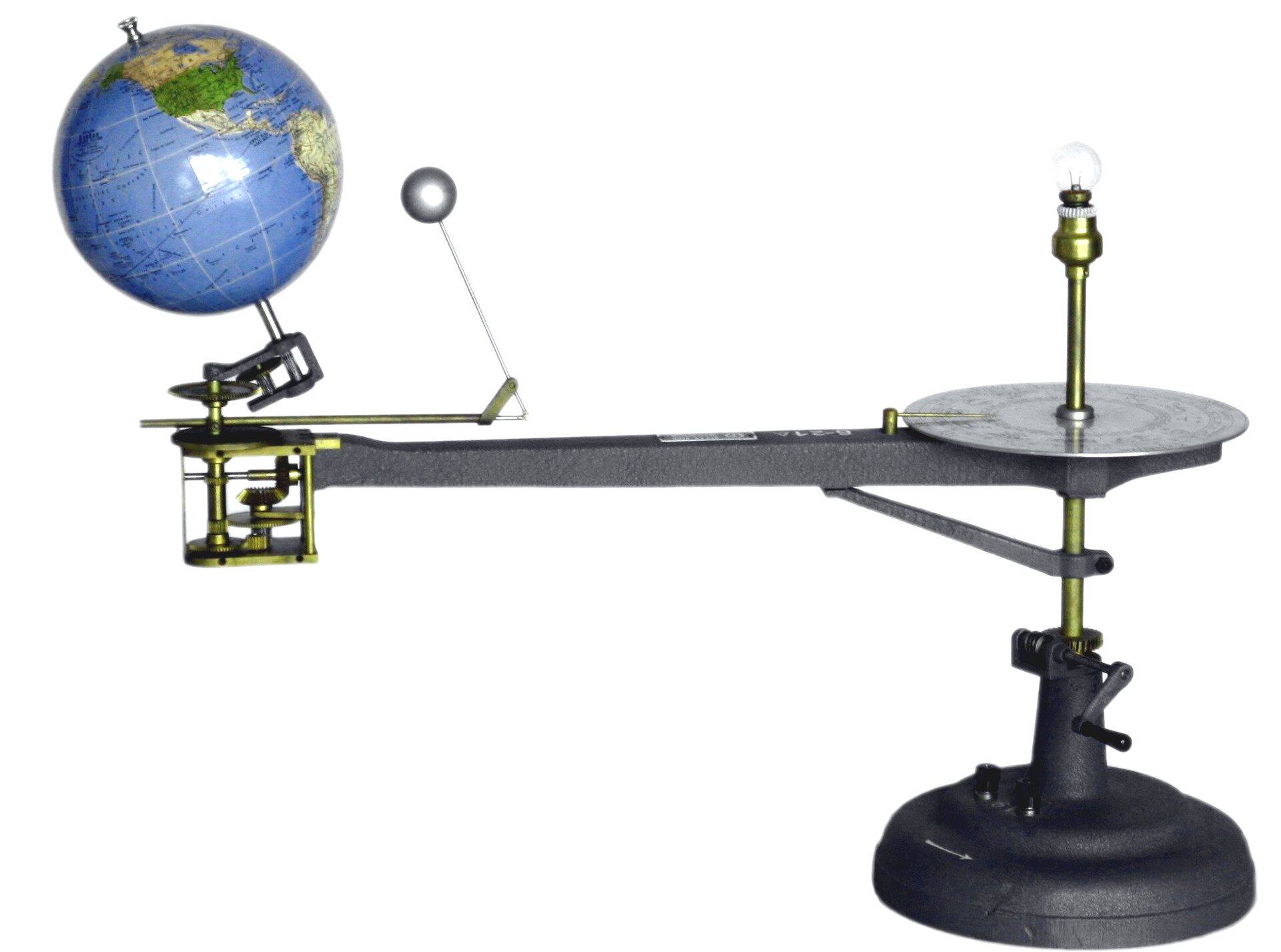
Zdjęcie przedstawia model do prezentacji ruchu Ziemi i Księżyca względem siebie oraz względem Słońca. Główna część modelu to podstawka po prawej stronie zdjęcia. Na pionowej osi, przymocowanej do podstawki, umocowano metalowe ramię w poziomie. Metalowe ramię skierowane w lewą stronę. Na końcu ramienia umieszczona kula ziemska. Kula ziemska nachylona w lewo. Na prawo od kuli ziemskiej mała srebrna kula. To Księżyc. Zarówno kula ziemska, jak i Księżyc mogą się swobodnie obracać wokół własnej osi oraz wokół Słońca. Księżyc dodatkowo może krążyć wokół Ziemi. Tellurium is a model that allows the presentation of the mutual movement of the Earth and the Moon relative to each other and to the Sun. It is used to show the illumination of the Earth at various times both day and year, phases of the Moon and solar and lunar eclipses.
Tellurium is a model that allows the presentation of the mutual movement of the Earth and the Moon relative to each other and to the Sun. It is used to show the illumination of the Earth at various times both day and year, phases of the Moon and solar and lunar eclipses
Source: Dr.-Ing. S.Wetzel alias, Wikimedia Commons, licencja: CC BY-SA 3.0.
Task 2
RrTBAIv3j7h1U
Korzystając z dostępnych źródeł informacji, scharakteryzuj ruch Księżyca wokół Słońca w trakcie roku.
Korzystając z dostępnych źródeł informacji, scharakteryzuj ruch Księżyca wokół Słońca w trakcie roku.
Set the tellurium into motion and follow the annual circulation of the Earth and Moon around the Sun. Note that the movement of the Earth around its own axis, the movement of the Moon around the Earth and the movement of the Earth (including the Moon) around the Sun occur simultaneously. Note the results in the table:
Exercise 1
R1UuHKVb2wFBr
Wysłuchaj nagrania abstraktu, ułóż do niego pytania i zadaj je koledze.
Wysłuchaj nagrania abstraktu, ułóż do niego pytania i zadaj je koledze.
Source: licencja: CC 0.
Exercise 2
Ro7HCF5yqwC4g
Match the definition to each of the concepts below
List of concepts:
1. sidereal year
2. equinox
3. the plane of the ecliptic
List of definitions:
1. time between two consecutive solar passages against the same stars
solar year
2. time between two consecutive solar passages during the March
3. the plane containing the orbit on which Earth circles around the Sun.
Match the definition to each of the concepts below
List of concepts:
1. sidereal year
2. equinox
3. the plane of the ecliptic
List of definitions:
1. time between two consecutive solar passages against the same stars
solar year
2. time between two consecutive solar passages during the March
3. the plane containing the orbit on which Earth circles around the Sun.
Match the definition to each of the concepts below
time between two consecutive solar passages against the same stars, the plane containing the orbit on which Earth circles around the Sun., time between two consecutive solar passages during the March equinox
sidereal year
solar year
the plane of the ecliptic
Exercise 3
RmYibhg44Njsf
Which of the following phenomena would we could not observe if the Earth's equator was positioned exactly in the ecliptic plane? Select three phenomena. Możliwe odpowiedzi: 1. The changing of seasons, 2. The succession of day and night, 3. The changes in sunrise and sunset position, 4. The change in the Sun’s height above the horizon at its highest point
Which of the following phenomena would we could not observe if the Earth's equator was positioned exactly in the ecliptic plane? Select three phenomena. Możliwe odpowiedzi: 1. The changing of seasons, 2. The succession of day and night, 3. The changes in sunrise and sunset position, 4. The change in the Sun’s height above the horizon at its highest point
Which of the following phenomena would we could not observe if the Earth's equator was positioned exactly in the ecliptic plane? Select three phenomena.
The changing of seasons
The succession of day and night
The changes in sunrise and sunset position
The change in the Sun’s height above the horizon at its highest point
Exercise 4
R1YQ1V0domD8S
Which of the following phenomena would be a consequence of the circular motion if the Earth's axis was set at a 90-degree angle to the ecliptic plane? Select the correct answer.
1. The changing of seasons
2. The change in the Sun’s position against the constellations during the year
3. The change in the Sun’s height above the horizon during the day
4. The changes in the length of day and night.
Which of the following phenomena would be a consequence of the circular motion if the Earth's axis was set at a 90-degree angle to the ecliptic plane? Select the correct answer.
1. The changing of seasons
2. The change in the Sun’s position against the constellations during the year
3. The change in the Sun’s height above the horizon during the day
4. The changes in the length of day and night.
Which of the following phenomena would be a consequence of the circular motion if the Earth's axis was set at a 90-degree angle to the ecliptic plane? Select the correct answer.
The changing of seasons
The change in the Sun’s position against the constellations during the year
The change in the Sun’s height above the horizon during the day
The changes in the length of day and night
Summary
The tilting of the Earth's axis is fundamental for the length of day and night, the altitude of the solar noon and the changing of seasons.
During the year, the equinox occurs twice on Earth, while the June solstice and the December solstice occur only once.
The places of sunrise and sunset as well as the altitude of the solar noon change throughout the year depending on the latitude.