Nematodes
maintaining proper hygiene protects against infections;
parasites live at the expense of the host organism.
to list characteristic features of flatworms and nematodes;
to identify an unknown organism as a representative of flatworms or nematodes based on the features of its construction;
to describe adaptations of worms to the parasitic mode of life;
to explain how you can become infected with pinworms, tapeworms and human roundworms;
to assess the role of flatworms and nematodes in nature.
Nematodes
Nematodes are vermiform animals. They are elongated, they do not have a separate head. Their body is slender cylindrical (elongated and round in cross‑section), spindly at both ends. Similarly to flatworms, their body is bi‑laterally symmetrical, and the front and rear part may be distinguished. The free‑living forms found among them occur in soil, fresh and salt waters. The nematodes also include internal parasitesinternal parasites of animals, such as: human roundworm, pinworm, trichinella spiralis or human whipworm, and of plants, e.g. beet cyst eelworm. Unlike flatworms, nematodes have an open gastrointestinal tract beginning with a mouth and ending with an anal hole. Nematodes do not have respiratory, circulatory or hard skeletal systems. Their body is filled with fluid that gives them shape and elasticity and allows the muscles to perform movements. The body colour of most nematodes is usually light cream or pink, just like flatworms.
The organs of the senses of soil nematodes are much less developed than those of flatworms living in water. Explain why it is the case.
Nematodes’ adaptations to parasitism
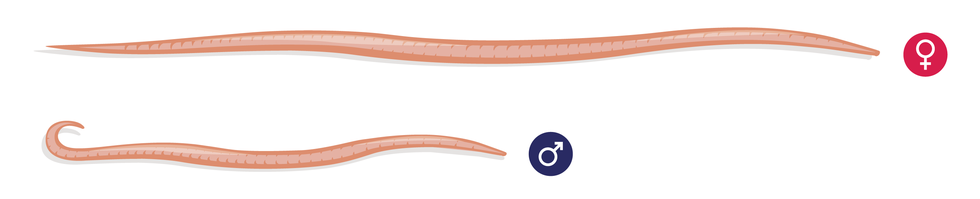
Parasitic nematodes show numerous adaptations to such a mode of life. Unlike parasitic flatworms, they do not have specialised clasping organs. They attach themselves to the wall of the host'shost's intestine with the help of lips, which surround their mouth. They do not have a separate head or neck. Parasitic nematodes, just like flatworms, can use aerobic and anaerobic respiration, and they intake respiratory gases and water with the entire surface of their body. Their body is covered with a thick layer of cuticle, just like in flatworms. Cuticle in free‑living forms protect against mechanical injuries, and in internal parasites it protects against the harmful effects of digestive fluids. Human roundworm, living in the host's intestine, feeds on nutrients contained in food digested by human. A distinct sexual dimorphismsexual dimorphism occurs. Female roundworms are even twice as large as males, they are up to 40 cm long. Whereas males, unlike females, have got a bent rear end of the body.
Many parasitic nematodes, such as human roundworms, can feed on human blood which they suck from the intestinal wall. Explain what consequences for the host organism it can have.
Explain why there is a digestive tract in the intestinal nematodes, but no digestive glands.
Nematode host – one for a lifetime
Parasitic nematodes usually stay in the host's body throughout their lives, in which they hatched from eggs. They can occur in large quantities. Most nematodes, unlike flatworms, are dioecious animals.
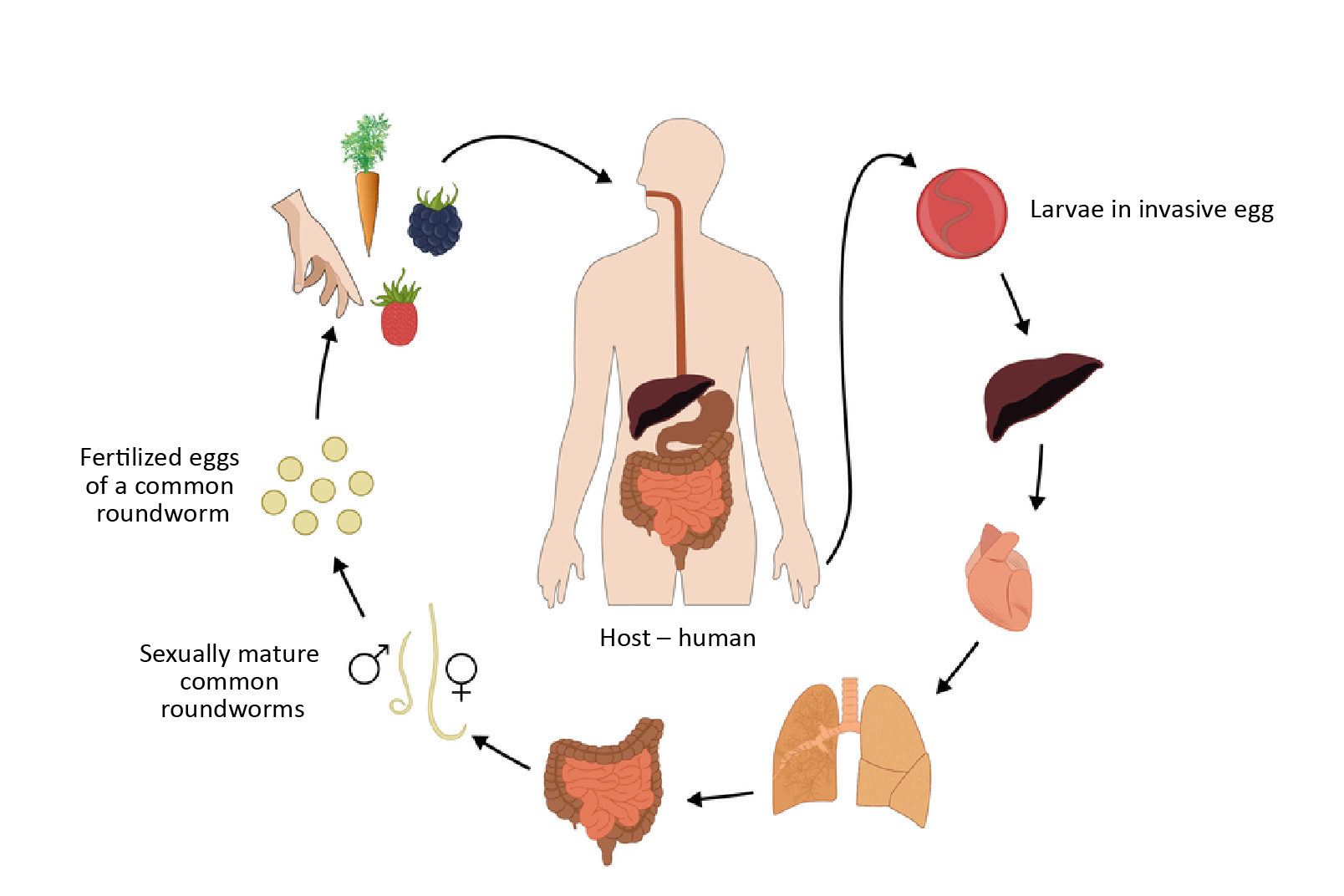
Adult roundworms live in the small intestine of a human. Females produce approximately 200,000 eggs daily. LarvaeLarvae develop in eggs. Such larvae‑containing eggs escape to the external environment with faeces and may contaminate water, vegetables or fruit. After ingestion by a human, the egg casings are digested in the intestine, and the larvae released from them pierce the intestinal wall and enter the blood vessels. Together with the bloodstream, they migrate to various organs: the liver, the heart, and finally they reach the lungs, where they break through the alveoli walls and migrate to the bronchi and trachea. The irritated trachea reacts with an expectorant reflex, which causes the larvae to enter the throat. Swallowed with saliva, they return to the small intestine. There, they mature sexually and reproduce.
Pinworm just like a roundworm has only one host – a human. Most people infected with this nematode are kindergarten children and their families because pinworm infection is very contagious. Unlike roundworms, pinworms live in the large intestine, not in the small intestine. At night, adult females lay eggs in the anus. The egg‑covering secretion causes unpleasant itching. The child, scratching, introduces eggs under the nails, from where they reach objects in its surroundings. They can also be transmitted to the mouth, then the so‑called autoinfection occurs. Prevention of pinworm infection is primarily a strict adherence to personal hygiene rules.
Prevention of worm infections is mainly about ensuring not to introduce eggs or larvae into the body. Plan other actions that should be taken to prevent the spread of infections.
Significance of flatworms and nematodes
Flatworms and nematodes are perceived by humans mainly as parasitic worms that seriously threaten not only health, but even life. They also cause dangerous animal diseases. They cause considerable losses in pigs and cattle breeding. They can infect pets, mainly dogs and cats, from which humans get infected. Therefore, we should remember about regular deworming of pets and adherence to basic hygiene rules, especially about washing hands after playing with them.
When buying wild game, we need to be sure that it has been tested and does not contain flatworm or nematode larvae. It is risky to eat raw meat, especially from home slaughter.
Parasitic nematodes living of plants can cause significant crop losses, up to 50% yields. It is worth noting, however, that worms have a positive impact on the environment, e.g. they regulate the number of zooplankton in the ecosystem, eliminate weaker individuals and provide food for snails and fish. Saprobionts in the soil take part in the processes of its formation.
Explain why fried or cooked pork is safe even when there are worm larvae in it.
Conclusion
Nematodes are worms with elongated, filamentous, limbless body with round cross‑section.
Most nematodes, such as human roundworms, pinworms, trichinella spiralis, are parasitic organisms. Only one host is present in their developmental cycle.
Adaptations of internal parasites to their mode of life consist, among others, in a very high fertility, reduction of sensory organs, immunity to digestive fluids, the ability to respirate anaerobicly.
Describe how to protect yourself against infection with:
pinwoms,
beef tapeworm (taenia saginata).
Match the pairs: English words with Polish definition.
organizm, którego kosztem żyje pasożyt dojrzały lub jego postaci larwalne, młodociane stadium wielu grup zwierząt, u których występuje rozwój złożony, dwupostaciowość, zróżnicowanie osobników męskich i żeńskich objawiające się w ich budowie zewnętrznej, organizm cudzożywny żyjący wewnątrz żywiciela, który stanowi źródło pożywienia
| sexual dimorphism | |
| larvae | |
| internal parasite | |
| host |
Keywords
human roundworm, pinworm, aschelminth
Glossary
dymorfizm płciowy – dwupostaciowość, zróżnicowanie osobników męskich i żeńskich objawiające się w ich budowie zewnętrznej
larwa – młodociane stadium wielu grup zwierząt, u których występuje rozwój złożony
pasożyt wewnętrzny – organizm cudzożywny żyjący wewnątrz żywiciela, który stanowi źródło pożywienia
żywiciel – organizm, którego kosztem żyje pasożyt dojrzały lub jego postaci larwalne