to experimentally present the third Newton's law and learn about its application,
to experimentally demonstrate the validity of the third Newton's law and show its application in practice.
Exercise 1
Answer the questions.
1. What is an interaction? 2. Can you only interact directly with other body? 3. What types of interactions do you know? 4. When do the forces balance?
1. Interaction is a kind of action that occur as two or more objects have an effect upon one another. 2. No, it is possible to interact directly or at a distance. 3. The basic types of interactions are gravitational, electric, magnetic and elastic. 4. If there are different forces acting on the body and the value of their resultant forceresultant forceresultant force is equal to 0 N, then the body is in a state of equilibrium, we are talking about the balancing of forcesbalancing of forcesbalancing of forces.
Watch the slideshow.
R18IihCly02kT1
Pokaz multimedialny - działanie sił akcji i reakcji. Instrukcja obsługi z poziomu klawiatury: 1. Uruchomienie aplikacji - ENTER, 2. Na każdym ze slajdów czytany jest automatycznie tekst alternatywny po polsku, 3. Przy pierwszym uruchomieniu na pierwszym slajdzie, czytanie tekstu po angielsku - TAB, 4. Przejście między slajdami: do następnego slajdu - TAB, do poprzedniego slajdu - TAB + SHIFT, 5. Przejście do czytania napisu po angielsku - strzałka w górę + strzałka w dół (czyta tekst po angielsku widoczny na slajdzie).
Pokaz multimedialny - działanie sił akcji i reakcji. Instrukcja obsługi z poziomu klawiatury: 1. Uruchomienie aplikacji - ENTER, 2. Na każdym ze slajdów czytany jest automatycznie tekst alternatywny po polsku, 3. Przy pierwszym uruchomieniu na pierwszym slajdzie, czytanie tekstu po angielsku - TAB, 4. Przejście między slajdami: do następnego slajdu - TAB, do poprzedniego slajdu - TAB + SHIFT, 5. Przejście do czytania napisu po angielsku - strzałka w górę + strzałka w dół (czyta tekst po angielsku widoczny na slajdzie).
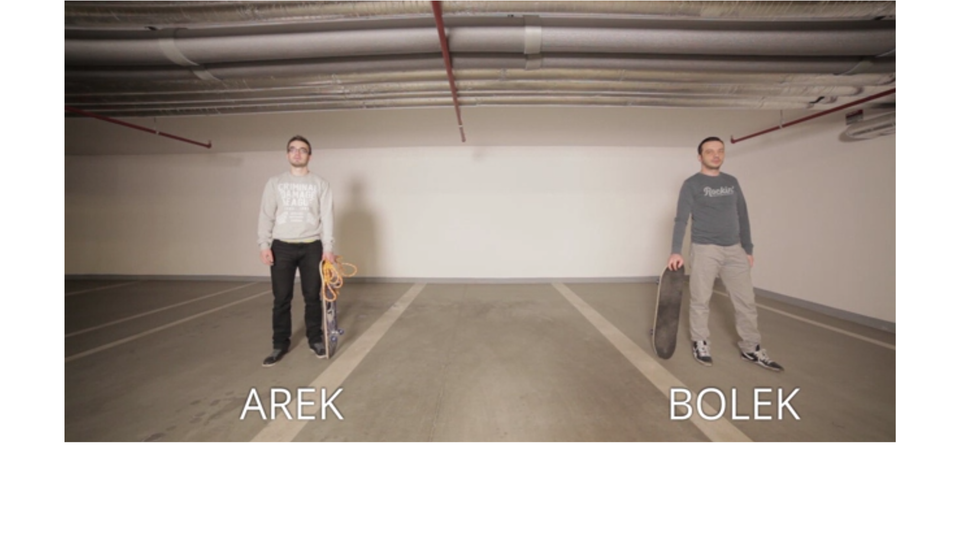
The following conclusions can be drawn based on the presented slides.
1. Arek attracts Bolek, but at the same time Bolek attracts Arek. 2. The boys act on each other with some force. 3. These forces have the same magnitude, but opposite directiondirectiondirection. These are the forces of actionactionaction and reactionreactionreaction. 4. The forces of action and reaction are not balanced because they are applied to two different bodies.
R1M0n8SFlLsCf1
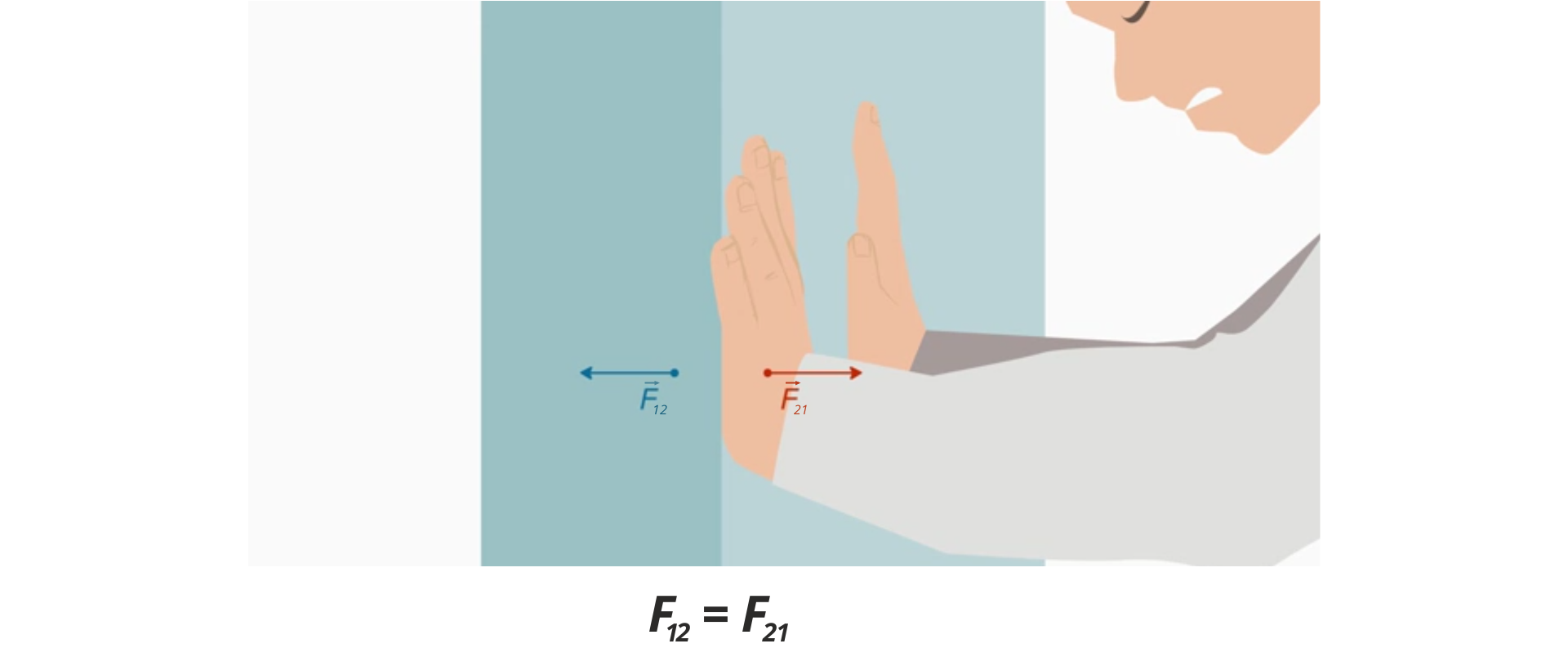
Rysunek przedstawia osobę, która opiera dłonie o ścianę. Na dłoni narysowana strzałka pozioma skierowana w prawo opisana F z indeksem dolnym 21. Na wysokości tej strzałki, na ścianie narysowana strzałka pozioma skierowana w lewo opisana F z indeksem dolnym 12. Bezpośrednio nad każdą literą F niewielka strzałka pozioma skierowana w prawo. Pod obrazkiem zapis F z indeksem dolnym 12 równa się F z indeksem dolnym 21.
1. Conduct the experiment on a flat surface, e.g. on a table with a smooth countertop or rails with a suitable spacing. 2. Attach the magnets to the front of the carts with plasticine. 3. The carts facing each other with magnets should attract each other. 4. Attach the thread to the back of each cart. 5. Attach the dynamometers to the ends of both threads. 6. With the help of a friend or a colleague, do not let the carts approach each other, pulling the end of the dynamometers. Make sure that the dynamometers are (if possible) parallel to the table surface. 7. Stop the carts at a short distance from each other. 8. Read the value indicated on the dynamometers. 9. Repeat the experiment several times.
When the body A acts on the body B with a certain forceforceforce , the body B acts on the body A with the force of the same magnitude, but the opposite directiondirectiondirection.
Wektor siły F z indeksem dolnym AB równa się minus wektor siły F z indeksem dolnym BA. Wartość siły F z indeksem dolnym AB równa się wartość siły F z indeksem dolnym BA.
Wektor siły F z indeksem dolnym AB równa się minus wektor siły F z indeksem dolnym BA. Wartość siły F z indeksem dolnym AB równa się wartość siły F z indeksem dolnym BA.
A man with a mass of 80 kg is standing at the bus stop with a backpack with a mass of 30 kg on his back. What is the force acting on the ground? What is the force the ground is acting on his feet? Give characteristics of these forces.
A man on the ground 1100 N, force characteristics: vertical downward direction, magnitude 1100 N. The ground on a man 1100 N, force characteristics: vertical upward direction, magnitude 1100 N.
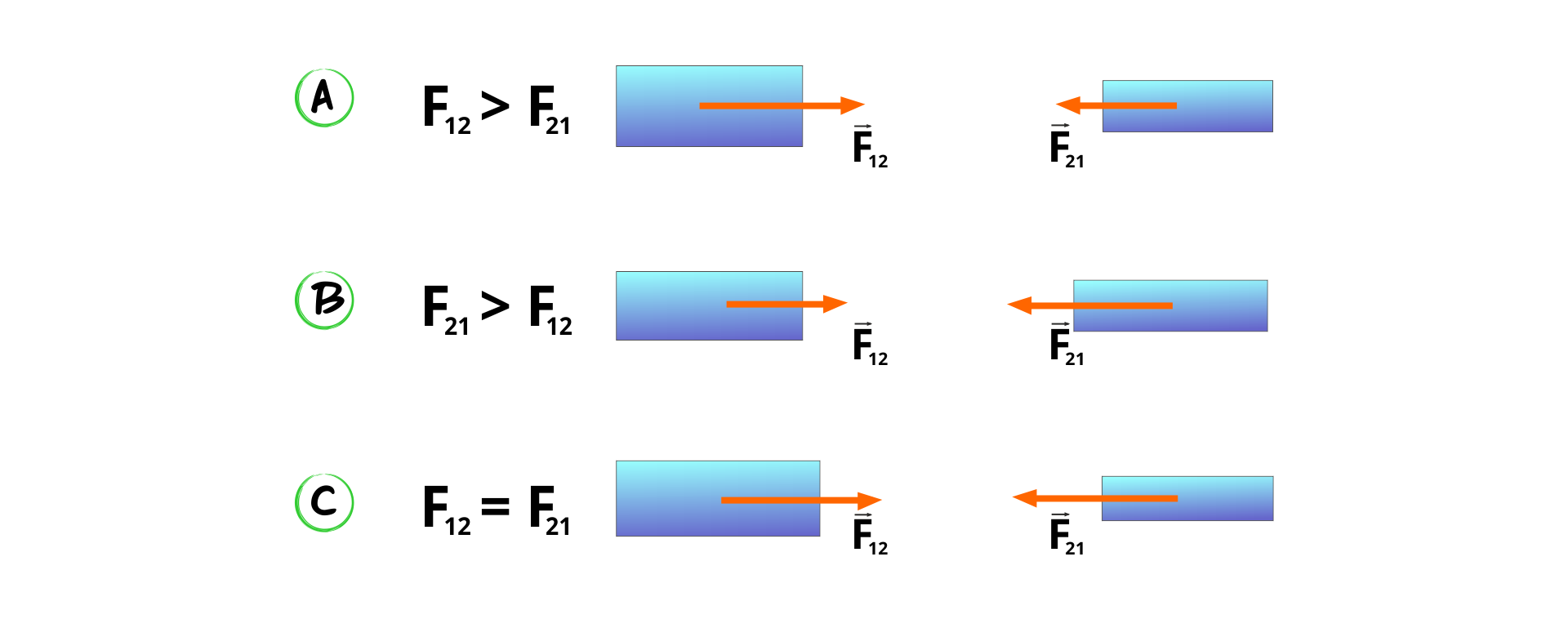
Which of the presented pictures correctly shows the force system resulting from mutual interactionsmutual interactionsmutual interactions?
R1W0RSgQNfUvO1
Rysunek przedstawia w punkcie a zapis F z indeksem dolnym 12 jest większe od F z indeksem dolnym 21. Obok narysowany prostokąt, z jego środka strzałka skierowana poziomo w prawo opisana F z indeksem dolnym 12. Nad literą F strzałka pozioma skierowana w prawo. Obok narysowany prostokąt, z jego środka krótsza strzałka skierowana poziomo w lewo opisana F z indeksem dolnym 21. Nad literą F strzałka pozioma skierowana w prawo. Rysunek przedstawia w punkcie b zapis F z indeksem dolnym 21 jest większe od F z indeksem dolnym 12. Obok narysowany prostokąt, z jego środka krótsza strzałka skierowana poziomo w prawo opisana F z indeksem dolnym 12. Nad literą F strzałka pozioma skierowana w prawo. Obok narysowany prostokąt, z jego środka strzałka skierowana poziomo w lewo opisana F z indeksem dolnym 21. Nad literą F strzałka pozioma skierowana w prawo. Rysunek przedstawia w punkcie c zapis F z indeksem dolnym 12 równa się F z indeksem dolnym 21. Obok narysowany prostokąt, z jego środka strzałka skierowana poziomo w prawo opisana F z indeksem dolnym 12. Nad literą F strzałka pozioma skierowana w prawo. Obok narysowany prostokąt, z jego środka strzałka skierowana poziomo w lewo opisana F z indeksem dolnym 21. Nad literą F strzałka pozioma skierowana w prawo.
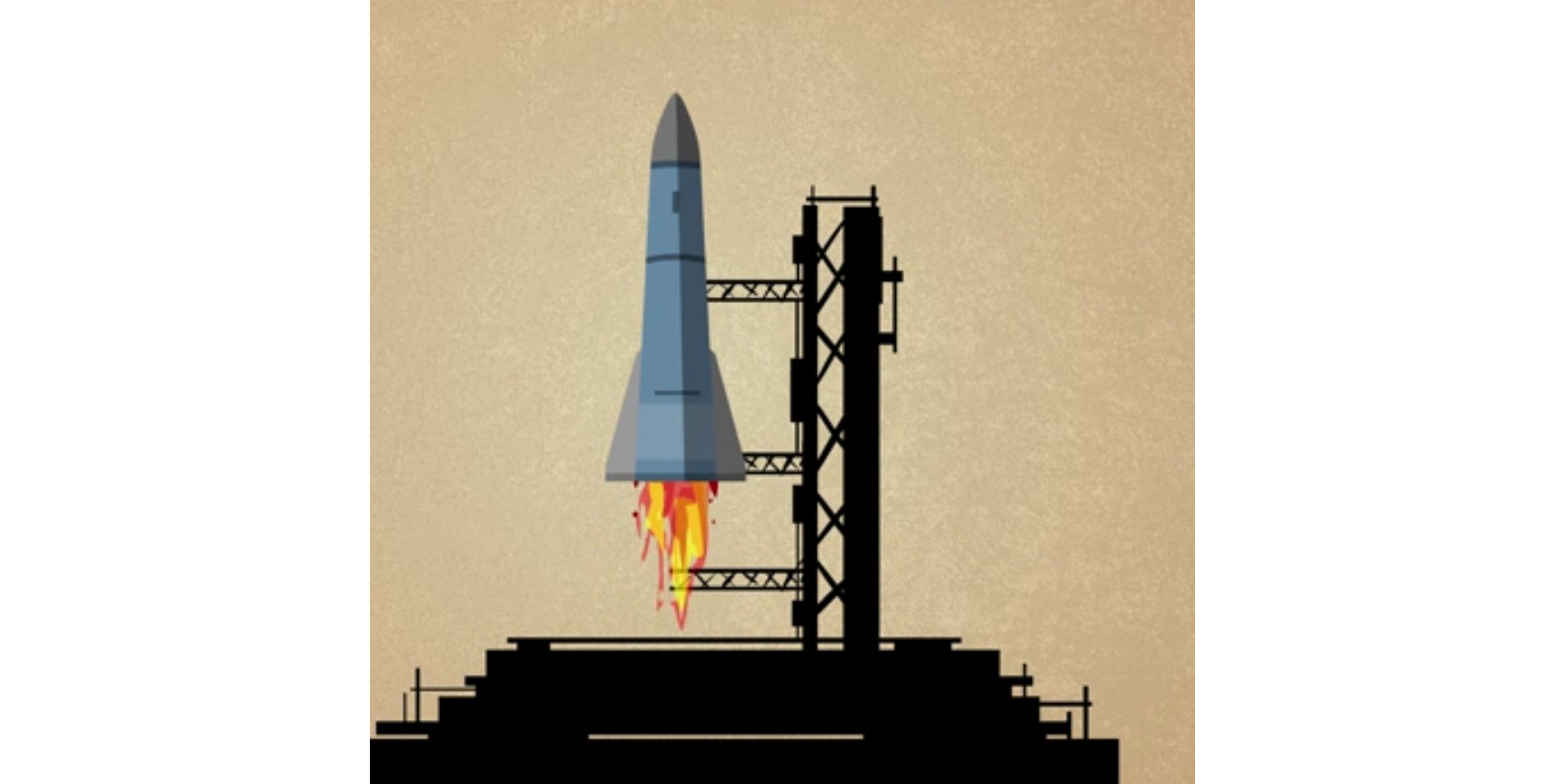
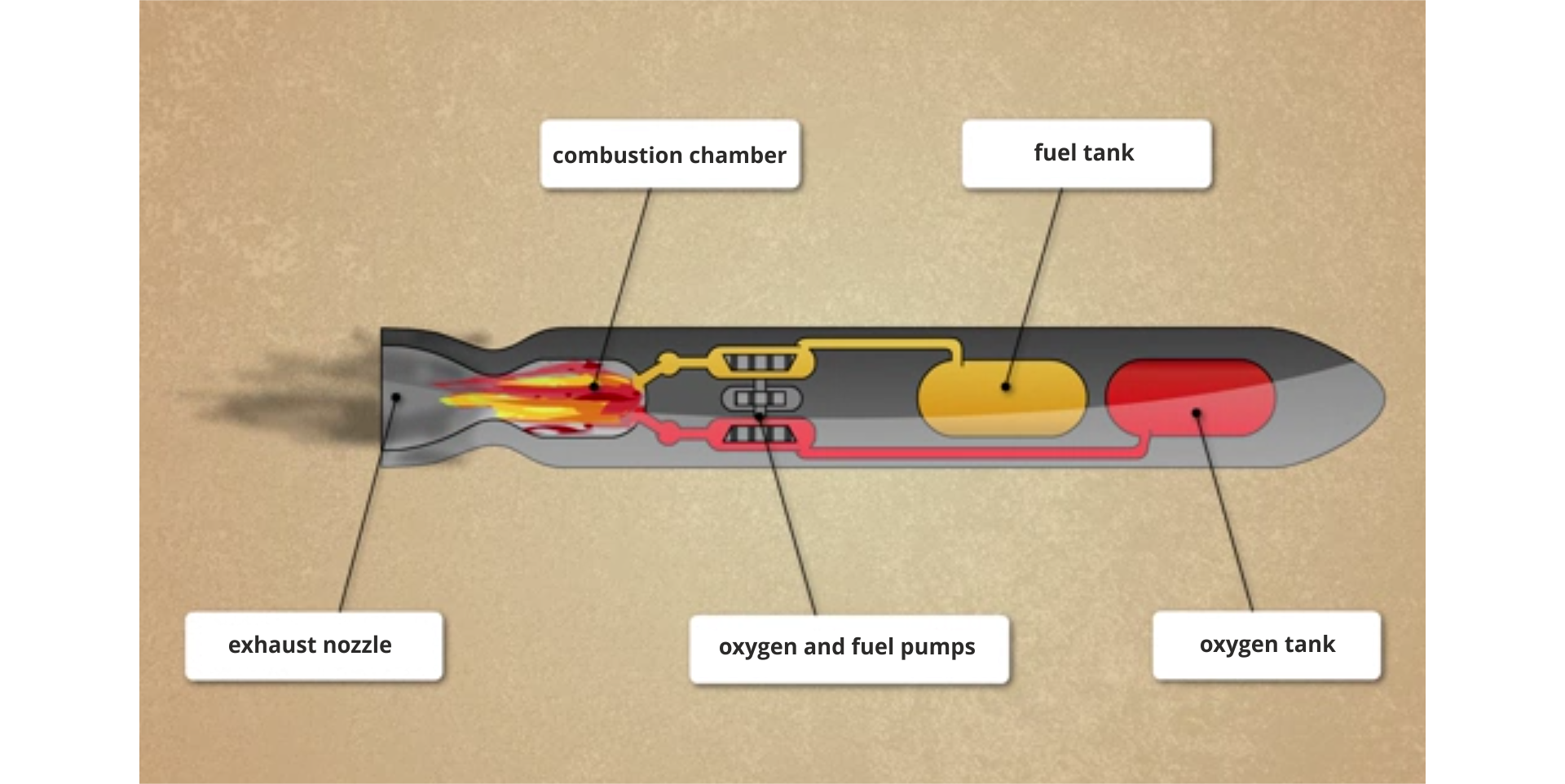
Using the illustration depicting the construction of a space rocket engine, explain how this type of engines work.
RdA3RFkceGHGk1
Ilustracja przedstawia rakietę przyczepioną do platformy startowej.
Source: GroMar, licencja: CC BY 3.0.
R1TOSS9VMxYjQ1
Rysunek przedstawia przekrój silnika rakiety z elementami. Rakieta znajduje się w pozycji poziomej, przód jej skierowany jest w prawo. Od prawej narysowany jest zbiornik tlenu opisany oxygen tank, za nim zbiornik paliwa opisany fuel tank. Od nich przewody do pomp opisanych oxygen and fuel pumps. Od pomp przewody prowadzą do komory spalania opisanej combustion chamber, wewnątrz której widoczne są płomienie przechodzące w dym w dyszy wylotowej opisanej exhaust nozzle.
Fuel in an oxygen atmosphere burns in the combustion chamber. The gas which is the combustion product rapidly expands as it passes through the outlet nozzle. The rocket ejects the fuel burning reaction product through the nozzle in only one direction. By leaving the rocket, the burnt fuel exerts on the rocket a forceforceforce of action called the force of thrust. This force causes the rocket to accelerate in the direction opposite to the direction of the ejected gases.
There are many types of interactions in nature. The value of force is a measure of the interaction. The interactions are mutual, that is, if we trigger a certain action by applying force, we must expect the reactionreactionreaction of the body on which we act.
The fact that the interactions were mutual was noticed by the English scholar Isaac Newton, who lived at the turn of the 17th and 18th centuries. The results of his research in this area are formulated in the form of the third Newton’s lawNewton’s third lawthird Newton’s law.
The third Newton's law is that when the body A acts on the body B with a certain force, the body B acts on the body A with the forceforceforce of the same magnitude, but the opposite directiondirectiondirection. These forces cannot be balanced because they are applied to two different bodies.
The third Newton's law is also called the action‑reaction lawaction - reaction lawaction‑reaction law. Each actionactionaction is accompanied by a reaction equal in magnitude, but with the opposite direction. However, it should be remembered that the forces do not balance, because they have a different point of application.
Exercises
RG6Sd8qQ9tfdU
Exercise 5
Wersja alternatywna ćwiczenia: The third Newton’s law is fulfilled when the result of interaction of the bodies is Możliwe odpowiedzi: 1. only rest., 2. rest when one body acts on the other force, the same as the value but the opposite. In the third principle, the dynamics are not information about motion., 3. only uniform rectilinear motion or uniformly accelerated motion., 4. only uniform rectilinear motion.
Wersja alternatywna ćwiczenia: The third Newton’s law is fulfilled when the result of interaction of the bodies is Możliwe odpowiedzi: 1. only rest., 2. rest when one body acts on the other force, the same as the value but the opposite. In the third principle, the dynamics are not information about motion., 3. only uniform rectilinear motion or uniformly accelerated motion., 4. only uniform rectilinear motion.
The third Newton’s law is fulfilled when the result of interaction of the bodies is
only rest.
rest when one body acts on the other force, the same as the value but the opposite. In the third principle, the dynamics are not information about motion.
only uniform rectilinear motion or uniformly accelerated motion.
only uniform rectilinear motion.
zadanie
Source: GroMar, licencja: CC BY 3.0.
Exercise 6
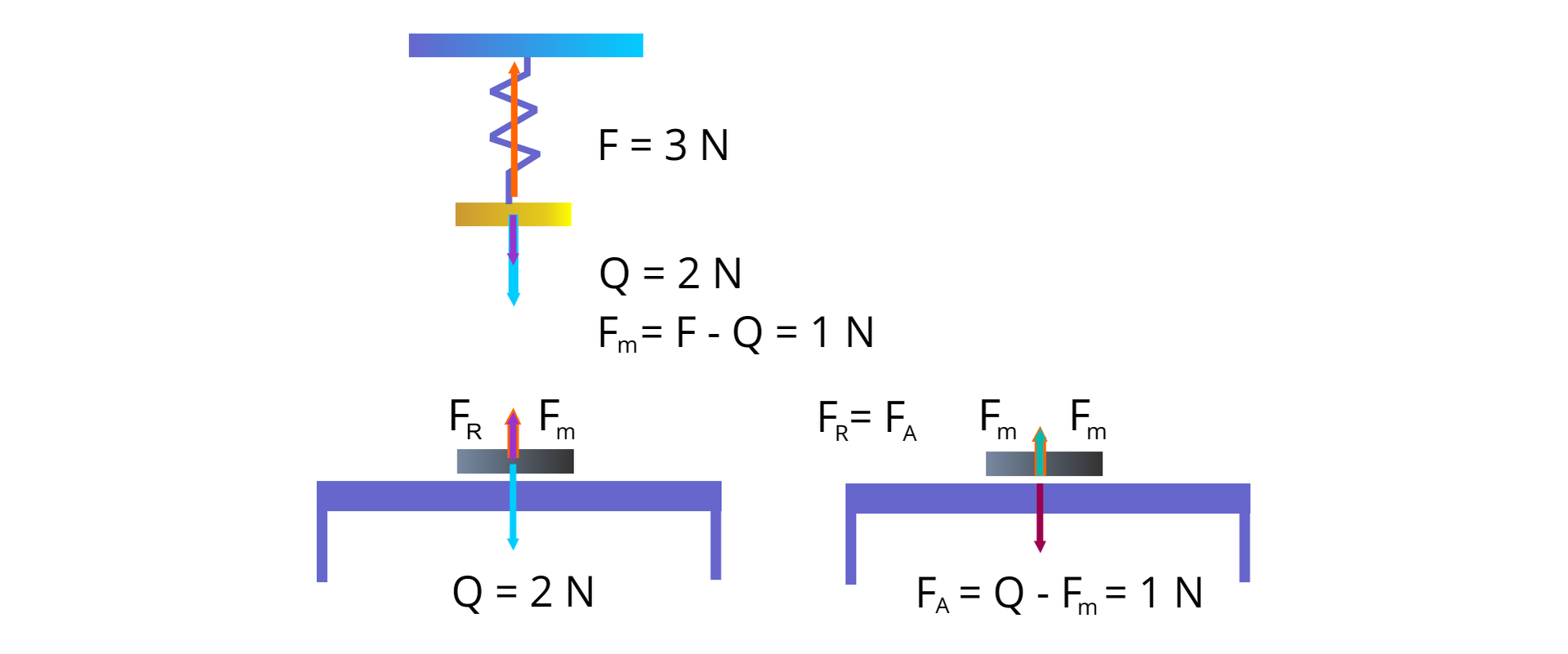
On the table lies a magnet with a mass of 0,2 kg, and above it an iron bar of the same mass hangs on a dynamometer. What is the force the magnet acts on the table if the dynamometer shows a force of 3 N. Present the force system in the drawing. Assume .
The weight of the magnet and the iron bar:
RoqAmeEOsSqNt1
Zastosowanie III zasady dynamiki Newtona do analizy rozkładu sił.
Source: GroMar, licencja: CC BY 3.0.
force of the force meter.
In accordance with the third principle of dynamics:
where: - is the strength of the magnet on the bar.
The normal force of the magnet on the table:
- strength of substrate reaction on magnet pressure.
The normal force of the magnet on the table is 1 N.
Exercise 7
Give four examples in English of the occurrence or application of the third Newton’s law.
Example answer.
a) If I stand on the floor, the normal force of my feet on the floor is equal to the force of the floor's reaction on my feet. b) The car is moving because the friction force of the rotating car tires when applied to the ground is equal to the ground reaction force, which is opposite to the friction force of the car's tires. c) The satellite in an orbit around the Earth acts gravitationally on the Earth with the force of the same magnitude as Earth on a satellite. d) The jet plane flies through the air due to the reaction force to the action force caused by bouncing of fuel particles in the combustion chamber from it.
RPtciT0L0yDvy
Exercise 8
Wersja alternatywna ćwiczenia: Match Polish terms with their English equivalents. punkt przyłożenia Możliwe odpowiedzi: 1. mutual interactions, 2. acting point, 3. balancing of forces, 4. resultant force, 5. Newton’s third law równoważenie sił Możliwe odpowiedzi: 1. mutual interactions, 2. acting point, 3. balancing of forces, 4. resultant force, 5. Newton’s third law oddziaływanie wzajemne Możliwe odpowiedzi: 1. mutual interactions, 2. acting point, 3. balancing of forces, 4. resultant force, 5. Newton’s third law III zasada dynamiki Newtona Możliwe odpowiedzi: 1. mutual interactions, 2. acting point, 3. balancing of forces, 4. resultant force, 5. Newton’s third law siła wypadkowa Możliwe odpowiedzi: 1. mutual interactions, 2. acting point, 3. balancing of forces, 4. resultant force, 5. Newton’s third law
Wersja alternatywna ćwiczenia: Match Polish terms with their English equivalents. punkt przyłożenia Możliwe odpowiedzi: 1. mutual interactions, 2. acting point, 3. balancing of forces, 4. resultant force, 5. Newton’s third law równoważenie sił Możliwe odpowiedzi: 1. mutual interactions, 2. acting point, 3. balancing of forces, 4. resultant force, 5. Newton’s third law oddziaływanie wzajemne Możliwe odpowiedzi: 1. mutual interactions, 2. acting point, 3. balancing of forces, 4. resultant force, 5. Newton’s third law III zasada dynamiki Newtona Możliwe odpowiedzi: 1. mutual interactions, 2. acting point, 3. balancing of forces, 4. resultant force, 5. Newton’s third law siła wypadkowa Możliwe odpowiedzi: 1. mutual interactions, 2. acting point, 3. balancing of forces, 4. resultant force, 5. Newton’s third law
Match Polish terms with their English equivalents.
Newton’s third law, resultant force, balancing of forces, acting point, mutual interactions
punkt przyłożenia
równoważenie sił
oddziaływanie wzajemne
III zasada dynamiki Newtona
siła wypadkowa
RhEuUQruhGbeH
Interaktywna gra, polegająca na łączeniu wyrazów w pary w ciągu jednej minuty. Czas zaczyna upływać wraz z rozpoczęciem gry. Jeden ruch to odkrywanie najpierw jednej potem drugiej karty z wyrazem. Każdy wyraz jest odczytywany. Kolejny ruch to odkrywanie trzeciej i czwartej karty. W ten sposób odsłuchasz wszystkie wyrazy. Nawigacja z poziomu klawiatury za pomocą strzałek, odsłuchiwanie wyrazów enterem lub spacją. Znajdź wszystkie pary wyrazów.
Interaktywna gra, polegająca na łączeniu wyrazów w pary w ciągu jednej minuty. Czas zaczyna upływać wraz z rozpoczęciem gry. Jeden ruch to odkrywanie najpierw jednej potem drugiej karty z wyrazem. Każdy wyraz jest odczytywany. Kolejny ruch to odkrywanie trzeciej i czwartej karty. W ten sposób odsłuchasz wszystkie wyrazy. Nawigacja z poziomu klawiatury za pomocą strzałek, odsłuchiwanie wyrazów enterem lub spacją. Znajdź wszystkie pary wyrazów.
Match Polish terms with their English equivalents.