All matter is made up of atoms. Atoms consist of electrons surrounding a nucleus. The nucleusnucleusnucleus consists of neutrons and protons. The nuclei of some atoms are unstable. These atoms (parent isotopes) decay spontaneously into more stable atoms (daughter isotope) and emit nuclear radiationNuclear radiationnuclear radiation. The substances emitting such radiation are called radioactive.
, and are the first letters of the Greek alphabet. The types of radiation are named in the order in which they were discovered.
RVvFyX7IynovV1
Rysunek pokazuje schematycznie trzy możliwe rozpady jądrowe macierzystego jądra w formie reakcji jądrowej. Z lewej strony rysunku pokazane jest jądro macierzyste, opisane parent isotope, w postaci zbioru ściśle przylegających do siebie kuleczek. Protony są symbolicznie zaznaczone jako niebieskie kuleczki, zielone kuleczki. Następnie zaznaczone jest wzbudzone jądro, opisane radioactive decay, a cząstka, która ma zostać wyemitowana oznaczona jest kolorem czerwonym. Jądro macierzyste połączone jest ze wzbudzonym jądrem poziomym odcinkiem. Z prawej strony rysunku pokazane są trzy różne reakcje połączone strzałkami ze wzbudzonym jądrem. W każdej z nich występuje jądro potomne opisane daughter isotope, zaznaczone podobnie jak jądro macierzyste oraz emitowane cząstki – alfa decay, jako cztery kuleczki niebieskie i zielone, opisane helium nucleus, cząstka beta decay – kuleczka koloru pomarańczowego opisana electron (positron) oraz promieniowanie gamma decay, zaznaczone w postaci niewielkiej fali opisanej photon (gamma ray).
Alpha particles are made up of 2 protons and 2 neutrons. They have a positive charge equal to twice the elementary charge and are identical to helium nuclei. Alpha particles are relatively slow and heavy compared with other forms of nuclear radiation. They have low penetrating power and have a range of a few centimetres in air. They can be stopped with a sheet of paper.
Beta particles have a negative charge equal to the elementary charge and a mass of about 1/2000Indeks górny thth of a proton mass. This means that beta particles are electrons (or positrons) produced in the nucleusnucleusnucleus as a result of a radioactive decay called beta decay (they are not orbital electrons). They are very light and move fast. Beta radiation can penetrate air and paper. It can be stopped by a thin sheet of aluminium.
Gamma rays are electromagnetic waves, not particles. They have no mass and no charge. Gamma rays have a high penetrating power. Low‑energy gamma rays can penetrate air, paper or thin metal. High‑energy gamma rays can only be stopped by a few centimetres of lead or a few meters of concrete.
RVoG27IlSaSH7
Ilustracja interaktywna przedstawia właściwości przechodzenia przez różne przedmioty (ciało człowieka, aluminium i ołów) trzech rodzajów promieniowania: alfa, beta i gamma. Od prawej strony pionowy prostokąt opisany lead, obok niego pionowy prostokąt opisany aluminium, obok niego zdjęcie dłoni. Od góry od lewej znajdują się trzy poziome linie przerywane symbolizujące promieniowania: numer 1 - linia pomarańczowa do dłoni, numer 2 - linia zielona do aluminium, numer 3 - linia niebieska do lead. Na ilustracji widoczne są numery, a na nich podpisy. 1. alpha radiation {audio}, 2. beta radiation {audio}, 3. gamma radiation {audio}.
Ilustracja interaktywna przedstawia właściwości przechodzenia przez różne przedmioty (ciało człowieka, aluminium i ołów) trzech rodzajów promieniowania: alfa, beta i gamma. Od prawej strony pionowy prostokąt opisany lead, obok niego pionowy prostokąt opisany aluminium, obok niego zdjęcie dłoni. Od góry od lewej znajdują się trzy poziome linie przerywane symbolizujące promieniowania: numer 1 - linia pomarańczowa do dłoni, numer 2 - linia zielona do aluminium, numer 3 - linia niebieska do lead. Na ilustracji widoczne są numery, a na nich podpisy. 1. alpha radiation {audio}, 2. beta radiation {audio}, 3. gamma radiation {audio}.
Penetrative properties of different types of radiation
Nuclear radiationNuclear radiationNuclear radiation can ionise matter, that is, atoms of the medium are no longer electrically neutral. Charged particles interact strongly with atoms and ionise them directly (Coulomb interaction), knocking out the electron and the atomic shell and losing energy.
Alpha particles can ionise other atoms strongly because they have a large charge.
Beta particles can ionise atoms, but weaker than alpha particles.
Gamma rays interact less with matter, having no electrical charge they ionize matter indirectly through other processes such as photoelectric effect or Compton scattering, where the released electrons have enough energy to be able to ionize matter as a result of Coulomb interaction. For this reason, the ability of gamma radiation to penetrate matter is the greatest.
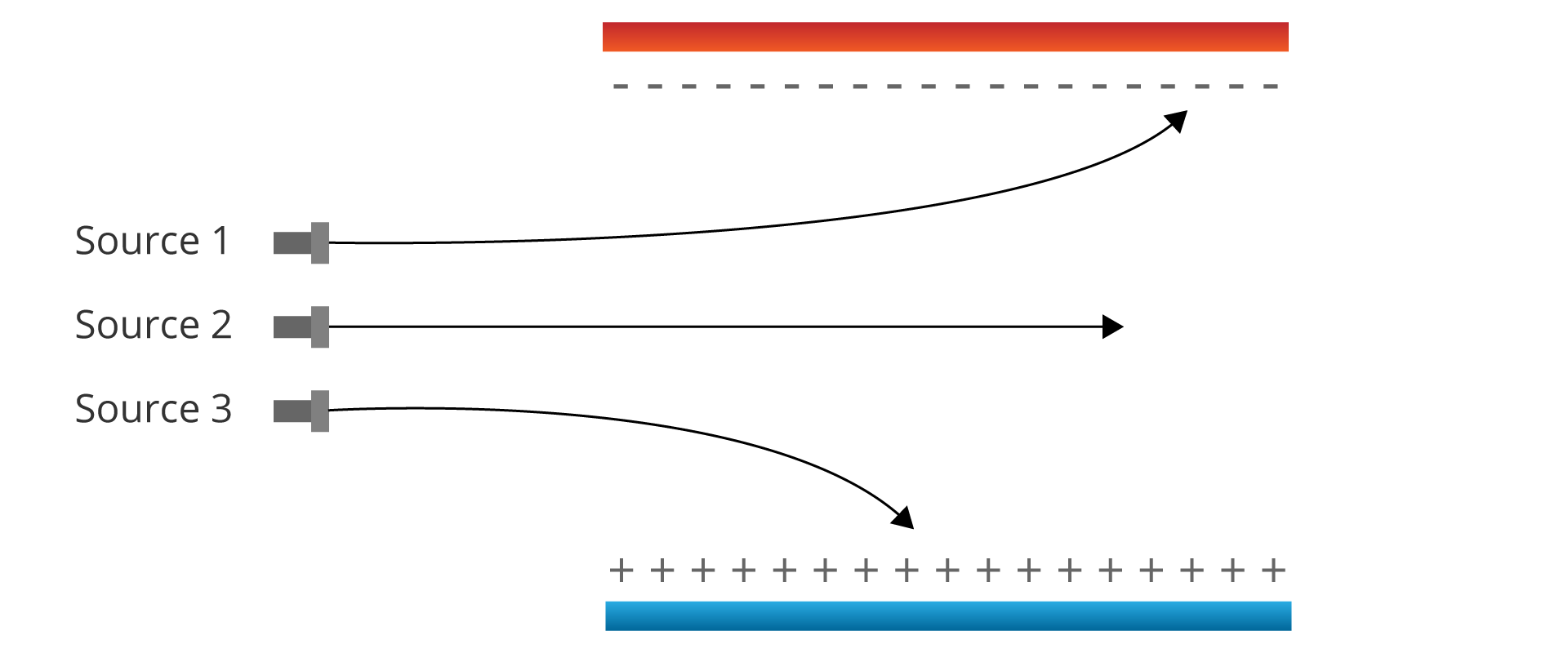
You already know some properties of alpha, beta and gamma radiation. How is the emission of alpha, beta and gamma particles affected by the electric field? Identify sources of radiation shown in the picture and justify your statement.
R15HHuILg2t4f1
Rysunek przedstawia zachowanie trzech rodzajów promieniowania w jednorodnym polu elektrycznym. Pole elektryczne ograniczone jest symbolicznie pomarańczowym prostokątem, pod którym znajdują się znaki minus (ładunek ujemny) oraz niebieskim prostokątem, nad którym znajdują się znaki plus (ładunek dodatni). Prostokąty umieszczone są poziomo w prawej części rysunku. Po lewej stronie zaznaczone są symbolicznie źródła promieniowania, od góry Source 1, Source 2, Source 3. Ze źródeł wychodzą krzywe ilustrujące tory cząstek. Najwyżej położona linia z pierwszego źródła skręca w stronę ładunku ujemnego, druga przechodzi równolegle do okładek, a trzecia skręca w stronę ładunku dodatniego.
Source: GroMar, licencja: CC BY 3.0.
Source 1 - alpha source
Source 2 - gamma source
Source 3 - beta source
Alpha particles carry positive charge. They are attracted by the negative plate and are less deflected then beta particles due to the greater mass. Gamma rays have no charge and are not deflected in the electric field. Beta particles are negatively charged and deflected towards the positive plate.
Nuclear radiation cannot be detected by human senses, so special equipment is necessary. The most common are personal dosimeters and Geiger‑Müller counters.
Film badges are the most known personal dosimeterdosimeterdosimeter in use. They are used to measure gamma, x‑ray, and high‑energy beta radiation. A badge consists of a small piece of photographic film wrapped in an opaque cover and held in a metal frame. Film badges are worn by people who work with radiation. Film badges monitor the levels of absorbed radiation. The photographic film goes dark when it absorbs radiation. The more radiation is absorbed, the darker is the film when it is developed.
The Geiger‑Müller counter is a gas‑filled tube, inside which there are two electrodes connected to a voltage of several hundred volts. Nuclear radiationNuclear radiationNuclear radiation passing through gas causes its ionization. The electrons and ions produced by ionization are accelerated in the electric field, causing further ionization processes and, as a result, an avalanche discharge. This is manifested by the creation of a electric current impulse, which is sent to a counting device. This device makes an acoustic sound or displays the count rate. The higher the sound frequency or the higher the counting rate, the higher the radiation.
Remember
There are three types of nuclear radiation: alpha (α), beta (β), gamma (γ).
Alpha and beta are charged particles while gamma rays are electromagnetic waves that don’t carry any charge.
The most penetrating radiation are gamma rays, while beta radiation has smaller range and alpha particles can travel in air only a few centimetres.
All three types of radiation can ionise matter.
Exercises
RYBbr2ubayzyd
Exercise 2
Wersja alternatywna ćwiczenia: Determine which sentences are true. Możliwe odpowiedzi: 1. Radiation that is high-energy electromagnetic waves is called gamma., 2. Nuclear radiation is a spontaneous phenomenon., 3. Speedy electron emissions are called beta decay., 4. Alpha radiation is the most penetrating radiation.
Wersja alternatywna ćwiczenia: Determine which sentences are true. Możliwe odpowiedzi: 1. Radiation that is high-energy electromagnetic waves is called gamma., 2. Nuclear radiation is a spontaneous phenomenon., 3. Speedy electron emissions are called beta decay., 4. Alpha radiation is the most penetrating radiation.
Determine which sentences are true.
Radiation that is high-energy electromagnetic waves is called gamma.
Nuclear radiation is a spontaneous phenomenon.
Speedy electron emissions are called beta decay.
Alpha radiation is the most penetrating radiation.
zadanie
Source: GroMar, licencja: CC BY 3.0.
Exercise 3
Which of the three radiation types (α, β, γ) fit best to the following statements? Write the answers to your notebook.
1. This radiation is charged ... 2. This radiation can travel through paper, but is stopped by aluminium ... 3. This radiation is the heaviest ...
1. α, β 2. β 3. α
Exercise 4
Describe in English different types of nuclear radiation and their properties.
R1KqId7MXVGHa
Exercise 5
Wersja alternatywna ćwiczenia: Indicate which pairs of expressions or words are translated correctly. Możliwe odpowiedzi: 1. jądro - nucleus, 2. jonizacja - ionisation, 3. przenikanie - penetration, 4. kondensator - capacitor, 5. wykrywanie - deflected, 6. odchylony - detection
Wersja alternatywna ćwiczenia: Indicate which pairs of expressions or words are translated correctly. Możliwe odpowiedzi: 1. jądro - nucleus, 2. jonizacja - ionisation, 3. przenikanie - penetration, 4. kondensator - capacitor, 5. wykrywanie - deflected, 6. odchylony - detection
Indicate which pairs of expressions or words are translated correctly.
jądro - nucleus
jonizacja - ionisation
przenikanie - penetration
kondensator - capacitor
wykrywanie - deflected
odchylony - detection
zadanie
Source: GroMar, licencja: CC BY 3.0.
R94Z0MZ68jwIr1
Interaktywna gra, polegająca na łączeniu wyrazów w pary w ciągu jednej minuty. Czas zaczyna upływać wraz z rozpoczęciem gry. Jeden ruch to odkrywanie najpierw jednej potem drugiej karty z wyrazem. Każdy wyraz jest odczytywany. Kolejny ruch to odkrywanie trzeciej i czwartej karty. W ten sposób odsłuchasz wszystkie wyrazy. Nawigacja z poziomu klawiatury za pomocą strzałek, odsłuchiwanie wyrazów enterem lub spacją. Znajdź wszystkie pary wyrazów.
Interaktywna gra, polegająca na łączeniu wyrazów w pary w ciągu jednej minuty. Czas zaczyna upływać wraz z rozpoczęciem gry. Jeden ruch to odkrywanie najpierw jednej potem drugiej karty z wyrazem. Każdy wyraz jest odczytywany. Kolejny ruch to odkrywanie trzeciej i czwartej karty. W ten sposób odsłuchasz wszystkie wyrazy. Nawigacja z poziomu klawiatury za pomocą strzałek, odsłuchiwanie wyrazów enterem lub spacją. Znajdź wszystkie pary wyrazów.
Match Polish terms with their English equivalents.
nuclear radiation
promieniowanie jądrowe
ionisation
wykrywanie
detection
radioaktywność
jonizacja
nucleus
radioactictivity
jądro
Source: Zespół autorski Politechniki Łódzkiej, licencja: CC BY 3.0.