In radioactive decay a single nucleusnucleusnucleus breaks into two parts. In other nuclear processes, in which two nuclei or nuclear particles collide, different products than the initial particles are produced. This process is called a nuclear reactionnuclear reactionnuclear reaction.
In a radioactive decay, the transformation is spontaneousspontaneousspontaneous, while in a nuclear reaction, it is initiated by the collision.
If the particles collide and separate without changing, the process is called an elastic collision rather than a reaction.
RXdsjzn9TPmMy
Na ilustracji interaktywnej przedstawione są dwa typy reakcji: reakcja jądrowa i zderzenie elastyczne. Reakcja po lewej stronie oznaczona numerem 1, reakcja po prawej stronie oznaczona numerem 2. Pokazane są zderzające się cząstki i produkty reakcji. Symbolizują je zielone i niebieskie kulki. Strzałkami zaznaczony jest kierunek ich ruchu. Miejsce zajścia reakcji zaznaczone jest czerwoną gwiazdą. Reakcja po lewej stronie: na górze po lewej jedna niebieska kulka strzałka do gwiazdy znajdującej się na środku, na dole po lewej połączone ze sobą 7 niebieskich i 7 zielonych kulek strzałka do gwiazdy, na górze po prawej połączone ze sobą 2 zielone i 2 niebieskie kulki strzałka do gwiazdy, na dole po prawej połączone ze sobą 5 zielonych i 6 niebieskich kulek strzałka do gwiazdy. Wynika z tego, że w reakcji jądrowej zderzają się dwa jądra lub nukleony i powstają produkty inne niż początkowe cząstki. Reakcja po prawej stronie: na górze po lewej połączone ze sobą jedna niebieska i jedna zielona kulka strzałka do gwiazdy znajdującej się na środku, na dole po lewej połączone ze sobą 7 niebieskich i 7 zielonych kulek strzałka do gwiazdy, na górze po prawej połączone ze sobą 7 zielonych i 7 niebieskich kulek strzałka do gwiazdy, na dole po prawej połączone ze sobą jedna niebieska i jedna zielona kulka strzałka do gwiazdy. Wynika z tego, że w zderzeniu elastycznym cząstki zderzają się, a produkty zderzenia pozostają takie same. Na ilustracji widoczne są numery, a na nich podpisy. 1. nuclear reaction {audio}, 2. elastic collision {audio}.
Na ilustracji interaktywnej przedstawione są dwa typy reakcji: reakcja jądrowa i zderzenie elastyczne. Reakcja po lewej stronie oznaczona numerem 1, reakcja po prawej stronie oznaczona numerem 2. Pokazane są zderzające się cząstki i produkty reakcji. Symbolizują je zielone i niebieskie kulki. Strzałkami zaznaczony jest kierunek ich ruchu. Miejsce zajścia reakcji zaznaczone jest czerwoną gwiazdą. Reakcja po lewej stronie: na górze po lewej jedna niebieska kulka strzałka do gwiazdy znajdującej się na środku, na dole po lewej połączone ze sobą 7 niebieskich i 7 zielonych kulek strzałka do gwiazdy, na górze po prawej połączone ze sobą 2 zielone i 2 niebieskie kulki strzałka do gwiazdy, na dole po prawej połączone ze sobą 5 zielonych i 6 niebieskich kulek strzałka do gwiazdy. Wynika z tego, że w reakcji jądrowej zderzają się dwa jądra lub nukleony i powstają produkty inne niż początkowe cząstki. Reakcja po prawej stronie: na górze po lewej połączone ze sobą jedna niebieska i jedna zielona kulka strzałka do gwiazdy znajdującej się na środku, na dole po lewej połączone ze sobą 7 niebieskich i 7 zielonych kulek strzałka do gwiazdy, na górze po prawej połączone ze sobą 7 zielonych i 7 niebieskich kulek strzałka do gwiazdy, na dole po prawej połączone ze sobą jedna niebieska i jedna zielona kulka strzałka do gwiazdy. Wynika z tego, że w zderzeniu elastycznym cząstki zderzają się, a produkty zderzenia pozostają takie same. Na ilustracji widoczne są numery, a na nich podpisy. 1. nuclear reaction {audio}, 2. elastic collision {audio}.
A nuclear reactionnuclear reactionnuclear reaction similarly to nuclear decays can be represented by a balanced equationbalanced equationbalanced equation
where: X - targed nucleus, a - bombarding particle (projectile), Y - final nucleus, b - produced particle (ejectile).
Sometimes a short notation is used.
As a result of a nuclear reaction, another nucleus is formed in the ground or excited state. The excited state is a short‑term intermediate state, after which the nucleus returns to the ground state. This process is accompanied by particle or radiation emission. When the product nucleusnucleusnucleus is in the excited state, this is indicated by placing an asterisk next to its symbol.
In all nuclear processes, the following quantities are conserved:
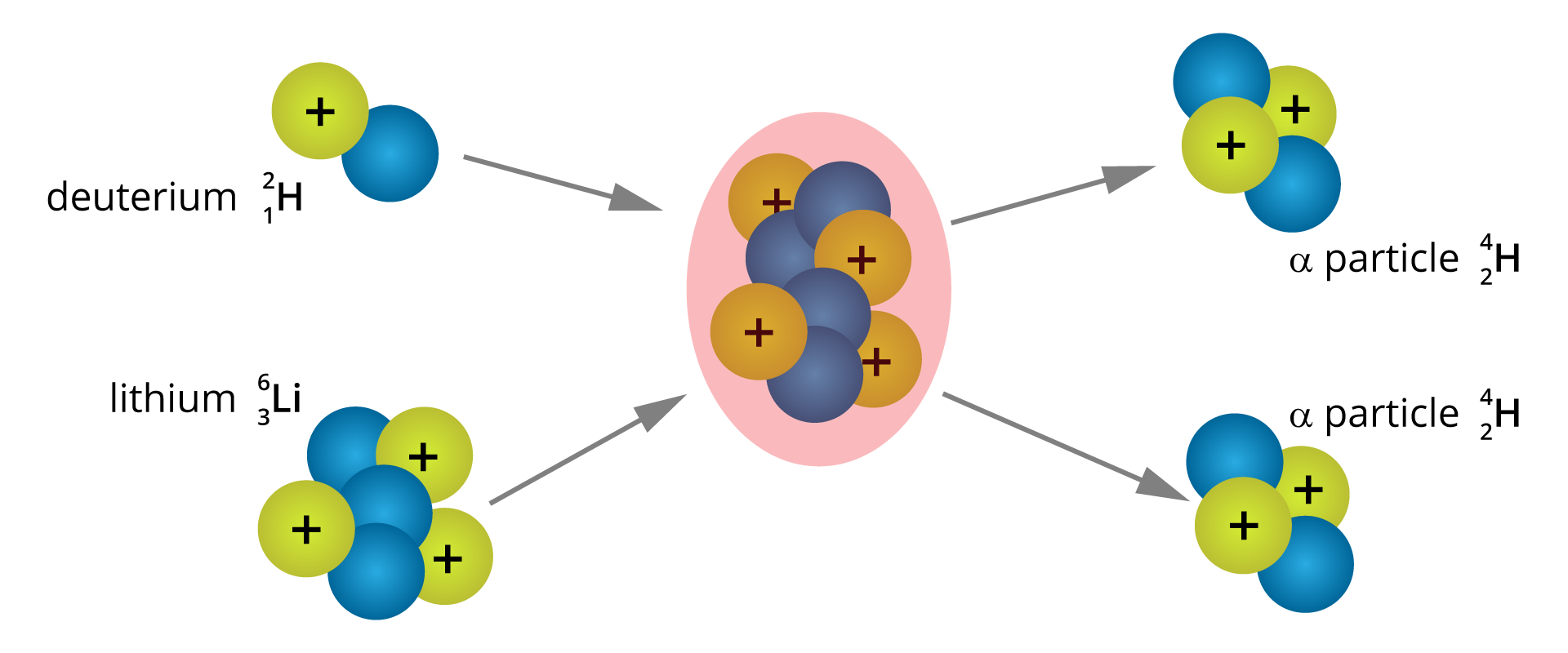
Lithium and deuterium collide and form the excited intermediate nucleusnucleusnucleus of beryllium . The excited berilium nucleus decays immediately into two alpha particles.
The total atomic number and mass number on both sides of the equation are equal.
RqtWuwQOYcka6
Na rysunku pokazana jest reakcja jądrowa zachodząca pomiędzy deutrem i litem, których atomy zaznaczone są symbolicznie za pomocą kombinacji zielonych i niebieskich kulek. Deuter - połączona kulka niebieska i zielona ze znakiem plus, podpisane deuterium w indeksie górnym 2, w indeksie dolnym 1, H. Lit - połączone 3 kulki niebieskie i 2 zielone ze znakiem plus, podpisane lithium w indeksie górnym 6, w indeksie dolnym 3, Li. Strzałki od nich wskazują na jądro w stanie wzbudzonym – tu zbiór połączonych 4 kulek niebieskich i 4 zielonych ze znakiem plus, dodatkowo otoczony elipsą o różowy kolorze. Od tego jądra strzałki prowadzą w stronę produktów rozpadu – dwóch cząstek alfa. Na górze - połączone 2 kulki niebieskie i 2 zielone ze znakiem plus, podpisane alfa particle, w indeksie górnym 4, w indeksie dolnym 2, H. Na dole - połączone 2 kulki niebieskie i 2 zielone ze znakiem plus, podpisane alfa particle, w indeksie górnym 4, w indeksie dolnym 2, H. Wynika z tego, że całkowita liczba atomowa i liczba masowa są równe przed zderzeniem i po.
Symbolic representation of the nuclear reaction of lithiumand deuterium isotopes
In nuclear reactions the energy is either produced or must be delivered. In the reaction equation the energy Q is given on the right side of the equation.
For the lithium‑deuterium reaction discussed above, the reaction energy is Q = 22,4 MeV.
The reaction energy Q is positive for exothermal reactions and negative for endothermal reactions. The energy can be delivered by accelerating the bombarding particle or obtained in form of ejectile emission and recoil of final nucleus.
Nuclear transmutationnuclear transmutationNuclear transmutation is an artificial method of the conversion of one element or an isotope into another.
In the first transmutation experiment, conducted by Rutherford in 1919, three nucleons from the helium nucleus get transferred and the oxygen was formed.
Before the stable nucleusnucleusnucleus of the oxygen is formed, an unstable fluorine nucleus forms, which breaks down and ejects the proton.
The neutron was discovered by Chadwick in 1932. He bombarded the beryllium with helium particles and in the reaction carbon and neutron were produced.
Nuclear reactionsnuclear reactionNuclear reactions can be used to generate electricity. In nuclear reactors or power plants the nuclear reaction called nuclear fissionfissionfission (splitting of atomic nuclei) is conducted under control and energy produced during the reaction is used to generate electricity.
In the Sun, the nuclear reaction which occurs is called the proton‑proton cycle. In the proton‑proton cycle four hydrogen atoms are involved in a series of reactions and form one helium atom. In this chain of reactions energy is produced in the form of gamma rays and particles called neutrinos.
Periodic tableperiodic tablePeriodic table and heavy nuclei
The most massive naturally occurring element on Earth is uranium U, with a nucleusnucleusnucleus of 92 protons. All the elements with Z > 92, are called the transuranium elements. However, the study of nuclear reactions led to the conclusion that there are even heavier nuclei. In 1934, scientists started the search for more massive elements with 93 or more protons. At present, the periodic tableperiodic tableperiodic table has 118 confirmed elements.
Plutonium can be produced by bombarding uranium with alpha particles. How many neutrons will be produced as a by‑product of each reaction? Write the corresponding nuclear reaction.
The nuclear reactionnuclear reactionnuclear reaction is a process, in which two nuclei or nuclear particles collide and different products than the initial particles are produced.
Exercises
RV3ksMbsFtokG
Exercise 3
Wersja alternatywna ćwiczenia: Determine which sentences are true. Możliwe odpowiedzi: 1. A nuclear reaction is initiated by the collision., 2. Nuclear reactions involve the particles in the nucleus., 3. Atoms of Uranium-235 and Uranium-238 differ by three neutrons., 4. Transmutation is the process of changing one element to another through nuclear decay.
Wersja alternatywna ćwiczenia: Determine which sentences are true. Możliwe odpowiedzi: 1. A nuclear reaction is initiated by the collision., 2. Nuclear reactions involve the particles in the nucleus., 3. Atoms of Uranium-235 and Uranium-238 differ by three neutrons., 4. Transmutation is the process of changing one element to another through nuclear decay.
Determine which sentences are true.
A nuclear reaction is initiated by the collision.
Nuclear reactions involve the particles in the nucleus.
Atoms of Uranium-235 and Uranium-238 differ by three neutrons.
Transmutation is the process of changing one element to another through nuclear decay.
Exercise 4
Bombarding of by alpha particles produces phosphorus and additional particle. Write the nuclear equation.
Exercise 5
Explain in English what the characteristics of nuclear reactions are.
R189rFvRn38Es
Exercise 6
Wersja alternatywna ćwiczenia: Indicate which pairs of expressions or words are translated correctly. Możliwe odpowiedzi: 1. reakcja jądrowa - nuclear reaction, 2. transmutacja jądrowa - nuclear transmutation, 3. spontaniczny - spontaneous, 4. układ okresowy - periodic table, 5. równanie zbilansowane - fission, 6. jądro - balanced equation
Wersja alternatywna ćwiczenia: Indicate which pairs of expressions or words are translated correctly. Możliwe odpowiedzi: 1. reakcja jądrowa - nuclear reaction, 2. transmutacja jądrowa - nuclear transmutation, 3. spontaniczny - spontaneous, 4. układ okresowy - periodic table, 5. równanie zbilansowane - fission, 6. jądro - balanced equation
Indicate which pairs of expressions or words are translated correctly.
reakcja jądrowa - nuclear reaction
transmutacja jądrowa - nuclear transmutation
spontaniczny - spontaneous
układ okresowy - periodic table
równanie zbilansowane - fission
jądro - balanced equation
zadanie
Source: GroMar, licencja: CC BY 3.0.
R17eOeM1TrZPb1
Interaktywna gra, polegająca na łączeniu wyrazów w pary w ciągu jednej minuty. Czas zaczyna upływać wraz z rozpoczęciem gry. Jeden ruch to odkrywanie najpierw jednej potem drugiej karty z wyrazem. Każdy wyraz jest odczytywany. Kolejny ruch to odkrywanie trzeciej i czwartej karty. W ten sposób odsłuchasz wszystkie wyrazy. Nawigacja z poziomu klawiatury za pomocą strzałek, odsłuchiwanie wyrazów enterem lub spacją. Znajdź wszystkie pary wyrazów.
Interaktywna gra, polegająca na łączeniu wyrazów w pary w ciągu jednej minuty. Czas zaczyna upływać wraz z rozpoczęciem gry. Jeden ruch to odkrywanie najpierw jednej potem drugiej karty z wyrazem. Każdy wyraz jest odczytywany. Kolejny ruch to odkrywanie trzeciej i czwartej karty. W ten sposób odsłuchasz wszystkie wyrazy. Nawigacja z poziomu klawiatury za pomocą strzałek, odsłuchiwanie wyrazów enterem lub spacją. Znajdź wszystkie pary wyrazów.
Match Polish terms with their English equivalents.
nuclear reaction
układ okresowy
transmutacja jądrowa
nuclear transmutation
równanie zbilansowane
balanced equation
spontaniczny
periodic table
spontaneous
reakcja jądrowa
Source: Zespół autorski Politechniki Łódzkiej, licencja: CC BY 3.0.